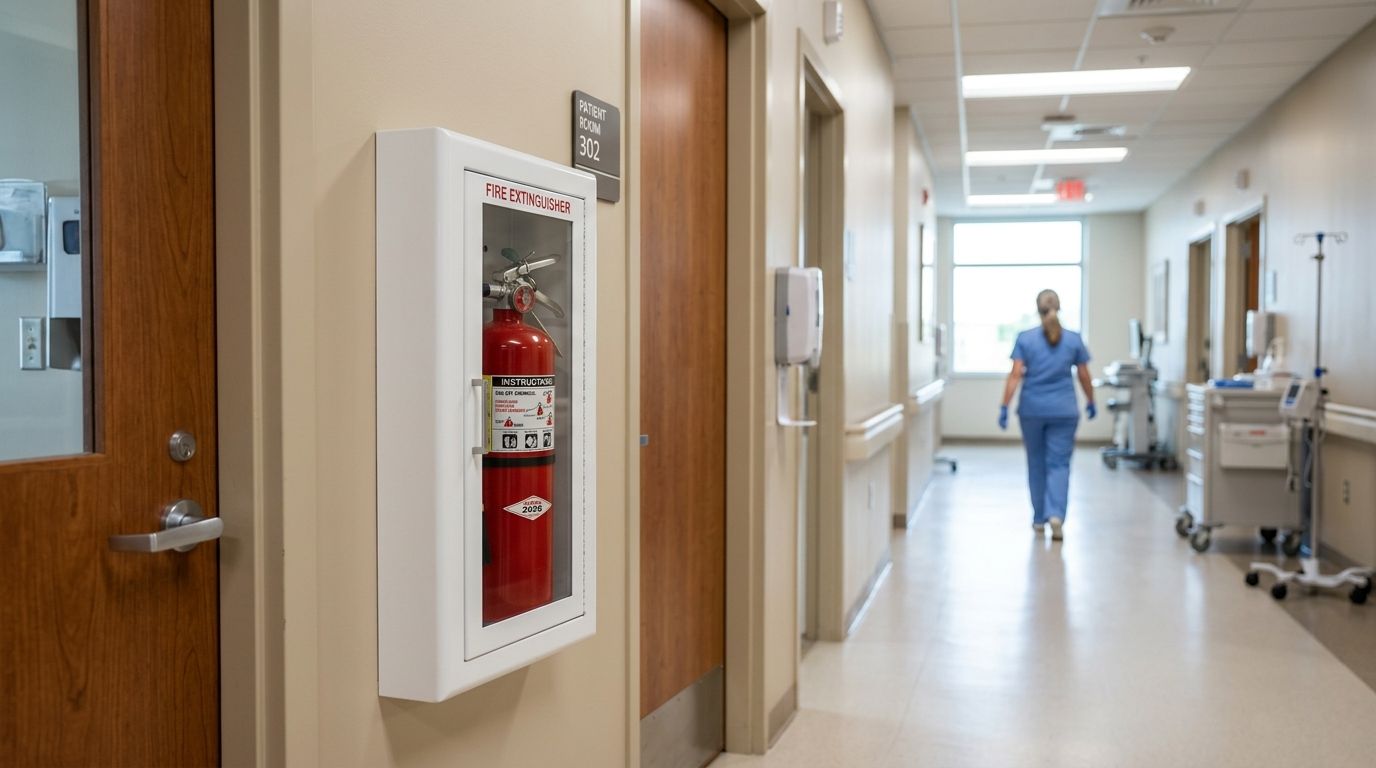
Hospitals, clinics, surgical centers, and long-term care facilities don't get to pick one fire extinguisher and call it done — a patient corridor, an MRI suite, and a hospital kitchen each carry a different fire risk, and the wrong extinguisher in the wrong room is a life-safety survey finding waiting to happen.
- ABC Dry Chemical wins for general patient-care corridors and non-clinical offices in 2026.
- Clean Agent (Halotron/FE-36) is the only real choice for MRI suites, imaging rooms and equipment near monitors.
- Water Mist extinguishers are the safest option for oxygen-enriched patient rooms and bedding fires.
- CO2 units belong in electrical rooms, server closets and lab equipment spaces, not patient hallways.
- Class K Wet Chemical is required for hospital kitchens and cafeteria fryers — no substitute works.
Why this matters
A healthcare facility isn't one occupancy — it's five or six stacked on top of each other. Patient rooms, imaging suites, mechanical rooms, kitchens, and administrative offices each fall under different hazard classifications in NFPA 10, and surveyors checking against NFPA 101 Life Safety Code will flag a mismatch between extinguisher type and room use during accreditation walkthroughs.
Get this wrong and you're not just risking a fire that spreads faster than it should. You're risking a citation, a re-survey, and staff who don't trust the extinguisher on the wall because nobody explained why it's there. The right call in 2026 is matching extinguisher chemistry to what's actually in the room — oxygen lines, electronics, bedding, or a deep fryer — not grabbing whatever's cheapest per unit.
General guidance for non-clinical office areas applies to hospital administrative wings and business offices attached to a facility, but patient-care zones need their own logic, which is what this list covers.
What makes the best fire extinguisher for a healthcare facility
- Agent compatibility with oxygen-enriched environments — some agents react badly near medical gas lines and portable oxygen concentrators.
- Residue and cleanup impact — dry chemical residue can damage imaging equipment, ventilators, and monitors; clean agents leave nothing behind.
- Hazard class match — Class A (ordinary combustibles), Class B (flammable liquids), Class C (energized electrical), and Class K (cooking oils) each need a different chemistry.
- NFPA 10 placement rules — travel distance caps at 75 feet for Class A hazards and 50 feet for Class B/C hazards.
- Usability under stress — nursing staff and techs, not trained firefighters, are the ones pulling the pin, so weight and simplicity matter.
- Survey and accreditation fit — the extinguisher on the wall has to match what a Joint Commission or state surveyor expects to see in that specific room.
At a glance
| Extinguisher Type | Best For | Standout Feature | Key Limitation |
|---|---|---|---|
| ABC Dry Chemical | General patient corridors, offices | Covers three hazard classes in one unit | Powder residue near sensitive equipment |
| Clean Agent (Halotron/FE-36) | MRI suites, imaging, electronics | Zero residue, non-conductive | Higher cost per pound of agent |
| Water Mist | Oxygen-enriched patient rooms | Safe near medical gas, no toxic byproducts | Limited on flammable liquid fires |
| CO2 | Electrical rooms, lab equipment | No residue, safe on live electrical | Short discharge range, cold-air displacement risk |
| Class K Wet Chemical | Hospital kitchens, cafeterias | Saponifies cooking oil fires | Useless outside kitchen hazard class |
1. ABC Dry Chemical: best fire extinguisher for general patient corridors
ABC Dry Chemical is the multipurpose workhorse in most healthcare facilities — it handles ordinary combustibles like paper and linens, flammable liquids, and energized electrical equipment in one canister. It's the default unit for hallways, waiting rooms, administrative offices, and stairwells where the fire risk is generic rather than specialized.
ABC Dry Chemical pros:
- Covers Class A, B, and C hazards without swapping units
- Widely stocked, straightforward for hydro testing and recharge cycles
- Handles the majority of square footage in any facility
ABC Dry Chemical cons:
- Powder residue can contaminate electronics, monitors, and open equipment
- Not appropriate for MRI suites or rooms with oxygen lines running
- Requires cleanup crews after any discharge near patient care areas
Best for: general corridors, waiting areas, and non-clinical offices. Verdict: Buy for every non-specialized zone in the building.
2. Clean Agent (Halotron/FE-36): best fire extinguisher for MRI suites and imaging rooms
Clean agent extinguishers use a halogenated agent that evaporates without leaving residue, which is the only reason they belong near an MRI magnet, CT scanner, or a bank of patient monitors. Non-conductive and safe on energized equipment, they're built for rooms where a dry chemical discharge would ruin six-figure hardware.
Clean Agent pros:
- Zero residue means no damage to imaging equipment or monitors
- Non-conductive, safe for use around live electrical systems
- Meets the expectation surveyors have for diagnostic and imaging spaces
Clean Agent cons:
- Agent cost runs higher than dry chemical per unit of coverage
- Smaller models carry less extinguishing agent than an ABC unit of the same size
- Not a substitute for Class K in kitchen hazards
Server rooms and imaging suites share the same core problem — sensitive electronics that can't tolerate residue — which is why the logic mirrors what's covered for server rooms and data centers.
Best for: MRI suites, CT/imaging rooms, and equipment closets full of monitors. Verdict: Buy for every diagnostic and electronics-heavy room.
3. Water Mist: best fire extinguisher for oxygen-enriched patient rooms
Water mist extinguishers atomize water into a fine mist that cools and smothers a fire without the electrical conductivity risk of a solid water stream and without the toxic byproduct concerns some clean agents raise in enclosed patient spaces. In rooms running portable oxygen concentrators or medical gas lines, water mist is the extinguisher that doesn't introduce a second hazard while fighting the first.
Water Mist pros:
- Safe to discharge near oxygen-enriched atmospheres
- No toxic byproducts, which matters in an occupied patient room
- Non-conductive up to typical patient-room voltage levels
Water Mist cons:
- Limited effectiveness on flammable liquid (Class B) fires
- Heavier per unit than a comparable clean agent canister
- Not a fit for kitchen or electrical-room hazards
Best for: occupied patient rooms with oxygen equipment and bedding-material fire risk. Verdict: Buy for patient wings running supplemental oxygen.
4. CO2: best fire extinguisher for electrical rooms and lab equipment
Carbon dioxide extinguishers displace oxygen at the fire's surface without leaving any residue, which makes them the standard for electrical rooms, server closets, and lab equipment where a dry chemical discharge would mean replacing everything in the room. The tradeoff is a shorter discharge range and a real risk of oxygen displacement in a small, unventilated space.
CO2 pros:
- No residue, safe on live electrical equipment and lab instruments
- Effective and fast on small, contained electrical fires
- Standard choice for mechanical and electrical rooms in NFPA 10 planning
CO2 cons:
- Short discharge range compared to dry chemical or clean agent
- Oxygen displacement risk in small enclosed rooms with staff present
- Cold discharge can cause frostbite on contact with skin
Best for: electrical rooms, IT closets, and lab equipment bays, not occupied patient areas. Verdict: Buy for mechanical and electrical rooms specifically.
5. Class K Wet Chemical: best fire extinguisher for hospital kitchens
Hospital cafeterias and staff kitchens run deep fryers and high-heat cooking surfaces just like any commercial kitchen, and that means Class K wet chemical extinguishers are non-negotiable there. The agent saponifies cooking oil, forming a soapy layer that stops re-ignition, something no other extinguisher class handles reliably.
Class K pros:
- Purpose-built for cooking oil and grease fires
- Prevents re-flash better than any other agent class
- Required by code alongside a kitchen suppression system in most jurisdictions
Class K cons:
- Zero utility outside kitchen hazard areas
- Requires its own inspection cycle separate from ABC units in the building
- Needs pairing with a proper hood suppression system, not a standalone fix
The same hazard class shows up in every facility running a full kitchen — the breakdown for commercial kitchens applies directly to a hospital cafeteria's fryer line.
Best for: hospital and long-term care facility kitchens, cafeterias, and fryer stations. Verdict: Buy for any facility running a commercial-grade kitchen.
How we ranked these
Each extinguisher type is scored against the criteria above — agent compatibility with oxygen and electronics, residue impact, hazard class match, NFPA 10 travel distance rules, staff usability, and survey fit. First-Line Fire Extinguisher Co. services hospitals, clinics, and long-term care facilities across Kentucky, Illinois, Indiana, Tennessee, Missouri, and Alabama, and the ranking reflects what actually passes a life-safety survey in those rooms, not just what's cheapest to stock.
Get your facility mapped by room
First-Line matches extinguisher type to hazard, room by room.
Which fire extinguisher should your facility choose?
Most healthcare facilities need all five types on this list, just placed correctly. ABC Dry Chemical covers the bulk of your square footage — corridors, offices, waiting rooms. Swap to Clean Agent the moment you're within 50 feet of an MRI magnet or a rack of monitors. Water mist covers patient rooms running oxygen. CO2 belongs in the electrical and IT rooms. Class K is mandatory the second there's a fryer on site.
The mistake First-Line sees most often walking into a facility in 2026 isn't the wrong extinguisher chemistry — it's one fire extinguisher type covering a building that actually needs three or four, because nobody re-mapped hazard zones after a floor got renovated.
FAQ
What is the best fire extinguisher type for hospitals?
There's no single best type — hospitals need ABC Dry Chemical for general corridors, Clean Agent for imaging suites, Water Mist for oxygen-enriched patient rooms, CO2 for electrical rooms, and Class K for kitchens. Matching chemistry to room hazard is what NFPA 10 and survey teams expect in 2026.
Can you use a CO2 extinguisher near oxygen tanks?
CO2 is generally fine near oxygen equipment from a chemical standpoint, but oxygen displacement in a small room is the bigger concern with any CO2 discharge. Water mist is usually the safer default for occupied patient rooms running oxygen lines.
Do MRI rooms need special fire extinguishers?
Yes — MRI suites need non-magnetic, non-conductive extinguishers, and Clean Agent units like Halotron or FE-36 are the standard because they leave zero residue on imaging equipment. A standard steel ABC canister is also a magnetic hazard near an active MRI magnet.
What extinguisher is required in a hospital kitchen?
Class K wet chemical is required for cooking oil and grease fires in any hospital cafeteria or kitchen running a fryer. It's paired with a hood suppression system, not used as a standalone fix.
How often do healthcare facility fire extinguishers need inspection?
Fire extinguishers need a monthly visual check and an annual maintenance inspection at minimum, with hydro testing on a longer cycle depending on the unit type. Surveyors will check inspection tags during a facility walkthrough.
Is a water mist extinguisher safe for patient rooms?
Yes — water mist is one of the safest options for occupied patient rooms because it's non-conductive at patient-room voltage levels and produces no toxic byproducts, which matters when the room has people in it during discharge.
What NFPA code governs fire extinguishers in healthcare facilities?
NFPA 10 governs extinguisher selection, placement, and maintenance, while NFPA 101 Life Safety Code governs the broader occupancy requirements that surveyors check against. Travel distance caps at 75 feet for Class A hazards and 50 feet for Class B/C hazards under NFPA 10.
How many fire extinguishers does a hospital need?
The count depends on square footage and hazard classification per room, driven by NFPA 10's travel distance rules rather than a flat number. A facility-specific hazard map is the only accurate way to get the count right.
One last thing
The extinguisher that fails a survey most often in 2026 isn't missing — it's the right unit in the wrong room, usually because a floor got renovated into an imaging suite and nobody swapped the ABC unit for Clean Agent. Walk your facility room by room before your next accreditation cycle, not after.