
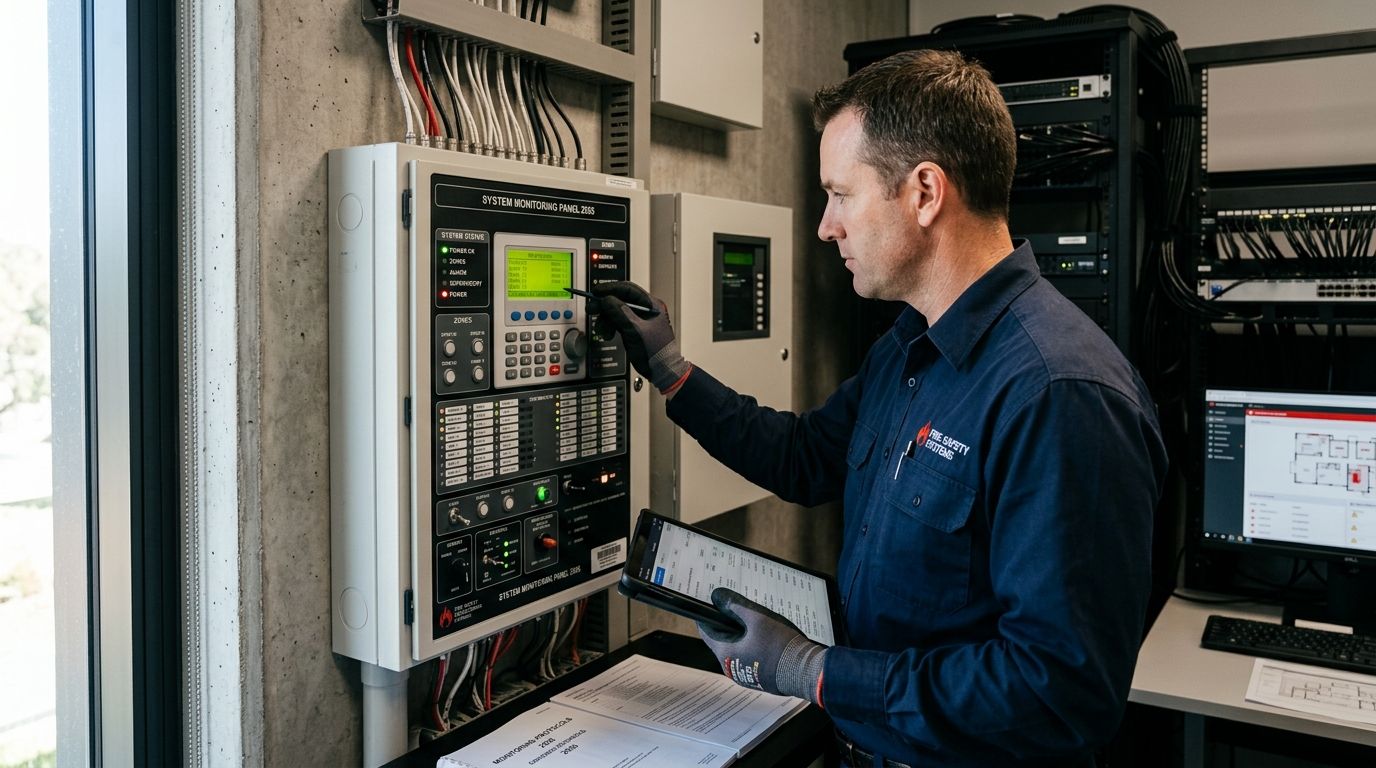
Fire alarm systems aren't ranked by brand — they're ranked by how the signal gets from your building to the people who respond. Monitoring type determines dispatch speed, staffing burden, and whether your building even qualifies for certain insurance credits, and most buyers never compare it because they're stuck comparing panel brands instead.
Best overall: Central station monitoring. Best for industrial and coal mining sites with on-site staff: Proprietary monitoring. Best budget option: Local alarm systems (unmonitored).
- Central station monitoring wins for most commercial buildings needing 24/7 third-party dispatch in 2026.
- Proprietary monitoring fits large industrial and coal mining sites with a staffed control room already on-site.
- Local alarm systems are unmonitored — audible only, no outside notification, and a real risk after hours.
- Auxiliary monitoring ties directly into the fire department but depends on municipal infrastructure you don't control.
- Fire alarm systems ranked by monitoring type comes down to one question: who answers the signal when nobody's in the building.
Why this matters
A fire alarm panel is only as good as what happens after it trips. NFPA 72 defines five recognized supervising station arrangements — Central Station, Proprietary, Remote Station, Auxiliary, and Local — and each one changes who gets notified, how fast, and what your AHJ (authority having jurisdiction) will accept for occupancy sign-off in 2026.
Most facilities across Kentucky, Illinois, Indiana, Tennessee, Missouri and Alabama default to whatever their alarm installer sold them ten years ago. That's often the wrong match for how the building operates now — a warehouse that added night shifts, a multi-family building that lost its overnight staff, a plant that expanded past what one control room can watch. First-Line Fire sees this mismatch constantly during inspections: the panel works fine, the monitoring arrangement doesn't fit the building anymore.
What makes the best fire alarm monitoring type
- Notification speed — how fast a signal reaches a human who can dispatch help
- Staffing dependency — whether the arrangement needs a person on-site 24/7 or relies on a third party
- AHJ and insurance acceptance — some occupancies require UL-listed central station service, not just any monitoring
- Redundancy — cellular, phone line, or IP backup if the primary path fails
- Cost structure — monthly monitoring fee versus staffing cost versus none at all
- Fit for occupancy type — multi-family, industrial, school, or small retail all weight these factors differently
At a glance
| Monitoring type | Best for | Standout feature | Key limitation |
|---|---|---|---|
| Central station | Most commercial buildings | Third-party 24/7 dispatch, UL-listed | Monthly monitoring fee |
| Proprietary | Industrial / coal mining sites | In-house control room, instant internal response | Requires trained staff on shift |
| Remote/cellular station | Small businesses, retail | Low-cost cellular signal path, no phone line needed | Depends on cell coverage |
| Auxiliary | Campuses near fire stations | Direct connection to the fire department | Municipal infrastructure dependent |
| Local (unmonitored) | Low-occupancy, budget-limited spaces | Lowest upfront cost | No outside notification if unattended |
1. Central station monitoring: best for occupied commercial buildings
A UL-listed central station receives your alarm signal, verifies it, and dispatches the fire department — all without anyone in your building lifting a phone. It's the arrangement most commercial insurance policies and building codes assume when they say "monitored fire alarm."
Central station monitoring pros:
- 24/7 coverage without staffing a control room yourself
- Meets insurance and code requirements for most commercial occupancies
- Third-party verification cuts down false-alarm dispatches
Central station monitoring cons:
- Ongoing monthly monitoring cost, unlike a local-only system
- Signal path (phone line, cellular, or IP) needs periodic testing to confirm it's live
Best for: offices, retail, warehouses, and multi-family buildings that need reliable dispatch without hiring anyone to watch a panel. Verdict: Buy.
2. Proprietary monitoring: best for industrial and coal mining sites with staffed control rooms
Proprietary monitoring puts the receiving equipment inside your own facility, watched by your own trained personnel — common at plants, mines, and marine terminals that already run a 24/7 operations center. The signal never leaves the property before a person acts on it.
Proprietary monitoring pros:
- Fastest internal response since staff are already on-site watching the board
- No dependency on outside phone or cellular infrastructure to reach a dispatcher
- Fits facilities where the fire watch overlaps with existing safety staff
Proprietary monitoring cons:
- Only works if you're already staffing a control room around the clock
- Training and certification requirements for the monitoring personnel add overhead
Best for: industrial plants, coal mining operations, and large marine facilities that already run continuous operations staff. Verdict: Buy — if you already have the staffing.
3. Remote/cellular station monitoring: best for small businesses on a tight budget
A remote or cellular supervising station receives the signal over a cellular radio path instead of a landline, then relays it to a monitoring center or directly to responders. It's become the default replacement for phone-line monitoring since most carriers have sunset copper lines.
Remote/cellular monitoring pros:
- No landline needed — works anywhere with cellular coverage
- Lower installation cost than running dedicated phone infrastructure
- Faster to deploy in retrofit buildings without existing alarm wiring
Remote/cellular monitoring cons:
- Signal reliability depends entirely on local cellular coverage
- Rural sites in parts of Kentucky, Missouri, and Tennessee can see weaker signal strength
Best for: small businesses and single-tenant retail spaces that want monitored coverage without commercial-grade infrastructure costs. Verdict: Buy for most small commercial spaces.
4. Auxiliary monitoring: best for campuses near a municipal fire station
Auxiliary systems connect your alarm directly into the municipal fire alarm circuit or a direct line to the fire department's dispatch center, bypassing a third-party monitoring company entirely. It's less common outside older municipal setups but still shows up on school and campus buildings.
Auxiliary monitoring pros:
- Direct line to the fire department, no intermediary company
- Often already wired into older municipal or campus infrastructure
Auxiliary monitoring cons:
- Availability depends on what your local fire department supports — many municipalities have phased it out
- Limited redundancy if the municipal circuit goes down
Best for: older school and campus buildings already tied into a municipal auxiliary circuit. Verdict: Hold — only if your municipality still supports it.
5. Local alarm systems: the budget option, unmonitored
A local system sounds horns and strobes inside the building when the panel trips — and does nothing else. No signal goes anywhere unless a person hears it and calls 911 themselves.
Local alarm system pros:
- Lowest upfront cost of any arrangement
- Simple to install and maintain
Local alarm system cons:
- Zero outside notification — a fire that starts after hours in an unoccupied building can burn for a long time before anyone calls it in
- Most commercial occupancy codes and insurers won't accept local-only as adequate protection
Best for: small, always-occupied spaces where someone hears the alarm and calls it in immediately, and budget rules out anything else. Verdict: Skip for anything unattended after hours.
“The monitoring arrangement matters more than the panel brand — a great panel wired to the wrong monitoring type still leaves nobody answering the signal.”
How we ranked these
Each monitoring type was weighed against notification speed, staffing dependency, AHJ and insurance acceptance, signal redundancy, and fit against real occupancy types — schools, industrial plants, multi-family buildings, and small retail. Central station and proprietary monitoring score highest on speed and reliability; local systems score lowest on outside notification, which is why they land at the bottom of this list for anything but a small, always-staffed space.
Which fire alarm monitoring type should you choose?
If you run an occupied commercial building and don't already staff a control room, central station monitoring is the default choice in 2026 — it clears code and insurance requirements without adding headcount. If you're running an industrial or coal mining site with people already watching an operations board around the clock, proprietary monitoring gets you the fastest internal response. Small businesses on tight budgets do fine with remote/cellular monitoring. Local-only systems belong in small, attended spaces only — not in anything left unoccupied overnight.
Get your monitoring type reviewed
Find out if your current fire alarm monitoring fits how your building actually operates.
FAQ
What's the best fire alarm monitoring type for a commercial building?
Central station monitoring is the best fit for most occupied commercial buildings in 2026 because it provides 24/7 third-party dispatch without requiring you to staff a control room. It also satisfies most insurance and code requirements that local-only systems don't meet.
Is central station monitoring better than local alarm systems?
Yes, for any building that isn't attended around the clock. Central station monitoring notifies a third party and dispatches the fire department automatically, while a local system only sounds an alarm inside the building and depends on someone hearing it and calling 911.
What is proprietary fire alarm monitoring?
Proprietary monitoring means the alarm signal is received and acted on by your own trained staff inside your own facility, rather than a third-party monitoring company. It's common at industrial plants and coal mining sites that already run a 24/7 operations center.
Does remote or cellular monitoring work without a phone line?
Yes. Remote/cellular station monitoring sends the alarm signal over a cellular radio path instead of a landline, which is why it's become the standard replacement as phone-line infrastructure has been phased out.
Is auxiliary fire alarm monitoring still available?
It depends on your municipality. Auxiliary monitoring ties directly into a local fire department's dispatch circuit, but many municipalities have phased this arrangement out in favor of central station monitoring.
Can a local alarm system meet fire code requirements?
Rarely for commercial occupancies. Most commercial fire codes and insurance policies require a monitored arrangement, not a local-only system that just sounds an alarm inside the building.
How do I know which monitoring type my building needs?
Start with your occupancy type and staffing: an always-staffed control room supports proprietary monitoring, while an unstaffed commercial space needs central station or remote/cellular monitoring to meet code.
One last thing
The monitoring type on your building's fire alarm rarely gets checked during a routine inspection — inspectors verify the panel works, not whether the signal path still matches how the building operates. A multi-family building that lost its overnight front desk staff five years ago may still be running on an arrangement that assumed someone was there to call it in. That's worth confirming before your next renewal, not after an incident report asks why nobody was notified.


