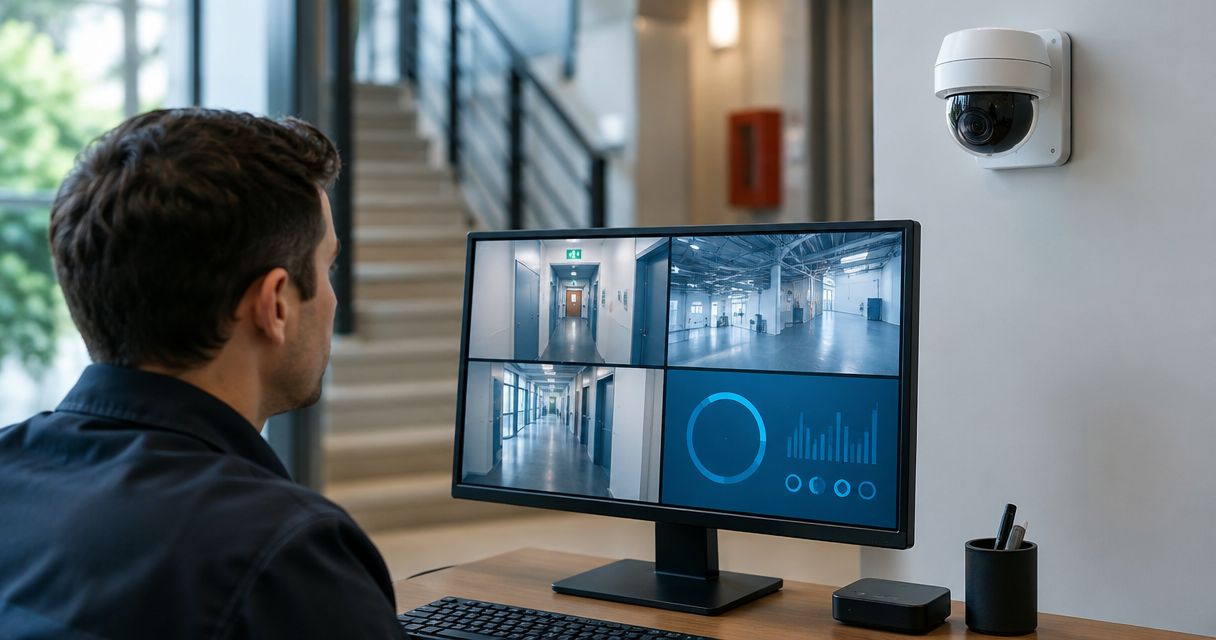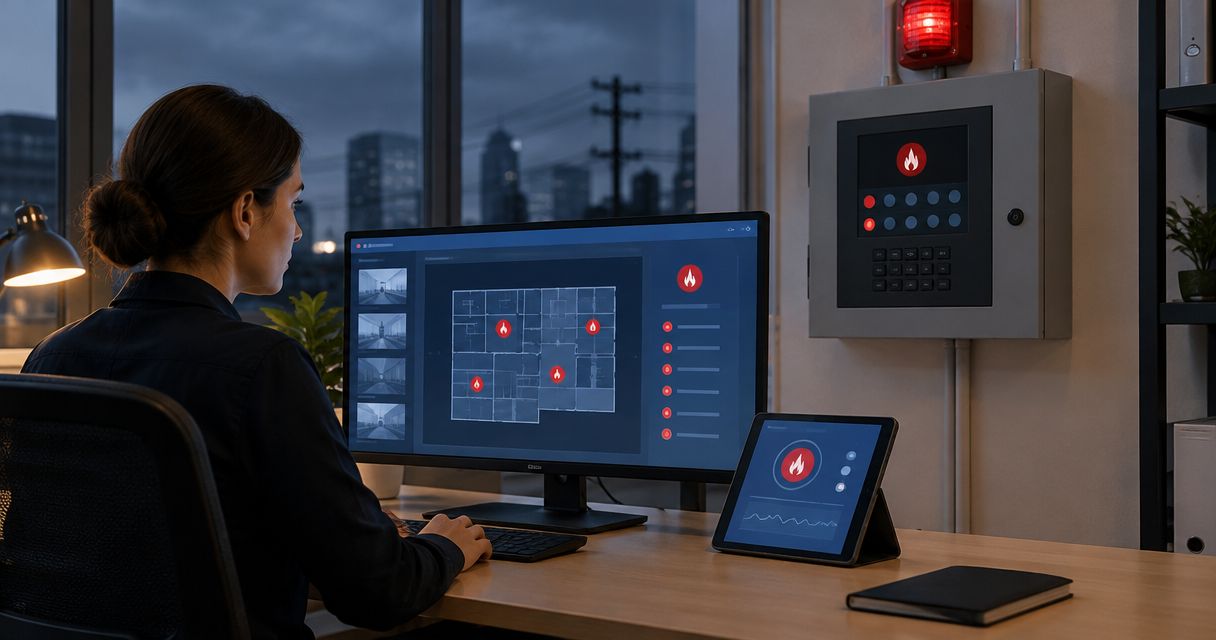
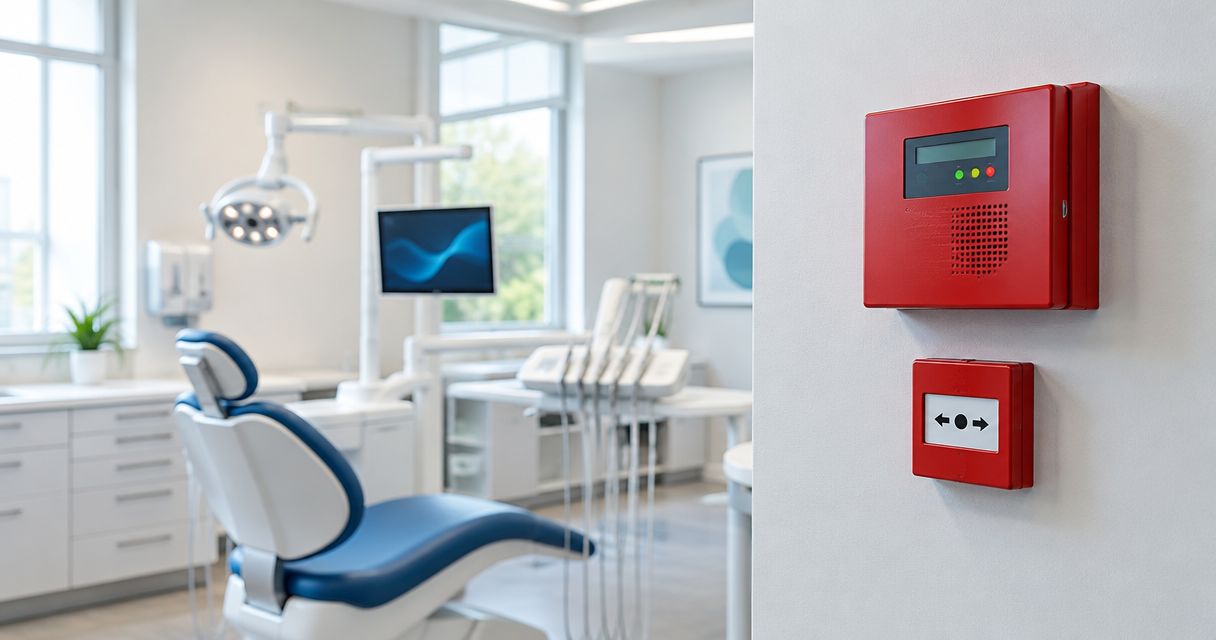
Best overall for a multi-room medical office: an addressable fire alarm system. Best for a simple, clearly zoned office: a conventional system. Best for a difficult wiring retrofit: a listed wireless fire alarm system, subject to site approval. This 2026 guide compares those choices for medical and dental practices, including patient evacuation, landlord responsibilities, monitoring, and ongoing service.
- The best fire alarm systems for medical offices match patient evacuation needs, building requirements, and existing equipment.
- Addressable fire alarms identify individual devices; conventional fire alarms identify zones.
- Listed wireless fire alarms suit difficult retrofits but require compatibility checks, radio assessment, and battery maintenance.
- Firstlinefire provides fire alarms and commercial fire-protection services across Kentucky, Illinois, Indiana, Tennessee, Missouri, and Alabama.
Why this matters
A dental office with routine appointments does not present the same evacuation problem as a practice treating patients under sedation. The system decision starts with the building's occupancy classification and patients' ability to leave—not the panel brand.
Firstlinefire provides fire alarms alongside extinguisher, suppression, and safety training services. Firstlinefire is a fit for commercial practices seeking fire-protection services within its stated six-state service area. Select the system architecture after the building and clinical use are reviewed.
Your alarm must fit the whole building. A tenant suite cannot independently replace shared notification, change building alarm connections, or assume the landlord handles every device inside the practice.
What makes the best fire alarm system for a medical office?
Use these six criteria when comparing a 2026 proposal:
- Occupancy fit: The design accounts for the actual clinical services, patient mobility, and applicable building requirements.
- Location clarity: Alarm information identifies a useful zone or individual device so responders can locate the reported condition.
- Patient notification: Audible and visible notification covers the required spaces, including enclosed treatment rooms.
- Building compatibility: Devices, control equipment, and interfaces work together under their listings and approved design.
- Signal handling: Required alarm, supervisory, and trouble signals reach the appropriate receiving point.
- Serviceability: The practice receives usable records, understands maintenance responsibilities, and can obtain qualified service.
Do not accept a detector count as a complete design. Detector selection and placement, notification coverage, power, monitoring, and building interfaces all need attention.
Ask who approves the work. The authority having jurisdiction, often called the AHJ, determines acceptance under the applicable local requirements. A sales recommendation does not replace that approval.
Fire alarm systems at a glance
These are system architectures, not manufacturer rankings. Wireless describes how compatible devices communicate; a wireless system can also provide addressable identification.
| Ranked option | Best for | Standout feature | Key limitation |
|---|---|---|---|
| Addressable fire alarm system | Multi-room practices needing precise device identification | Reports the identity of an individual initiating device | Requires compatible equipment and maintained programming records |
| Conventional fire alarm system | Simple offices with clear, limited zones | Reports the initiating zone | Does not ordinarily identify the individual detector within that zone |
| Listed wireless fire alarm system | Retrofits where running device wiring is difficult | Uses listed radio-connected devices in a compatible system | Requires radio assessment and device battery maintenance |
Monitoring and voice evacuation are separate decisions. Neither follows automatically from choosing addressable, conventional, or wireless equipment.
1. Addressable alarms: best for multi-room medical practices
An addressable fire alarm system identifies individual initiating devices at the control panel. Instead of reporting only a general zone, the system can identify the detector or module associated with the signal.
That distinction helps in practices with multiple exam rooms, treatment areas, corridors, and support spaces. It depends on accurate programming. A device labeled with an outdated room name gives staff and responders bad information.
For a 2026 renovation, review the room labels against the finished floor plan. Moving a partition or changing room use also calls for a design review; keeping the same panel does not make the revised layout acceptable.
Addressable system pros:
- Identifies individual devices rather than only a general zone.
- Supports specific location labels when programmed correctly.
- Provides a useful architecture for practices with several distinct treatment areas.
- Allows compatible modules to connect required building functions.
Addressable system cons:
- Device compatibility depends on the selected control equipment and listings.
- Programming, device maps, and service access need ongoing management.
- Precise reporting does not compensate for missing detectors or inadequate notification.
Best for: A multi-room practice where knowing the reported device location matters to the building's response plan.
Ask the contractor to show how an alarm, a supervisory condition, and a trouble condition appear. Review the labels with someone who knows the office layout.
Verdict: Buy an addressable system when precise location reporting fits the approved design. Do not replace a satisfactory existing system solely to obtain a different panel type.
2. Conventional alarms: best for simple, clearly zoned offices
A conventional fire alarm system groups initiating devices into zones. The panel reports the affected zone rather than ordinarily identifying the individual detector that operated.
That can be a practical fit for a straightforward office with clearly defined areas. The zone arrangement must still give responders useful information. A zone label that covers unrelated areas weakens that benefit.
An existing conventional system deserves a condition and suitability review before replacement. Check the equipment, records, notification coverage, building connections, and supportability—not just whether the panel lights up.
Conventional system pros:
- Provides clear zone-level reporting when zones are well planned.
- Fits straightforward layouts that do not need individual device identification.
- Can preserve an existing installation when that installation remains suitable and compliant.
Conventional system cons:
- Staff cannot ordinarily identify the initiating detector from the zone indication alone.
- Changed room layouts can make old zone descriptions misleading.
- Expansion remains subject to circuit capacity, compatibility, and the approved design.
Best for: A simple medical or dental office where approved zone-level reporting meets the building's needs.
Ask for a zone map. Compare it with the office as it exists today, including storage rooms and spaces added during earlier renovations. The map should help someone unfamiliar with the practice find the reported area.
Verdict: Buy or retain a conventional system when clear zoning meets the requirements. Skip it when the practice needs individual device identification.
3. Listed wireless alarms: best for difficult wiring retrofits
A listed wireless fire alarm system uses radio-connected devices within a compatible fire alarm installation. It is not a collection of household alarms connected to a phone application.
Wireless deserves consideration where running new device wiring creates a difficult retrofit. It does not mean the entire installation needs no wiring. Control equipment, power supplies, notification appliances, and interfaces still follow the selected system's design.
For a 2026 retrofit, require a documented radio assessment and review of the proposed device locations. Building materials and layout affect radio communication; suitability must be established at the site.
Listed wireless system pros:
- Provides an alternative to running wiring to each applicable wireless device.
- Helps address retrofit constraints in finished spaces.
- Can provide individual device identification when the selected system supports it.
Listed wireless system cons:
- Radio suitability requires assessment rather than assumption.
- Wireless device batteries add maintenance responsibilities.
- Devices must remain compatible with the system, and local acceptance still applies.
Best for: An existing practice where device wiring is difficult and the approved wireless design meets the building requirements.
Request a written battery maintenance plan and a record of device locations. Identify who receives communication faults and who arranges repairs. A wireless detector that loses communication needs attention, even if nothing appears wrong in the treatment room.
Verdict: Buy listed wireless equipment only after compatibility, radio performance, and local acceptance are confirmed. Skip consumer smart alarms as a substitute for a required commercial system.
Sedation changes the questions you must ask
Do not classify a practice by the sign outside. Clinical activities and patient capability matter. Patients receiving sedation or anesthesia can need staff assistance to evacuate, which affects the life-safety review.
Give the designer a plain description of procedures, recovery arrangements, and evacuation assistance. Include patients who use mobility aids and rooms where doors stay closed during treatment.
Ask these questions before approving equipment:
- What occupancy classification applies to this practice and building?
- How does patient inability to self-evacuate affect the requirements?
- Who assists patients during an alarm?
- What audible and visible notification does each space require?
- Are voice instructions required by the applicable design?
Voice evacuation is a notification feature, not a universal medical-office requirement. Where required, it must be designed as part of the approved system. Do not assume ordinary sounders are sufficient—or that speakers are mandatory—based only on the word medical.
Monitoring: distinguish sounding from reporting
Local notification alerts people in the building. Off-site monitoring handles signals beyond the premises. Those functions are different, and an addressable panel does not automatically include a monitoring arrangement.
Your proposal should state which signals transmit, where they transmit, and how the receiving service handles them. Review the alarm monitoring to central dispatch workflow when defining those responsibilities.
Separate these signal types in the handover:
- Alarm: A fire alarm initiating condition requires the response specified by the system and emergency plan.
- Supervisory: A monitored fire-protection condition needs attention under its designated procedure.
- Trouble: A fault affecting equipment or communication requires investigation and correction.
Do not describe every signal as a fire. Staff need to recognize the difference without delaying the required emergency response. During an actual alarm, follow the evacuation plan; do not send someone searching for a detector before assisting patients.
From site review to handover
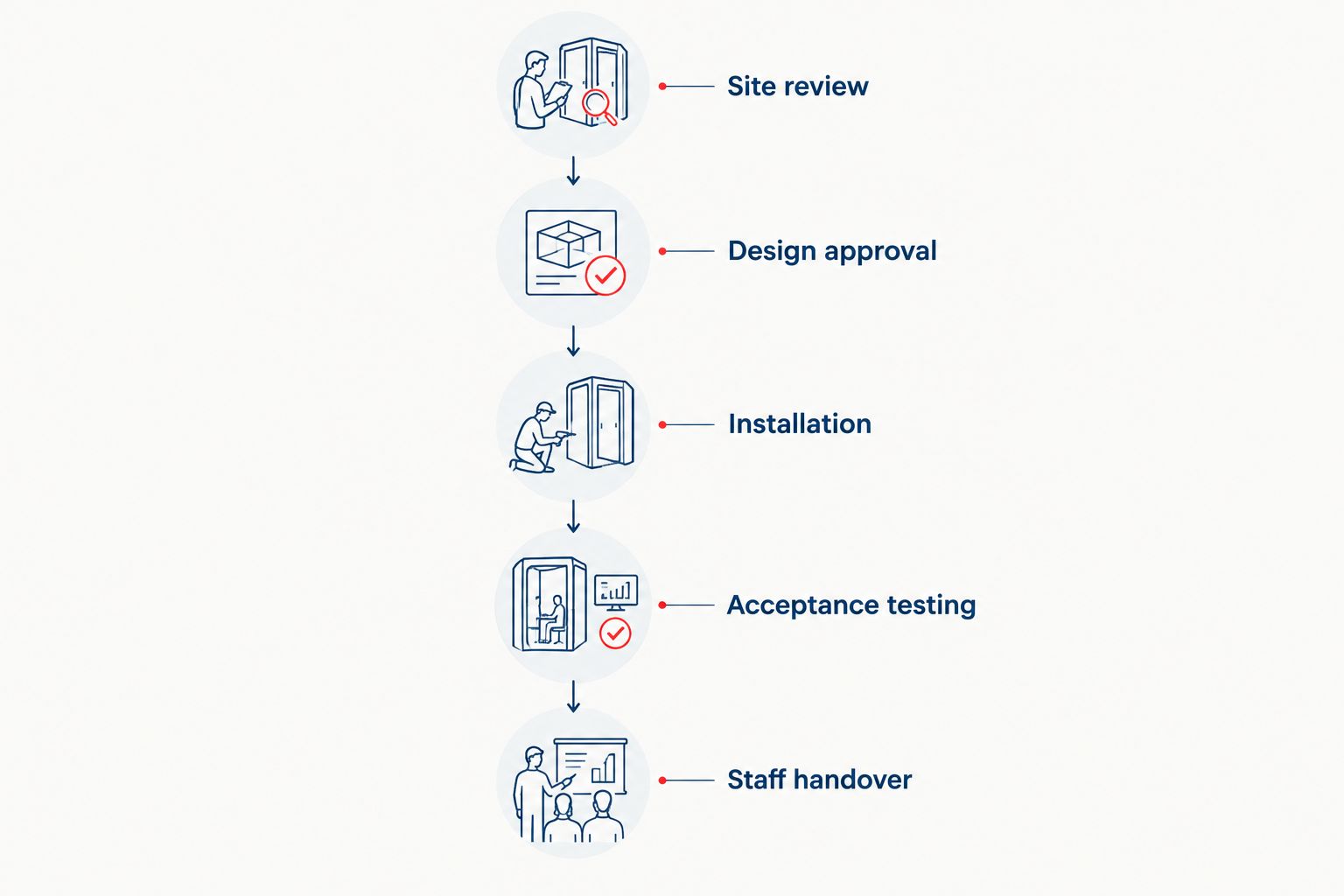
A 2026 project needs a documented sequence. Firstlinefire provides fire alarms and safety training services; your proposal should define the exact scope, equipment, responsibilities, and acceptance work for your practice.
Site review
Provide the floor plan, clinical use, existing system information, and landlord contacts. Identify planned construction before the design is settled.
Design approval
Confirm occupancy requirements, device locations, notification, monitoring, and interfaces. Establish who submits the design and who accepts it.
Installation
Agree on access to treatment rooms and how the contractor manages any system impairment. Coordinate work with the landlord when shared equipment is involved.
Acceptance testing
Verify the installed functions against the approved design. Testing must address the relevant devices, notification, interfaces, and signal transmission—not just one successful panel indication.
Staff handover
Obtain records, operating instructions, service contacts, and maintenance responsibilities. Assign staff roles for evacuation and reporting faults.
Keep the final drawings and device labels with the practice's safety records. A future technician should not need to reconstruct the system from memory.
Check backup power without guessing
For a 2026 design, ask the designer to document the applicable NFPA 72 secondary-power requirements and battery calculations. Under its standard protected-premises provisions, secondary power supports 24 hours of standby followed by 5 minutes of alarm operation; in-building emergency voice/alarm communication provisions generally require 15 minutes of alarm operation after standby.
Those figures are not a battery shopping list. Applicable exceptions, system configuration, current demand, and the adopted requirements determine the actual design. Wireless device batteries also require their own maintenance review.
Ask for the calculation, not an assurance that the cabinet contains batteries. Verify that the maintenance records identify battery condition and replacement responsibilities.
How these options are ranked
Addressable systems take the default position because individual device identification serves multi-room practices. Conventional systems occupy the simple-layout slot. Listed wireless systems address difficult device-wiring retrofits.
This is a fit-based ranking, not a claim that one architecture passes every inspection. Each option must satisfy the same occupancy, notification, compatibility, signal-handling, and service criteria.
Which fire alarm system should you choose?
Start with addressable fire alarms for a multi-room practice, then confirm the approved design. Retain a suitable conventional system when clear zoning meets the requirements. Consider listed wireless equipment when wiring constraints justify it.
Before you sign, resolve the landlord boundary, patient evacuation needs, monitoring arrangement, and service responsibilities. Firstlinefire's fire alarm and related fire-protection services are relevant to that discussion within its stated service area. Require a site-specific scope rather than treating this ranking as a finished specification.
Review your practice's fire protection
Discuss fire alarms and related fire-protection services for your medical or dental office.
FAQ
What's the best fire alarm system for a medical office?
An addressable fire alarm system is the default choice for a multi-room medical office needing individual device identification. The final choice must match the approved occupancy, building layout, notification requirements, and existing equipment.
Is an addressable alarm better than a conventional alarm for a dental office?
An addressable alarm is better when the dental office needs individual device identification rather than zone-level reporting. A suitable conventional system remains a valid choice when clear zoning meets the applicable requirements.
Can a medical office use wireless fire alarms?
A medical office can use listed wireless fire alarm equipment when the compatible design is accepted for the site. Require a radio assessment and a device battery maintenance plan; consumer smart alarms do not substitute for a required commercial system.
Does a dental office using sedation need a different fire alarm system?
Sedation requires a review of patient evacuation capability and the applicable occupancy requirements. The clinical use, building conditions, and local requirements determine whether the alarm and other life-safety provisions need changes.
Does an addressable fire alarm automatically call the fire department?
No, addressable device reporting does not establish an off-site monitoring or dispatch arrangement. The proposal must identify the communication equipment, receiving service, and procedures for handling transmitted signals.
Who handles fire alarms in a leased medical office?
Responsibilities depend on the building arrangement, lease, and applicable requirements. Establish who handles suite devices, shared equipment, testing, monitoring, repairs, and records before authorizing changes.
Can Firstlinefire help with medical office fire protection?
Firstlinefire provides fire alarms, extinguishers, suppression systems, and safety training services to commercial customers across Kentucky, Illinois, Indiana, Tennessee, Missouri, and Alabama. Discuss the practice's needs to establish the project-specific scope.
One last thing
Walk the office with the device map before accepting the handover. Check every room name. Precise device identification is only useful when the label points to the right place. A renamed recovery room deserves the same attention as a new detector.