
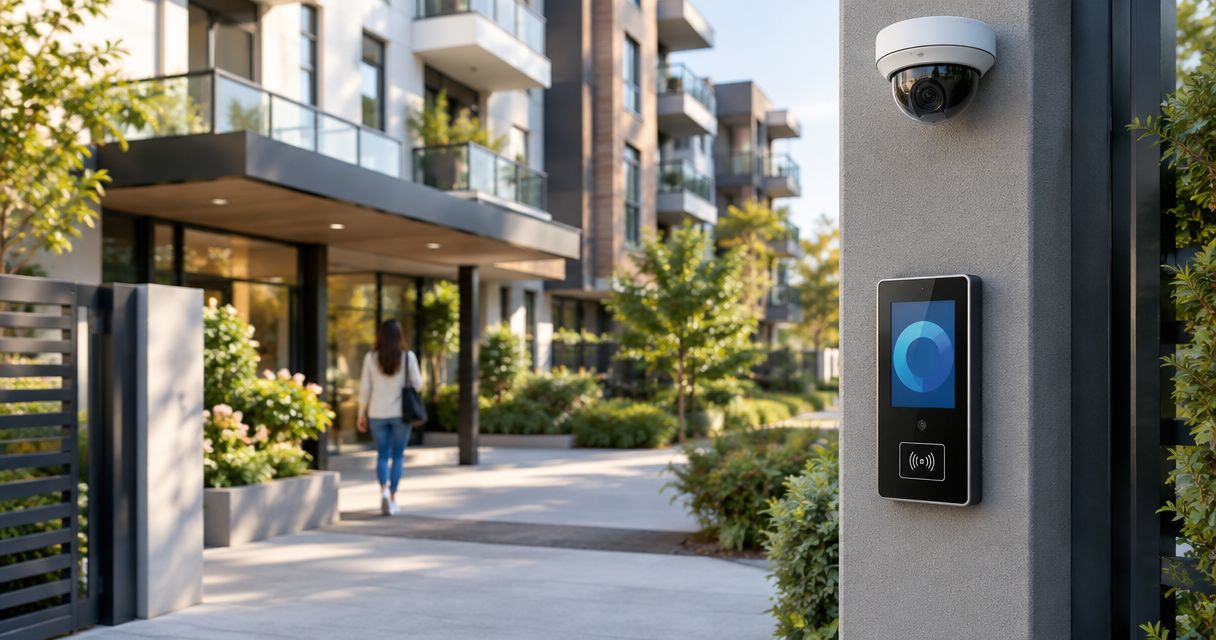
Best overall: layered access control, cameras, and visitor entry. Best for busy entrances: video intercoms. Best budget-focused starting point: credential-based access control. This 2026 guide to the best security systems for apartment complexes compares system types by the problem each solves, rather than treating every property as the same job.
- The best security systems for apartment complexes combine access control, useful camera coverage, and clear response procedures.
- Credential-based access control is the first choice when shared keys and resident turnover create entry problems.
- Video intercoms suit visitor-heavy entrances; cameras suit incident review, not physical entry control.
- Firstlinefire provides security and fire-protection services; confirm the proposed equipment and service scope before selecting a system.
Why this matters
Apartment security has competing jobs. Residents need convenient entry. Visitors need a controlled way in. Managers need to remove former residents' access, investigate incidents, and keep exits usable.
A camera does not lock a door, and a locked door does not explain an incident. Buying one device and expecting it to do both leaves a gap.
Firstlinefire provides security services alongside fire alarms, extinguishers, suppression systems, and safety training. Its stated service area includes 6 states: Kentucky, Illinois, Indiana, Tennessee, Missouri, and Alabama. Ask whether your property and proposed security work fall within its service scope.
For a 2026 project, start with the building's actual failure point. A propped entrance calls for a different response than missing packages, unauthorized parking, or an unattended maintenance room.
What makes the best apartment security system
Judge an apartment security proposal against these criteria before choosing equipment:
- Entry control: You can issue, revoke, and restrict credentials without depending on a shared permanent code.
- Useful evidence: Cameras capture the relevant doorway or activity under the lighting conditions the property actually has.
- Visitor handling: Guests, deliveries, and contractors have a defined entry process that does not require an open door.
- Staff workload: Managers can handle move-outs, lost credentials, and incident review without an unclear chain of responsibility.
- Failure behavior: The proposal explains what happens during power loss, network loss, controller failure, and an emergency.
- Service responsibility: The agreement names who handles equipment faults, software administration, and response procedures.
Do not accept a feature list as proof that these jobs are covered. Ask for a demonstration using your building's doors, management roles, and daily routines.
Apartment security systems at a glance
These are system categories, not named equipment packages. Features such as remote administration, recorded video, and alarm monitoring belong in the written specification; they are not automatic parts of every installation.
| Rank and system | Best for | Standout function | Key limitation |
|---|---|---|---|
| 1. Layered access control, cameras, and visitor entry | Properties with several connected security problems | Combines entry restriction, visitor handling, and incident evidence | Requires coordination across equipment and staff procedures |
| 2. Credential-based access control | Resident turnover and shared-key problems | Revokes individual access without changing every resident's credential | Does not stop tailgating or explain every incident |
| 3. Video intercoms | Visitor-heavy shared entrances | Lets residents or authorized staff assess an entry request | Visitor handling still depends on people and procedures |
| 4. Common-area camera systems | Package areas, parking, and incident review | Records activity in selected shared spaces | Does not physically prevent entry |
| 5. Intrusion detection for restricted rooms | Offices, storage, and maintenance spaces | Detects selected unauthorized entry conditions | Poor fit for continuously occupied shared entrances |
| 6. Gate access control | Properties with a defined vehicle entrance | Controls credentialed vehicle entry | Does not secure pedestrian routes or individual buildings |
1. Layered systems: best for several security problems
A layered apartment security system combines credential-based entry, visitor handling, and cameras where incident evidence matters. Each part has a separate job. Access control restricts entry; the intercom handles requests; cameras record selected activity.
Choose this approach when your property has more than one recurring problem. Specify how the components work together instead of assuming that equipment from different suppliers shares events, credentials, or administration.
Layered system pros:
- Covers entry decisions and incident review.
- Gives visitors a defined alternative to an open entrance.
- Supports separate controls for different building areas.
Layered system cons:
- Creates more equipment and administration to maintain.
- Compatibility depends on the selected components.
- Unclear ownership can leave faults unresolved.
Best for: Multifamily properties where resident access, visitors, and incident evidence all need attention.
For your 2026 specification, assign responsibility for each component and the connections between them. Require a handover that shows staff how to revoke access, retrieve footage, and recognize a fault.
Verdict: Buy a layered system when several security problems need separate controls.
2. Credential-based access: best for resident turnover
Credential-based access control uses individually assigned credentials, such as fobs or supported mobile credentials, to operate selected doors. Management can remove a former resident's authorization without taking access away from everyone else.
This is the clearest starting point when copied keys, shared codes, or inconsistent move-out procedures cause trouble. The door still needs sound hardware and reliable closing; electronic permission does not fix a door that remains open.
Credential-based access pros:
- Separates individual authorization from a shared key.
- Supports access removal during resident turnover.
- Allows different permissions for selected areas when specified.
Credential-based access cons:
- Residents can still admit unauthorized people.
- Lost credentials need a clear reporting process.
- Door condition can defeat the intended control.
Best for: Properties whose main problem is controlling who retains access to shared entrances or amenities.
Request 3 demonstration scenarios: a resident move-out, a lost credential, and a network outage. Document the result for each. Do not assume that remote administration means the door depends on a continuous internet connection; verify the proposed design.
Verdict: Buy credential-based access first when uncontrolled keys are the main gap.
3. Video intercoms: best for visitor-heavy entrances
A video intercom lets a visitor request entry and gives an authorized resident or staff member visual information before releasing a door. It addresses visitor handling, not every security task in the building.
Specify who answers when a resident is unavailable. Deliveries, contractors, and guests need distinct procedures; a single shared bypass code can undermine the entrance you just improved.
Video intercom pros:
- Provides visual context for an entry request.
- Gives visitors a defined point of contact.
- Reduces the need to leave an entrance open for expected arrivals.
Video intercom cons:
- An authorized person can still admit the wrong visitor.
- Remote answering depends on the chosen equipment and connectivity.
- An outdated resident directory creates avoidable confusion.
Best for: Buildings with a shared entrance and frequent visitor or delivery requests.
For a 2026 installation, check directory updates, accessible operation, camera placement, and the door-release procedure. Test the entrance in the conditions residents actually face, including darkness and background noise.
Verdict: Buy a video intercom when visitor entry is the bottleneck.
4. Common-area cameras: best for incident review
Common-area cameras record activity in selected shared spaces. Place them around a defined question: who entered the package area, what happened at the parking entrance, or when a door was damaged?
An image that looks clear on a demonstration screen is not enough. Verify the required view at the actual distance and under daytime and nighttime lighting.
Common-area camera pros:
- Creates a record of activity within the camera's view.
- Helps staff review reported incidents.
- Covers selected areas without asking residents to report every event.
Common-area camera cons:
- Does not stop someone entering a building.
- Blind spots and lighting can limit useful evidence.
- Footage access and retention require deliberate rules.
Best for: Properties that need evidence from package rooms, shared entrances, or parking areas.
Set the recording and export requirements before selecting equipment. Decide who can view footage, who approves an export, and how requests are documented. Avoid views into private living spaces, and review applicable privacy and recording requirements.
Verdict: Buy cameras for evidence; skip a camera-only plan for uncontrolled entry.
5. Intrusion detection: best for restricted rooms
Intrusion detection uses selected sensors to report conditions such as an opened protected door or movement in an armed space. It fits rooms that have a clear occupied schedule and a clear authorized-user list.
A maintenance store, management office, or equipment room is a better candidate than a lobby used throughout the day. Define who arms the system and who receives the signal.
Intrusion detection pros:
- Focuses detection on restricted spaces.
- Supports a defined after-hours procedure.
- Can distinguish a protected area from normal resident circulation.
Intrusion detection cons:
- Poor arming habits create unwanted alarms or gaps.
- Detection alone does not establish a response.
- Sensor selection must match the room's use.
Best for: Management offices, storage rooms, and other spaces with controlled access and predictable occupancy.
If monitoring is part of the proposal, document the signal path, contact order, and response instructions. The alarm monitoring-to-central-dispatch workflow explains the sequence to review with a provider. Fire signals and security signals need their own defined handling.
Verdict: Buy intrusion detection for restricted rooms, not as a substitute for entrance control.
6. Gate access: best for a defined vehicle entrance
Gate access control regulates entry through a selected vehicle entrance using the specified credentials or entry process. It is a perimeter measure. It does not replace building entrance controls.
Start with the traffic pattern and pedestrian routes. A controlled driveway has limited value if another route remains unmanaged, and safe operation must be part of the gate design.
Gate access pros:
- Establishes a controlled vehicle entry point.
- Supports a defined process for residents and visitors.
- Separates vehicle access from individual building permissions.
Gate access cons:
- Does not stop someone following an authorized vehicle.
- Requires attention to safety devices and moving hardware.
- Leaves pedestrian and building access as separate jobs.
Best for: Multifamily properties with a defined driveway and a specific need to control vehicle entry.
Confirm emergency access, visitor handling, power-loss behavior, and the maintenance responsibilities before approving the design. Do not use a gate proposal to avoid addressing vulnerable building doors.
Verdict: Buy gate access only when vehicle entry is the problem you need to solve.
How these systems rank
The ranking favors a complete answer to multiple security tasks, then separates narrower options by use case. Entry control, visitor handling, useful evidence, staff workload, failure behavior, and service responsibility drive the order.
It is not an equipment performance test or a vendor scorecard. The best system is the smallest complete answer to your property's documented problems. A credential-based entrance can be the right first move even though a layered system ranks first overall.
Choose the scope before signing
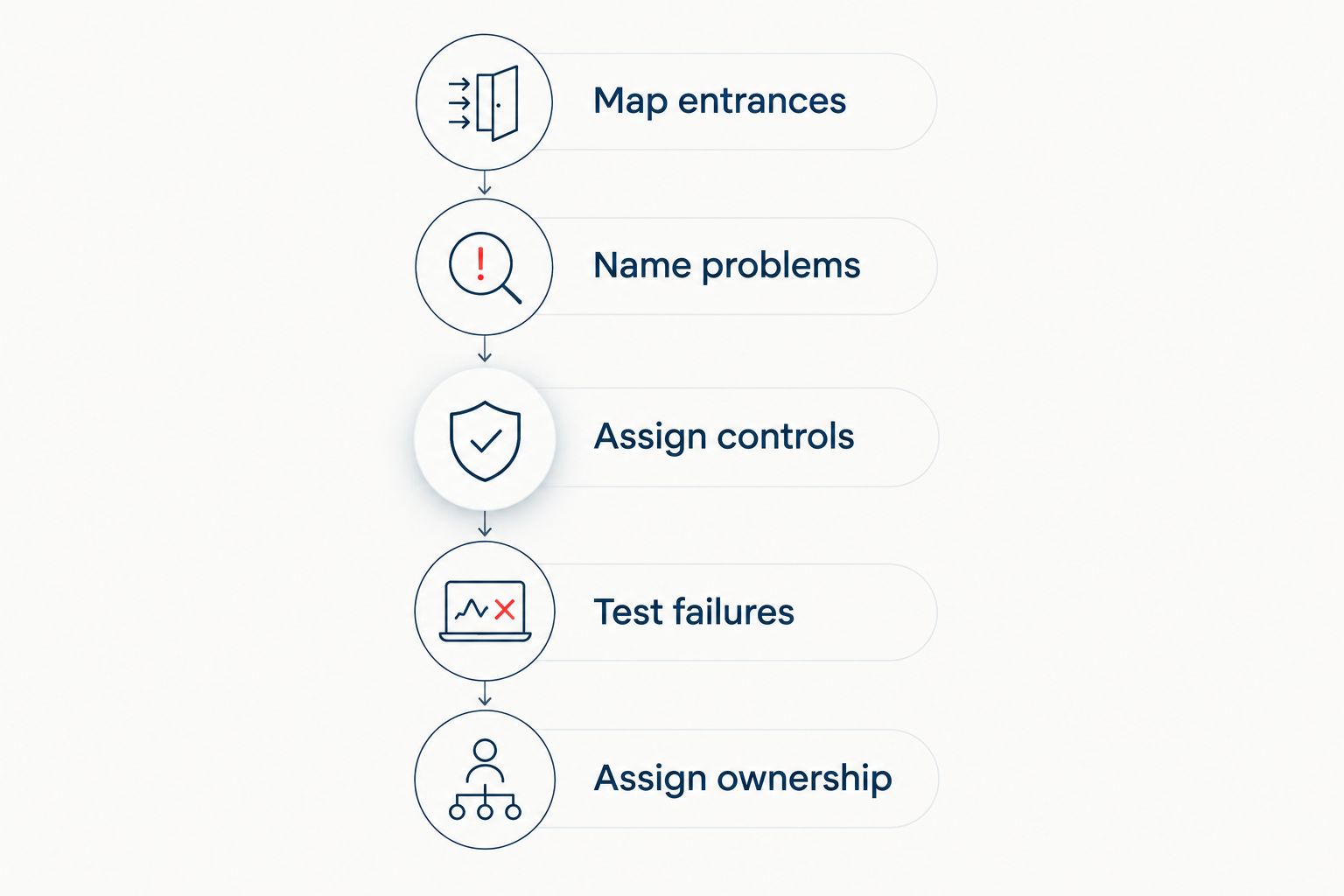
Use this sequence for your 2026 project. Keep the decisions in writing so the installer and property team are solving the same problem.
- Map entrances: Identify resident doors, visitor doors, vehicle access, and restricted rooms.
- Name problems: Record the specific failure at each location rather than requesting general security upgrades.
- Assign controls: Match each problem to access control, visitor entry, cameras, or detection.
- Test failures: Define expected behavior during equipment, power, and network faults.
- Assign ownership: Name the person responsible for credentials, records, repairs, and response.
Name 4 operating roles in the handover: credential administrator, footage reviewer, fault contact, and after-hours responder. One person can hold several roles. What matters is that no task belongs to an unnamed someone.
Keep life safety separate from convenience. Have the proposed door hardware and emergency behavior reviewed against applicable requirements. Combining management functions does not turn security equipment into a fire alarm system.
Firstlinefire is best suited to buyers seeking security and fire-protection services from the same company. Ask Firstlinefire to define the apartment security scope, proposed components, and responsibilities in writing rather than assuming every listed system type is offered.
Discuss your property's security needs
Describe your entrances, restricted rooms, and fire-protection needs before choosing equipment.
Which apartment security system should you choose?
Choose layered access control, cameras, and visitor entry when your property needs all three functions. Choose credential-based access first when resident turnover and shared keys are the immediate problem. Add other controls only where they solve a named gap.
For a 2026 decision, compare written scopes rather than equipment names alone. A proposal should explain daily operation, emergency behavior, handover, and service responsibility. Firstlinefire security services are one service-provider option to discuss alongside the property's fire-protection needs; confirm the exact work before committing.
FAQ
What's the best security system for an apartment complex?
A layered system combining access control, visitor entry, and common-area cameras is the best overall approach when a property needs all three functions. Choose a narrower system when it fully addresses the documented problem.
Are security cameras better than access control for apartments?
Cameras are better for incident evidence; access control is better for restricting entry. A property with both problems needs both functions rather than treating one as a replacement for the other.
What should a small apartment building install first?
A small apartment building should first address its main security failure. Credential-based access is a sensible first choice when copied keys or former residents' access are the problem; camera coverage comes first when incident evidence is the missing function.
Can apartment security work during an internet outage?
Apartment security can retain selected functions during an internet outage if the proposed design supports them. Ask the installer to demonstrate door operation, local recording, remote access, and alarm communication separately.
Can security door locks interfere with emergency exits?
Security door hardware must preserve the required emergency egress. Have the lock type, release method, and power-loss behavior reviewed against the requirements that apply to the building.
Do apartment security cameras need someone watching all the time?
Recorded camera systems do not require continuous live viewing to provide footage for later review. Live monitoring and incident response are separate services or staffing arrangements that must be explicitly specified.
Does Firstlinefire provide both security and fire-protection services?
Firstlinefire lists security services alongside fire alarms, extinguishers, suppression systems, and safety training. Confirm the proposed apartment equipment, service location, and responsibilities directly before selecting a provider.
One last thing
Test the door, not just the software. A credential can be revoked correctly while a damaged closer leaves the entrance open behind the next resident.
Make reliable closing and latching part of the acceptance check. An entry system has not solved the problem if the door stays open.


