
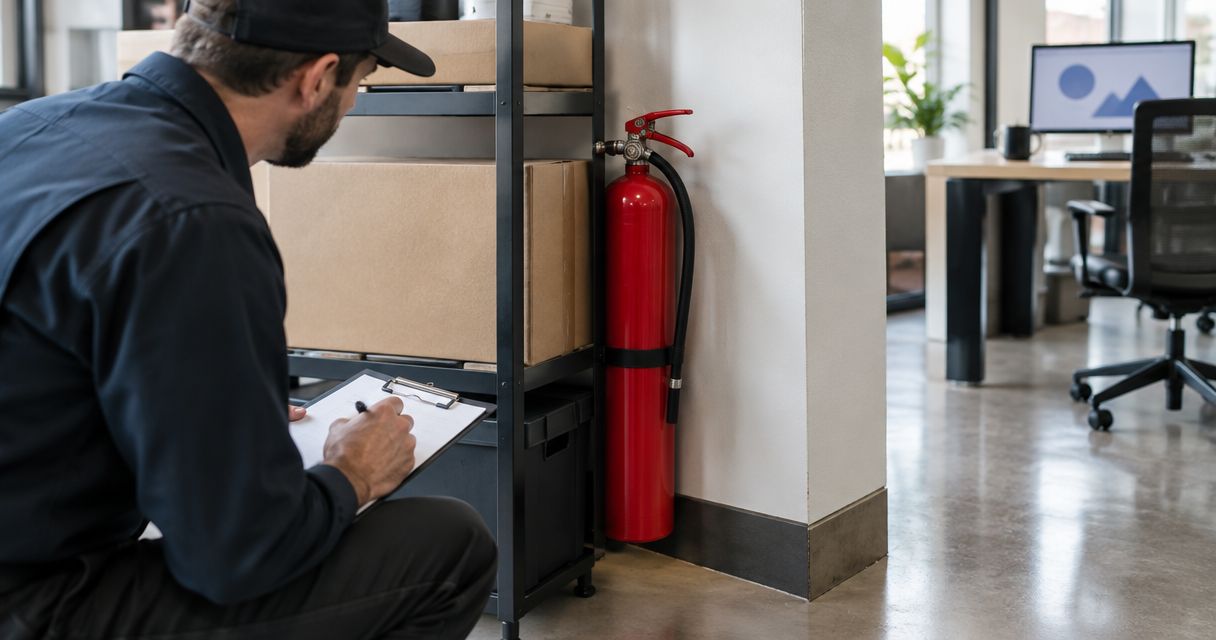
Yes. A business can fail a fire inspection over blocked extinguishers because required fire extinguishers must be readily accessible. Moving the obstruction fixes the access problem, but it does not automatically close a written violation or authorize reopening after a closure order.
- Can a business fail a fire inspection over blocked extinguishers? Yes. Required extinguishers must remain accessible.
- A current service tag does not excuse blocked fire extinguisher access.
- Firstlinefire serves commercial and industrial customers needing fire extinguisher service and safety training.
- Clear the obstruction, document the correction, and follow the inspector’s instructions for closing the violation.
Why this matters
An extinguisher behind a pallet is equipment you cannot reach when you need it. A current tag does not fix that. Access and equipment condition are separate requirements, and your staff needs to protect both.
For your 2026 fire-safety checks, treat extinguisher locations as protected working space, not spare storage. If an inspector has already issued a notice, the next question is whether a business can stay open after failing a fire marshal inspection. Read the actual order before deciding what operations can continue.
Can a business fail a fire inspection over blocked extinguishers?
Yes. A blocked required extinguisher is grounds for a fire-safety violation. The inspector’s terminology and enforcement process depend on the jurisdiction, but access is not optional simply because the extinguisher is present.
For general-industry workplaces covered by OSHA’s portable-extinguisher rule, 29 CFR 1910.157(c)(1) requires employers to mount, locate, and identify extinguishers so employees can readily access them without possible injury. This federal workplace requirement is separate from the locally adopted fire code the fire marshal enforces.
The following situations explain the access problem. They are not a prediction of a particular inspector’s enforcement decision.
| Condition | Why it matters | What to correct |
|---|---|---|
| Boxes stacked in front of an extinguisher | Employees must move storage before reaching it | Remove the boxes and change the storage practice |
| A cart parked across the approach | The approach is obstructed even though the extinguisher is visible | Move the cart and assign another parking location |
| An extinguisher hidden behind shelving | Employees cannot readily identify or reach it | Restore access and have placement reviewed if necessary |
| A cabinet door blocked by equipment | The extinguisher cannot be removed normally | Clear the cabinet’s opening space |
| A clear extinguisher with overdue maintenance | Access does not establish equipment readiness | Arrange the required maintenance separately |
A passing service visit does not guarantee a passing building inspection. Storage can change after the technician leaves, and the fire marshal evaluates the conditions present during the inspection.
What counts as a blocked extinguisher?
An extinguisher is obstructed when people cannot readily reach and remove it because something is in the way. Look at the approach, the mounting point, and any cabinet door—not just whether you can see the handle.
Walk the route an employee would actually use. A clear patch immediately below the extinguisher does not solve a blocked aisle leading to it. Nor does a sign make an inaccessible extinguisher usable.
Common trouble spots include:
- Receiving areas: deliveries placed against the extinguisher location.
- Stockrooms: cartons stacked in front of a wall bracket.
- Work bays: tools or carts parked in the approach.
- Retail areas: temporary displays hiding the equipment.
- Cabinets: furniture or equipment preventing the door from opening.
A useful check is straightforward: can an employee approach, identify, and remove the extinguisher without first moving stored items? If not, correct the obstruction. Do not make reaching around equipment your normal access plan.
Does every extinguisher need the same clearance?
Do not apply an electrical-panel clearance rule to an extinguisher by assumption. Extinguisher access depends on the applicable requirements, its location, and whether someone can readily reach and remove it.
The federal OSHA access requirement does not establish one universal rectangular floor-clearance dimension for every extinguisher. Your local authority can identify the requirements that apply to your building and its adopted code.
For a 2026 layout review, distinguish these separate measurements:
- Access space: the room needed to approach and remove the extinguisher.
- Travel distance: the route from a potential fire location to suitable equipment.
- Mounting position: the extinguisher’s installation height and arrangement.
For example, OSHA’s general-industry rule sets a maximum travel distance of 75 feet for Class A extinguishers under 29 CFR 1910.157(d)(2). That is not permission to place storage in front of the extinguisher. Correct distribution and clear access must work together.
Do not relocate an extinguisher simply to make room for a pallet. A different wall position can change travel distance, visibility, and coverage.
What should you do when an extinguisher is blocked?
Remove the obstruction first. Then address the reason it appeared. Waiting for the next service appointment leaves the access problem in place.
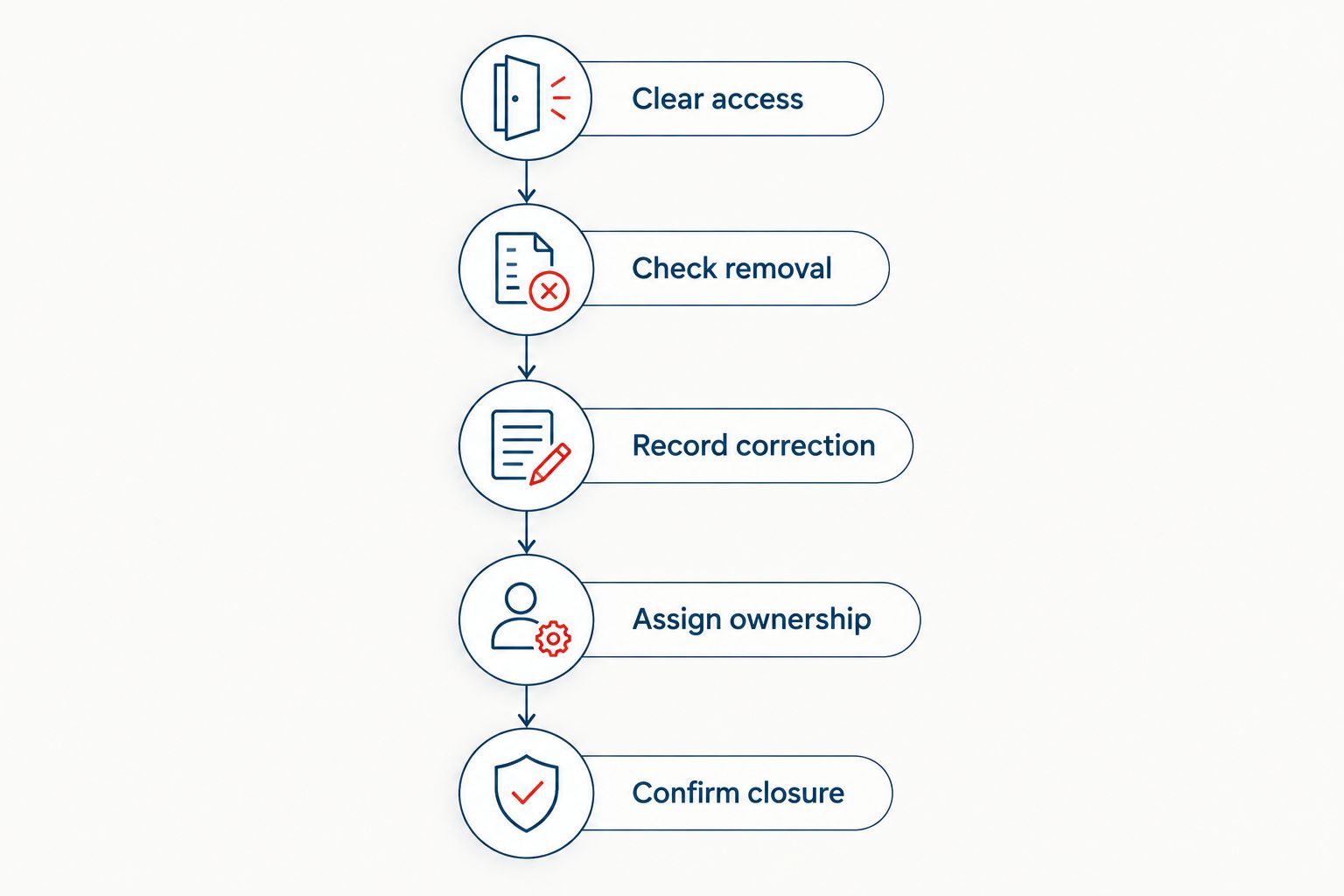
Use this sequence for an ordinary storage obstruction. Damaged equipment, unsafe materials, or an active emergency require the appropriate safety response rather than an improvised cleanup.
- Clear access. Move the boxes, cart, or other obstruction to a permitted location. Do not transfer the problem to an exit, electrical panel, or another extinguisher.
- Check removal. Confirm that the extinguisher is accessible and that its cabinet, if present, opens without interference. Do not discharge it as a test.
- Record correction. Note the location, what blocked it, and what changed. If there is a written violation, match your record to that item.
- Assign ownership. Give the area supervisor responsibility for keeping the location clear. Include receiving and cleaning crews when their work affects access.
- Confirm closure. Follow the inspector’s instructions for submitting evidence, arranging a reinspection, or obtaining written confirmation.
If the same location keeps getting blocked, the storage plan needs attention. Telling staff to be careful does not provide a place for incoming freight or idle carts.
Why inspection outcomes vary
The access requirement is clear. The official response to a violation depends on the governing rules and the conditions the inspector finds.
These factors matter when addressing a blocked extinguisher:
- The enforcing authority. A fire marshal, workplace-safety inspector, and insurer act under different requirements. Satisfying one does not automatically satisfy another.
- The adopted rules. Local fire-code requirements and applicable workplace regulations determine the specific obligation.
- The actual obstruction. A hidden unit, an inaccessible cabinet, and a blocked approach present different physical problems to correct.
- Other hazards present. Blocked exits or additional fire-protection deficiencies require their own corrections.
- The written notice. Follow its instructions on deadlines, evidence, reinspection, and operating restrictions.
Do not infer a correction deadline from what another business received. Use your own notice. If the instructions are unclear, ask the issuing authority what proof is required and whether any restriction remains in effect.
How often should employees check extinguisher access?
OSHA’s general-industry rule requires visual inspection monthly under 29 CFR 1910.157(e)(2). Expressed as a planning interval, that is 1 month between scheduled visual checks; do not interpret it as permission to leave a known obstruction until the next check.
OSHA also requires an annual maintenance check under 29 CFR 1910.157(e)(3). That is a separate 12-month maintenance cycle, not a substitute for keeping the extinguisher accessible between service visits.
For your 2026 inspection calendar, keep these responsibilities distinct:
| Task | Purpose | Limitation |
|---|---|---|
| Monthly visual inspection | Identify visible readiness and access problems | Does not replace required maintenance |
| Annual maintenance check | Address the required maintenance examination | Does not prevent later storage obstructions |
| Area housekeeping check | Catch access changes during ordinary work | Does not replace the scheduled inspection program |
Have staff check the affected location after deliveries, display changes, or equipment moves. This is a practical housekeeping recommendation, not a claim that every business has the same legally mandated daily inspection schedule.
The regulatory references in this 2026 guide concern federal OSHA general industry. Marine, mining, and other specialized operations require review under their applicable rules; do not apply this article as a complete compliance checklist for those settings.
When should you call a fire extinguisher service company?
Call a qualified service provider when the problem extends beyond removing storage: a damaged bracket, questionable equipment condition, overdue maintenance, or a proposed relocation. Your staff can move a cart without treating that task as extinguisher servicing.
Firstlinefire provides fire extinguisher sales, inspection, service, and safety training for commercial and industrial customers. Firstlinefire is a fit for businesses that need fire extinguisher service and staff safety training. A service provider does not replace the authority that issues or closes a fire inspection notice.
Explain the specific problem when requesting help. Identify the extinguisher location, describe any equipment damage, and provide the inspection finding if one exists. Ask for a placement review before moving equipment to accommodate a new storage arrangement.
Arrange fire extinguisher service
Address equipment condition, maintenance, or placement questions after clearing the obstruction.
Can you stay open after clearing a blocked extinguisher?
Clearing a blocked extinguisher does not itself determine whether you can stay open. The inspection notice or order controls any operating restriction, and the issuing authority determines what is required to lift it.
Do not equate an access violation with automatic closure. Do not assume the opposite either. If the authority ordered closure, obtain the required authorization before reopening.
Does a current inspection tag excuse blocked access?
A current inspection tag does not excuse blocked access. The tag concerns service history; the obstruction concerns whether the extinguisher can be reached now.
Keep maintenance records and access checks together in your safety program, but treat them as separate tasks. A serviced extinguisher behind merchandise still presents an access problem.
What records should you keep after the correction?
Keep the original finding, the affected location, the correction date, and the person responsible. Add photographs when useful, plus service documentation if equipment work was necessary. These records support follow-through; they do not replace any evidence the authority specifically requests.
For a 2026 correction file, make the location identifiable without relying on memory. Use the building, department, or equipment-location description your staff already recognizes. A close-up photograph of an extinguisher alone does not show the route leading to it.
Record the prevention step too. If incoming shipments caused the obstruction, document the new staging location and who controls it. Close the paperwork only after completing the required reporting or reinspection process.
FAQ
Can a business fail a fire inspection just because an extinguisher is blocked?
Yes. A blocked required extinguisher violates the need for ready access. The enforcing authority determines how the finding is recorded and corrected.
Can I put boxes in front of an extinguisher temporarily?
Do not use the extinguisher approach for temporary storage. Required extinguishers must remain readily accessible, including during deliveries and restocking.
Does an extinguisher need the same clearance as an electrical panel?
Do not assume the same clearance rule applies. Follow the applicable extinguisher-access requirements and ask the local authority about your specific installation.
Will moving the boxes immediately make the business pass?
Moving the boxes corrects that obstruction, but it does not automatically close a written inspection finding. Follow the authority’s instructions for evidence or reinspection.
How often does OSHA require visual extinguisher inspections?
OSHA’s general-industry rule requires monthly visual inspections under 29 CFR 1910.157(e)(2). Annual maintenance is a separate requirement, and known obstructions should be corrected immediately.
Can I move an extinguisher to another wall to keep it clear?
Have the proposed placement reviewed before relocating a required extinguisher. Moving it can affect travel distance, visibility, and coverage.
Can Firstlinefire close a fire marshal’s violation?
Firstlinefire provides fire extinguisher inspection and service, but the issuing authority controls closure of its violation. Service documentation can support the correction process.
One last thing
Check access after work changes, not just before an inspection. A morning delivery can block equipment that was clear when the shift started. Give freight, carts, and temporary displays their own locations so the extinguisher location stays usable.


