
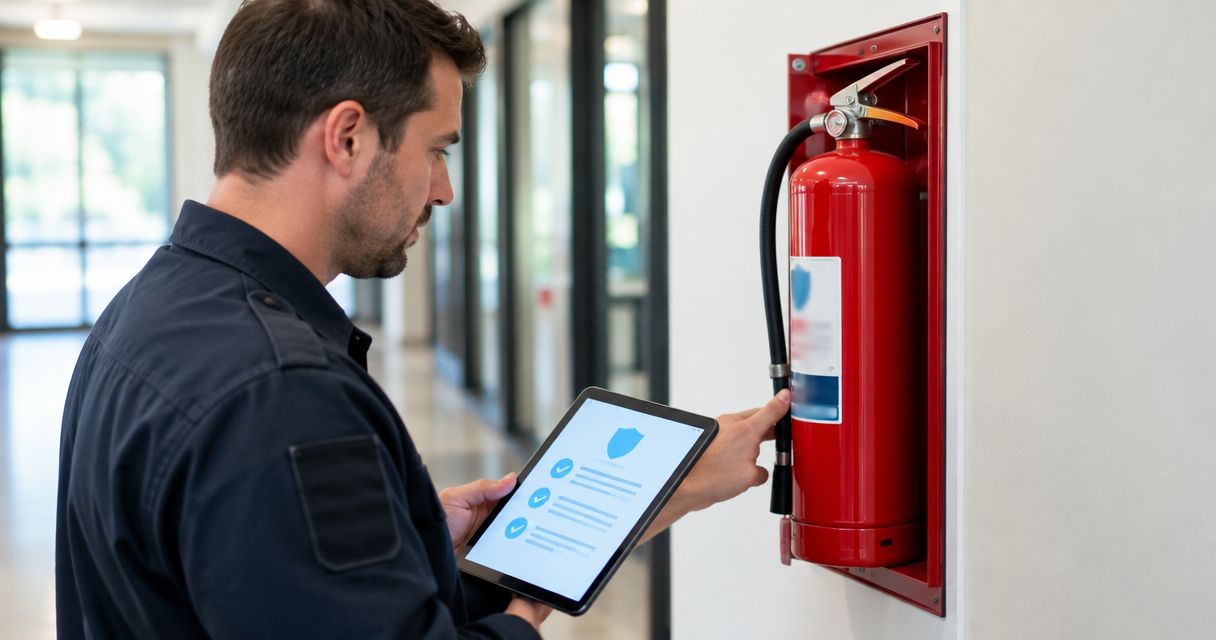
An extinguisher with overdue required maintenance or hydrostatic testing is not compliant and should not be counted on to pass a fire marshal inspection. An old manufacture date alone does not automatically disqualify a serviceable, rechargeable extinguisher. For your 2026 inspection, identify which deadline has passed, correct the deficiency, and keep the service records; a green pressure gauge does not prove compliance.
- Can an expired fire extinguisher pass a fire marshal inspection? Not with overdue required maintenance or hydrostatic testing.
- OSHA requires monthly visual inspections and annual maintenance checks for workplace portable fire extinguishers.
- A green gauge does not establish cylinder condition, service history, or compliance.
- Firstlinefire provides fire extinguisher service and hydro testing for commercial and industrial customers.
Can an expired fire extinguisher pass a fire marshal inspection?
Not if expired means required service or testing is overdue. If expired means the extinguisher is simply old, the answer depends on its type, condition, manufacturer instructions, and applicable requirements. There is no single expiration date that applies to every portable extinguisher.
For commercial extinguisher service and hydro testing, Firstlinefire serves customers across Kentucky, Illinois, Indiana, Tennessee, Missouri, and Alabama. Service corrects equipment deficiencies; the local authority having jurisdiction, often the fire marshal, determines inspection acceptance.
| What you find | What it establishes | What to do before inspection |
|---|---|---|
| Old manufacture date | Age, not proof of failed condition | Verify the model, service history, and applicable retirement instructions |
| Overdue annual maintenance | Required maintenance has not been kept current | Arrange maintenance and obtain the completed record |
| Overdue hydrostatic test | Required cylinder testing is outstanding | Arrange testing or replacement and maintain required coverage |
| Missing or unreadable service tag | Service status is not clear from the tag | Locate records and have the service status verified |
| Green pressure gauge | Indicated pressure only | Check condition, service dates, placement, and suitability too |
| Corrosion, leakage, or damage | A condition requiring qualified evaluation | Arrange prompt evaluation and suitable replacement coverage |
Do not confuse equipment compliance with the outcome of the entire building inspection. A marshal can identify an extinguisher deficiency without that fact alone establishing whether the building must close. Follow the written notice and any restrictions issued by the authority.
Why this matters
An extinguisher has to be ready when someone reaches for it. A current-looking tag does not correct a damaged cylinder, and a charged cylinder does not erase an overdue test.
For your 2026 inspection, separate three questions: Is the extinguisher serviceable? Is its required maintenance documented? Is it suitable and correctly located for the hazard? Passing one check does not answer the others.
OSHA's workplace portable-extinguisher rule, 29 CFR 1910.157, addresses inspection, maintenance, and testing. Local fire-code requirements and manufacturer instructions also matter. Treat those as separate checks, not interchangeable paperwork.
Overdue annual maintenance: arrange service
OSHA 29 CFR 1910.157(e)(2) requires monthly visual inspections of workplace portable extinguishers. Section 1910.157(e)(3) requires an annual maintenance check and a record of that maintenance.
A monthly visual check does not replace annual maintenance. Your staff can identify an empty bracket, blocked access, or visible damage during a routine check. Those checks do not establish that the required maintenance was completed.
If the annual tag appears overdue, find the underlying service record before deciding what happened. A missing tag and missed maintenance are different problems, but neither should remain unresolved before inspection. Do not backdate a tag or treat an appointment confirmation as evidence of completed work.
For the 2026 maintenance file, match each record to the extinguisher and its location. A report saying that extinguishers were serviced is less useful when nobody can connect it to the unit beside the loading dock.
Overdue internal maintenance: check the extinguisher type
Certain stored-pressure dry-chemical extinguishers require more than the annual maintenance check. Under OSHA 29 CFR 1910.157(e)(4), stored-pressure dry-chemical extinguishers requiring a 12-year hydrostatic test must be emptied and subjected to applicable maintenance procedures every 6 years, subject to the rule's exceptions and timing provisions.
That requirement does not apply identically to every extinguisher. The agent, cylinder construction, rechargeable status, and manufacturer instructions determine the correct service path.
Do not look at a current annual tag and assume internal maintenance is current. Ask the technician to identify both requirements separately. Your records should distinguish annual maintenance from internal maintenance and hydrostatic testing.
Use the extinguisher's actual type to set the schedule. A generic reminder labeled extinguisher expiration hides the distinction you need to make.
Overdue hydrostatic testing: maintain coverage during removal
Hydrostatic testing addresses cylinder integrity. It is not the same task as checking the pressure gauge, performing a visual inspection, or adding extinguishing agent.
OSHA 29 CFR 1910.157(f), Table L-1, specifies a 12-year hydrostatic test interval for listed stored-pressure dry-chemical extinguishers with the specified cylinder construction. The table specifies a 5-year interval for carbon dioxide extinguishers. Other listed extinguisher types have their own requirements; damage or corrosion can also require action before a scheduled interval.
For a 2026 inspection, verify the last qualifying test record against the exact extinguisher type. Do not calculate the next test from the annual service tag unless that record actually documents the hydrostatic test.
If an extinguisher leaves service for maintenance or recharging, OSHA 29 CFR 1910.157(e)(5) requires alternate equivalent protection. Do not solve an overdue-test problem by leaving an empty bracket. Arrange the coverage before the extinguisher is removed.
Old manufacture date: age alone is not the verdict
A rechargeable extinguisher can remain serviceable when it meets applicable maintenance, testing, condition, and manufacturer requirements. Its manufacture date starts the review; it does not finish it.
Nonrechargeable extinguishers require a different decision. Follow the manufacturer's replacement instructions and applicable requirements rather than assuming a technician can recharge any cylinder. Read the label before ordering service.
An extinguisher with unreadable identification presents another problem: you cannot reliably establish its type or instructions by guessing from its color or shape. Have a qualified technician evaluate it.
Do not replace a serviceable rechargeable extinguisher solely because it looks old. Do not retain an unserviceable one solely because it still shows pressure. Neither shortcut establishes compliance.
Why inspection outcomes vary
The same word, expired, describes several different conditions. These factors determine what corrective work is needed:
- Extinguisher type. Rechargeable and nonrechargeable units do not follow the same service path. Agent and cylinder construction affect testing requirements.
- Which deadline passed. Annual maintenance, internal maintenance, and hydrostatic testing are separate obligations.
- Physical condition. Leakage, damage, corrosion, or an obstructed discharge path require attention regardless of the calendar.
- Available records. A clear service history helps establish completed work. An unexplained tag does not establish that history.
- Hazard and placement. A maintained extinguisher still needs the correct classification, rating, location, and accessibility for its use.
- Applicable authority. The adopted fire code, manufacturer instructions, and workplace or sector-specific rules define the requirements for your site.
A warehouse, vessel, and coal mine are not interchangeable inspection settings. Confirm who regulates the equipment at that location before applying a general workplace checklist.
What should you do before the fire marshal arrives?
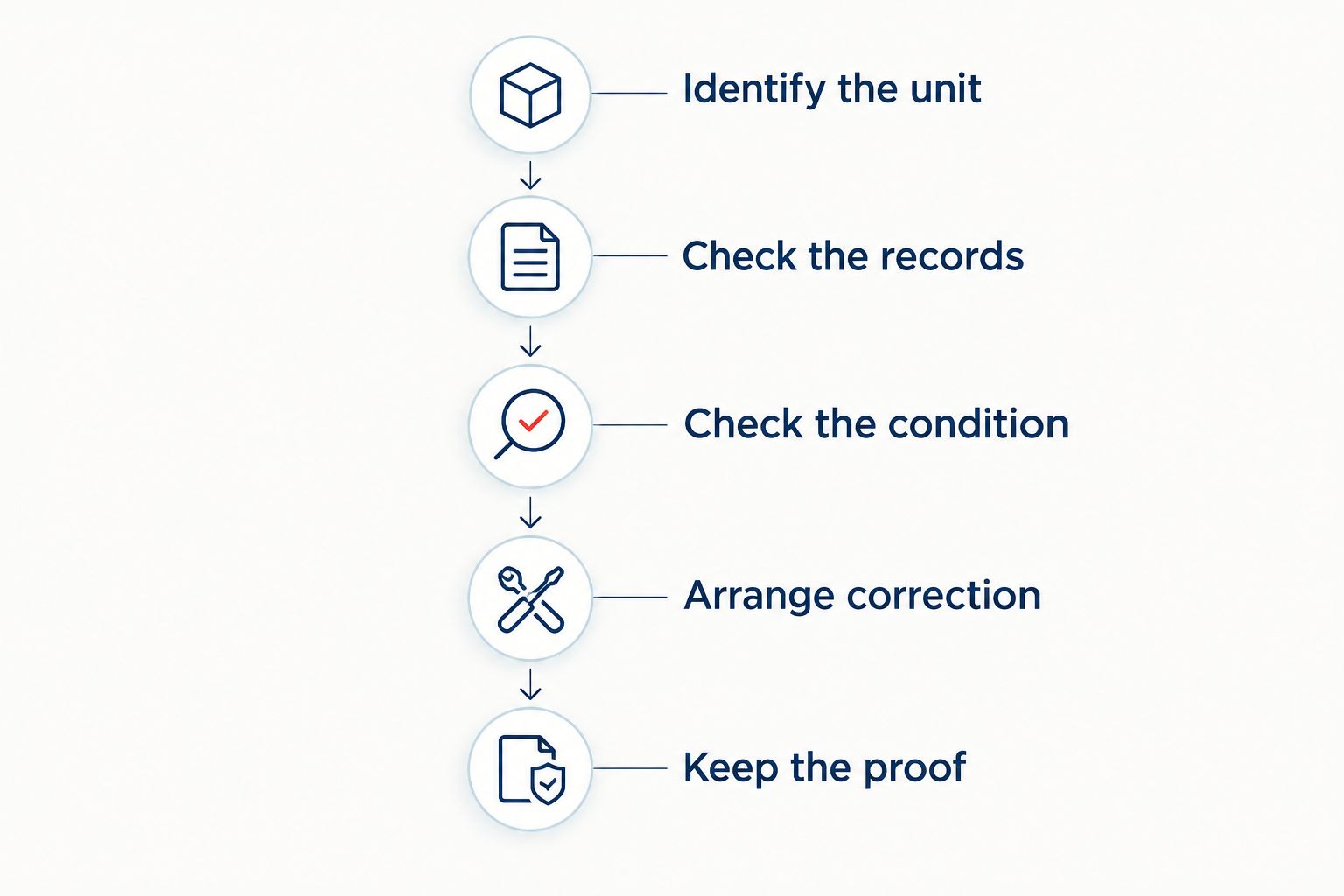
Start with the extinguisher in front of you, not a purchase date in an accounting file. Use this sequence to establish the problem and document the correction.
- Identify the unit. Record its location, manufacturer, model, serial number, agent, and rechargeable status. Photograph legible labels and service markings.
- Check the records. Compare annual maintenance, applicable internal maintenance, and hydrostatic test dates. For your 2026 review, flag unclear dates as well as overdue work.
- Check the condition. Look for visible damage, corrosion, leakage, missing components, and blocked access. Do not disassemble or pressure-test the extinguisher yourself.
- Arrange correction. Have a qualified service provider determine whether maintenance, testing, recharging, or replacement is appropriate. Maintain required protection during removal.
- Keep the proof. Retain the completed report and identify what happened to each deficient extinguisher. If a notice was issued, follow its correction and reinspection instructions.
The sequence matters because a new tag alone does not explain whether the correct work occurred. Ask for records that identify the extinguisher, the work completed, and the service date.
Should you service, test, or replace the extinguisher?
Choose the action that corrects the identified deficiency. Recharging does not substitute for a required hydrostatic test. Replacement does not solve poor placement unless you also address the location.
| Action | Best for | Benefit | Limitation |
|---|---|---|---|
| Maintenance | A serviceable unit with required maintenance due | Addresses the applicable maintenance tasks | Does not automatically satisfy a separate hydrostatic test requirement |
| Hydrostatic testing | An eligible cylinder with testing due | Evaluates cylinder integrity through the required test procedure | Requires appropriate equipment and removal from normal use |
| Recharging | An eligible rechargeable unit after use or agent loss | Restores the specified charge after appropriate service | Does not make a damaged or otherwise condemned cylinder acceptable |
| Replacement | A unit that is unserviceable or due for retirement | Removes unsuitable equipment from service | The replacement still needs correct selection, placement, and maintenance |
Firstlinefire is a fit for commercial operators needing fire extinguisher service and hydro testing. That service scope does not replace the marshal's approval or establish that every extinguisher is repairable.
Before authorizing work, ask the provider to separate each finding from its remedy. You need to know whether the problem is overdue maintenance, a failed condition check, a test requirement, or retirement under the manufacturer's instructions.
Arrange extinguisher service
Discuss extinguisher inspection, service, and hydro testing with Firstlinefire.
Can an extinguisher pass if the gauge is green?
A green gauge does not prove compliance. It indicates pressure within the gauge's marked range, not current maintenance, cylinder integrity, the correct agent, or unobstructed discharge components.
Use the gauge as one check, not a pass certificate. Some extinguisher types, including carbon dioxide units, do not use that familiar pressure gauge.
Does a new service tag guarantee the marshal will approve it?
A new service tag does not guarantee approval. The extinguisher must also meet applicable requirements for condition, classification, rating, accessibility, and placement.
Keep the service report with the tag information. If the marshal identifies a remaining deficiency, respond to that finding rather than pointing only to the tag date.
Does an overdue extinguisher mean the business must close?
An overdue extinguisher does not by itself establish a universal closure requirement. The authority's findings, applicable rules, available protection, and written order determine what happens next.
Correct the deficiency promptly and follow any operating restrictions. Do not assume that a scheduled service visit authorizes continued operation contrary to an order.
FAQ
Can an expired fire extinguisher pass a fire marshal inspection?
An extinguisher with overdue required maintenance or hydrostatic testing is not compliant. An old manufacture date alone does not automatically disqualify a serviceable rechargeable extinguisher; verify its type, condition, records, and applicable requirements.
How often does OSHA require fire extinguisher checks?
OSHA 29 CFR 1910.157 requires monthly visual inspections and annual maintenance checks for workplace portable extinguishers. Those checks do not replace applicable internal maintenance or hydrostatic testing.
Does a green gauge mean my extinguisher is still good?
A green gauge does not establish that an extinguisher is compliant or fully serviceable. It does not verify maintenance history, cylinder condition, agent suitability, or unobstructed discharge components.
Do all fire extinguishers need hydrostatic testing every 12 years?
No, the 12-year interval does not apply to every extinguisher. OSHA Table L-1 lists different intervals by type, including a 5-year interval for carbon dioxide extinguishers.
Can I put a new inspection tag on an overdue extinguisher?
A new tag does not correct overdue maintenance or testing. Have the required work completed and documented; do not backdate records or represent an appointment as completed service.
Can I remove an overdue extinguisher until the technician arrives?
Do not leave required protection missing while an extinguisher is out for service. OSHA requires alternate equivalent protection when extinguishers are removed for maintenance and recharging.
Will recharging fix an expired extinguisher?
Recharging corrects the charge in an eligible rechargeable extinguisher, not every cause of noncompliance. Overdue testing, damage, retirement requirements, or unsuitable placement require their own corrective action.
One last thing
Track the next required action, not a generic expiration date. Your extinguisher register should distinguish annual maintenance, applicable internal maintenance, hydrostatic testing, and manufacturer-directed replacement.
For your 2026 inspection file, include the service dates, equipment identification, location, and corrective-work records. The useful question is not whether the cylinder looks old. It is whether the required work is current and the extinguisher is suitable for service.


