
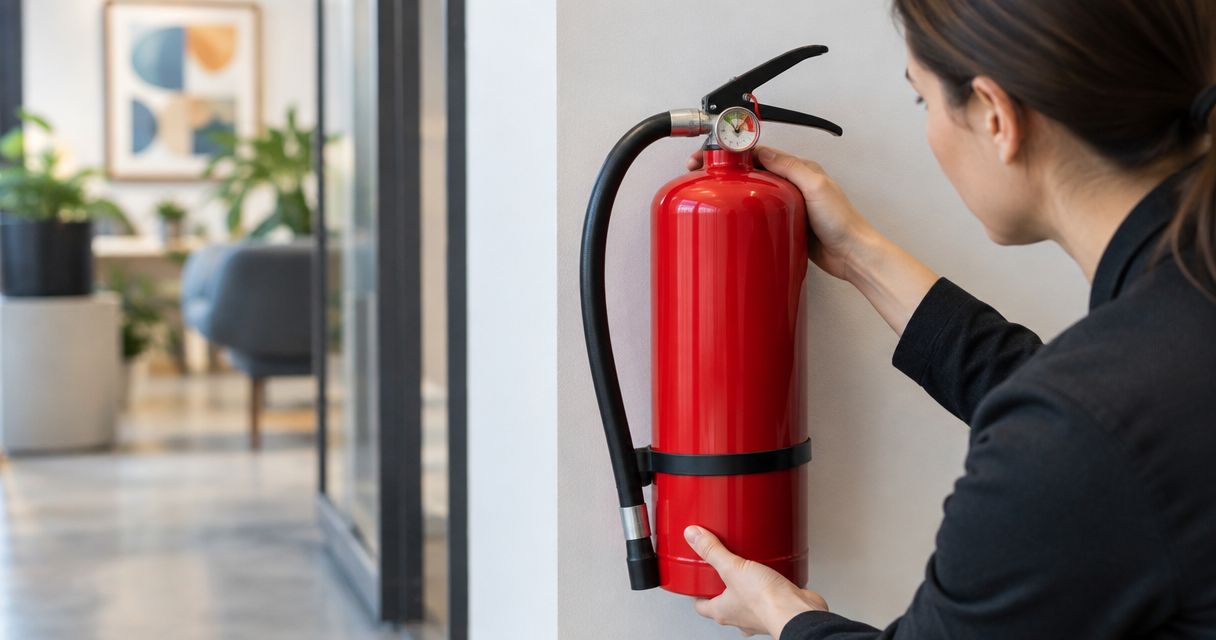
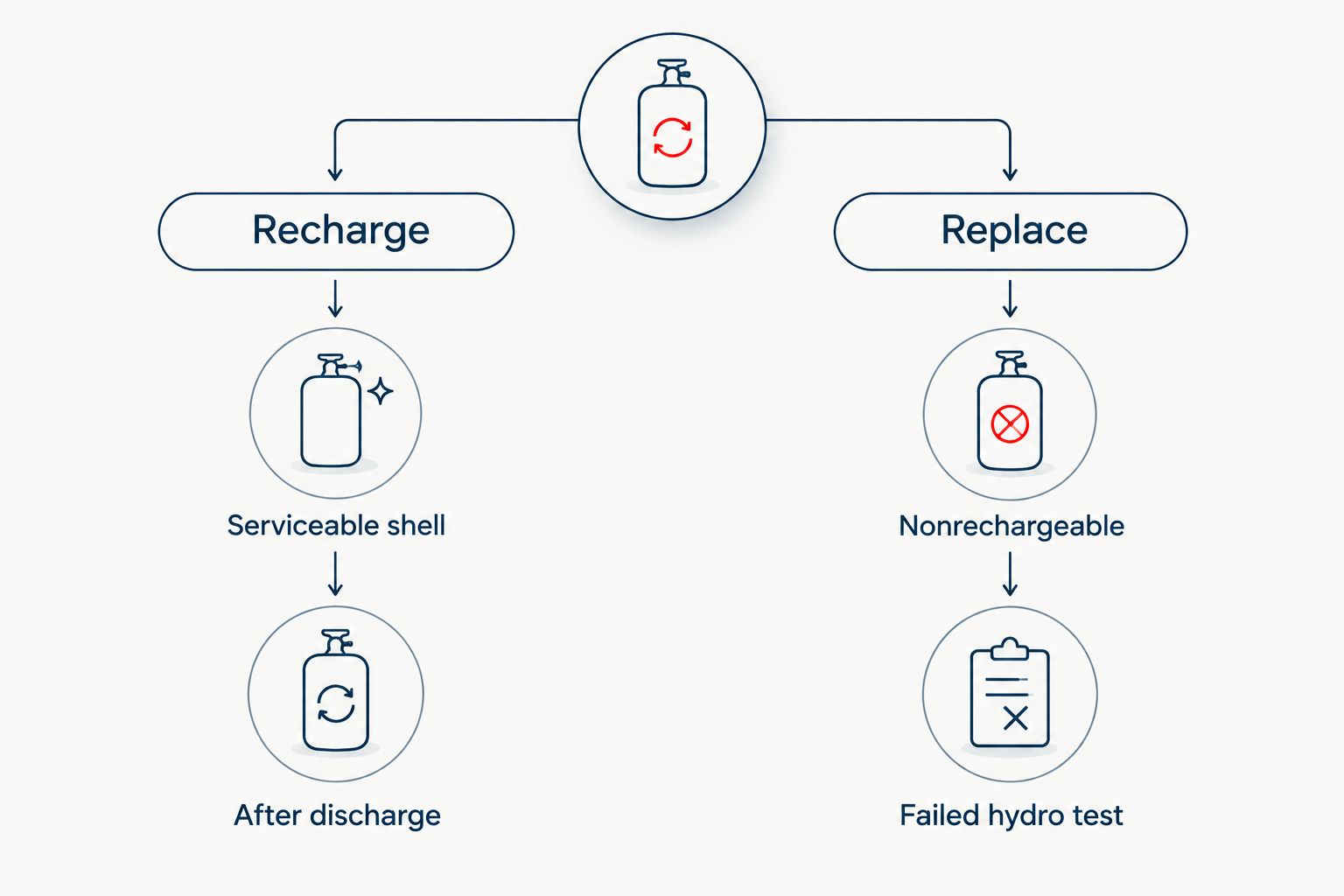
Replace a fire extinguisher when its cylinder is damaged, it fails a hydrostatic test, or it is marked nonrechargeable. Recharge a serviceable, rechargeable extinguisher after it has been used, even briefly. A gauge in the green does not settle the question: the cylinder, label, service history and test status still matter in 2026.
- A fire extinguisher needs replacing instead of recharging when its cylinder fails inspection or hydrostatic testing.
- Recharge a serviceable, rechargeable extinguisher after any discharge, even if the gauge still reads green.
- Firstlinefire is best for businesses that need extinguisher service and hydro testing; a damaged cylinder still needs replacement.
- In 2026, keep a suitable replacement in place while a workplace extinguisher is out for service.
Why this matters
A discharged extinguisher and an unsafe extinguisher can look similar from across a shop floor. The decisions are different. One needs service before it returns to its bracket; the other must come out of service and be replaced.
For a commercial site, the decision also affects coverage while the unit is away. OSHA's portable-extinguisher rule, 29 CFR 1910.157, requires an alternate extinguisher suitable for the hazard and of at least equal rating when one is removed for maintenance or recharging. Firstlinefire provides fire extinguisher sales and service for businesses; that is relevant when a used unit needs evaluation or a failed unit needs replacing.
When does a fire extinguisher need replacing instead of recharging?
Replace it if the extinguisher is nonrechargeable or its cylinder cannot pass the required safety checks. Recharge it if it is a rechargeable unit that remains serviceable. When you cannot establish which condition applies, remove the extinguisher from service and have a qualified service provider evaluate it. Do not use a recharge to work around a damaged shell or a failed hydrostatic test.
| What you find | Next move | Why |
|---|---|---|
| Rechargeable extinguisher discharged, with no identified cylinder defect | Have it inspected and recharged | Discharge calls for service; it does not, by itself, condemn the cylinder. |
| Extinguisher marked nonrechargeable | Replace it after use | It is not designed to be refilled. |
| Cylinder fails hydrostatic testing | Remove it from service and replace it | OSHA requires a failed shell or cylinder to be removed from the workplace. |
| Damage or corrosion raises concern about cylinder integrity | Remove it from service for evaluation; replace it if unfit | Adding agent does not repair the pressure vessel. |
| Service or test date is due, with no identified defect | Arrange the required service or test | A due date calls for evaluation, not automatic replacement. |
| Gauge, hose, pin or seal presents a problem | Remove it from service for inspection | The remedy depends on what inspection finds; replacement is not automatic. |
The table separates a service trigger from a replacement verdict. You can identify an obvious problem during a visual check, but you cannot clear a suspect cylinder by reading its pressure gauge. In 2026, record what was found, take the unit out of service and let the inspection or test determine whether it can return.
Check the label before choosing a route
Look for whether the extinguisher is identified as rechargeable or nonrechargeable. Then check its recorded service and test information. A label or tag that you cannot read is a reason to stop and get the unit evaluated, not a reason to guess its agent, rating or maintenance status.
The correct replacement must suit the fire hazards at that location. A unit that fits the bracket but has the wrong rating does not solve the coverage problem. That matters on a job site, vessel, vehicle or industrial floor where the hazard differs from the one in a nearby office.
When should you recharge a fire extinguisher?
Recharge a rechargeable, serviceable extinguisher after any use. Even a short discharge means the unit needs attention before it goes back into service. Inspection comes first: the provider must determine whether the extinguisher is fit to recharge and whether other maintenance is due.
A low gauge reading is another service signal on an extinguisher equipped with a pressure gauge. It does not tell you why pressure was lost, and it does not prove the cylinder is sound. Some extinguishers do not use the same kind of gauge, so use the unit's label and the service record rather than applying one gauge rule to every type.
A rechargeable extinguisher is best for continued service when its cylinder passes inspection. The advantage is that a used but sound unit can return to its assigned location after proper service. The limit is firm: recharging cannot make an unfit cylinder safe. For a commercial building or fleet in 2026, put a suitable alternate unit in place while the original is out for service.
When must you replace a fire extinguisher?
Replace a nonrechargeable extinguisher after discharge. Replace a rechargeable extinguisher when its cylinder fails hydrostatic testing or is found unfit for further service. Keep these decisions separate from routine service: an inspection finding is not a replacement order until the condition of the unit supports that order.
OSHA's 29 CFR 1910.157(f) sets hydrostatic-testing requirements for portable extinguishers in covered workplaces. A shell or cylinder that fails the test must come out of service and out of the workplace. The test addresses the pressure vessel; it is not a refill, and a refill cannot reverse its result.
Damage deserves the same stop-and-check response. Look for dents, corrosion or other signs that the shell needs professional evaluation. Do not decide from a photograph, a green gauge or the fact that the extinguisher has never been discharged. In 2026, the practical rule is simple: a suspect cylinder stays out of service until it is cleared or replaced.
A nonrechargeable extinguisher is best treated as a replace-after-use unit. It avoids the question of refilling, but it cannot be returned to service by topping it up. A rechargeable extinguisher allows service after discharge, but only while it remains fit for use. Neither option is better for every location; the hazard and the required rating still control what belongs there.
Does an overdue service date mean replacement?
No. An overdue service date means the extinguisher needs the applicable maintenance or test. It does not automatically mean the cylinder has failed. If that work finds the unit unfit, replace it. If the unit passes and is otherwise serviceable, the required maintenance can be completed instead.
For covered workplaces, OSHA requires a visual inspection each month and an annual maintenance check. Certain stored-pressure dry-chemical extinguishers also require 6-year maintenance, while hydrostatic-test intervals depend on extinguisher type. Under OSHA's schedule, carbon dioxide extinguishers are tested at 5-year intervals and listed dry-chemical types at 12-year intervals. These are service requirements, not blanket expiration dates.
Check the actual unit and its records before applying an interval. A missing record leaves a question that needs service review; it does not prove the extinguisher is safe or condemned. In 2026, treat the due date as an instruction to act, not as a substitute for the test result.
Why the replace-or-recharge decision varies
The answer follows the condition and design of the specific extinguisher, not its age alone. These factors change the next step:
- Rechargeable or nonrechargeable design. A unit marked nonrechargeable is replaced after use. A rechargeable unit can be serviced if it remains fit.
- Cylinder condition. Damage or corrosion calls for evaluation. A shell that cannot be cleared does not go back into service.
- Hydrostatic-test result. A due test calls for testing; a failed test calls for removal and replacement.
- Discharge history. Any use calls for service, even when the unit appears to contain agent. Discharge alone does not establish that a rechargeable cylinder has failed.
- Agent and extinguisher type. The applicable maintenance and test schedule depends on the unit. Do not apply one interval to every extinguisher in a building or fleet.
- Assigned hazard and rating. When a unit leaves its station, the alternate must protect the same hazard at an adequate rating. A convenient spare is not enough if it is the wrong type.
This is why a site-wide instruction to replace every used extinguisher wastes serviceable units, while an instruction to recharge every used extinguisher misses failed cylinders. The decision has to follow the unit. For a business with extinguishers across vehicles, vessels or multiple facilities, record each unit's status and keep the assigned location covered during service.
Can you recharge an extinguisher with a damaged cylinder?
No. Do not recharge an extinguisher whose cylinder is suspected to be unsafe. Remove it from service and have its condition assessed. If it is unfit or fails hydrostatic testing, replace it; a refill changes the contents, not the strength of the cylinder.
Do not use the pressure gauge as a shortcut. Its reading does not clear a dent, corrosion or a failed test. In a 2026 workplace inspection, the finding to record is the visible condition and the action taken, not an assumption that pressure means the unit is ready.
Can you keep using an extinguisher while it awaits testing?
Do not treat an extinguisher awaiting required testing as cleared for continued service. Arrange the test and maintain suitable coverage while the unit is out of service. The test result determines whether the cylinder can return; the passage of a due date does not provide that answer.
For a covered workplace, plan the swap before removing the extinguisher from its station. OSHA's alternate-extinguisher requirement applies when a unit is removed for maintenance or recharging. In 2026, that makes replacement coverage part of the service job, not an afterthought.
Get the extinguisher checked
Arrange extinguisher service or hydro testing for your business.
FAQ
When does a fire extinguisher need replacing instead of recharging?
Replace it when it is nonrechargeable, fails hydrostatic testing or is found unfit for service. Recharge a rechargeable unit only after it has been found serviceable.
Do you replace a fire extinguisher after one use?
Replace a nonrechargeable extinguisher after use. A rechargeable extinguisher needs inspection and service after any discharge, but use alone does not mean its cylinder must be replaced.
Does a green gauge mean a fire extinguisher can be recharged?
No. A green gauge does not establish that the cylinder is sound or that required maintenance is current. The unit still needs the appropriate inspection before recharging.
Does an expired fire extinguisher have to be replaced?
A past service or test date does not automatically require replacement. The unit needs the applicable maintenance or test, and the result determines whether it can return to service.
What happens if a fire extinguisher fails a hydrostatic test?
A fire extinguisher that fails hydrostatic testing must be removed from service and replaced. OSHA requires a failed shell or cylinder to be removed from the workplace.
How often should a workplace fire extinguisher be checked?
OSHA requires visual inspection each month and an annual maintenance check for covered workplaces. Additional maintenance and hydrostatic-testing intervals depend on the extinguisher type.
Can a business leave an extinguisher station empty during recharging?
A covered workplace must provide a suitable alternate extinguisher of at least equal rating when one is removed for maintenance or recharging. Match the alternate to the hazard at that station.
One last thing
The decision is not used versus unused. An unused extinguisher can fail a required test, while a discharged rechargeable unit can return after proper service. Firstlinefire is best for businesses coordinating extinguisher service and hydro testing across sites; a unit found unfit still needs replacing. Keep the service record with the decision, and keep a suitable extinguisher at the station while work is done.


