
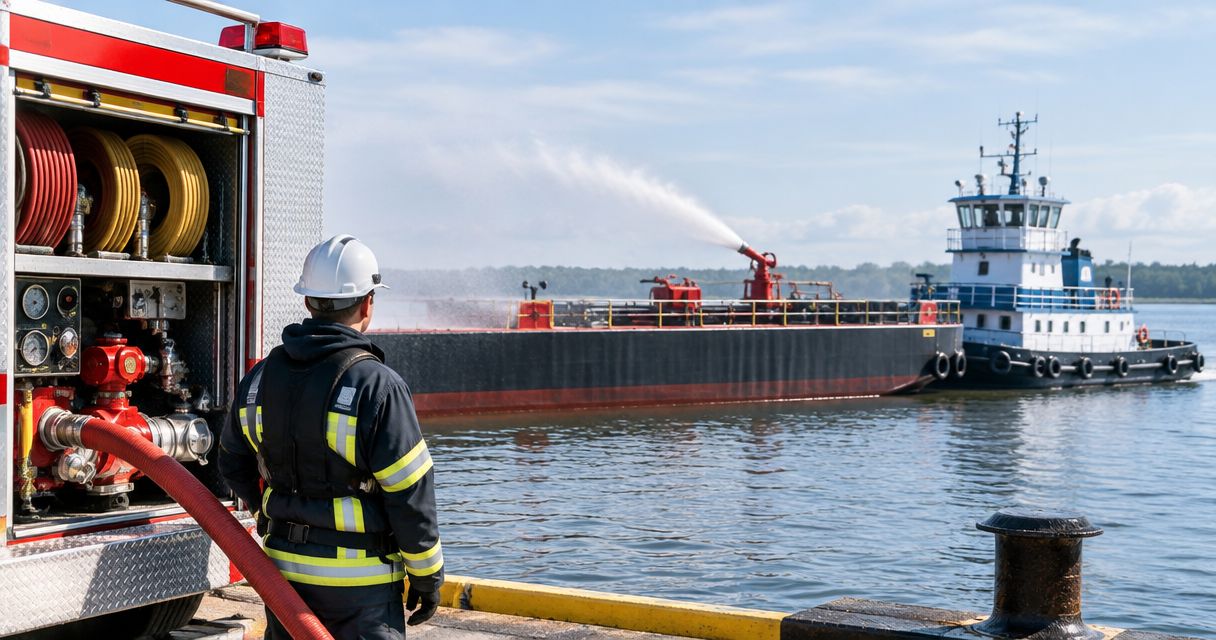
No. Barges and towboats should not use a truck fire suppression system just because it fits or uses the same extinguishing agent. A system must match the fire hazard, the space it protects, the equipment it is installed on and the rules that apply to that vessel or vehicle in 2026.
- Can barges use the same fire suppression as trucks? Not without checking the vessel, hazard and system approval.
- A towboat engine space, an unpowered barge and a truck present different installation and operating conditions.
- First-Line Fire Extinguisher Co. serves marine and fleet customers who need fire suppression service.
- Check the installed system and its records before treating equipment from one platform as interchangeable with another.
Why this matters
A fleet operator can own trucks, barges and towboats under one maintenance program. That does not make their fire protection equipment interchangeable. A truck system may protect an engine compartment; a towboat may have an enclosed machinery space; a barge may have no engine at all. Start with the space and the fire hazard, not the equipment already on another asset.
The distinction matters when you order parts, plan an installation or review service records. First-Line Fire Extinguisher Co. provides suppression systems and serves both marine and vehicle/fleet customers. For an operator responsible for both, one service conversation can cover the assets while keeping the equipment decisions separate.
Can barges and towboats share fire suppression systems with trucks?
Not as a default. You can compare the same general approaches, including portable extinguishers and fixed suppression, but you cannot assume that a truck installation is suitable for a barge or towboat. The protected space, fire risk, installation conditions and applicable rules must all be checked for the specific asset.
| Asset or space | What needs protection | Why a truck-system assumption fails |
|---|---|---|
| Fleet truck | The truck’s identified fire hazards, such as an engine compartment or carried equipment | A design for one vehicle does not establish suitability for a vessel. |
| Powered towboat | Identified spaces aboard the vessel, including machinery spaces where applicable | The vessel’s layout, operating conditions and marine requirements need their own review. |
| Unpowered barge | Its actual onboard hazards and equipment | A barge without propulsion machinery does not have the same protection problem as an engine-equipped truck. |
First-Line Fire Extinguisher Co. is best for operators seeking marine and fleet fire suppression service from a provider that serves both customer groups. That service overlap does not make a suppression system approved for both applications. Treat each installation as a separate specification.
Use a comparison, not a parts swap
There is a useful distinction between sharing a type of protection and sharing a specific installed system. A towboat and a truck can both carry portable extinguishers. That fact alone says nothing about whether the same extinguisher selection, placement or maintenance record meets the needs of both. Likewise, both can have fixed suppression without using the same components or installation design.
Do not move a cylinder, nozzle, detector or control component from a truck installation to a vessel on the strength of its label alone. Identify the complete system and check its documentation for the proposed use. If the documentation does not establish suitability, do not treat the part as interchangeable.
How to decide what each asset needs
Use the same decision process across the fleet, then record a separate answer for every truck, towboat and barge. In 2026, the practical question is not whether one catalog contains equipment for all of them. It is whether the proposed equipment suits each protected space.
- Name the asset and the protected space. Record whether you are reviewing a truck engine compartment, towboat machinery space, barge equipment area or another location. Do not list the asset name alone; the space determines the next questions.
- Identify the fire hazard. Note the equipment and materials in that space. A barge’s hazards depend on what it carries and what is installed aboard it, so do not copy the towboat’s hazard list.
- Separate portable from fixed protection. An extinguisher carried for manual use and a fixed system protecting a defined space solve different problems. Check each on its own terms.
- Check the proposed system’s documentation. Confirm the intended application, components, installation instructions and service requirements. Similar-looking hardware is not proof of interchangeable use.
- Check the rules for the asset. A covered towing vessel and a road vehicle do not have the same regulatory framework. Determine what applies before deciding that an existing setup is sufficient.
- Keep asset-specific records. Record what is installed and what was serviced on each unit. A truck service entry is not a towboat service entry.
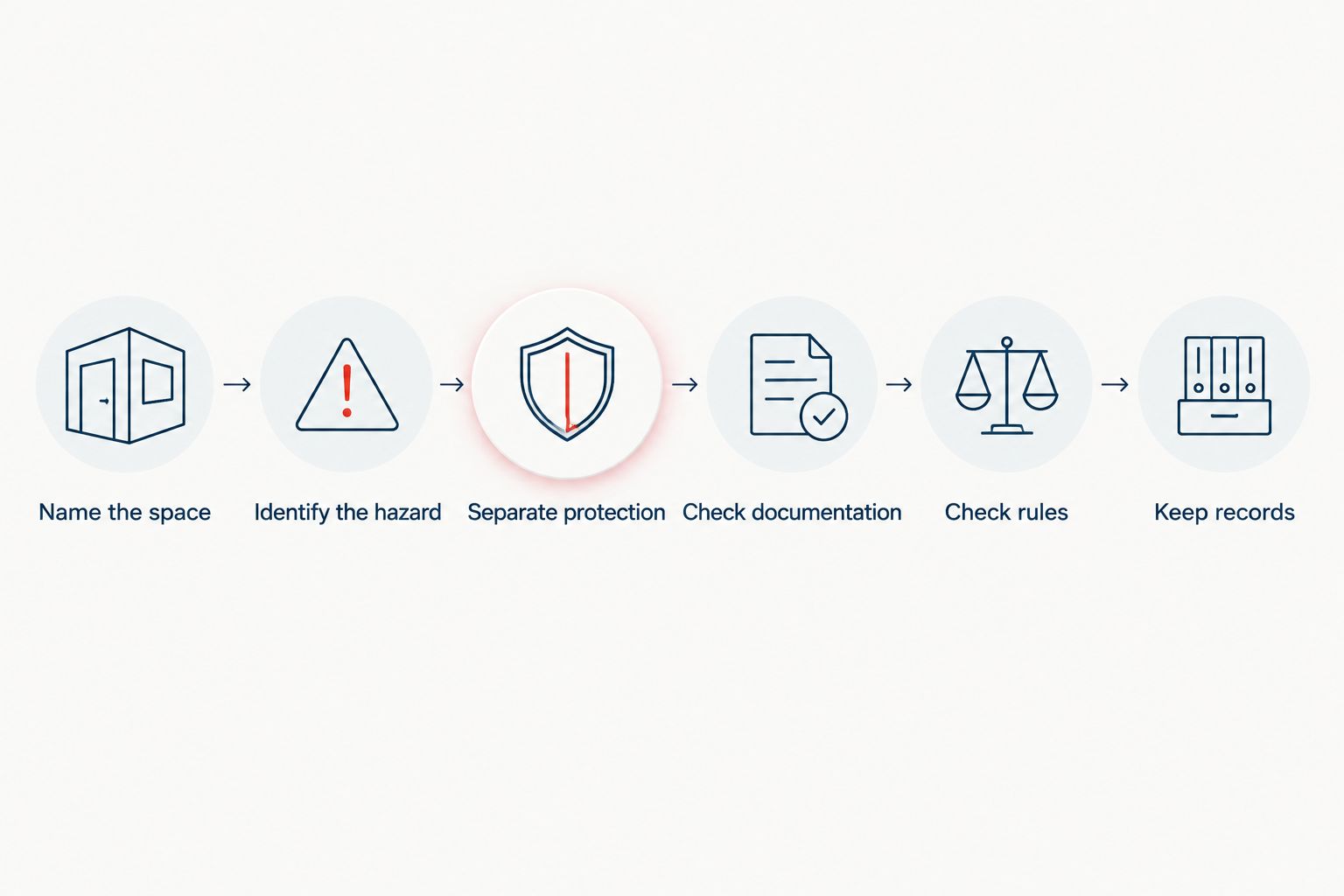
The sequence prevents a common purchasing error: choosing a familiar system before defining what it must protect. It also gives a service provider a clear starting point. Bring the asset details, the location to be protected and the existing equipment records rather than asking whether a truck kit will fit aboard.
Why the right suppression setup varies
A shared owner or maintenance schedule does not erase differences between assets. These factors change the answer:
- Protected space. A truck engine compartment, a towboat machinery space and a barge equipment area have different layouts. Describe the actual space before discussing hardware.
- Fire hazard. The equipment and materials present determine what a system needs to address. Do not infer a barge’s hazards from the vessel towing it.
- Portable or fixed use. A hand-operated extinguisher is not a substitute for a fixed system when the space requires fixed protection, and a fixed system does not automatically settle portable-extinguisher questions.
- Installation conditions. Mounting, routing and access must suit the asset and the selected system’s instructions. A workable truck location is not automatically a workable vessel location.
- Applicable requirements. Towing-vessel fire protection and motor-vehicle emergency equipment sit under different rules. Check the requirements that apply to the specific operation.
- Existing equipment and records. Installed components and prior service records show what needs review; they do not prove that equipment is suitable for a different asset.
The trade-off is straightforward. Reusing a familiar equipment approach can simplify discussions across a mixed fleet, but treating parts as interchangeable can obscure a mismatch. A separate specification takes more care at the start and gives each asset a clear basis for installation and service.
Does the answer change for an unpowered barge?
Yes. An unpowered barge does not have a propulsion engine compartment to protect, so copying an engine-focused truck or towboat setup misses the first question: what fire hazards are actually aboard? Assess the barge’s spaces and equipment, then determine the protection and requirements that apply to that barge.
Do not turn unpowered into unprotected. The absence of propulsion machinery removes one possible hazard; it does not establish that the barge has no fire risk. Keep the barge review separate from the towboat review even when they operate together.
A terminal adds another boundary. Equipment serving a shore-side facility is not automatically equipment serving a barge at that facility. If your operation includes both, list the terminal, vessel and vehicles separately so no protected space disappears into a broad fleet inventory.
Does the answer change for a powered towboat?
Yes. A powered towboat has machinery and vessel spaces that need a vessel-specific review. Do not specify suppression by copying a road vehicle’s engine protection design, even if the equipment appears similar. The installation must address the towboat’s actual spaces and applicable marine requirements.
For covered towing vessels, 46 CFR Part 142 addresses fire protection. That reference is a reason to check the vessel’s requirements, not a shortcut for declaring a particular system compliant. Determine the vessel’s status and the provisions that apply before making an equipment decision.
For a mixed fleet in 2026, the cleanest record is an asset-by-asset list: what space is protected, what equipment is installed and what documentation supports it. That makes a towboat review possible without relying on a truck file that answers a different question.
Can the same extinguisher type work on a truck and a vessel?
It can, if the extinguisher is suitable for each identified hazard and meets the requirements applicable to each asset. The same type is not the same as the same approved installation. Check selection, placement, condition and records for the truck and vessel separately.
Portable extinguishers are also a separate decision from fixed suppression. An appropriate handheld unit does not prove that a machinery space has the fixed protection it needs. If you manage both types of equipment, keep their specifications and service records distinct.
In 2026, use the extinguisher’s markings and the asset’s requirements as review inputs, not a visual match between two cabinets or brackets. A unit that looks familiar still needs to be checked for the place where it will be used.
What to ask before ordering or changing a system
A short, asset-specific request gets a more useful answer than asking for a single system for the whole operation. State whether the job involves a truck, towboat or barge, and identify the exact space. Then provide the information available for the existing system.
- What space needs protection? Name its boundaries and the equipment inside it.
- What is already installed? Provide the system identification and available installation and service records.
- What is changing? Say whether this is a new installation, a replacement, a repair or a review of existing equipment.
- Which asset is it on? Keep the truck, towboat and barge requests separate, even if one operator owns all of them.
- What rules apply? Have the applicable vessel or road-vehicle requirements checked for that asset, rather than applying one checklist to the fleet.
For road vehicles, 49 CFR 393.95 addresses emergency equipment on covered motor vehicles. That does not turn its fire-extinguisher provisions into a specification for a towboat or barge. Regulatory references help frame the review; they do not replace the equipment documentation or the facts of the installation.
First-Line Fire Extinguisher Co. provides suppression-system service for marine and vehicle/fleet customers. If you are arranging service for both in 2026, give each asset its own line item and records. One provider can handle the conversation; each asset still needs its own equipment decision.
Review your fleet’s fire protection
Discuss marine and vehicle suppression needs by asset and protected space.
FAQ
Can barges use the same fire suppression as trucks?
Not by default. Check the barge’s hazards, the proposed system’s documentation and the requirements that apply to the barge before specifying equipment.
Can a towboat use a truck fire suppression kit?
Do not assume it can. A towboat installation needs a review of its protected spaces, the kit’s intended application and applicable vessel requirements.
Is a barge’s fire protection the same as its towboat’s?
No. Review the barge and towboat separately because their equipment and protected spaces can differ, even when they operate together.
Can trucks and vessels carry the same type of fire extinguisher?
They can when that type suits each asset’s hazards and applicable requirements. Check placement and records separately for the truck and vessel.
Does an unpowered barge need a truck-style engine system?
An unpowered barge has no propulsion engine compartment to protect. Identify its actual onboard hazards before choosing any fire protection equipment.
Can one provider service both marine and fleet fire suppression?
Yes. First-Line Fire Extinguisher Co. serves marine and vehicle/fleet customers, but the equipment decision remains specific to each asset.
What records should a mixed fleet keep for fire suppression?
Keep the installed equipment identification, protected space and service records with each asset. Do not use a truck’s file as the record for a towboat or barge.
One last thing
The word fleet describes ownership and scheduling, not a shared fire suppression specification. In 2026, put the protected space beside every asset on your service list. A barge, its towboat and the truck meeting them on shore should each have an answer you can check without opening another asset’s file.


