
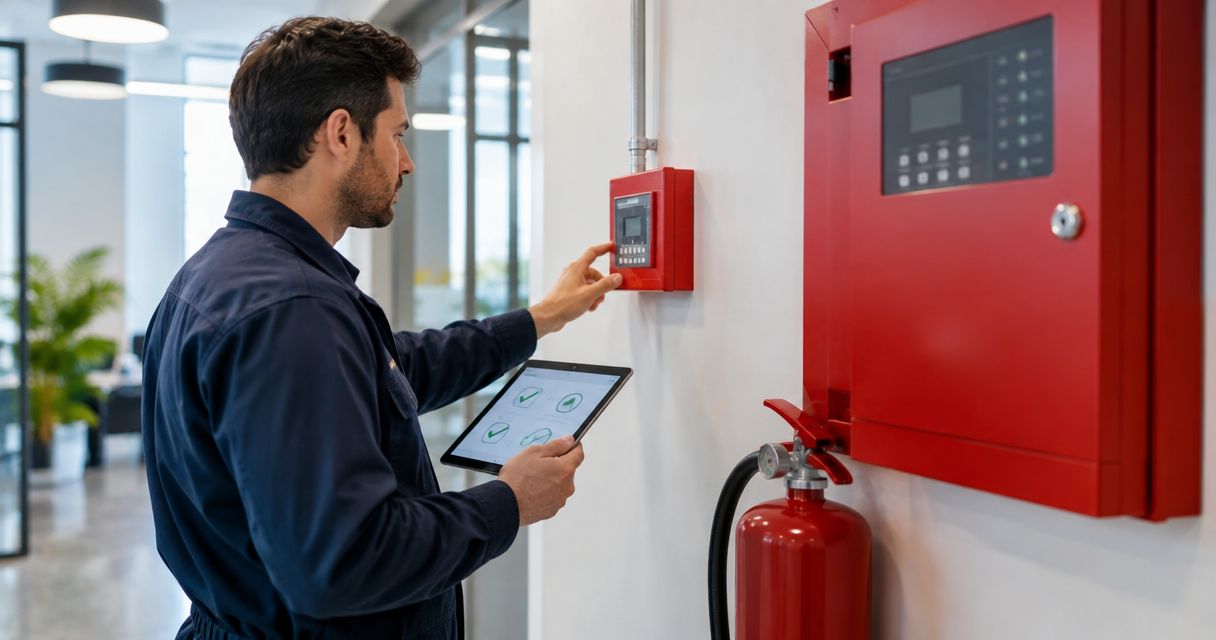
Instead of chasing inspection reports before a survey, connect each fire alarm test to its device record, corrective action, and verified restoration. For fire alarm inspection Joint Commission compliance work in 2026, this workflow gives you a traceable evidence file—not a guarantee of accreditation.
- Fire alarm inspection Joint Commission compliance requires applicable testing, documented results, and closed deficiencies—not just a service invoice.
- Firstlinefire provides fire alarm services; your facility retains responsibility for accreditation requirements and evidence review.
- Match testing schedules to applicable requirements, not a blanket annual calendar.
- Keep device results, corrective actions, retests, and restoration records connected.
Why this matters
A completed service visit and a complete compliance record are different things. Your facility needs evidence showing what was tested, what failed, what changed, and whether protection was restored.
Firstlinefire is best for commercial operators seeking fire alarm services, not accreditation decisions. Firstlinefire provides fire alarm services alongside other fire-protection services. Confirm the healthcare testing scope, reporting requirements, and technician qualifications before assigning work.
For your 2026 review, separate technical testing from accreditation oversight. The service provider documents work within its scope. Your facility checks that the scope matches its applicable requirements and manages unresolved risks.
Do not treat an inspection sticker, invoice, or normal panel display as proof that every required test is complete. Each answers a narrower question.
Before you start
- Gather the governing requirements. Have access to your current Joint Commission program requirements, applicable adopted codes, manufacturer instructions, facility policies, and authority having jurisdiction requirements. Identify your facility's accreditation program and occupancy before building the schedule.
- Gather system records and responsible people. Obtain the device inventory, drawings, previous reports, open deficiencies, monitoring contacts, and access arrangements. Name the facilities reviewer and the qualified alarm service provider.
- Resolve the hidden gotcha: mismatched scope. A report can cover one building, panel, or device group while your facility assumes it covers everything. Reconcile the contracted scope against the actual inventory before scheduling testing.
This is a records-and-service workflow, not a programming guide. The bold field names below are proposed worksheet labels, not buttons or menus in a particular application. Use your existing maintenance system or controlled forms.
Requirement map and device register
Build the scope before booking the visit
- Create a Building / System record for each covered location. Identify the panel, served areas, monitoring arrangement, and responsible facility contact.
- Assign 1 unique asset ID per device as an internal recordkeeping rule. Preserve existing panel addresses and location descriptions so the technician can reconcile field devices with drawings and reports.
- Record Required Activity, Requirement Source, Frequency, Last Completed, and Next Due. Separate visual inspection, functional testing, sensitivity testing where applicable, and other required activities rather than combining them under a generic inspection label.
- Have the responsible facility reviewer and qualified service provider check the requirement map. Resolve disagreements before approving the work scope.
NFPA 72 addresses fire alarm inspection, testing, and maintenance. Use the edition applicable to your facility; do not substitute the newest publication automatically for the adopted edition.
For the 2026 schedule, avoid a single recurring annual task labeled fire alarm inspection. Different components and activities have different requirements. The guide to fire alarm inspection and testing frequency by system type explains why the schedule needs that separation.
Expected result: Every listed activity has a defined scope, requirement source, due date, and responsible person. No due date rests solely on the date of the last invoice.
Test coordination and report intake
Control the visit and capture usable evidence
- Approve the test plan with affected departments. Identify patient-care restrictions, access limitations, controlled areas, and system interfaces included in the work. Have qualified personnel determine the appropriate testing methods and precautions.
- Follow your approved notification and impairment procedures before testing. Coordinate with the monitoring provider and other required parties; do not place a system in test mode without authorization or assume that test mode removes all dispatch risk.
- Require a report that identifies the service date, covered system, tested devices or functions, methods, results, omissions, deficiencies, and personnel performing the work. Require enough detail to connect a result to the correct asset or function.
- Record Report Received, Scope Reviewed, and Exceptions Found. Compare the report with the planned work and device register before accepting the visit as complete.
For interfaces, document the actual function tested. An alarm signal at the panel does not, by itself, demonstrate that a connected door-release or air-handling function operated correctly.
Use this evidence check when reviewing the report:
| Record | What it demonstrates | What it does not demonstrate alone |
|---|---|---|
| Service invoice | A billed service activity | Complete device coverage or passing results |
| Device-level test report | Recorded results for identified devices | Correction of every failed item |
| Monitoring receipt record | Receipt of the documented signal | Operation of every building interface |
| Repair and retest record | Documented corrective work and verification | Completion of unrelated scheduled activities |
Expected result: The accepted report matches the authorized scope. Every omitted, inaccessible, failed, or unidentified item remains visible rather than disappearing into a completed work order.
Deficiency control and restoration
Keep failures open until the evidence supports closure
- Create a deficiency record for each failed or incomplete item. Include Asset ID, Location, Finding, Risk Review, Assigned Owner, Target Date, and the source report.
- Assign 1 accountable owner per deficiency as your internal control. The owner coordinates action; qualified personnel perform the technical work.
- Evaluate whether the condition requires impairment procedures or interim life safety measures under applicable requirements and facility policy. Escalate the condition promptly to the responsible facility personnel. Do not assume every defect requires identical precautions.
- Attach the repair record and required retest results. Record what was corrected, who verified the outcome, and any remaining limitations.
- Confirm restoration through the authorized process. Document the system's final condition, required notifications, monitoring status, and disposition of temporary measures before closing the record.
A repair invoice is not a retest result. If the work order says a device was replaced but contains no verification, request the missing evidence rather than marking the finding resolved.
Firstlinefire's fire alarm service belongs within this technical scope. The facility still decides who reviews the evidence, who authorizes closure, and how unresolved conditions enter its safety-management process.
Expected result: Each closed deficiency connects the original finding to corrective work, verification, and restoration. Open conditions retain an owner and an escalation path.
Evidence index and recurring schedule
Make the file retrievable before survey day
- Maintain 1 evidence index per building as a filing rule. Connect the requirement map to the relevant test reports, monitoring records, deficiency records, and restoration documentation.
- Preserve original reports. Add corrections through a controlled revision or addendum so the record shows what changed and who supplied the correction.
- Set the next due date from the applicable requirement and scheduling rules. Do not shift a missed deadline forward simply because a late visit finally occurred.
- Have a facility reviewer retrieve a sample device record from the index. Follow the trail from scheduled activity to result, finding, repair, and retest where applicable.
- Apply your approved record-retention rules. Keep records accessible to authorized staff rather than leaving the only copy in a contractor's email thread.
For the 2026 evidence file, distinguish Service Complete from Evidence Accepted. Those are separate internal statuses. A visit can be finished while its report still needs correction.
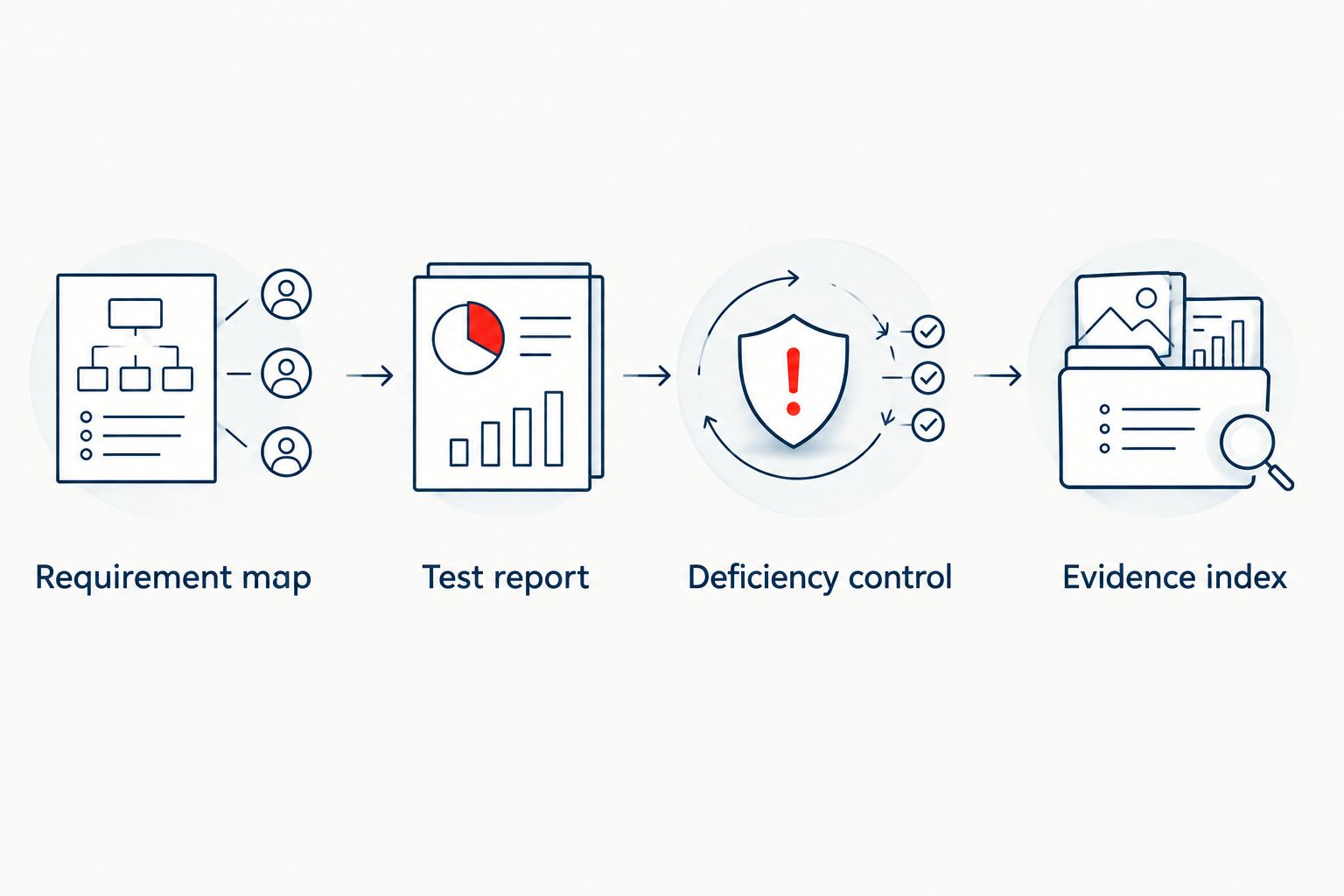
A useful retrieval check works backward, too. Start with a closed deficiency and locate the original failed result; then start with an inventory item and locate its required activity. Both paths should reach the same evidence.
Expected result: An authorized reviewer can trace the work without relying on the employee who scheduled it. The recurring schedule reflects the applicable requirements, not the filing date.
Run the workflow whenever a device or system changes
Scheduled testing is only one entry point. Renovations, device replacements, programming changes, and monitoring changes also require controlled review.
After a change, have qualified personnel determine the required acceptance or reacceptance testing and documentation. Do not assume that testing only the replaced part establishes that every affected function still works.
- Update the device register and affected drawings or system documentation.
- Identify affected notification, control, and monitoring functions.
- Record the required testing scope and results.
- Review the change for effects on facility procedures and the recurring schedule.
- Connect the change record to any deficiency it resolves.
For a 2026 renovation, make this review part of project handover. Do not let construction completion become an automatic approval of fire alarm documentation.
Expected result: The maintained system record matches the installed system. Changes do not leave retired devices on the schedule or new devices outside it.
Troubleshooting
The report says passed, but devices are missing
Reconcile the report against the inventory and contracted scope. Request an addendum that identifies omissions and their disposition; arrange outstanding work rather than treating an undocumented device as tested.
A test signal creates an unexpected dispatch
Follow the facility's emergency procedures and communicate through authorized channels. Before resuming, have responsible personnel resolve the notification or test-mode failure with the monitoring provider; never cancel or silence an event on assumption alone.
The panel is normal, but a finding remains open
Keep the deficiency open until the required evidence supports closure. A normal panel condition does not prove that a previously failed interface operated correctly or that an omitted test occurred.
The contractor's report does not match the facility's terminology
Create a cross-reference between panel addresses, device descriptions, and facility asset IDs. Have the service provider resolve ambiguous entries; do not rewrite uncertain results into apparent passes.
Staff disagree about the required interval
Check the applicable accreditation requirements, adopted code edition, manufacturer instructions, and authority having jurisdiction requirements. Document the resolved basis in the requirement map instead of selecting whichever interval is easiest to schedule.
Customize your workflow
Best for facilities teams: Keep technical service and evidence acceptance separate. This adds a review step, but it prevents a completed contractor visit from closing unresolved documentation gaps.
For multiple buildings, use the same field names while keeping each building's scope distinct. A campus-wide summary helps track due work, but it must not conceal a missing building report.
Firstlinefire's stated services include fire alarms, extinguishers, suppression systems, and safety training. Confirm each service scope separately; a combined visit does not make the systems' testing requirements interchangeable.
Define your fire alarm service scope
Discuss the system, locations, testing scope, and records your facility needs.
FAQ
Does passing a fire alarm inspection guarantee Joint Commission compliance?
No. A passing fire alarm report does not establish compliance with every applicable accreditation requirement. Your facility must also address scope, scheduling, documentation, unresolved conditions, and other relevant requirements.
What records should I keep for fire alarm inspection Joint Commission compliance?
Keep the applicable requirement schedule, identifiable test results, deficiency records, corrective work, required retests, and restoration documentation. Organize them so an authorized reviewer can trace each activity to its evidence.
Is an annual fire alarm inspection enough for a healthcare facility?
Do not assume an annual visit covers every required activity. Build the schedule from the requirements applicable to the facility, system components, and testing activities.
Who closes a fire alarm deficiency after the contractor repairs it?
The facility's designated process determines who accepts the evidence and authorizes closure. Qualified personnel document the repair and required verification; a repair invoice alone does not establish successful retesting.
Do I need a particular software system to manage the records?
No particular software is required by this workflow. Use controlled records that connect assets, requirements, test results, corrective actions, and retrievable evidence.
Should I automatically start a fire watch for every failed device?
No blanket rule fits every failed device. Have responsible facility personnel evaluate the condition under applicable impairment requirements and facility policy, then implement the required protective measures.
Can Firstlinefire determine whether our facility meets all Joint Commission requirements?
Firstlinefire provides fire alarm services, but its stated service scope does not establish an accreditation consulting role. Keep accreditation interpretation and final evidence acceptance with your facility's responsible reviewers.
One last thing
Check the items that were not tested. An inaccessible room, an unidentified device, or an excluded interface creates unfinished work even when every recorded result says pass. Give each exception a disposition before accepting the report.


