
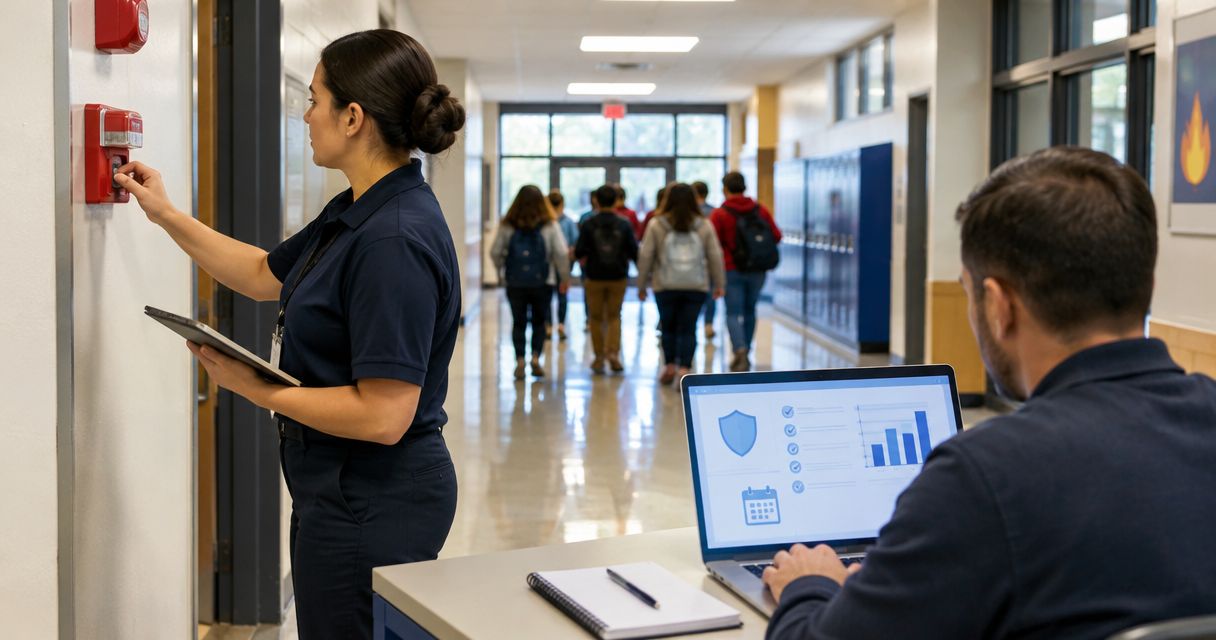
Instead of manually chasing test reports and rebuilding drill dates, connect your fire alarm testing records to a school fire drill schedule with named owners, approval checks, and separate completion records. Use a shared register to coordinate the work—not to treat an alarm test as a completed evacuation drill.
- Connect fire alarm testing school fire drill schedule records, but keep equipment testing and evacuation drills separate.
- Firstlinefire provides fire alarm and safety training services; school staff should own drill scheduling and attendance accountability.
- Confirm local drill requirements before setting calendar recurrence for 2026.
- Close each event with evidence: a test report for equipment, a drill record for evacuation performance.
Why this matters
A technician checks equipment operation. A school drill checks how people evacuate and account for occupants. Linking the dates helps you coordinate access and staffing, but neither record replaces the other.
Firstlinefire is best for facilities teams seeking fire alarm and safety training services. Start with Firstlinefire for the service side, and assign a school administrator to own the evacuation calendar and drill records.
For your 2026 plan, keep the distinction visible. A calendar marked complete should tell you exactly what happened, who confirmed it, and where the supporting record lives.
Before you start
- Collect the requirements and records. Gather the current emergency plan, campus calendar, alarm inspection reports, unresolved deficiencies, and applicable drill requirements. Confirm those requirements with district leadership and the authority having jurisdiction, or AHJ—the official responsible for interpreting and enforcing applicable fire requirements.
- Assign access and ownership. Give the facilities lead, school administrator, and designated backup access to a shared register and calendar. Identify the alarm service contact, monitoring contact where applicable, and staff responsible for evacuation assistance and occupant accountability.
- Resolve the monitoring gotcha first. A planned alarm activation can transmit a signal to a monitoring center. Confirm the authorized notification, test, restoration, and verification procedure before scheduling activation; a school calendar invitation does not notify monitoring personnel.
Do not copy another school's recurrence into your calendar. Drill obligations depend on the applicable rules, and alarm inspection and testing intervals depend on the system, components, and adopted requirements.
Configuration unit: the campus requirements register
Use a spreadsheet, shared list, or existing facilities system. The bold labels below are fields you create, not buttons or built-in settings in a particular software product.
Establish the record structure
- Create Campus, Building, Event type, Requirement source, Owner, Backup owner, Due date, Status, and Evidence fields. Use a separate row for each event so one completion cannot hide another unfinished task.
- Set Event type to distinguish equipment testing from evacuation drills. Keep 2 records when both occur on the same day: one test record and one drill record.
- Enter the applicable requirement in Requirement source. Record the issuing authority, document or instruction, date checked, and relevant section when available. Do not enter a remembered interval without checking it.
- Record the next required event dates. Build the 2026 calendar from confirmed obligations, then check school closures, examinations, transportation activity, and building access.
- Add Open deficiencies and Approval notes. Link supporting files within your own document system, using access permissions that protect student and staff information.
Expected result: Every event has a requirement source, accountable owner, due date, and evidence location. Missing information remains visible instead of becoming an unsupported calendar assumption.
Keep the records distinct
| Record | Best for | What it documents | Strength | Limitation |
|---|---|---|---|---|
| Alarm testing record | Facilities staff and alarm technicians | Equipment tested, results, deficiencies, and restoration | Preserves technical evidence | Does not demonstrate occupant evacuation or accountability |
| School drill record | Administrators and emergency-plan coordinators | Drill conditions, evacuation observations, accountability, and follow-up | Documents staff and occupant performance | Does not replace technical alarm testing |
| Shared coordination register | Staff managing both activities | Owners, dates, dependencies, and supporting records | Makes handoffs visible | Requires updates; it does not establish compliance by itself |
Use the shared register to coordinate, not certify. A completed row means only what its attached evidence supports.
Configuration unit: the testing handoff
The alarm test should produce a usable handoff, not just a calendar reminder that disappears. Have the facilities lead coordinate technical work with the service provider and school administration.
Prepare and close the test event
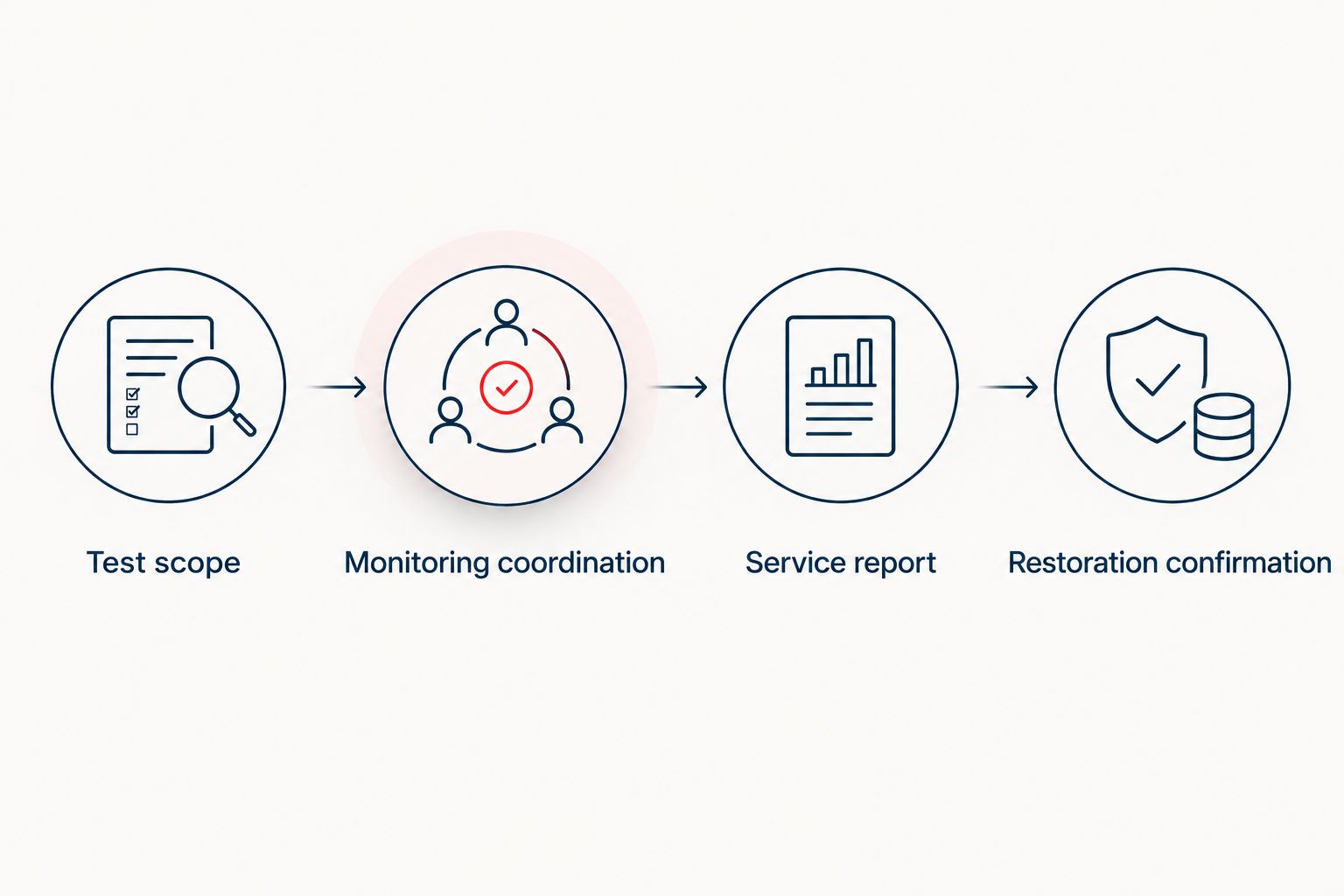
- Add Test scope, Service contact, Affected areas, Access needs, and Monitoring coordination to the test record. Have the qualified service provider define the technical scope; school staff should not improvise panel programming or device testing.
- Confirm the work window with the administrator. Identify occupied areas and explain how planned testing differs from an actual emergency notification under the school's approved procedures.
- Confirm who is authorized to coordinate with the monitoring center and other required parties. Record the agreed procedure and responsible person. Do not assume the technician, office staff, and monitoring provider have notified one another.
- Obtain the service report after testing. Enter the completion date, technician or company details shown on the report, results, and unresolved items. Preserve the report itself rather than summarizing everything as passed.
- Record restoration confirmation from the responsible qualified person. Address impairments through the school's approved procedure and AHJ direction; do not clear them simply to release a calendar event.
Expected result: The test record shows what was tested, what remains unresolved, and whether normal operation was restored. School staff can review the handoff without interpreting technical shorthand from memory.
For 2026 scheduling, make report review an assigned task. A visit date alone does not establish that every deficiency was corrected.
Configuration unit: the drill calendar
A school's drill calendar needs its own approval path. Equipment service informs the plan, but the administrator remains responsible for arranging the drill under applicable requirements and school procedures.
Build the event and review gate
- Create the drill record with Drill owner, Planned date, Participating areas, Accountability lead, Assistance arrangements, and Observer assignments. Keep sensitive individual assistance details in the school's controlled records, not a broadly shared calendar description.
- Add Review needed when a relevant alarm deficiency, route change, construction activity, or staffing gap affects the plan. Route that issue to the administrator and appropriate technical or regulatory contact. Do not automatically postpone a required drill or approve an unsafe arrangement.
- Confirm evacuation routes, assembly arrangements, visitor handling, and staff responsibilities against the approved emergency plan. Include substitute staff and people who need assistance in the planning process.
- Use 3 review checks before releasing the calendar event: applicable requirements confirmed, operational arrangements reviewed, and responsibilities assigned. These are coordination checks, not substitute code requirements.
- Configure reminders only after confirming the required dates. Keep any advance-notice restrictions in school policy intact; calendar visibility should not undermine the required drill format.
Expected result: The drill has a responsible leader, a defensible date, and a reviewed operating plan. Unresolved issues have an escalation owner rather than a silent scheduling block.
Close the drill with evidence
- Record the actual date and time, participating areas, conditions, observers, and accountability outcome. Measure elapsed time using the school's approved method; do not substitute a generic target for local requirements.
- Enter problems as specific observations: an assembly area conflict, an inaudible signal report, or an incomplete visitor count. Separate equipment concerns from staff-procedure concerns.
- Assign each corrective action an owner and due date. Send technical concerns to the qualified service provider and procedural concerns to the administrator.
- Attach the drill record and obtain the school's required review. Mark Status complete only for the event actually completed; keep corrective actions open until resolved.
Expected result: The drill record explains what happened and what needs correction. It does not close the alarm service record by association.
Second workflow: update the plan when conditions change
Best for: Schools managing construction, room changes, staffing changes, or revised emergency procedures. This workflow catches changes between scheduled events; it does not replace the required testing or drill calendar.
Create a change record whenever an authorized staff member reports a relevant change. Examples include an altered exit route, a new assembly location, or a service report identifying an unresolved alarm issue.
- Record Change description, Affected building, Reported by, and Review owner. Preserve the original report or instruction.
- Have the administrator and facilities lead assess the effect on the emergency plan, alarm service needs, and upcoming drills. Refer technical questions to qualified personnel and requirement questions to the AHJ or district authority.
- Update affected assignments and calendar details after approval. Retain the previous entry or revision history so staff can distinguish the current plan from an outdated copy.
- Notify the staff who must act differently. Close the change record only after the required review and communication are documented.
The benefit is a traceable response to changed conditions. The limitation is reporting discipline: the register cannot act on a blocked route or staffing change nobody records.
Troubleshooting
The test finished, but the drill is marked complete
Separate the records and correct the drill status. Attach the technical report only to the test event, then check the actual drill evidence before recording completion.
Planned activation causes an unexpected monitoring response
Stop the planned test activity and follow the established response procedure. Have authorized personnel resolve the communication issue with the monitoring provider; do not silence, disconnect, or reprogram equipment to avoid notification.
A deficiency is still open when the drill date approaches
Escalate to the administrator, qualified service provider, and AHJ as appropriate. Follow approved impairment and emergency procedures; neither a calendar deadline nor a drill requirement authorizes ignoring a life-safety problem.
Recurring events land during closures
Review the 2026 school calendar against the confirmed scheduling rules. Adjust dates through the approved process and preserve the reason for each change; do not assume a software recurrence satisfies the required interval.
Staff evacuate, but accountability is incomplete
Record the drill as performed and document the accountability failure honestly. Review rosters, visitor procedures, assembly reporting, and backup assignments before the next required exercise or directed follow-up.
Customize your workflow
Start with 1 campus before copying the register district-wide. Check that staff can find the current plan, identify the event owner, and retrieve supporting records without searching personal inboxes.
Then expand the register to building-specific responsibilities and shared service visits. Keep each school's requirements and completion records separate, even when the same provider serves several locations.
Use the guide to connecting fire alarm systems to your life safety plan to develop the planning handoff. Firstlinefire provides fire alarm and safety training services; ask about the scope needed for your facilities rather than assuming a service visit includes drill administration.
FAQ
Does a fire alarm test count as a school fire drill?
A fire alarm test does not, by itself, count as a school evacuation drill. Equipment testing and occupant evacuation have different purposes; record each activity separately and confirm applicable drill requirements.
How often should a school schedule fire drills in 2026?
Set the 2026 drill schedule from the requirements that apply to the school. Confirm the required frequency, timing, conditions, and documentation with district leadership and the authority having jurisdiction before creating recurring events.
Should alarm testing happen before every school fire drill?
Do not assume a full technical alarm test is required before every drill. Follow the applicable testing schedule and approved school procedures, and escalate known deficiencies before conducting planned activities.
Who should coordinate the monitoring center before a drill?
The person authorized under the school's monitoring arrangement should coordinate any required notification. Document that responsibility and follow the agreed activation, restoration, and verification procedure.
Can a spreadsheet manage alarm testing and school drill dates?
A shared spreadsheet can manage dates, owners, and evidence references. It cannot verify equipment operation, determine legal requirements, or confirm that occupants were accounted for.
What should a school keep after a fire drill?
Keep the drill record required by applicable rules and school policy. Include the actual event details, observations, accountability outcome, corrective actions, and required review without exposing sensitive personal information.
Can Firstlinefire help with the service side of this workflow?
Firstlinefire provides fire alarm and safety training services. Confirm the requested scope directly, and keep school drill scheduling, student accountability, and administrative approval assigned to designated school personnel.
One last thing
The useful connection is the handoff, not the shared date. Before you close your next event, ask someone other than its owner to find the requirement, completion evidence, and unresolved actions. If they cannot, fix the record structure before copying it across the 2026 calendar.


