
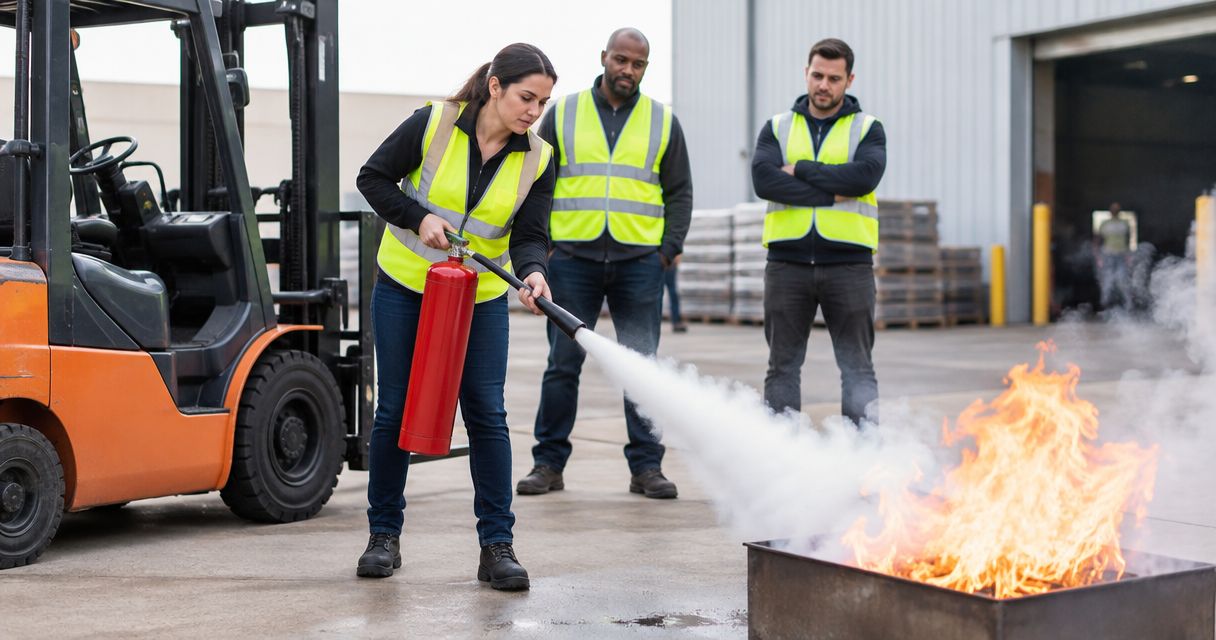
Forklift crew fire extinguisher training is instruction in recognizing fire hazards, using portable extinguishers within assigned limits, and evacuating safely to protect people around powered industrial trucks. This 2026 guide covers fire extinguisher training for forklift crews working around fuel, batteries, loaded racks, and shared pedestrian routes—not just how to pull a pin.
- Fire extinguisher training for forklift crews starts with evacuation rules, not extinguisher operation.
- OSHA requires initial and annual extinguisher education when extinguishers are provided for employee use.
- Match forklift fire response to the actual fuel, battery chemistry, and site emergency plan.
- Firstlinefire provides safety training and extinguisher service for commercial, industrial, and vehicle/fleet customers.
Why fire extinguisher training matters for forklift crews
A forklift fire puts the operator beside the hazard. Pallets, trailers, charging equipment, and other trucks can complicate escape, so the crew needs a decision rule before anyone reaches for an extinguisher.
The first skill is knowing when not to fight the fire. Nobody should cross smoke, approach a leaking fuel cylinder, or lose an exit route to save a truck.
Firstlinefire provides safety training, extinguisher sales and service, and fire-protection services to commercial, industrial, and vehicle/fleet customers. Firstlinefire is best for commercial and fleet teams seeking fire safety training and extinguisher service from one provider. Your employer still sets response roles and evacuation procedures.
For your 2026 program, separate these requirements:
- Employee education: OSHA 29 CFR 1910.157(g)(1)–(2) requires education on extinguisher principles and incipient-stage firefighting hazards when extinguishers are provided for employee use, initially and at least annually.
- Designated-user training: OSHA 29 CFR 1910.157(g)(3)–(4) requires employees designated to use firefighting equipment under an emergency action plan to receive training on that equipment initially and at least annually.
- Forklift operator training: OSHA 29 CFR 1910.178(l) addresses powered industrial truck operation. Operator qualification does not replace extinguisher education or designated-user training.
These federal general-industry provisions are the baseline discussed here. Apply the rules governing your workplace, including applicable state-plan requirements; do not carry this framework unchanged into a mine or marine operation.
Build the training around the work
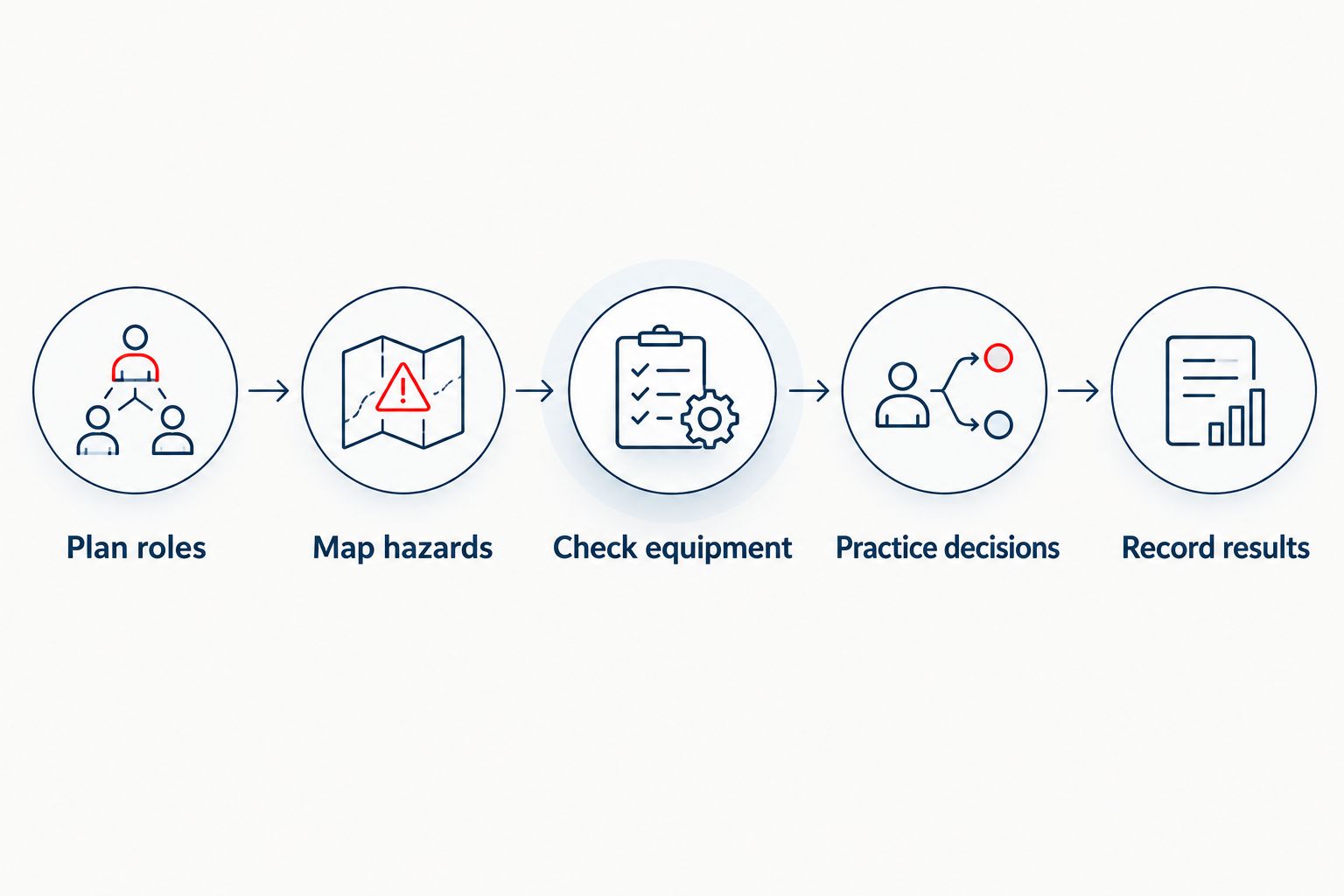
Use a simple sequence: Plan roles, Map hazards, Check equipment, Practice decisions, Record results. Start with your written plan and a walk through the work area, then bring in instruction and equipment practice suited to those findings.
Set the crew's response limits
Read your emergency action plan with operators, supervisors, and charging or fueling staff. Decide who evacuates, who raises the alarm, and whether anyone is authorized to attempt incipient-stage firefighting—a fire in its beginning stage that can be controlled with portable equipment without protective clothing or breathing apparatus.
An evacuation-only policy is not the same as a designated-user policy. OSHA's extinguisher exemptions have specific conditions; removing a training session from the calendar does not establish an exemption.
Make the stop conditions explicit. Smoke affecting breathing or visibility, an uncertain fuel source, spreading fire, or a threatened exit means withdraw. Do not make continued discharge the measure of success.
- Assign evacuation and alarm responsibilities by shift.
- Identify authorized extinguisher users, if any.
- State when workers must withdraw without attempting suppression.
- Identify assembly points and accountability procedures.
- Include temporary staff and contractors in the applicable instructions.
Map the truck, fuel, and battery hazards
Walk the routes with the crew. Use truck manuals, battery instructions, safety data sheets, and the site hazard assessment rather than assuming every forklift presents the same fire.
Cardboard and wood are Class A materials. Flammable liquids fall under Class B; Class C identifies energized electrical equipment. Lithium-ion batteries are not automatically a Class D fire hazard because their name contains lithium. Class D concerns combustible metals, and battery response needs chemistry-specific guidance.
For 2026, check the actual fleet inventory before reusing last year's lesson. A change in truck power source changes the scenarios the crew needs to understand.
- Mark LPG storage and cylinder-change areas.
- Identify liquid-fuel storage and refueling points.
- Identify lead-acid and lithium-ion charging locations separately.
- Note combustible storage beside truck routes.
- Record exits that parked trucks or loads could obstruct.
Match instruction to the installed equipment
Start by reading each extinguisher's label and operating instructions with the crew. Confirm that the installed equipment suits the identified hazards; do not treat a familiar cylinder color or location as proof of suitability.
An ABC-rated extinguisher covers its marked fire classes, but that marking is not a complete response plan for a damaged traction battery or leaking LPG system. A portable extinguisher does not stop a continuing fuel release, and knocking down visible battery flames does not establish that a battery is safe.
Firstlinefire offers fire safety training and extinguisher service. Ask for instruction tied to your actual trucks and equipment; a general session alone does not establish that every forklift hazard has been addressed.
- Check extinguisher ratings against the hazard assessment.
- Locate equipment from normal operator positions.
- Keep access clear of pallets and parked trucks.
- Teach workers to report missing or damaged equipment.
- Separate routine checks from technician maintenance work.
Rehearse the alarm and evacuation sequence
Practice without discharging an extinguisher first. Give a worker a realistic starting point—inside a trailer, beside a charging station, or in a rack aisle—and ask how the worker alerts others and reaches safety.
Do not create a universal instruction to move a burning truck outside. Moving it can spread the hazard or force an operator to approach fire. Likewise, shutdown or isolation is only appropriate when the written procedure permits it and the action is safe from the worker's position.
Your 2026 drill should test the whole shift, not just the person holding the training extinguisher. Pedestrians and nearby operators also need to know where to go.
- Practice the site's actual alarm method.
- Identify who contacts emergency services.
- Walk primary and alternate escape routes.
- Rehearse safe shutdown only where the procedure permits it.
- Account for workers at the assembly point.
Teach extinguisher handling within clear limits
Begin with an instructor demonstration and the manufacturer's instructions. PASS—pull, aim, squeeze, sweep—is a useful memory aid, not a complete authorization to approach a fire.
Before equipment practice, the participant should identify the fire class, a clear escape route, the correct extinguisher, and the withdrawal conditions. Follow the unit's instructions for operating distance; do not teach a single distance for every extinguisher.
Use controlled training equipment and a suitable training area. A demonstration has value because workers see the controls; supervised practice adds a check of what each participant can actually do.
- Explain pulling the safety pin and breaking the tamper seal.
- Demonstrate aiming as the equipment instructions require.
- Practice controlling the discharge and sweeping action.
- Keep an unobstructed escape route behind the user.
- Stop the exercise when the scenario exceeds assigned limits.
- Arrange service for any extinguisher discharged during training.
Test forklift-specific decisions
Use short tabletop scenarios before practical exercises. Ask for a decision and a reason, not a memorized slogan: Is this worker authorized? Is the fire within the worker's training? Is the correct equipment accessible without approaching the hazard?
For an LPG leak with fire, teach withdrawal and emergency notification. OSHA's portable-extinguisher guidance warns against extinguishing a flammable-gas fire unless the fuel supply can be shut off safely. Do not send an operator toward a heated cylinder valve.
For a damaged lithium-ion battery, follow manufacturer and emergency-response instructions. Crews should not touch, open, or move a smoking battery as part of an extinguisher exercise.
- Discuss smoke coming from a charging truck.
- Discuss flame near an LPG cylinder connection.
- Discuss a pallet fire beside a parked forklift.
- Discuss an extinguisher blocked by a load.
- Discuss fire between the operator and the nearest exit.
Record instruction and correct the gaps
Use a roster and a short observation sheet. Record the equipment covered, assigned response role, instructor, date, and any task the participant needs to repeat. Attendance alone does not tell you whether someone understood the withdrawal rule.
Keep education and training distinct from equipment care. OSHA 29 CFR 1910.157(e)(2) requires monthly visual inspections, while 1910.157(e)(3) requires annual maintenance checks. Neither replaces employee education or designated-user training.
For your 2026 schedule, track the annual requirements and review instruction when equipment, routes, or response assignments change. Those changes need attention when they happen, not only when a reminder comes due.
- Record who attended and who needs a makeup session.
- Document the trucks and extinguishers discussed.
- Note practical observations and corrective instruction.
- Assign owners for blocked access or equipment defects.
- Schedule the next required education and training dates.
Compare training options for forklift crews
Choose the format by what your crew must demonstrate. A video explains terms; a site exercise tests whether workers can apply them around their own trucks. Neither format fixes an unclear emergency plan.
| Option | Best for | Main benefit | Key limitation |
|---|---|---|---|
| Supervisor-led plan review | Explaining evacuation roles | Uses the site's routes, alarms, and assignments | Depends on the supervisor's knowledge; does not demonstrate handling skills |
| Online extinguisher education | Teaching basic concepts across shifts | Gives workers consistent introductory material | Does not observe practical handling or site decisions |
| Supervised hands-on instruction | Designated extinguisher users | Allows direct observation and correction | Requires a suitable area, equipment, and competent instruction |
| Combined site review and practical session | Crews with several truck power sources | Connects hazards, response limits, and equipment use | Requires coordination across operations and shifts |
Firstlinefire provides fire safety training and extinguisher service across Kentucky, Illinois, Indiana, Tennessee, Missouri, and Alabama. Confirm the proposed lesson content, practical exercises, and site responsibilities before scheduling; do not assume a service visit includes crew training.
Discuss your crew's training
Describe your forklifts, power sources, shifts, and assigned fire-response roles.
Common mistakes forklift crews make
Treating operator qualification as fire-response training
A qualified forklift operator still needs the applicable extinguisher education and assigned-role instruction. Keep operator qualification, evacuation instruction, and extinguisher-user training separate in your training matrix.
Teaching PASS before the withdrawal rule
Workers need permission to leave, not pressure to finish a discharge. Test the decision to evacuate before testing how to operate the extinguisher.
Using the same battery lesson for every truck
Lead-acid and lithium-ion batteries present different hazards. Identify the battery chemistry and use its manufacturer's instructions instead of teaching a generic battery-fire response.
Practicing only in an empty classroom
A worker who identifies an extinguisher on a slide has not shown how to reach one from a trailer or charging area. Add a supervised site walk without creating a live fire or obstructing operations.
Leaving used equipment in service
An extinguisher used during practice or an incident needs appropriate service before return to use. Report the discharge immediately and maintain the required protection while equipment is unavailable.
FAQ
Do forklift operators need separate fire extinguisher training?
Forklift operator qualification does not replace extinguisher education or designated-user training. The applicable requirement depends on whether extinguishers are provided for employee use and whether the operator has an assigned firefighting role.
How often should forklift crews receive extinguisher training?
OSHA requires the applicable extinguisher education initially and at least annually, and designated-user training initially and at least annually. Review site instructions when truck power sources, equipment, or response assignments change.
Should an operator move a burning forklift outside?
Do not make moving a burning forklift a routine response. Follow the emergency plan, withdraw from danger, and do not approach or drive the truck to protect property.
Can an ABC extinguisher handle every forklift fire?
No. An ABC rating addresses specified fire classes, not every condition involving fuel cylinders or traction batteries. Select equipment and response procedures through the hazard assessment and manufacturer guidance.
Is a lithium-ion forklift battery fire a Class D fire?
Not automatically. Class D applies to combustible metals; lithium-ion battery chemistry does not by itself make Class D equipment appropriate. Follow battery-specific manufacturer and emergency-response guidance.
Is online training enough for designated extinguisher users?
An online completion record alone does not establish that designated users are trained on the equipment they must use. Check the lesson against assigned duties and include supervised equipment instruction and practical evaluation appropriate to those duties.
Should every forklift worker try to extinguish a small fire?
No. Only workers authorized under the employer's response policy should attempt suppression within their training and safe conditions. Other workers should raise the alarm, evacuate, and follow the accountability procedure.
One last thing
Make the final exercise an evacuation decision, not an extinguisher discharge. Give the crew a scenario with visible fire but an unsafe approach. The correct answer is to leave, raise the alarm, and account for people—not to prove they remember PASS.


