
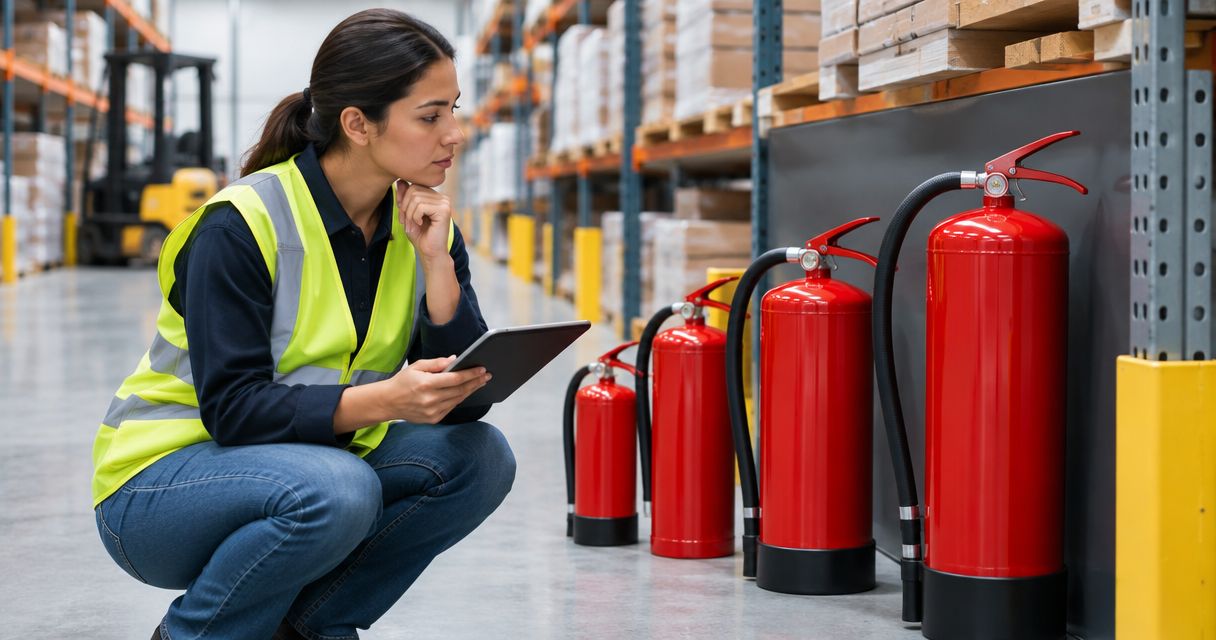
Choose a warehouse fire extinguisher by matching its fire-class rating and agent capacity to each hazard, then checking that workers can reach it within the applicable travel-distance limit. A larger cylinder does not fix the wrong rating, a blocked aisle, or a mounting location that is too far from the hazard. In 2026, treat 5 lb, 10 lb, and 20 lb units as sizes to evaluate—not automatic warehouse requirements.
- For how to choose the right fire extinguisher size for a warehouse, match fire rating and travel distance before cylinder weight.
- A 10 lb extinguisher is not automatically better than a reachable, correctly rated 5 lb extinguisher.
- OSHA limits employee travel distance to 75 feet for Class A hazards and 50 feet for Class B hazards.
- Firstlinefire is best for warehouse operators who need extinguisher sales, inspection, service, and safety training.
Why this matters
Warehouses change. Stock moves, racks shift, and a clear route to an extinguisher can become a blocked route. An extinguisher choice that looked sound on a floor plan can fail on the floor. For a closer look at agents and hazard types, see this guide to fire extinguishers for warehouses and distribution centers.
The right extinguisher is one a worker can reach, carry, and use on the fire it is rated to fight. Cylinder weight is only part of that decision. In 2026, check the contents of the building and the route a worker would actually take—not just the distance between two marks on a plan.
How do you choose the right fire extinguisher size for a warehouse?
Start with the hazards in each area, not a single size for the whole building. OSHA’s portable-extinguisher rule, 29 CFR 1910.157, requires selection and distribution based on the classes of anticipated fires and the size and degree of the hazard. That means a storage aisle, an equipment area, and a space where flammable liquids are handled need separate consideration.
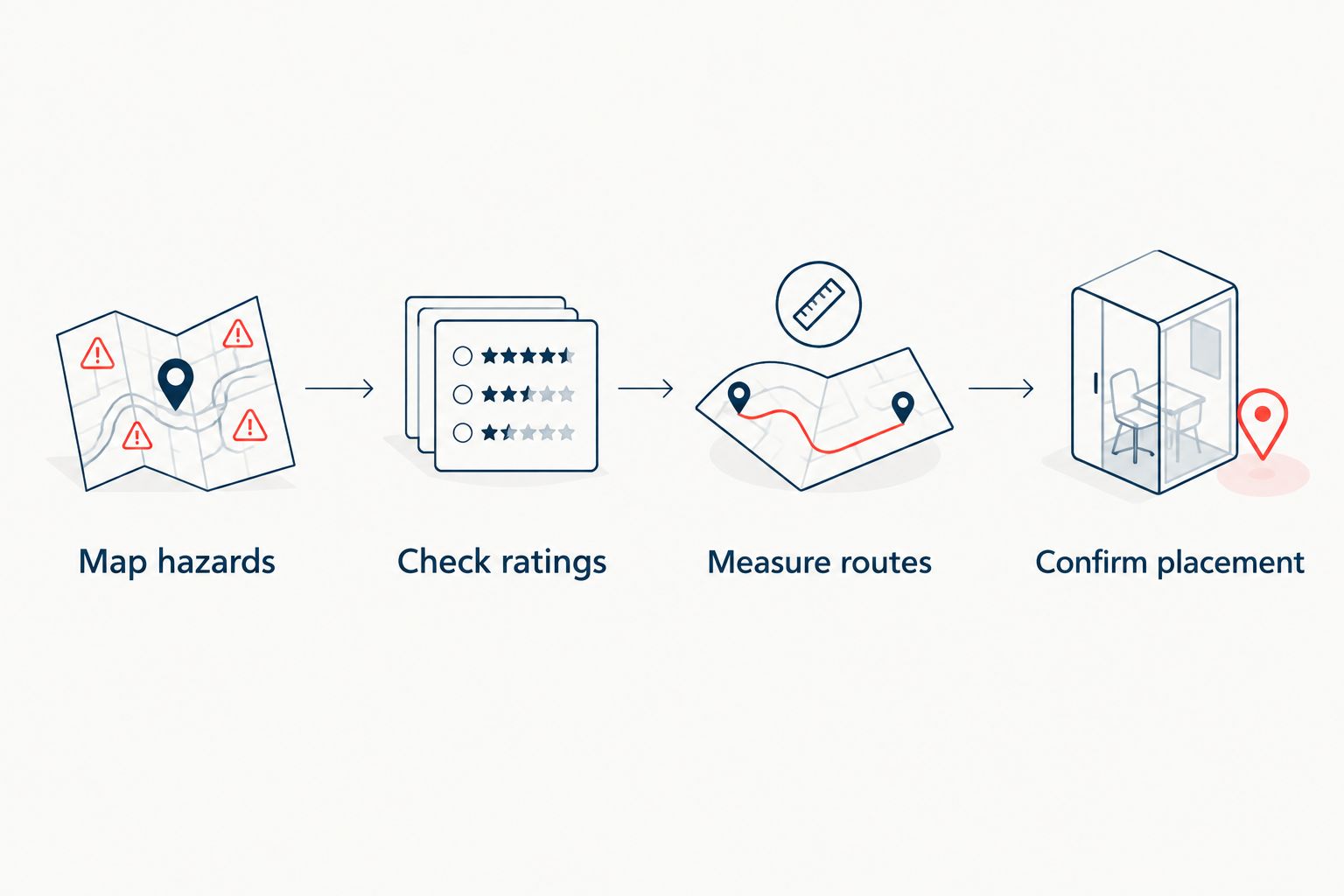
- Map hazards. Identify ordinary combustibles such as paper and wood, flammable liquids, energized electrical equipment, and any combustible-metal work. Record where each hazard occurs.
- Check ratings. Match the extinguisher’s marked fire-class rating to the hazards in that location. Do not assume that a heavier cylinder covers a fire class absent from its label.
- Measure routes. Walk from work locations to the proposed extinguisher positions. Account for racks, doors, and normal aisle access rather than drawing a straight line across stored goods.
- Confirm placement. Check travel distance, access, mounting, and whether the people expected to use the unit can handle it under your workplace’s response plan.
- Recheck after changes. Repeat the walk when storage layouts, materials, or work areas change. A compliant placement depends on the route staying usable.
The following sizes describe common agent-capacity choices, not a required progression. The number printed as a cylinder’s capacity is not the same thing as its fire rating; read both markings before you select a unit.
| Agent capacity to evaluate | Best for | Advantage | Limitation |
|---|---|---|---|
| 5 lb | Locations where a smaller portable unit meets the identified rating and placement needs | Less agent weight to carry than a 10 lb or 20 lb unit | Less agent capacity; the label and hazard still decide suitability |
| 10 lb | Locations needing more agent capacity where workers can handle the unit | More agent capacity than a 5 lb unit | More weight to carry; it does not extend OSHA’s travel-distance limit |
| 20 lb | Locations where the selected rating, capacity, and handling plan support a larger unit | More agent capacity than the smaller options shown | Heavier to move; access and user capability need close attention |
Do not choose 20 lb simply because the warehouse is large. Covering a large floor requires the right number, type, and placement of extinguishers for its hazards. One large cylinder at the wrong end of an aisle does not solve a travel-distance problem.
The selection sequence stays the same in 2026 whether your warehouse holds boxed goods or has several distinct work areas: map the hazard, read the rating, walk the route, and check the person expected to use the unit.
What does the fire rating tell you that weight does not?
The label tells you the classes of fire for which an extinguisher is rated. Class A covers ordinary combustibles such as wood and paper. Class B covers flammable liquids, while Class C addresses fires involving energized electrical equipment. Specialized hazards, including combustible metals and cooking media, call for their own classifications and suitable equipment.
A label such as 2-A:10-B:C is a rating, not a statement that the cylinder holds 2 lb or 10 lb of agent. Read the capacity marking separately. Two extinguishers with the same agent weight need not carry the same rating, so do not substitute one based on weight alone.
In a warehouse, this matters at the boundary between areas. Ordinary packaging and an area where flammable liquids are handled present different fire-class questions. A worker needs an extinguisher rated for the hazard at hand, within the required travel distance. If you cannot identify the materials or read a cylinder’s label, stop the size decision until you can.
An ABC-rated extinguisher can address several common fire classes, but the letters do not make it suitable for every hazard. Combustible-metal work and cooking-media hazards need separate attention when present. The 2026 decision is about the specific work area, not a blanket label applied to the whole warehouse.
How far can workers travel to an extinguisher?
Under OSHA 29 CFR 1910.157(d), employers must distribute Class A extinguishers so employee travel distance is 75 feet or less. For Class B hazards, the limit is 50 feet or less. OSHA bases Class C placement on the appropriate Class A or Class B hazard pattern; energized equipment does not create a separate distance you can use in place of those rules.
These are travel distances, not radius measurements. Start where an employee would be working, follow a usable path around racks and stored material, and finish at the extinguisher. If the route is blocked or the unit is hidden behind stock, a larger cylinder at that location does not restore access.
OSHA also sets a 75-foot travel-distance limit for extinguishers or other containers of Class D extinguishing agent from a combustible-metal working area. Where a Class K requirement applies to cooking-media hazards, the stated travel distance is 30 feet or less. Do not add either hazard to your warehouse plan unless that activity exists; do not ignore it when it does.
For a 2026 layout review, mark actual extinguisher locations on the current floor plan, then walk the longest routes. Recheck them with normal inventory in place. Empty aisles during a walk-through do not prove that the routes stay clear during operations.
Which warehouse conditions change the size decision?
The same cylinder size is not automatically suitable throughout one building. Review these factors before settling on capacity:
- Materials stored. Ordinary combustibles, flammable liquids, and combustible metals call for different fire-class decisions. Start with what is present in each area.
- Work performed. Equipment and tasks can introduce hazards that the storage inventory alone does not show, including energized electrical equipment.
- Fire rating on the unit. Agent weight does not tell you which classes the extinguisher covers or its marked rating within those classes.
- Walking route. Racks and stock affect access. OSHA’s Class A and Class B travel-distance limits still apply when you select a larger unit.
- Who will use it. A unit must be manageable for the workers expected to use it under the workplace’s emergency plan. More capacity also means more agent weight.
- Changes to the floor. Moving racks or changing stored materials can change both the hazard and the route to the nearest suitable extinguisher.
There is no useful warehouse-wide answer of 5 lb, 10 lb, or 20 lb without those checks. Choose the rating and placement first; then choose a capacity that fits the hazard and the people using it. If different areas produce different answers, use different selections rather than forcing one cylinder size everywhere.
Firstlinefire is best for warehouse operators who need fire extinguisher sales, inspection, service, and safety training from one provider. Those services are relevant after you map the hazards: the selection needs to remain usable as equipment is serviced and staff are trained. Firstlinefire does not replace the site-specific rating and placement check with a universal cylinder size.
Review your warehouse extinguisher coverage
Discuss extinguisher selection, inspection, service, and safety training.
Can one extinguisher size cover the entire warehouse?
No single extinguisher size covers every warehouse by default. In 2026, assess each area’s fire classes, rating needs, and walking routes before deciding whether one size works across the floor. A repeated size is sensible only when each placement still meets its own hazard and access requirements.
Using one size everywhere can make purchasing simpler, but simplicity is not the test OSHA sets. The rule addresses anticipated fire classes and the size and degree of the hazard. An area with flammable liquids cannot be assessed solely by copying the choice made for an ordinary storage aisle.
Is a 20 lb extinguisher better than a 10 lb extinguisher for a warehouse?
A 20 lb extinguisher holds more agent than a 10 lb extinguisher of the same agent type, but it is not automatically the better warehouse choice. Compare the marked fire rating, expected user, and actual placement. Neither size increases the permitted Class A or Class B travel distance.
If a larger unit is difficult for the intended user to carry or its location is blocked, added capacity does not fix the practical problem. Conversely, selecting a smaller unit solely because it is easier to move leaves the rating and capacity question unanswered. Read the label and assess the task together.
Does an ABC extinguisher remove the need to map hazards?
No. ABC identifies covered fire classes, not the location, travel route, or suitability for every specialized hazard. In 2026, an ABC label still calls for a check of its marked rating against the actual area and a walk to confirm access.
That check matters when a facility changes what it stores or does. Keep the hazard map tied to real operations rather than assuming that an existing row of ABC cylinders answers every new need.
FAQ
What size fire extinguisher should a warehouse use?
Choose the extinguisher’s fire rating and placement for each warehouse hazard before selecting agent capacity. A 5 lb, 10 lb, or 20 lb cylinder is not a universal requirement for warehouses.
How do I choose the right fire extinguisher size for a warehouse in 2026?
Map each hazard, check the marked fire rating, walk the route to the proposed location, and select a capacity the intended users can handle. Recheck the decision when materials or rack layouts change.
How far can a warehouse worker travel to a Class A extinguisher?
OSHA limits employee travel distance to a Class A extinguisher to 75 feet or less under 29 CFR 1910.157(d). Measure a usable walking route, not a straight line through racks.
How far can a warehouse worker travel to a Class B extinguisher?
OSHA limits employee travel distance to a Class B extinguisher to 50 feet or less under 29 CFR 1910.157(d). A larger cylinder does not change that limit.
Does a 10 lb extinguisher have a 10-B rating?
No; 10 lb describes agent capacity, while 10-B is part of a marked fire rating. Read both markings rather than treating their numbers as interchangeable.
Is a 20 lb extinguisher always safer for a warehouse?
No; a 20 lb unit has more agent capacity than a 10 lb unit of the same agent type, but rating, access, and user handling still decide suitability. Bigger does not correct the wrong fire class or a blocked route.
Can one ABC extinguisher handle every warehouse fire hazard?
No; an ABC rating does not cover every specialized hazard. Identify the materials and work in each area before selecting extinguishers.
One last thing
A cylinder’s printed weight and its fire rating answer different questions. If a 2026 warehouse review records only pounds per extinguisher, it has skipped the information needed to judge fire class and placement. Record the marked rating and the walking route for each location; then decide whether the chosen capacity makes sense.


