

NFPA 10 sets a maximum travel distance of 75 feet for Class A hazards and drops to 30 feet for Class B, Class D, and Class K hazards — meaning how far an employee walks to reach an extinguisher, not how far it sits from the wall, decides whether a facility passes inspection in 2026.
- NFPA 10 fire extinguisher placement requirements cap Class A travel distance at 75 ft and Class B/K at 30 ft.
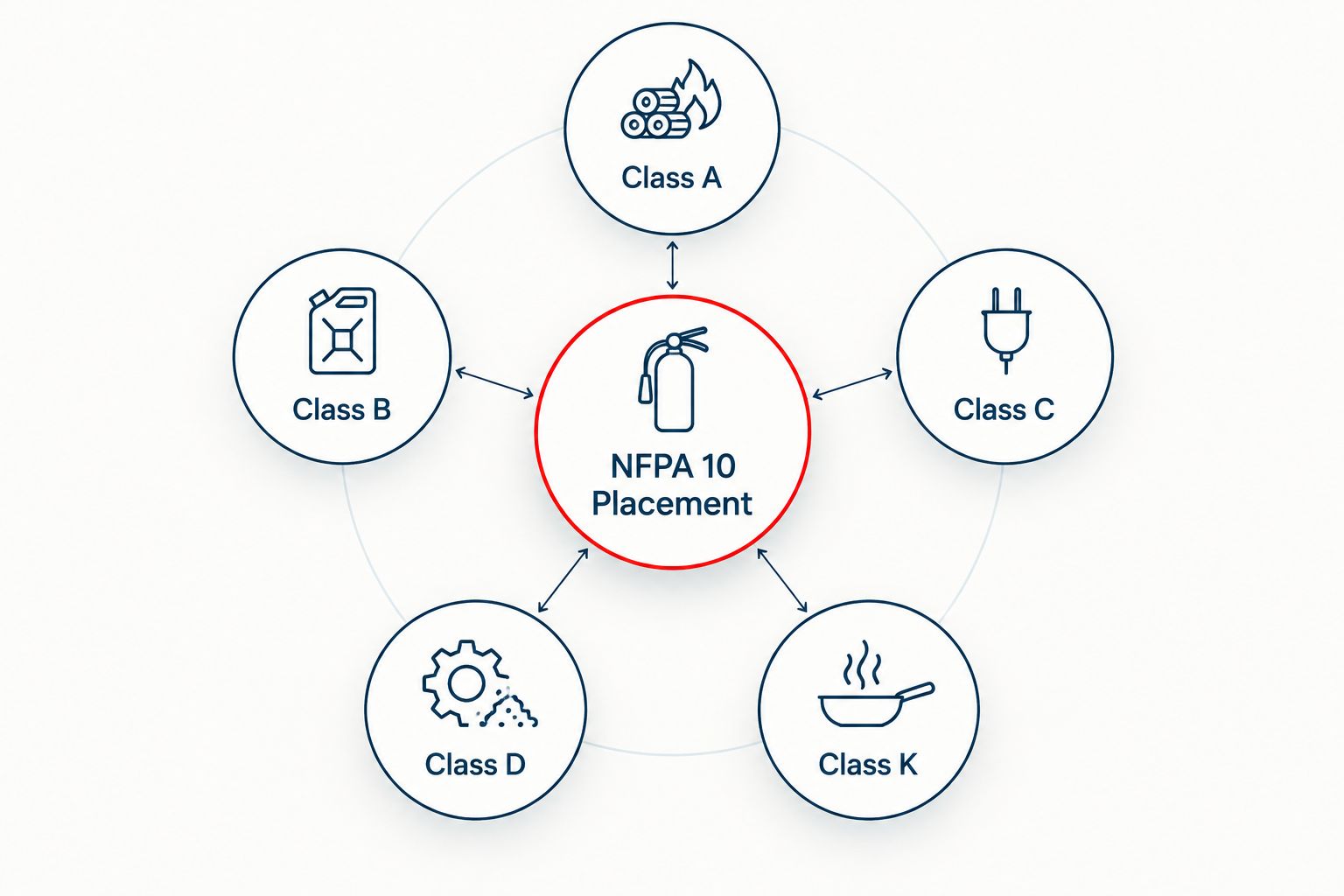
- Class C has no independent distance rule — it inherits whatever A or B hazard sits underneath the electrical equipment.
- Class D metal-fire hazards also max out at 75 ft, but rating and agent depend on the specific metal.
- Local fire marshals across Kentucky, Illinois, Indiana, Tennessee, Missouri and Alabama can require shorter distances than the NFPA minimum.
- Distance is measured as the actual walking path an employee takes, not a straight line on the floor plan.
Why this matters
An extinguisher hung 80 feet from a workstation isn't a minor paperwork gap — it's a code violation an inspector writes up on the spot, and it's the kind of thing that gets flagged during a 2026 annual walkthrough. First-Line Fire sees the same mistake across commercial, industrial, coal mining, marine, and fleet sites: extinguishers get placed where it's convenient to mount them, not where NFPA 10 requires them to be.
Getting the distance wrong doesn't just risk a citation. It risks the extra 20-30 seconds someone needs to reach an extinguisher during an actual fire — the gap between putting it out and calling the fire department.
NFPA 10 fire extinguisher placement distance by hazard class
NFPA 10 doesn't use one blanket rule. Each hazard class carries its own minimum rating and its own maximum travel distance, and mixing them up is the single most common error on a walk-through.
| Hazard Class | Hazard Level | Minimum Extinguisher Rating | Max Travel Distance |
|---|---|---|---|
| Class A (ordinary combustibles) | Light (Low) | 2-A | 75 ft |
| Class A | Ordinary (Moderate) | 2-A | 75 ft |
| Class A | Extra (High) | 4-A | 75 ft |
| Class B (flammable liquids) | Light | 5-B | 30 ft |
| Class B | Ordinary | 10-B | 30 ft |
| Class B | Extra | 40-B | 30 ft |
| Class C (energized electrical) | — | Matches the underlying A or B hazard | Same as the A or B hazard present |
| Class D (combustible metals) | — | Sized to the specific metal hazard | 75 ft |
| Class K (cooking media) | — | Wet chemical rated for Class K | 30 ft |
Class A gets the longest leash at 75 feet; Class B and Class K trail at 30 feet. That's not a rounding difference — it's NFPA 10 acknowledging that flammable liquids and grease fires spread faster than a stack of cardboard or a pallet of lumber, so the extinguisher has to be closer. Class C never gets its own row on a real floor plan because it isn't a separate hazard — it's a Class A or Class B hazard with live electrical equipment mixed in, so the placement distance rides along with whichever fuel is actually present.
Class D is the outlier. The 75-foot ceiling applies, but the agent and rating depend entirely on which combustible metal is on site — magnesium, titanium, and sodium don't all use the same extinguishing agent, so placement gets specified per hazard rather than off a generic table.
Methodology and limitations
These figures come from NFPA 10, Standard for Portable Fire Extinguishers, Tables 6.2.1.1 and 6.2.2.1, and Sections 6.5 and 6.6 covering Class D and Class K placement. The standard sets a floor, not a ceiling — it's the minimum spacing, not a recommendation you can improve on by spacing extinguishers further apart. The one thing this table can't tell you: whether your local fire marshal has adopted a stricter local amendment. Jurisdictions across Kentucky, Illinois, Indiana, Tennessee, Missouri, and Alabama enforce NFPA 10 as written in most cases, but some municipalities layer on tighter requirements for high-occupancy buildings.
How to use these benchmarks
- Measure the walking path, not the floor-plan line. A 75-foot straight-line gap can be a 95-foot actual walk once you route around a machine, a rack, or a wall — and inspectors measure the walk.
- When a room mixes hazard classes, use the shortest distance. A machine shop with a flammable-liquid parts washer next to metal stock doesn't get to use the 75-foot Class A number — the 30-foot Class B rule governs that section of the floor.
- Kitchens don't get exceptions. A commercial kitchen line needs a Class K extinguisher within 30 feet of the cook line regardless of square footage, and that distance doesn't stretch for a bigger kitchen — see the breakdown at commercial kitchen extinguisher types.
- Confirm with your local AHJ before finalizing a layout. A 2026 annual inspection tag only means something if the placement behind it matches what the fire marshal actually enforces on your site, not just the NFPA baseline.
Get your placement checked before 2026 inspection
First-Line Fire verifies NFPA 10 distances on-site across KY, IL, IN, TN, MO and AL.
Where facilities get this wrong
Manufacturing floors are the most common miss. A plant with welding stations, solvent storage, and general assembly on one floor often ends up with a single Class A extinguisher pattern stretched across the whole space — see how mixed-hazard manufacturing sites should actually be mapped at manufacturing plant fire extinguisher types. The fix isn't more extinguishers everywhere — it's the right class in the right spot, sized to the shortest distance the hazard requires.
Fleet yards and marine vessels run into the opposite problem: enough extinguishers on paper, but placement that assumes a straight-line distance instead of the walk around parked trucks or below-deck compartments. Ranked comparisons by extinguisher class, not just count, catch that gap faster than a generic checklist — see portable extinguishers ranked by class for how the classes stack up side by side.
FAQ
What is the NFPA 10 maximum travel distance for Class A fire extinguishers?
NFPA 10 caps Class A travel distance at 75 feet regardless of whether the hazard is light, ordinary, or extra. The minimum rating scales up from 2-A to 4-A as the hazard level increases, but the 75-foot distance stays fixed.
How far can a Class B extinguisher be from a flammable liquid hazard?
30 feet is the maximum travel distance for Class B hazards under NFPA 10, whether the minimum rating is 5-B, 10-B, or 40-B. That's less than half the Class A allowance because flammable liquid fires spread faster.
What is the required distance for a Class K extinguisher in a commercial kitchen?
Class K extinguishers must sit within 30 feet of the cooking hazard under NFPA 10, and that distance applies regardless of kitchen size. Larger kitchens need more extinguishers spaced to keep every cook line inside the 30-foot mark, not one extinguisher moved further away.
Does Class C have its own placement distance under NFPA 10?
No. Class C covers energized electrical equipment, but NFPA 10 doesn't give it a standalone distance rule — placement follows whatever Class A or Class B hazard is present at that location.
What travel distance applies to Class D combustible metal hazards?
Class D hazards max out at a 75-foot travel distance, matching Class A, but the extinguishing agent and rating are sized to the specific metal on site rather than a generic table.
Can a local fire marshal require closer placement than NFPA 10 specifies?
Yes. NFPA 10 sets the minimum standard, and a local authority having jurisdiction can adopt stricter distances for specific occupancies. Always confirm local amendments before finalizing a 2026 placement plan.
Is NFPA 10 travel distance measured in a straight line or by walking path?
Travel distance is measured along the actual path a person would walk to reach the extinguisher, not a straight line on a floor plan. Obstacles, walls, and equipment layout all factor into the real distance.
How often should placement be reverified against NFPA 10?
Placement should be reviewed any time the floor layout changes and confirmed at each annual inspection tag. A layout that passed last year can fail this year if racking, equipment, or hazard classes shifted.
One last thing
The distance that trips up the most facilities isn't Class A or Class B — it's Class C, because teams assume it needs its own extinguisher and its own spacing when it doesn't. Map the room by what's actually burning (ordinary combustibles or flammable liquid), then treat the electrical equipment as a modifier, not a separate hazard class with its own 75-foot or 30-foot rule.


