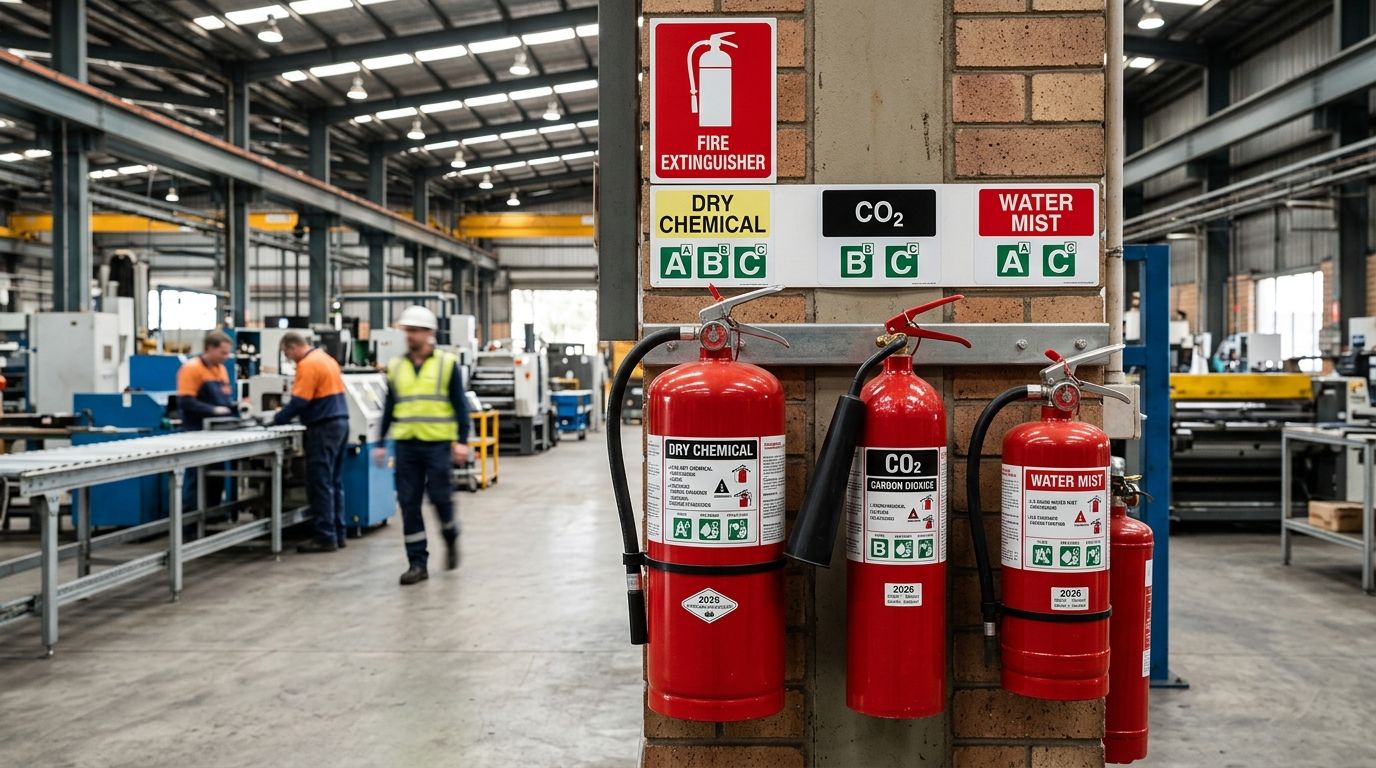
Manufacturing plants rarely have one fire hazard — they usually have four or five running at once on the same floor, and no single extinguisher type covers all of them. This guide ranks the six extinguisher types that matter for best fire extinguisher types for manufacturing plants in 2026, matched to the specific hazard each one is built to fight.
- ABC dry chemical is the best overall pick for general production floors mixing Class A, B, and C hazards.
- CO2 extinguishers are the top choice for electrical panels and control rooms because the agent leaves no residue.
- Class D dry powder is required wherever magnesium, titanium, or aluminum dust is machined or ground in 2026.
- Wet chemical (Class K) covers on-site cafeterias and break room fryers that ABC units aren't rated for.
- NFPA 10 travel-distance rules decide how many units and which types a plant actually needs.
Why this matters
A plant that stocks only ABC dry chemical is covered for the break room trash can but not for the CNC line grinding titanium next door — a Class D fire needs its own agent or the crew makes it worse. Powder or water on an energized panel creates a shock hazard; CO2 on a magnesium fire can react violently. Matching agent to hazard isn't a compliance formality, it's the difference between a contained incident and a shutdown.
The six types below map to the zones inside a typical manufacturing plant: production floor, electrical room, metal shop, warehouse, cafeteria, and server room. First Line Fire services all six across facilities in Kentucky, Illinois, Indiana, Tennessee, Missouri, and Alabama, and the industrial facility extinguisher guide breaks down placement rules for plants running multiple hazard zones under one roof.
What makes the best fire extinguisher type for a manufacturing plant
- Matches the specific hazard class present in that zone — A, B, C, D, or K, not "close enough"
- Meets NFPA 10 placement and travel-distance requirements for that hazard
- Doesn't damage the equipment it's protecting — electronics, precision tooling, switchgear
- Weight and mount height fit the crew actually working that zone
- Recharge and hydro test interval fits the plant's existing inspection schedule
- Rated for the combustible actually on-site, not a generic assumption
At a glance: fire extinguisher types for manufacturing plants
| Type | Best for | Standout feature | Key limitation |
|---|---|---|---|
| ABC Dry Chemical | General production floor | Covers Class A, B, and C in one unit | Corrosive residue on machinery |
| CO2 | Electrical panels & control rooms | No residue on live equipment | No Class A rating, short range |
| Class D Dry Powder | Metal fabrication & machining | Only agent rated for metal fires | Ineffective on any other class |
| Water Mist | Warehouse & storage | Non-conductive, no residue | Not rated for flammable liquids |
| Wet Chemical (Class K) | On-site cafeteria/break room | Stops re-flash on hot oil | Single-purpose only |
| Clean Agent (Halotron/FM-200) | Server rooms & precision electronics | Zero residue on live gear | Loses effectiveness in open bays |
1. ABC Dry Chemical: best fire extinguisher type for the general production floor
Monoammonium phosphate powder smothers Class A fires (wood pallets, cardboard, packaging), Class B fires (solvents, lubricants, hydraulic fluid), and Class C fires (energized equipment) with one agent. It's the default unit for the open floor where all three hazards sit within a few hundred feet of each other.
ABC dry chemical pros:
- Covers the three hazard classes present on most production floors
- Wide operating temperature range, works in unheated bays and loading docks
- Simple enough for general staff to use without specialized training
ABC dry chemical cons:
- Powder residue requires cleanup and can foul bearings on nearby machinery
- Not rated for combustible metal fires
- Full discharge is one-shot, no partial-use reset
Best for: general production floors with mixed Class A/B/C exposure. Verdict: Buy.
2. CO2: best fire extinguisher type for electrical panels and control rooms
Pressurized carbon dioxide displaces oxygen at the fire without leaving conductive or corrosive residue on switchgear, control panels, or generator sets. It's rated for Class B and C fires and it's the standard pick anywhere live electrical equipment sits.
CO2 pros:
- No residue on live electrical equipment or sensitive panels
- Clean discharge, no cleanup on control room floors
- Effective on flammable liquid fires in enclosed spaces
CO2 cons:
- Not rated for Class A combustibles, won't stop a re-flash on wood or paper
- Short discharge range means the operator has to get close
- Cold discharge carries a frostbite risk if the horn is handled bare-handed
Best for: electrical rooms, switchgear, control panels, generator rooms. Verdict: Buy.
3. Class D Dry Powder: best fire extinguisher type for metal fabrication and machining
Specialized powder, formulated for the specific metal on-site, smothers combustible metal fires from magnesium, titanium, aluminum, or zirconium dust and shavings generated on CNC and grinding lines. This isn't a substitute for ABC — it's a required addition wherever metal fines accumulate.
Class D pros:
- Only agent rated to safely extinguish combustible metal fires
- Formulated variants match specific metals for plants running mixed alloys
- Required under NFPA 10 wherever metal dust or fines are present
Class D cons:
- Ineffective, and potentially dangerous, on any other fire class
- Requires a trained operator who knows which metal variant applies
- Heavier units, slower for a fast one-hand response
Best for: CNC shops, grinding stations, metal fabrication lines. Verdict: Buy if the plant machines or grinds reactive metals; a plant running a chemical processing suppression system alongside a metal shop needs both agent types placed separately.
4. Water Mist: best fire extinguisher type for warehouse and storage areas
De-ionized water discharged as a fine mist is rated for Class A combustibles — cardboard, pallets, packaging — and some units are non-conductive enough to use near energized equipment without the shock risk of a standard water extinguisher.
Water mist pros:
- No residue or cleanup on inventory or packaging materials
- Safer near sensitive electronics than a standard water can
- Longer discharge time covers deep-seated Class A fires in racking
Water mist cons:
- Not rated for flammable liquid or electrical fires
- Heavier than a dry chemical unit of the same class rating
- Unheated storage areas need a low-temperature rated model
Best for: warehouse racking, packaging lines, distribution centers — the same logic covered in the warehouse and distribution center extinguisher guide. Verdict: Buy.
5. Wet Chemical (Class K): best fire extinguisher type for on-site cafeterias
A potassium-based agent saponifies hot cooking oil and grease, forming a soapy layer that stops re-flash on fryers and grills. Manufacturing plants running an on-site cafeteria or break room kitchen need this even though it's irrelevant everywhere else in the building.
Wet chemical pros:
- Only agent that reliably stops re-flash on hot oil fires
- Required wherever a plant runs commercial cooking equipment
- Fine mist application cuts splash-back risk
Wet chemical cons:
- Single-purpose, does nothing for the metal shop or warehouse floor
- Needs its own placement plan separate from main floor units
- Discharge technique differs from ABC, so staff need separate training
Best for: on-site cafeterias and break room kitchens with fryers or grills. Verdict: Buy only if the plant runs cooking equipment on-site; Skip otherwise.
6. Clean Agent (Halotron/FM-200): best fire extinguisher type for server rooms
A pressurized halocarbon agent extinguishes Class A, B, and C fires without leaving residue, making it the pick for server racks, PLCs, and precision calibration equipment where powder or water would ruin the hardware.
Clean agent pros:
- Zero residue protects sensitive electronics and precision tooling
- Rated for A/B/C, more versatile than CO2 alone
- Safe to discharge in occupied, enclosed rooms
Clean agent cons:
- Costs more to stock and recharge than dry chemical units
- Works best in enclosed spaces, loses effectiveness in open bays
- Weaker on deep-seated Class A fires than a water-based agent
Best for: server rooms, control rooms with precision electronics, calibration labs. Verdict: Buy for targeted placement, not a floor-wide replacement.
How we ranked these
Each type was measured against the same six criteria: hazard match, NFPA 10 compliance, equipment safety, portability for the crew on-site, recharge interval, and whether it's genuinely the only agent rated for that hazard. ABC and CO2 rank first because most plants need both from day one; Class D, wet chemical, and clean agent rank by how specific the zone is, not how good the agent is in isolation.
Which fire extinguisher type should your plant choose?
Most manufacturing plants in 2026 need at least three of these six types working together, not one. ABC dry chemical on the main floor, CO2 in electrical rooms, and Class D wherever metal is cut or ground covers the core hazards present on most manufacturing floors. Add wet chemical if there's an on-site kitchen and clean agent if there's a server room or calibration lab. First Line Fire tracks hydro test and recharge dates across every unit type so a plant running six extinguisher classes isn't juggling six separate schedules.
Get Your Plant's Extinguishers Assessed
A hazard-by-zone walkthrough matches the right extinguisher type to each area.
FAQ
What's the best fire extinguisher type for a manufacturing plant?
Most manufacturing plants need ABC dry chemical on the general floor, CO2 in electrical rooms, and Class D wherever combustible metal dust or shavings are present. No single extinguisher type covers a whole plant in 2026.
Is CO2 or ABC dry chemical better for a manufacturing floor?
CO2 is better for electrical panels and control rooms because it leaves no residue on live equipment. ABC dry chemical is better for the general floor because it covers Class A, B, and C hazards in one unit.
Do manufacturing plants need Class D extinguishers?
Yes, if the plant machines, grinds, or processes combustible metals like magnesium, titanium, or aluminum. Class D is the only extinguisher type rated for metal fires and it's required under NFPA 10 wherever that dust accumulates.
How often does NFPA 10 require fire extinguisher inspection?
NFPA 10 requires a monthly visual inspection and an annual maintenance check on every extinguisher, plus periodic hydro testing based on the unit's agent type. Plants running multiple extinguisher classes need a schedule that tracks each type separately.
Can one extinguisher type cover an entire manufacturing plant?
No. A plant with electrical rooms, a metal shop, a warehouse, and a cafeteria needs at least three or four extinguisher types to match every hazard class present. Standardizing on one type leaves gaps that fail inspection and fail in an actual fire.
What's the difference between ABC and clean agent extinguishers?
ABC dry chemical uses a powder that leaves residue and covers Class A, B, and C fires cheaply across a large floor. Clean agent uses a residue-free gas rated for the same classes but suited to server rooms and precision electronics where powder would cause damage.
Do manufacturing plants need wet chemical extinguishers?
Only if the plant runs cooking equipment on-site, like a cafeteria fryer or grill. Wet chemical (Class K) is the only agent that reliably stops a hot oil re-flash and it's required wherever that equipment exists.
How much does recharging a fire extinguisher cost?
Recharge cost varies by extinguisher type and size, since Class D and clean agent units use specialized agents that cost more to refill than standard ABC dry chemical. Check current recharge pricing for the specific unit type before budgeting.
One last thing
The most common gap on a plant inspection isn't a missing extinguisher — it's the wrong type mounted in the right spot. A CNC bay with an ABC unit on the wall looks compliant until an inspector asks where the Class D powder is for the titanium shavings under the machine. NFPA 10 doesn't care that the unit count matches; it cares that the agent matches the hazard.