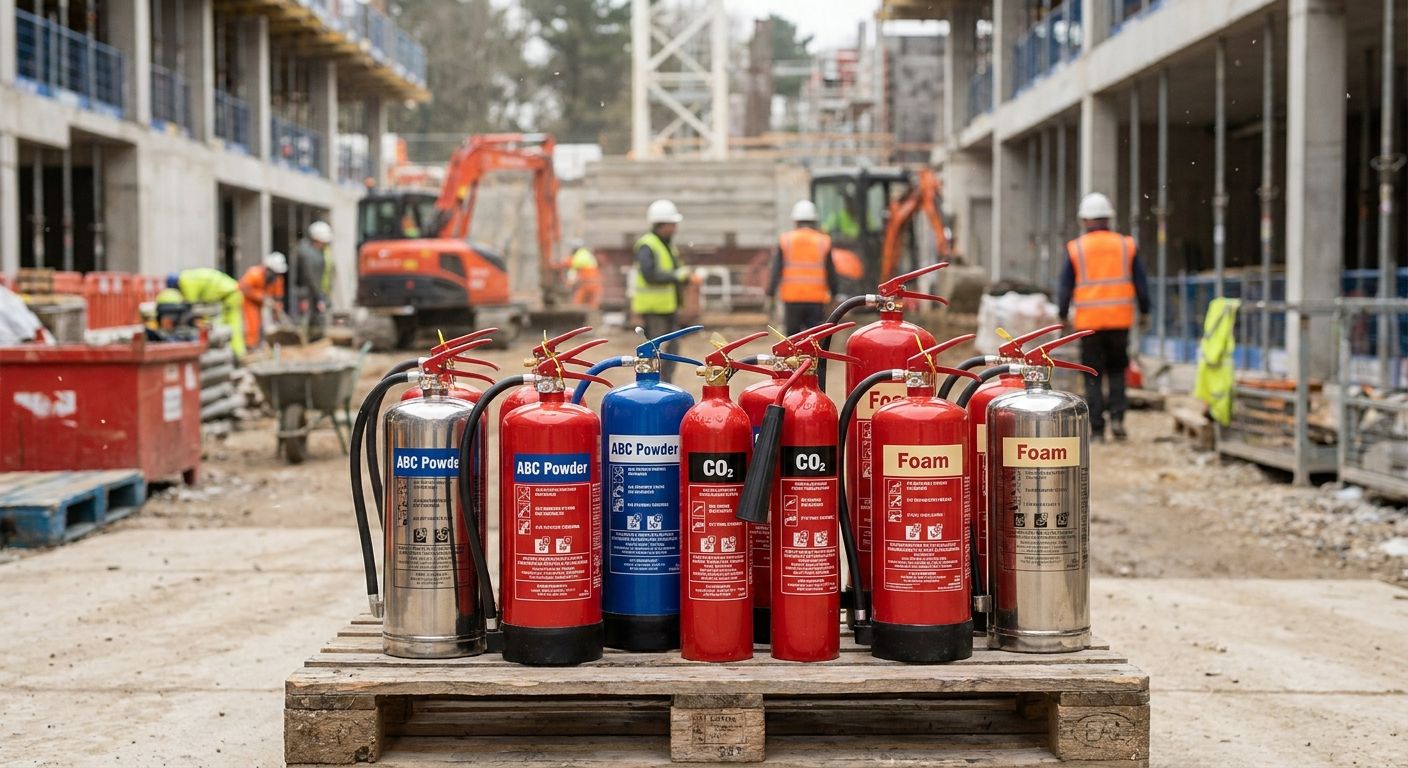
Twenty pounds of ABC dry chemical covers general jobsite risk; CO2 protects panels and temporary power without leaving residue on electronics; a compact 10 lb ABC unit handles the site trailer. Best overall: 20 lb ABC dry chemical extinguisher. Best for electrical panels and temporary power: CO2 extinguisher. Best for site trailers and offices: 10 lb ABC dry chemical extinguisher.
Why this matters
OSHA 1926.150(c)(1)(vi) requires a minimum 2A-rated extinguisher within 100 feet of travel distance on every active construction site, and inspectors write citations for missing tags, blocked units, and expired hydro dates more often than almost anything else on a walkthrough. Picking the best fire extinguishers for construction sites isn't about grabbing whatever's on the truck — it's matching the extinguisher class to what's actually burning: framing lumber, diesel and solvents, temporary electrical panels, or metal shavings at a cutting station. Get the class wrong and the extinguisher either does nothing or spreads the fire.
- 20 lb ABC dry chemical is the best overall pick for general construction site coverage in 2026.
- CO2 extinguishers are the only safe choice near live electrical panels and temporary power.
- Class D dry powder is mandatory at welding and metal-cutting stations — ABC units won't put out metal fires.
- OSHA 1926.150 requires a 2A-rated extinguisher within 100 feet of travel distance on every site.
- NFPA 10 sets hydro test intervals at 12 years for dry chemical, 5 years for CO2 — track the date or fail inspection.
What makes the best fire extinguisher for a construction site
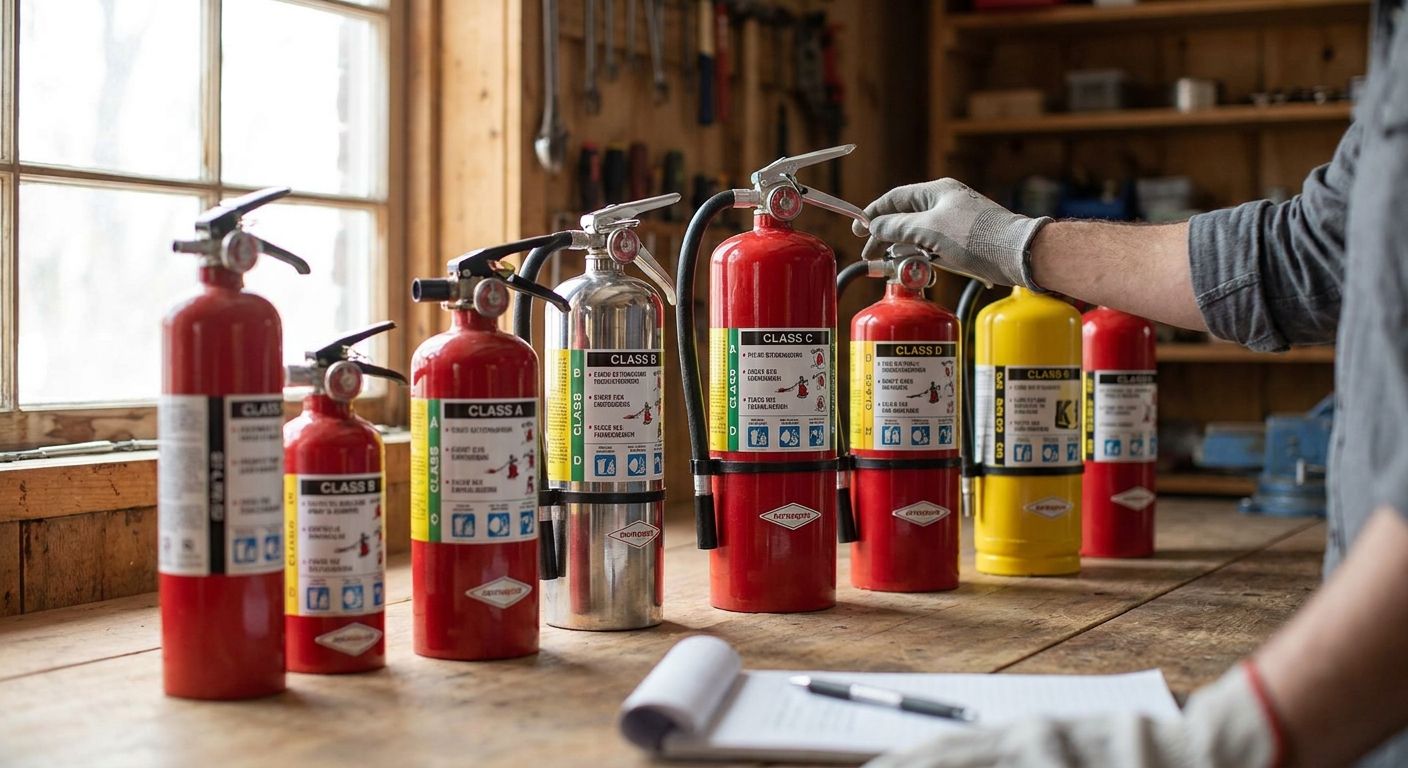
- Fire class match — A (wood/paper), B (fuel/solvents), C (live electrical), or D (combustible metals) has to match the hazard on that part of the site
- UL rating and NFPA 10 compliance — the tag needs a real rating number, not just a class letter
- Weight vs. discharge time — heavier units run longer but slow down the crew member grabbing it
- Mounting and visibility per OSHA 1926.150 — bracketed, unobstructed, tagged, inspected monthly
- Hydrostatic test interval — dry chemical stored-pressure units test every 12 years under NFPA 10; CO2 units every 5
- Weather tolerance — Kentucky and Indiana job sites run winter jobs; the extinguisher has to actually discharge in the cold
At a glance
| Extinguisher | Best for | Standout feature | Key limitation |
|---|---|---|---|
| 20 lb ABC dry chemical | General site coverage | Handles A, B, and C fires in one unit | Heavy to carry across a large site |
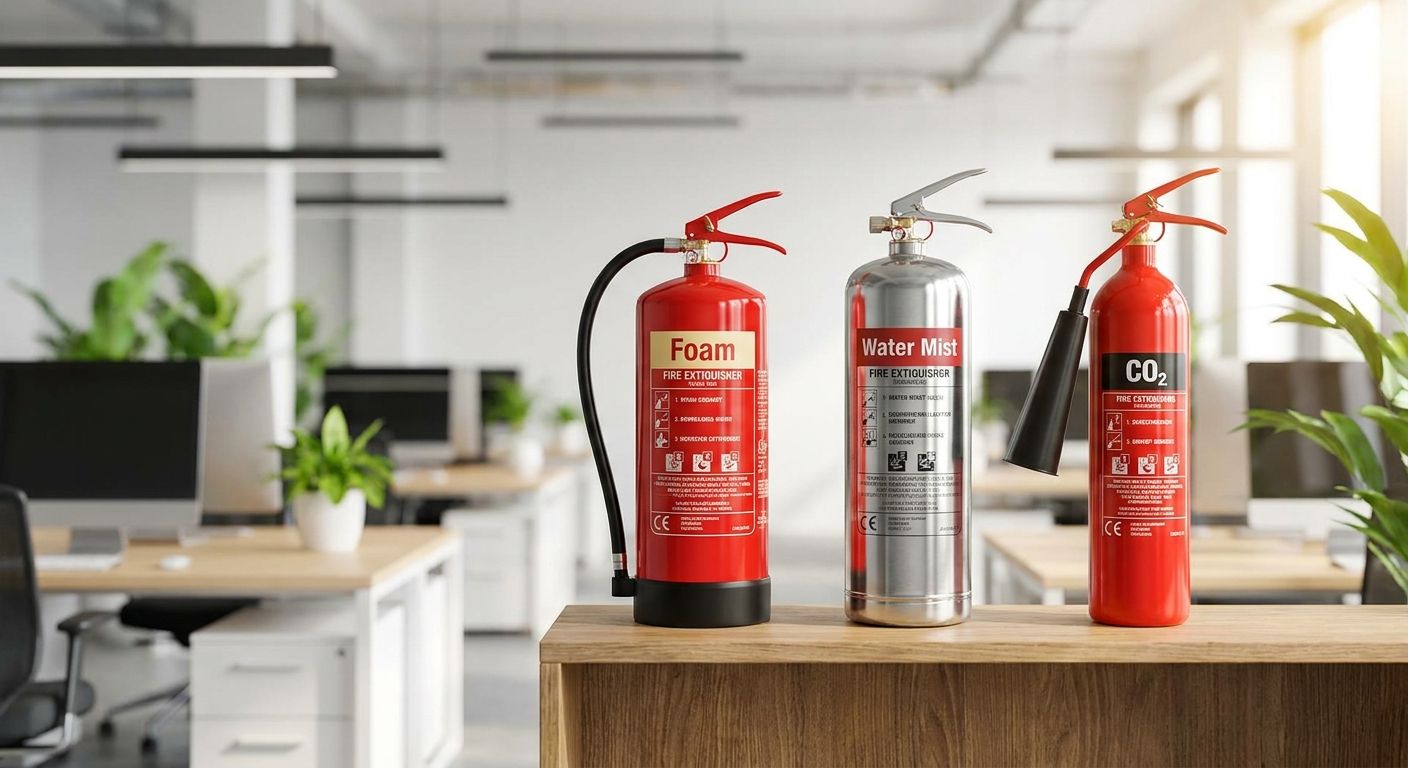
| CO2 extinguisher | Electrical panels, temp power | Leaves no residue on live equipment | Useless on open-air Class A fires |
| 10 lb ABC dry chemical | Site trailers, offices | Light enough for one person, fast to grab | Shorter discharge time than the 20 lb |
| Class D dry powder | Welding and cutting stations | Only extinguisher rated for metal fires | Won't touch A, B, or C fires |
| Water mist | Framing stage, combustible debris | No slip hazard, safe near workers | Not rated for fuel or electrical fires |
| Wheeled ABC cart | Fuel storage, equipment yards | Massive discharge volume and range | Not portable — needs a fixed staging spot |
1. 20 lb ABC dry chemical extinguisher: best fire extinguisher for construction sites overall
A 20 lb ABC unit covers wood framing, paper and packaging waste, fuel spills, and electrical panels with one extinguisher, which is why it's the default pick crews stage near the main work area and material storage. It's the one unit on this list rated for all three common construction hazards at once.
20 lb ABC pros:
- Covers Class A, B, and C fires without swapping units
- Widely available with UL ratings up to 4A:80B:C on the larger models
- Long enough discharge time to knock down a spreading fire, not just a flare-up
20 lb ABC cons:
- Weighs enough that a smaller crew member struggles to carry it fast
- Dry chemical residue corrodes electronics and tools it lands on
- Still needs a Class D unit nearby if metal cutting happens on site
Best for: general jobsite coverage near material staging and main work zones. Verdict: Buy.
2. CO2 extinguisher: best for electrical panels and temporary power
Every active construction site runs temporary power — panels, spider boxes, generators — and CO2 is the only extinguisher class that puts out an electrical fire without leaving conductive residue that shorts the equipment out again later. It discharges as gas, displacing oxygen at the source instead of coating everything nearby.
CO2 pros:
- Leaves zero residue on panels, generators, or tools
- Rated specifically for live electrical fires (Class C)
- Discharges clean, so equipment can go back into service faster
CO2 cons:
- Ineffective on open Class A fires like burning lumber or debris piles
- Shorter effective range than dry chemical in open air or wind
- Needs to sit right at the panel or temp power location to be useful
Best for: electrical panels, spider boxes, and temporary power distribution points. Verdict: Buy.
3. 10 lb ABC dry chemical extinguisher: best for site trailers and offices
Site trailers and job shacks don't need the 20 lb unit's discharge time — they need something a superintendent can grab off the wall and use in five seconds. The 10 lb ABC covers the same Class A, B, and C hazards in a compact size built for confined spaces.
10 lb ABC pros:
- Light enough for anyone in the trailer to deploy fast
- Still rated for the same fire classes as the larger 20 lb unit
- Fits standard trailer brackets without blocking walkways
10 lb ABC cons:
- Shorter discharge time means it's not enough for a spreading fire outdoors
- Undersized for open equipment yards or large material stacks
Best for: site trailers, field offices, and small enclosed spaces. Verdict: Buy.
4. Class D dry powder extinguisher: best for metal fires at welding and cutting stations
Welding, grinding, and metal cutting throw off shavings and dust that ABC and CO2 units cannot extinguish — combustible metal fires burn hotter and react violently with water-based or standard dry chemical agents. Class D dry powder is purpose-built for magnesium, titanium, and other metal fire hazards, and it has no substitute. A related look at hazard-specific coverage for heavier industrial operations is in fire extinguisher types for industrial facilities.
Class D pros:
- Only agent rated for combustible metal fires
- Purpose-built for welding bays and metal fabrication stations
Class D cons:
- Completely ineffective on A, B, or C fires — needs a separate ABC unit nearby
- Less common on general sites, so crews sometimes don't know it's required
Best for: welding stations, metal cutting, and grinding areas. Verdict: Buy if metal work happens on site; Skip if it doesn't.
5. Water mist extinguisher: best for framing stage and combustible debris
During framing and rough carpentry, sites accumulate sawdust, scrap lumber, and paper waste — a straightforward Class A fuel load. Water mist extinguishers knock those fires down without the slip hazard of a soaked floor or the residue of dry chemical.
Water mist pros:
- No slip hazard on scaffolding or elevated work platforms
- Safe to use around workers without chemical exposure concerns
- No cleanup residue on tools or partially built structures
Water mist cons:
- Not rated for Class B fuel fires or Class C electrical fires
- Less common, so replacement cartridges and service can take longer to source
Best for: framing stage work and combustible debris piles. Verdict: Hold — pair with ABC coverage rather than replacing it.
6. Wheeled ABC cart extinguisher: best for fuel storage and heavy equipment yards
Fuel storage areas and heavy equipment yards carry enough Class B risk that a handheld unit runs out before the fire is out. Wheeled ABC carts hold far more agent and discharge it longer, which matters when diesel or hydraulic fluid ignites near parked equipment. Fleet and vehicle-adjacent coverage is worth checking against vehicle fire suppression systems for fleet trucks if the yard also stages company vehicles.
Wheeled ABC cart pros:
- Massive discharge capacity compared to any handheld unit
- Covers the same A, B, C classes with far longer runtime
- Effective from a distance on a large fuel or equipment fire
Wheeled ABC cart cons:
- Not portable — it stays staged at one location, not carried by a crew member
- Needs a dedicated, unobstructed staging spot near the hazard it protects
Best for: fuel storage areas and heavy equipment yards. Verdict: Buy for sites with active fuel storage; Skip for small residential jobs.
How we ranked these
Each extinguisher is scored against the six criteria above — fire class match, UL rating, weight-to-discharge tradeoff, OSHA 1926.150 mounting rules, NFPA 10 hydro test intervals, and cold-weather reliability. No unit wins across every category, which is the point: a jobsite needs two or three of these working together, not one extinguisher trying to cover everything.
“One extinguisher class covering every hazard on a job site doesn't exist — match the unit to the fire, not the other way around.”
Get the right extinguishers on site
First-Line Fire tracks hydro dates and inspection schedules so the tags never lapse.
Which fire extinguisher should you choose for your construction site?
For most active sites in 2026, the 20 lb ABC dry chemical extinguisher is the right default — it covers wood, fuel, and electrical hazards in one unit and satisfies the general OSHA 1926.150 requirement. Add a CO2 unit at every panel and spider box, a 10 lb ABC in the trailer, and a Class D unit the moment welding or metal cutting starts. Skip the wheeled cart unless fuel storage or heavy equipment staging is part of the site plan — it's overkill for a small residential job but necessary for anything running diesel storage or a fabrication yard.
FAQ
What is the best fire extinguisher for construction sites in 2026?
A 20 lb ABC dry chemical extinguisher is the best overall choice because it covers wood, fuel, and electrical fire classes in one unit. Add a CO2 unit near electrical panels and a Class D unit if welding or metal cutting happens on site.
How many fire extinguishers does OSHA require on a construction site?
OSHA 1926.150(c)(1)(vi) requires a minimum 2A-rated extinguisher within 100 feet of travel distance from any work area. Larger sites need multiple units staged at material storage, trailers, and equipment yards.
Is CO2 or ABC dry chemical better for electrical panels?
CO2 is better for electrical panels because it discharges as gas and leaves no residue that could short the equipment again later. ABC dry chemical is rated for Class C fires too, but the residue can damage sensitive electronics.
How often do construction site fire extinguishers need hydro testing?
NFPA 10 requires stored-pressure dry chemical extinguishers to be hydrostatically tested every 12 years and CO2 units every 5 years. Monthly visual inspections and annual maintenance checks are required in between.
Do I need a Class D extinguisher on a construction site?
Only if welding, grinding, or metal cutting produces combustible metal shavings on site. Standard ABC and CO2 extinguishers cannot put out magnesium, titanium, or other metal fires.
What size fire extinguisher is best for a site trailer?
A 10 lb ABC dry chemical extinguisher is best for site trailers because it's light enough to grab and deploy quickly in a confined space. It covers the same fire classes as larger units, just with less discharge time.
Are wheeled fire extinguishers necessary on construction sites?
Wheeled ABC cart units are necessary when a site has active fuel storage or a heavy equipment yard, since handheld units run out before a large Class B fire is out. Small sites without fuel storage can skip them.
One last thing
The extinguisher class is only half the requirement — a fully-charged, correctly-rated unit with an expired hydro test tag still fails an OSHA walkthrough, and crews rarely check the tag date until an inspector does it for them. Track the 12-year dry chemical and 5-year CO2 intervals against your site's install dates now, before the next inspection catches it.