
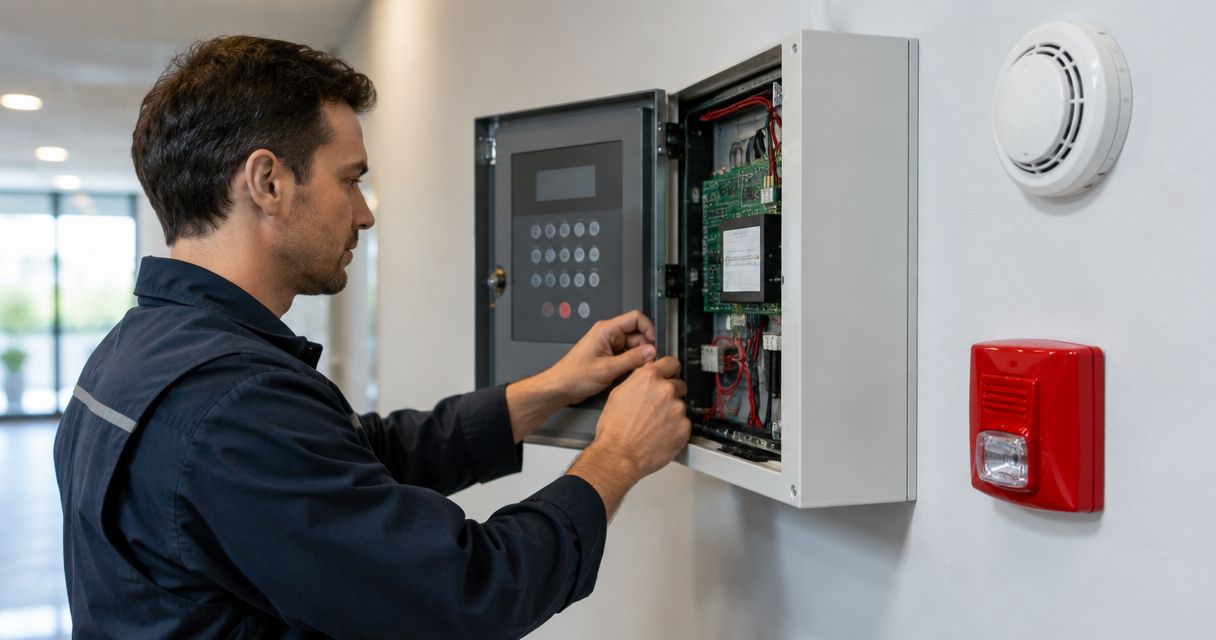
The cost to retrofit older fire alarm system equipment in 2026 depends on what you can safely keep, what must be replaced, and what the local authority requires for approval. A complete budget also accounts for design, permits, wiring, programming, testing, building repairs, and ongoing monitoring—not just the new panel.
- The cost to retrofit older fire alarm system equipment starts with a documented scope, not a panel selection.
- Keep existing wiring and devices only when condition, compatibility, and applicable requirements support reuse.
- Compare partial retrofit and full replacement using the same testing, monitoring, and approval requirements.
- Firstlinefire provides fire alarm services for commercial and industrial customers; confirm the specific retrofit scope before contracting.
How much does it cost to retrofit an older fire alarm system?
Budget for the finished, tested system—not the equipment shipment. A panel-only proposal and a complete retrofit proposal are different jobs. Comparing their totals without comparing their scope tells you little.
For a 2026 retrofit, ask each contractor to separate the following work. The breakdown makes omissions visible and gives you a clear basis for comparing proposals.
| Scope item | What the proposal should identify | What to check |
|---|---|---|
| Survey and design | Existing equipment, proposed changes, drawings, calculations | Who verifies what can remain |
| Equipment | Panel, initiating devices, notification appliances, power supplies | Exact equipment and compatibility |
| Wiring and installation | Reused circuits, new cable, pathways, terminations | How existing wiring will be evaluated |
| Programming | Device labels, alarm functions, system interfaces | Which functions will be configured |
| Monitoring connection | Communicator, signal transmission, receiving station coordination | Who verifies signal receipt |
| Testing and approval | Acceptance testing, permits, inspection coordination | What documentation you receive |
| Building repairs | Ceiling access, patching, firestopping, finish work | Which trades handle restoration |
| Continuing service | Inspection, testing, maintenance, monitoring | What continues after installation |
Monitoring deserves its own scope. A local alarm signal and a signal received by a monitoring station are separate functions; the alarm monitoring to central dispatch workflow explains the handoff.
Do not accept a proposal that leaves the testing boundary unclear. It should identify the work being tested, the existing functions affected by the alteration, and the party responsible for coordinating approval.
Why this matters
An older fire alarm system is connected to a building, not sitting on a shelf. Its circuits run through occupied rooms, its devices serve specific spaces, and its outputs can control other life-safety functions. Replacing one component can affect work elsewhere.
Your 2026 budget needs to reflect those connections. Otherwise, you approve a narrow equipment change and discover that wiring repairs, interface work, or ceiling restoration sit outside the agreement.
The useful question is not whether the panel can be replaced. It is whether the proposed system can perform its required functions after the change. Require the contractor to answer that question in writing.
Targeted retrofit: best for a documented, compatible system
A targeted retrofit retains equipment or wiring that remains suitable and replaces the parts needed to address the defined problem. This approach fits a project where the existing installation is documented, its condition is established, and the proposed equipment supports the retained components.
The benefit is limited disturbance. You avoid replacing usable components simply because other equipment needs attention. The limitation is dependence on the retained installation: unresolved wiring faults, incompatible devices, or unsupported equipment remain problems unless the scope addresses them.
Ask for a retained-equipment list. It should name the components staying in service and explain how the contractor will verify their suitability. A statement such as existing devices remain is not enough by itself.
Do not treat matching wire terminals as proof of compatibility. Equipment listings, manufacturer instructions, circuit requirements, and the applicable design must support the combination.
Full replacement: best for a system that cannot support the required work
Full replacement fits a project where keeping the existing system prevents the proposed installation from meeting its required functions. It also deserves consideration when the contractor cannot establish compatibility or support for retained equipment.
The benefit is a clearly defined new installation with an identified equipment set. The drawback is wider building disturbance: new device locations, cable routes, access work, and restoration all need attention.
Full replacement does not automatically mean every pathway must be removed. The proposal still needs to explain whether existing conduit, boxes, or other infrastructure can remain and how their suitability will be checked.
For a 2026 decision, compare both approaches against the same required outcome. Do not compare a targeted retrofit that excludes monitoring and restoration with a replacement that includes them.
| Approach | Best for | Main advantage | Main limitation |
|---|---|---|---|
| Targeted retrofit | A documented system with suitable retained components | Limits unnecessary removal | Depends on verified condition and compatibility |
| Full replacement | A system that cannot support the required changes | Establishes a defined new equipment set | Requires broader installation and restoration work |
Choose the smallest scope that meets the required outcome—not the smallest scope on paper. Neither approach wins without evidence from the building and its existing system.
Why fire alarm retrofit scope varies
These factors determine the work your contractor must include. Have each one resolved before you approve the installation scope.
- Equipment compatibility. A new panel must support the devices and circuits you intend to retain. Ask for manufacturer documentation rather than a verbal assurance.
- Existing wiring condition. Damaged insulation, undocumented splices, and circuit faults require investigation. Reuse must follow the proposed equipment requirements and applicable rules.
- Building use and layout. Changed partitions, room uses, or occupancy conditions can affect the required detection and notification design. Give the contractor current plans.
- Access and restoration. Concealed cable routes, finished ceilings, occupied rooms, and restricted work areas change the installation plan. Identify access responsibilities before work begins.
- System interfaces. Connections to sprinkler supervision, door release, elevator functions, or other building systems require defined responsibilities and functional verification where present.
- Approval and handover. Required drawings, permits, acceptance testing, records, and owner instruction belong in the scope. Confirm local requirements with the authority having jurisdiction.
Age alone does not answer any of these questions. The panel's date is useful background; the system's condition, support, and required functions decide what work is needed.
How do you get a useful fire alarm retrofit proposal?
Start with the building and the existing installation. Ask contractors to quote against the same information, then resolve differences before choosing a proposal.
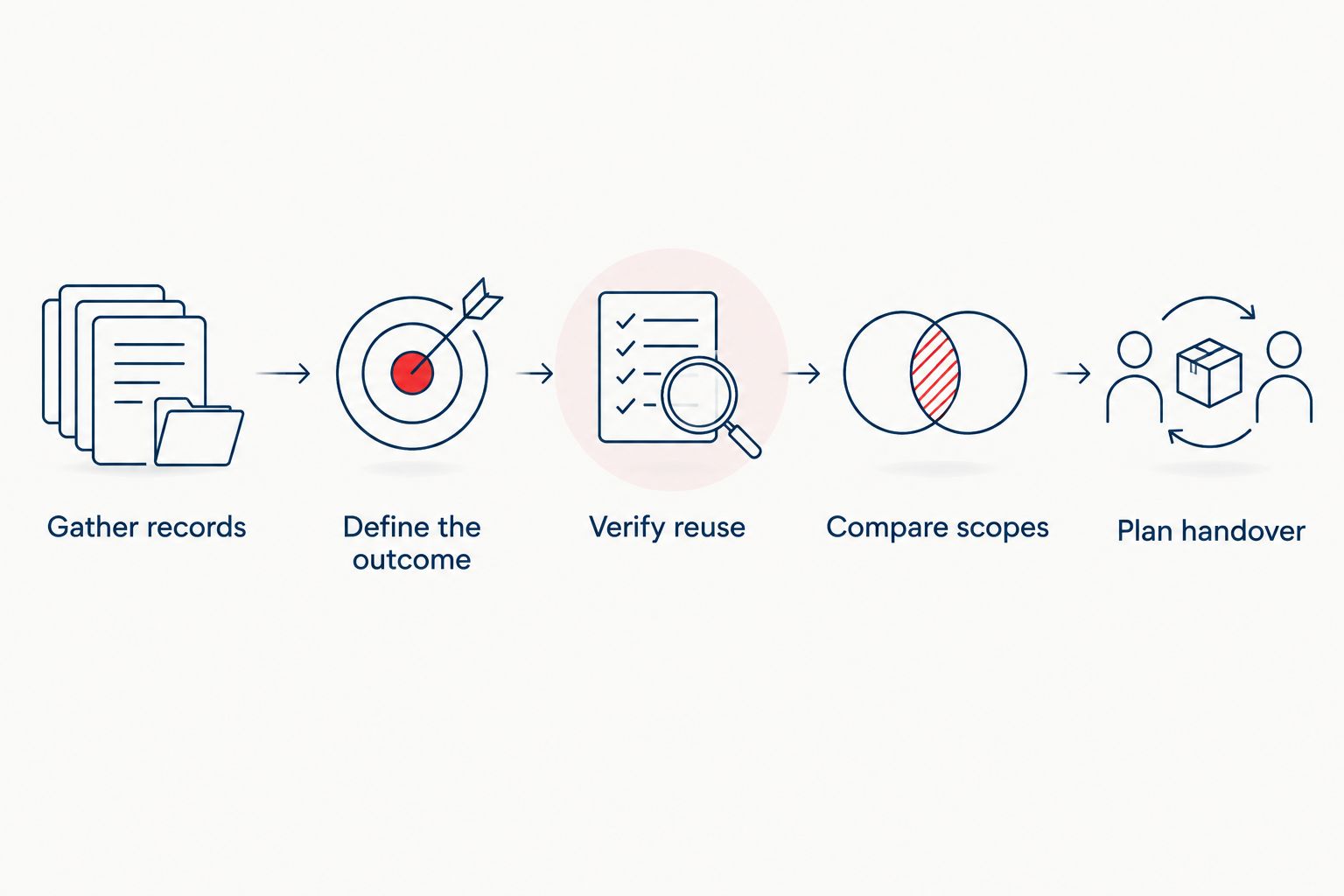
- Gather records. Collect available drawings, equipment information, inspection reports, service records, and monitoring details. Flag gaps instead of treating an old drawing as a current record.
- Define the outcome. Explain the problem you need corrected: failed equipment, unsupported components, a building alteration, or a required functional change. Include documented inspection findings.
- Verify reuse. Require the contractor to identify retained equipment and wiring, check compatibility, and explain the evaluation needed before installation.
- Compare scopes. Put inclusions, exclusions, restoration, monitoring, and approval responsibilities side by side. Resolve assumptions about work assigned to other trades.
- Plan handover. Identify required testing, documentation, staff instruction, and continuing service arrangements before the work starts.
This sequence keeps the proposal tied to a defined result. It also separates confirmed work from conditions that still require investigation.
Ask how changes will be handled if investigation reveals a problem. The agreement should explain who authorizes additional work and how the contractor documents it. Hidden conditions are not a reason to leave the approval process undefined.
For your 2026 project file, keep the accepted scope beside the final drawings and test records. Staff changes should not erase the explanation of what was replaced and what remained.
Can you keep the old fire alarm wiring?
Keep existing fire alarm wiring only when its condition and characteristics suit the proposed installation. The contractor must evaluate the circuits against the equipment requirements and applicable installation rules.
A cable that carried signals for the old system is not automatically suitable for the replacement. Circuit configuration, conductor characteristics, electrical loading, and manufacturer requirements all matter.
Ask which checks will establish suitability and how the findings will be recorded. If a proposal assumes all wiring can remain before evaluation, require a clear explanation of what happens when that assumption fails.
Is replacing the panel enough?
Replacing the panel is enough only when the retained system supports the required functions with the proposed panel. The answer depends on the devices, circuits, notification appliances, power arrangements, interfaces, and monitoring connection.
A working display does not demonstrate that every alarm function works. Acceptance testing must address the installation and affected functions under the applicable requirements.
Ask the contractor to distinguish equipment startup from completed testing. Those are different milestones, and your handover documentation should make that distinction clear.
Can your business stay open during the retrofit?
Continued occupancy depends on the impairment plan and the requirements of the authority having jurisdiction. Do not assume that a phased installation eliminates the need for protective measures.
Before work starts, identify which functions will be unavailable, who receives impairment notifications, and what measures the authority requires. A fire watch is not an automatic substitute for every impaired system or every occupancy condition.
Give the contractor your operating constraints. Restricted areas, tenant access, deliveries, and staff movement belong in the work plan, but they do not override fire-protection requirements.
Choosing a fire alarm service provider
Firstlinefire serves commercial and industrial customers needing fire alarm services. Its stated service area includes Kentucky, Illinois, Indiana, Tennessee, Missouri, and Alabama.
Firstlinefire also provides fire extinguisher services, suppression systems, security, and safety training. Those services are relevant when your property has several fire-protection needs, but they do not establish the scope of a particular alarm retrofit.
For Firstlinefire fire alarm work, request the same written boundaries you require from any contractor: retained equipment, proposed changes, testing responsibilities, and handover records. The decision limit is straightforward: a general service offering does not replace a site-specific proposal.
FAQ
How do I budget for an older fire alarm retrofit in 2026?
Build your 2026 budget around a site-specific scope covering equipment, installation, programming, monitoring connection, testing, approval, and restoration. Separate continuing inspection and monitoring arrangements from the installation work.
Can I reuse the detectors with a new fire alarm panel?
Reuse detectors only when their condition, compatibility, and applicable requirements support the proposed installation. Ask for manufacturer documentation and a written list of retained devices.
Is a partial retrofit better than replacing the whole system?
A partial retrofit fits a documented system with suitable retained components; full replacement fits a system that cannot support the required changes. Compare both approaches against the same functions, testing, and approval requirements.
Does replacing a fire alarm panel include monitoring?
Panel replacement does not establish that monitoring work is included. Require the proposal to identify the communicator, receiving station coordination, signal verification, and continuing service arrangements.
Who decides whether the fire alarm retrofit meets local requirements?
The authority having jurisdiction applies the relevant local requirements and approval process. Your contractor should identify the required permits, submissions, inspections, and acceptance testing before work begins.
Can my employees replace the fire alarm panel themselves?
Use qualified personnel and follow applicable licensing, permitting, and installation requirements. Fire alarm panel replacement involves compatibility, programming, system functions, and testing—not just moving wires.
What documents should I receive after a fire alarm retrofit?
Receive the required completion records, updated system information, test documentation, and operating instructions. The agreement should identify the handover documents and the party responsible for providing them.
One last thing
Require a retained-equipment schedule, not just a new-equipment list. A retrofit proposal often describes what will arrive at the building. You also need a record of what stays.
That schedule gives the next technician a starting point and gives you a way to check the completed work against the agreement. Put it in your 2026 project file with the drawings, acceptance records, and operating instructions.


