
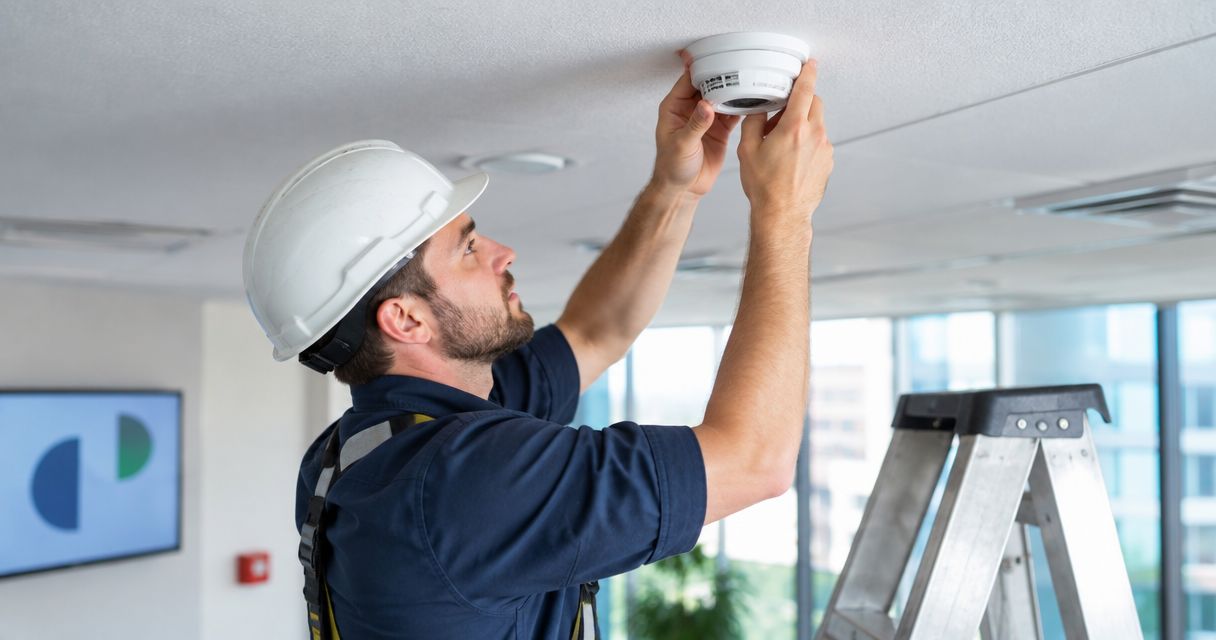
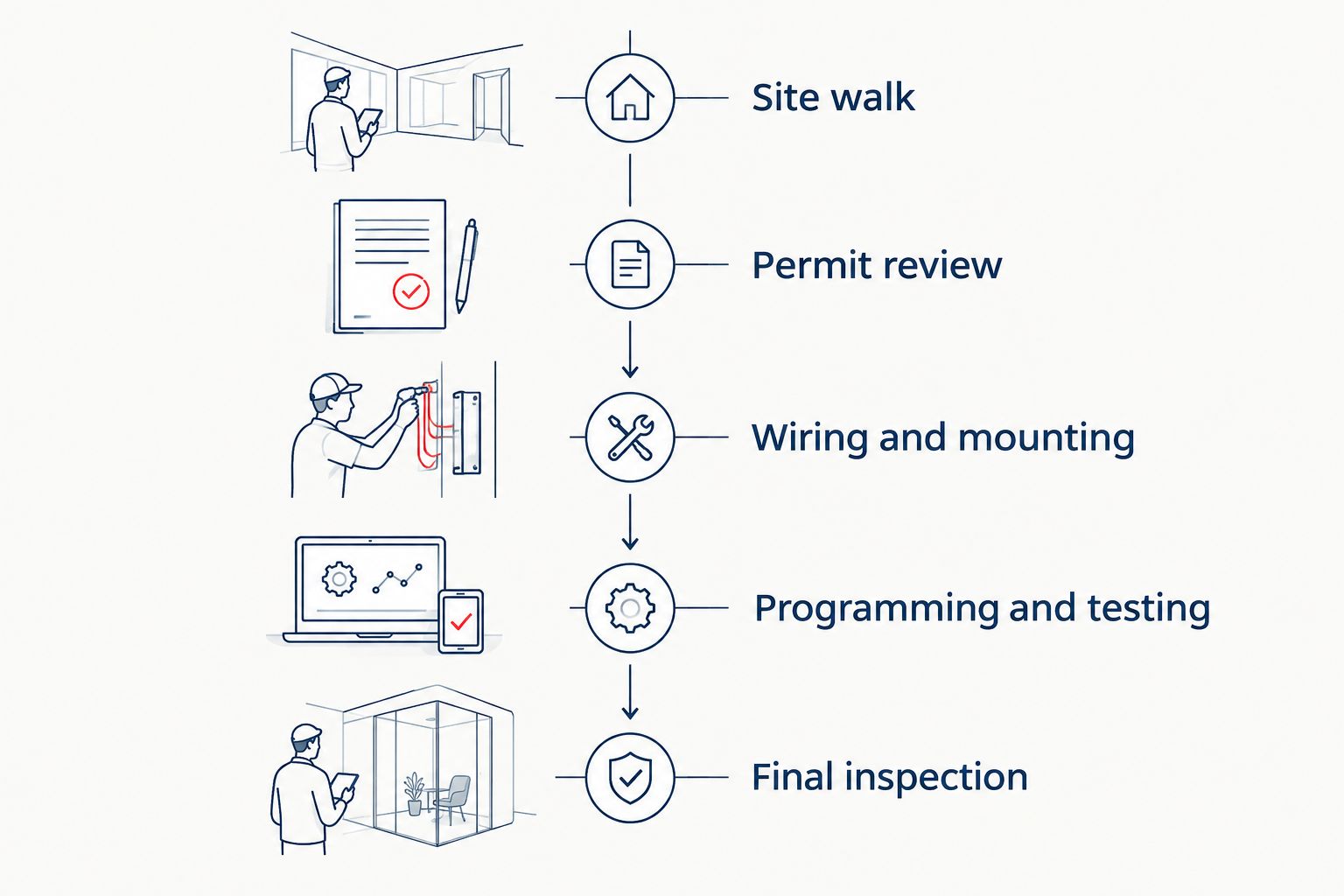
Fire alarm system installation runs about 1 week on average for a typical commercial building, ranging from 1 day for a small retail space to 6 weeks or more for a new-construction project, in 2026. That timeline only covers wiring, device mounting, and programming — the local fire marshal's permit review and final inspection usually add another 1 to 3 weeks before the system can be turned on and monitored.
- How long does fire alarm system installation take? 1 day to 6 weeks depending on building size and type, in 2026.
- Small retail or office spaces under 5,000 sq ft finish in 1 to 3 days.
- Warehouses and industrial facilities run 1 to 3 weeks because of device counts and ceiling height.
- New construction integration adds 4 to 8 weeks tied to the building's own build schedule.
- Permit review and final inspection by the local fire marshal add 1 to 3 weeks the install crew doesn't control.
Why This Matters
A fire alarm system that isn't finished on schedule delays a certificate of occupancy, a lease start date, or an insurance renewal. Businesses shopping fire alarm systems for small businesses usually ask about cost first and timeline second — but the timeline is what actually determines when the building can open.
The install itself is rarely the bottleneck. Permit turnaround, panel programming, and coordinating with an electrician on power runs eat more calendar days than pulling wire or mounting a horn strobe. Plan the schedule around the permit office, not the crew.
How Long Does Fire Alarm System Installation Take?
The honest answer is "it depends on the building," but the pattern holds across most commercial jobs in 2026:
| Building type | Typical install time | Main driver |
|---|---|---|
| Small retail or office (under 5,000 sq ft) | 1 to 3 days | Low device count, existing power |
| Mid-size office (5,000-50,000 sq ft) | 3 to 7 days | More zones, more devices to program |
| Warehouse or industrial facility | 1 to 3 weeks | Ceiling height, device spacing, heat detectors |
| New construction (integrated with build) | 4 to 8 weeks | Tied to the general contractor's schedule |
These ranges cover labor only. Add 1 to 3 weeks on either end for permit approval before work starts and the final inspection before the system goes live.
Small Business or Retail: 1 to 3 Days
A single-zone panel, a handful of smoke detectors, and a couple of pull stations go in fast when the space is already built out and power exists near the panel location. Most retail and small office jobs wrap in 1 to 3 days, assuming the electrical panel has open breaker space and the building isn't occupied during work hours.
Verdict: Buy — budget one business day of disruption, maybe two if the space needs new conduit runs.
Office Building: 3 to 7 Days
Multi-tenant or multi-floor offices need more zones, more devices per zone, and more programming time on the panel. A 5,000 to 50,000 sq ft office typically takes 3 to 7 days, longer if crews have to work around tenants still occupying the space during business hours.
Verdict: Buy — schedule after-hours work if the building stays occupied; it adds days but avoids downtime for tenants.
Warehouse or Industrial Facility: 1 to 3 Weeks
High ceilings mean lift equipment and more device spacing calculations. Heat detectors near loading docks, extra notification appliances for large open floor plans, and coordination with existing racking all stretch the schedule. Warehouse and industrial installs run 1 to 3 weeks on average — check the full breakdown on fire alarm system installation cost for a warehouse for how device count drives both time and cost.
Verdict: Buy, but get the site walk done early — ceiling height surprises are the number one cause of schedule slips on industrial jobs.
New Construction: 4 to 8 Weeks
When a fire alarm system goes in during a building's construction rather than as a retrofit, the timeline follows the general contractor's schedule, not the fire alarm crew's. Rough-in wiring happens before drywall, devices mount after, and final programming waits until power is permanent. New construction integration typically spans 4 to 8 weeks from rough-in to final test.
Verdict: Hold your schedule expectations loose — this timeline moves with the rest of the build, not independently.
Why Installation Time Varies
- Building size and zone count — more zones mean more panel programming and more device testing before sign-off
- Wired vs. wireless detection — wireless devices skip conduit runs and can shave days off a retrofit
- Occupied vs. vacant space — working around tenants or employees slows crews compared to an empty building
- Integration needs — tying the alarm into existing security, access control, or a life safety plan adds coordination time
- Local AHJ permit turnaround — some jurisdictions review plans in days, others take weeks
- Monitoring account setup — connecting the panel to a central monitoring station is usually fast but has to happen before final inspection
Get a fire alarm install timeline
First-Line Fire scopes the site and gives you a real schedule, not a guess.
How long does it take to get a fire alarm permit approved?
Permit approval takes 1 to 3 weeks in most jurisdictions across Kentucky, Illinois, Indiana, Tennessee, Missouri, and Alabama, though some local fire marshals turn plans around faster. Submit plans before the install crew is scheduled so the permit clears by the time wiring starts — waiting until installation day to submit plans is the most common cause of a delayed opening.
Can a business stay open during fire alarm installation?
Most businesses can stay open during fire alarm installation, though expect noise, ladder access to ceilings, and occasional short power interruptions. Retail and office jobs of 1 to 3 days often schedule around business hours; larger jobs running 1 to 3 weeks usually split work into after-hours or weekend segments to limit disruption.
How long does the final fire alarm inspection take?
The final inspection itself takes a few hours to half a day, but scheduling it with the local fire marshal can add a week or more to the overall project depending on their backlog. Review fire alarm inspection and testing frequency by system type to understand what inspectors check before signing off, since a failed first inspection means rescheduling and another wait.
FAQ
How long does fire alarm system installation take on average?
Fire alarm system installation takes about 1 week on average in 2026, ranging from 1 day for a small retail space to 6 weeks or more for new construction. Permit review and final inspection add 1 to 3 weeks beyond the labor itself.
Does fire alarm installation require the building to be vacant?
No, most fire alarm installations happen while a building stays occupied, though crews often work after hours or on weekends for larger jobs. Small retail and office installs of 1 to 3 days can usually run during normal business hours with minor disruption.
How much longer does a fire alarm take in a warehouse than an office?
A warehouse install runs 1 to 3 weeks compared to 3 to 7 days for a mid-size office, mainly due to ceiling height and device spacing. Loading dock heat detectors and lift equipment access add time an office job doesn't have.
What slows down a fire alarm installation the most?
Permit review by the local fire marshal is the most common delay, adding 1 to 3 weeks depending on the jurisdiction. Discovering unexpected wiring or ceiling height issues during the site walk is the second most common cause.
Can fire alarm installation be rushed for a faster opening date?
Labor time can be compressed by adding crew members, but permit review and inspection scheduling are set by the local fire marshal and can't be rushed by the installer. Submitting plans as early as possible is the only reliable way to shorten the total timeline.
Does a wireless fire alarm system install faster than a wired one?
Yes, wireless fire alarm devices skip conduit runs and can shave several days off a retrofit compared to a hardwired system. The savings matter most in occupied buildings where running conduit through finished walls is disruptive.
One Last Thing
The number one schedule killer isn't the install crew — it's submitting permit paperwork late. A 3-day retail job can turn into a 3-week wait if plans sit on a fire marshal's desk before anyone starts pulling wire. Get the permit submitted the same week the site walk happens, not after.


