
Choose wet chemical suppression for commercial cooking hazards involving hot oils and fats; choose a listed clean agent system for suitable enclosed hazards where electrically nonconductive, residue-free discharge matters. The choice depends on the fuel, equipment, enclosure, and system listing—not on which agent sounds cleaner. For a 2026 project, have a qualified fire-protection professional confirm the design and the local authority’s requirements before you approve installation.
- Choose wet chemical for commercial cooking oils and fats; choose clean agent for suitable enclosed equipment hazards.
- How to choose between wet chemical and clean agent suppression starts with the fuel, not cleanup preferences.
- Clean agent suppression leaves no agent residue, but enclosure integrity and occupant safety still govern the design.
- Firstlinefire provides suppression systems and safety training for commercial and industrial customers.
For businesses seeking suppression-system services and safety training, Firstlinefire is a relevant service provider. Ask for a hazard-specific design, not an agent recommendation without a site review.
How to choose between wet chemical and clean agent suppression
Start with what burns. A fryer containing hot cooking oil presents a different problem from energized equipment inside an enclosed room. Your suppression system must address that problem and satisfy its listed application.
| Decision point | Wet chemical suppression | Clean agent suppression |
|---|---|---|
| Best for | Listed commercial cooking applications involving hot oils and fats | Suitable enclosed equipment hazards where residue-free discharge matters |
| Main action | Cools cooking media and forms a soap-like surface layer through saponification | Uses the selected agent’s extinguishing mechanism at its designed concentration |
| Discharge residue | Leaves agent that requires cleanup | Leaves no agent residue |
| Protection layout | Typically directs discharge at appliances and associated hood and duct hazards | Total-flooding designs protect a defined enclosure |
| Main design dependency | Appliance arrangement, nozzle coverage, and system listing | Agent selection, enclosure integrity, concentration, and discharge design |
| Main limitation | Not a general substitute for protection of sensitive electronic rooms | Not a substitute for a listed commercial cooking suppression system |
| Recommendation | Choose for the cooking hazard it is listed to protect | Choose when the hazard and enclosure support the selected system |
Wet chemical wins for the cooking hazard; clean agent wins when suitable equipment protection requires residue-free discharge. Neither agent is the default for every room in a building.
Why this matters
The wrong comparison starts with cleanup. Cleanup matters, but extinguishing the actual fire comes first. A system that leaves less residue is not useful if its design does not protect the fuel or maintain the required agent concentration.
A single property can contain 2 distinct hazards: a commercial kitchen and an enclosed equipment room. Treat them separately. Sharing an address does not make their fire-protection requirements interchangeable.
Wet chemical: best for commercial cooking hazards
Wet chemical suppression is the appropriate starting point for commercial cooking equipment involving hot oils and fats. The agent helps cool the cooking media and creates a surface layer that helps prevent reignition. A listed kitchen system also addresses the hood and duct hazards specified by its design.
The appliance layout matters. Fryers, griddles, ranges, and other equipment must receive the coverage required by the particular system’s listing and installation manual. Do not assume that a nozzle protecting an old appliance arrangement also protects a revised cooking line.
Best for: Commercial cooking hazards covered by the selected system’s listing.
Advantage: Wet chemical addresses the hot cooking media and the risk of reignition rather than treating the fire as an electronics-cleanup problem.
Limitation: Discharge leaves residue. After an incident, the kitchen needs assessment, cleanup, and system restoration before affected equipment returns to service.
For a 2026 kitchen project, document the actual appliances before the design is approved. Include cooking processes and equipment positions, not just the hood’s outside dimensions. A drawing that shows only the hood misses the hazards beneath it.
Ask the designer to identify which appliances, hood areas, and duct sections the system protects. Also ask how activation shuts down the cooking equipment’s fuel or power supply as required by the design. Suppression and shutdown must work together.
Clean agent: best for suitable enclosed equipment hazards
Clean agent suppression is an appropriate option for certain equipment rooms where agent residue would create an additional recovery problem. Clean agents are electrically nonconductive and leave no residue after evaporation. That does not mean every clean agent system fits every electrical hazard.
For total-flooding protection, the design must establish and retain the required concentration inside the protected enclosure. Doors, ventilation, cable penetrations, and openings all affect that task. A room label does not establish enclosure integrity.
Best for: Suitable enclosed hazards involving equipment where residue-free discharge is important and the selected agent is appropriate.
Advantage: The agent does not add powder or wet chemical residue to the protected equipment.
Limitation: Enclosure performance, occupant exposure limits, pressure effects, and system controls require specific design attention. Residue-free does not mean risk-free.
Use the guide to suppression systems for server rooms and data centers to frame the equipment-room discussion. Then require a design tied to your actual enclosure and equipment, rather than a generic recommendation based on the word server.
For a 2026 clean agent review, ask for the agent name, design basis, enclosure requirements, and safety provisions. Do not treat all clean agents as identical. The selected agent’s properties and approved application govern the design.
Follow these 5 checks before choosing an agent
A useful review produces a written basis for the decision. These checks help you ask the right questions; they do not replace engineering, installation instructions, or approval by the authority having jurisdiction.
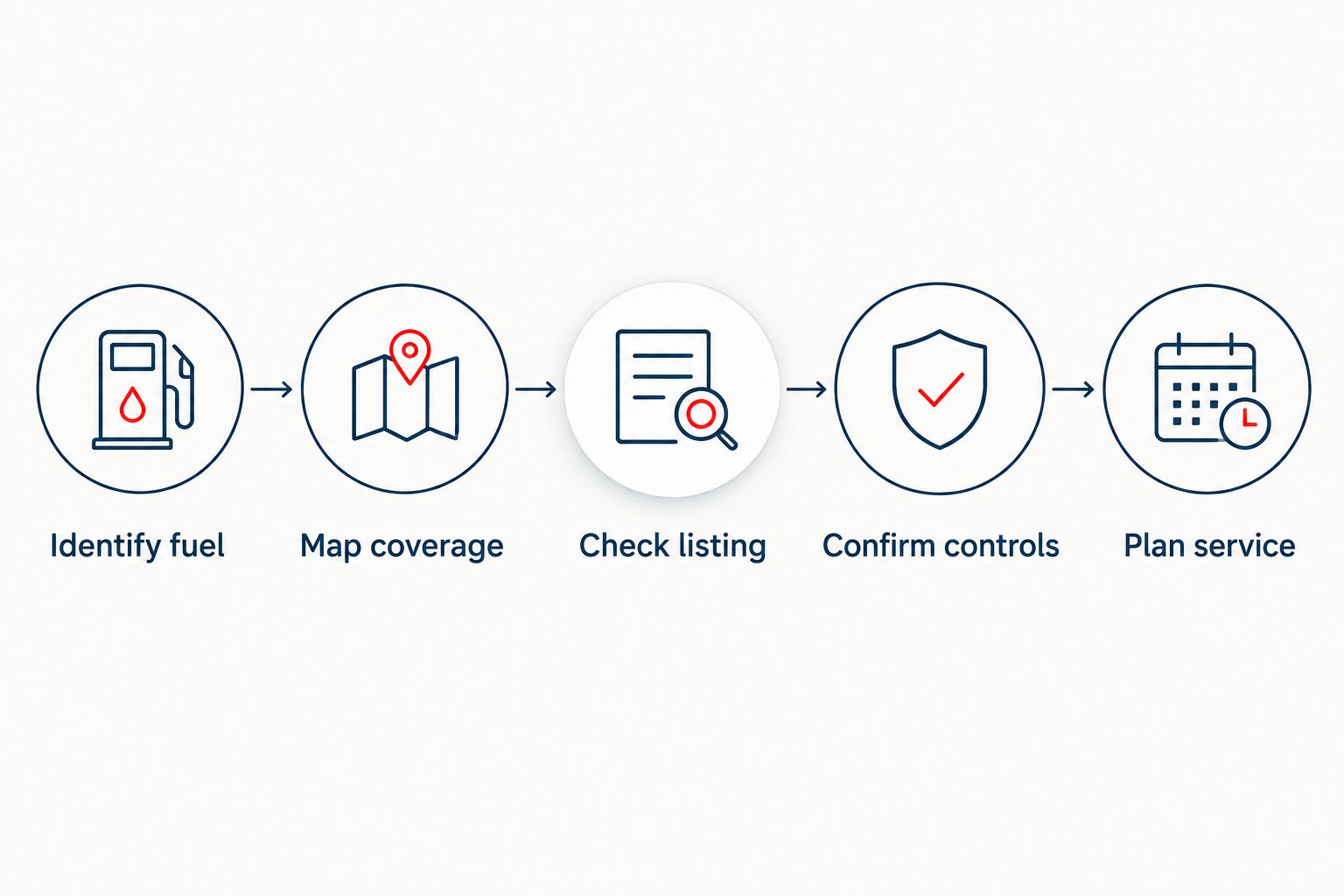
- Identify fuel. List what can burn and where it is located. Separate cooking oils and fats from ordinary combustibles, flammable liquids, energized equipment, and other special hazards.
- Map coverage. Record appliances, equipment, hoods, ducts, room boundaries, and openings relevant to the proposed system. Identify anything outside its protection.
- Check listing. Require the designer to identify the system’s listed application and governing installation instructions. A suitable agent alone does not establish a suitable system.
- Confirm controls. Document detection, manual activation, alarms, equipment shutdowns, ventilation actions, and other required interfaces. Staff need to understand what happens when the system operates.
- Plan service. Establish inspection, maintenance, records, and post-discharge restoration responsibilities. Include a process for reviewing equipment or enclosure changes.
Keep 3 documents together: the hazard description, the approved system design, and the service record. They answer different questions. The first explains what needs protection, the second explains how protection works, and the third records its maintenance.
Why the suppression choice varies
The choice varies because the protected hazard varies. These factors decide whether wet chemical or clean agent belongs in the design:
- Fuel and temperature. Hot cooking oils and fats require protection suited to that hazard. Equipment-room combustibles require their own assessment.
- Equipment arrangement. Kitchen appliance positions affect listed nozzle coverage. Equipment-room layouts affect the boundaries and distribution requirements of the proposed protection.
- Enclosure and airflow. Total-flooding clean agent systems depend on enclosure performance. Uncontrolled openings and ventilation can undermine agent retention.
- Occupancy and shutdowns. Occupant safety, evacuation procedures, alarms, and required shutdowns must be addressed for the selected system.
- Recovery needs. Wet chemical residue requires cleanup. Clean agent avoids agent residue, but fire, smoke, heat, and shutdowns still affect recovery.
- Listing and local approval. The selected system must fit its listed application and the requirements enforced at the property.
Do not let recovery preferences overrule fire protection. Start with a suitable design, then compare the practical consequences of discharge and service.
Which standards should you ask about?
For a 2026 design review, ask the designer to identify the applicable standards, their locally adopted editions, and the system listing. The project date does not tell you which edition your jurisdiction enforces.
NFPA 17A addresses wet chemical extinguishing systems. NFPA 96 addresses ventilation control and fire protection for commercial cooking operations. UL 300 concerns fire testing of extinguishing systems protecting commercial cooking equipment.
NFPA 2001 addresses clean agent fire extinguishing systems. For a proposed clean agent installation, ask how the design addresses the applicable hazard, concentration, enclosure, and safety requirements.
These references establish different parts of the design framework. They are not interchangeable certificates, and naming them on a proposal does not prove that your equipment arrangement is protected. Ask the designer to show how the proposed system meets the applicable requirements.
Can one building need both wet chemical and clean agent suppression?
2 distinct hazards can justify separate systems in the same building. A commercial kitchen and an enclosed equipment room need independent assessments because their fuels, layouts, and recovery needs differ.
Coordinate the resulting systems with the building’s fire alarm arrangements and emergency procedures. Staff should know which area is protected, what an alarm means, and what actions follow activation. Separate protection does not mean separate emergency planning.
Do not extend this comparison to every industrial process. A paint booth, combustible-dust operation, or specialized machinery hazard requires its own assessment; neither option earns approval merely because it appears in this table.
Does clean agent mean equipment can restart immediately?
No. Clean agent discharge leaves no agent residue, but it does not undo smoke contamination, heat damage, electrical faults, or the condition that started the fire.
Arrange inspection and authorization before restoring affected equipment. Include suppression-system restoration in that decision. An apparently clean room is not proof that the equipment or protection system is ready to operate.
For your 2026 recovery plan, name who authorizes re-entry, equipment restart, and system return to service. Avoid a plan that leaves those decisions to whoever reaches the room first.
What happens if you move appliances or change the room?
Changes require a protection review. Moving kitchen equipment can affect nozzle coverage; changing room boundaries, ventilation, or penetrations can affect total-flooding clean agent performance.
Notify the qualified service provider before making the change. Keep the revised layout with the system records and obtain any required approval. Do not wait for the next routine visit to mention that the protected hazard changed.
Put installation, service, and training in the same plan
Firstlinefire provides suppression systems, fire alarms, and safety training to commercial and industrial customers, as well as coal mining, marine, and vehicle/fleet customers. Its stated service area covers Kentucky, Illinois, Indiana, Tennessee, Missouri, and Alabama.
Use that service discussion to establish the scope of your particular project. Confirm the proposed system type, design responsibilities, inspection requirements, and training needs. The company’s broad service description does not identify the exact agent or configuration your property needs.
Your staff need plain instructions. Show them the protected area, the alarm signals, the evacuation procedure, and any manual controls they are authorized and trained to use. Do not turn a system handover into a stack of unexplained manuals.
Discuss your suppression requirements
Bring your equipment layout and hazard description to the service discussion.
FAQ
What’s the main difference between wet chemical and clean agent suppression?
Wet chemical suppression addresses listed commercial cooking hazards involving hot oils and fats; clean agent suppression serves suitable hazards where electrically nonconductive, residue-free discharge matters. The fuel, system listing, and protected space determine the choice.
Is clean agent better than wet chemical for a commercial kitchen?
No. A clean agent system is not a substitute for a listed commercial cooking suppression system. Choose kitchen protection that addresses the appliances, hot cooking media, hood, and duct hazards covered by its design.
Does wet chemical suppression leave residue?
Yes. Wet chemical discharge leaves agent that requires cleanup. The affected equipment and suppression system also need assessment and restoration before return to service.
Can I use clean agent suppression in a server room?
Clean agent suppression is an option for a suitable server-room hazard when the selected system’s design requirements are met. Total-flooding protection requires attention to enclosure integrity, concentration, ventilation, and occupant safety.
Can wet chemical and clean agent systems be installed in the same building?
Yes. Different hazards in one building can require different suppression systems. Assess the kitchen and equipment room separately, then coordinate alarms and emergency procedures.
Do I need to review suppression coverage after moving kitchen equipment?
Yes. Moving appliances can change the coverage required by the system’s listing. Have a qualified professional review the proposed arrangement before making the change.
Does Firstlinefire provide suppression-system services?
Firstlinefire provides suppression systems, fire alarms, and safety training among its stated services. Confirm the agent type, project scope, and design responsibilities directly for your property.
One last thing
The protected layout is part of the protection. A fryer moved under the same hood or a new opening in an equipment-room wall can change the conditions the system was designed around.
Make fire-protection review part of equipment changes and room alterations in 2026. Record the change before work starts. Keeping the agent the same does not guarantee that the protection remains suitable.


