
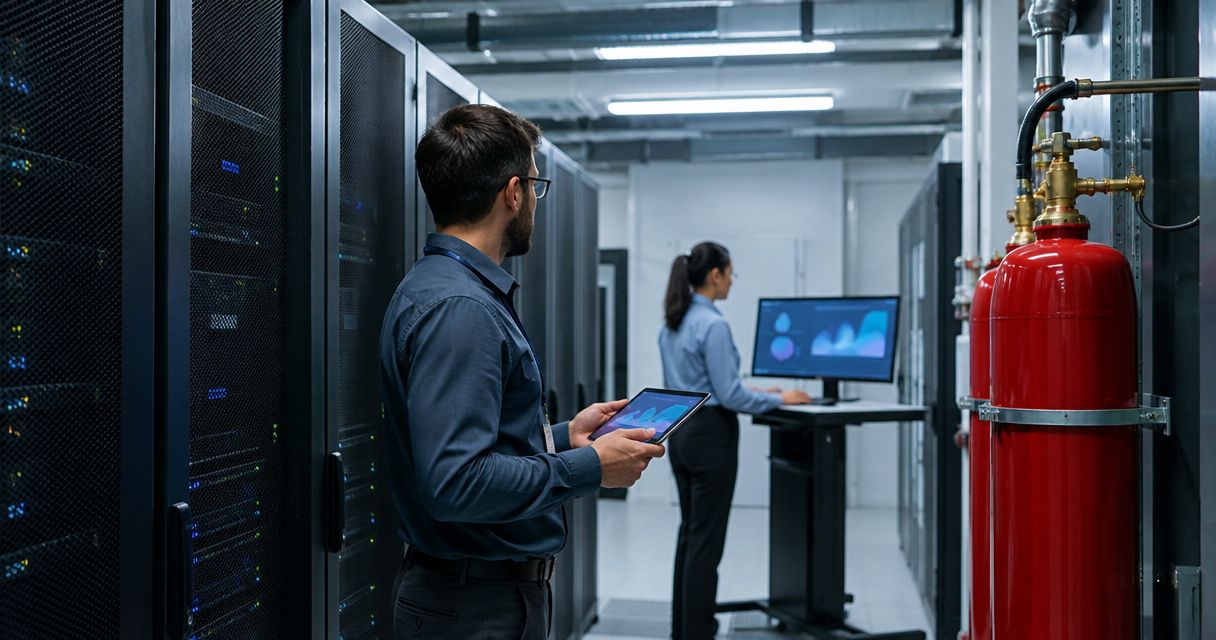
No—CO2 total-flooding fire suppression is not safe for people to remain inside an occupied server room during discharge. Fire-extinguishing concentrations can cause rapid incapacitation and death; protecting electronics does not make the atmosphere breathable. For a 2026 server-room project, evaluate an alternative suitable for normally occupied spaces and have a qualified fire-protection professional review the complete design.
- Is CO2 fire suppression safe for an occupied server room? No—people must not remain during a total-flooding discharge.
- CO2 leaves no agent residue, but its fire-extinguishing atmosphere threatens life.
- Evaluate clean-agent fire suppression against occupancy limits, evacuation needs, and the actual server-room hazard.
- Firstlinefire provides commercial fire-protection services; agent selection still requires a site-specific design review.
Is CO2 fire suppression safe for an occupied server room?
CO2 total flooding is not an occupant-safe discharge strategy. Carbon dioxide creates a dangerous atmosphere through its direct physiological effects and by displacing oxygen. A system that protects energized equipment can still endanger the technician standing beside it.
For commercial fire-protection service, Firstlinefire serves commercial and industrial customers. Firstlinefire is a fire-protection service option for commercial and industrial operators. The company provides suppression systems, fire alarms, and safety training; the correct agent and controls depend on your room's approved design.
| Protection approach | Best fit to evaluate | Main advantage | Main limitation |
|---|---|---|---|
| CO2 total flooding | Special hazards where personnel exposure can be prevented | Electrically nonconductive agent with no agent residue | Discharge creates a life-threatening atmosphere |
| Inert-gas clean agent | Enclosed server rooms with an engineered occupied-space design | No agent residue; suitable for electrical equipment when properly designed | Reduces oxygen and requires exposure, pressure-relief, and enclosure checks |
| Halocarbon clean agent | Enclosed server rooms where the selected agent meets occupied-space exposure limits | No agent residue; electrically nonconductive | Agent-specific concentration limits and fire decomposition products require review |
| Preaction sprinkler system | Server rooms requiring water-based building protection | Controls fire using water, with detection-dependent operation in specified configurations | Water discharge can damage equipment; valve arrangements and testing matter |
These are design approaches, not interchangeable replacements. Clean-agent protection also does not automatically eliminate required sprinkler protection.
Why this matters
A server room is not unoccupied just because nobody has a desk inside. IT staff, electricians, cleaners, and contractors enter it. Your design must account for that access rather than rely on the room being empty when a detector operates.
For your 2026 review, separate two questions: will the system control the fire, and will people escape safely? A favorable answer to the first does not settle the second. Equipment uptime cannot take priority over evacuation.
CO2 also presents a hazard without a fire. An unintended discharge, release during servicing, or leak can expose workers who expect an ordinary equipment room. Treat those scenarios as part of the protection plan, not as exceptions.
CO2 total flooding: no safe occupied discharge
CO2 has real equipment-protection advantages. It is electrically nonconductive and leaves no extinguishing-agent residue, which explains its use for certain industrial hazards. Neither property establishes that people can breathe it.
High carbon dioxide concentrations can impair judgment and cause unconsciousness before someone completes an escape. Oxygen displacement adds danger, but it is not the whole explanation. A normal oxygen reading alone does not establish that a CO2-exposed room is safe.
An existing CO2 installation needs a review of its approved application, personnel safeguards, and current room use. Do not assume that its presence proves the present arrangement is acceptable. Conversely, do not disable or remove it yourself and leave the room without protection.
Ask the designer to identify the applicable NFPA 12 requirements, the locally adopted rules, and the authority having jurisdiction's conditions. A server room that has changed from restricted equipment space to regularly accessed workspace needs that change evaluated.
Clean agents: evaluate occupied-space limits, not the label
An appropriately selected clean-agent system is an alternative to evaluate for an occupied server room. The selection must address the specific agent, design concentration, permitted exposure, room enclosure, and evacuation arrangements. Clean agent does not mean harmless agent.
Inert-gas systems reduce oxygen to suppress combustion. Their suitability depends on the engineered concentration and exposure conditions, not simply on using gases that occur naturally in air. Pressure changes during discharge also require design attention.
Halocarbon systems have agent-specific exposure limits. Contact with fire or sufficiently hot surfaces can produce hazardous decomposition products. Prompt detection, proper discharge design, and evacuation remain necessary.
For a broader equipment-selection discussion, review fire suppression systems for server rooms and data centers. Bring the room drawings and occupancy information to that discussion. An agent name alone is not a specification.
What do CO2 exposure limits tell you?
40,000 ppm is the NIOSH immediately dangerous to life or health concentration for carbon dioxide. That is a worker-safety reference, not an acceptable target for occupied fire suppression. Fire-extinguishing concentrations are far above ordinary occupational exposure limits.
For a 2026 workplace review, the NIOSH Pocket Guide to Chemical Hazards entry for carbon dioxide provides these exposure references:
- 5,000 ppm: NIOSH recommended exposure limit as a time-weighted average for up to a 10-hour workday during a 40-hour workweek.
- 30,000 ppm: NIOSH short-term exposure limit over 15 minutes.
- 40,000 ppm: NIOSH immediately dangerous to life or health concentration.
These values describe different exposure conditions. They are not interchangeable, and none authorizes remaining inside a room during CO2 suppression discharge. Do not use a workplace exposure limit to calculate a release delay yourself.
OSHA's general-industry air-contaminant limit for carbon dioxide is 5,000 ppm over an 8-hour time-weighted average. The different averaging periods matter when comparing OSHA and NIOSH references. Your safety professional must apply the requirements relevant to the work.
Why CO2 risk varies between server rooms
CO2 discharge remains dangerous regardless of room size. What changes is the exposure scenario and the safeguards needed to control it. Have the designer examine these factors:
- Occupancy and access. Regular maintenance, lone working, and contractor entry affect who can be exposed and how warnings reach them.
- Room boundaries. Raised floors, ceiling voids, cable openings, and connected spaces affect agent movement and the protected volume.
- Release sequence. Detection logic, warning signals, release delays, and manual controls determine what happens before discharge.
- Escape conditions. Door hardware, travel paths, access controls, and alarm recognition affect evacuation.
- Ventilation and migration. Air-handling arrangements and connected areas affect where gas travels and how the space is cleared afterward.
- Maintenance controls. Work on detectors, cylinders, and releasing equipment introduces hazards that require documented procedures.
A room alteration can change several factors at once. Adding racks can narrow an escape path. New cable penetrations can change enclosure performance. Changing access rules can put unfamiliar contractors inside the protected area.
What should you do about an existing CO2 system?
Arrange a documented fire-protection and life-safety review before changing the system or its operating procedures. In your 2026 review, use the actual installation records rather than an assumed description of how it works.
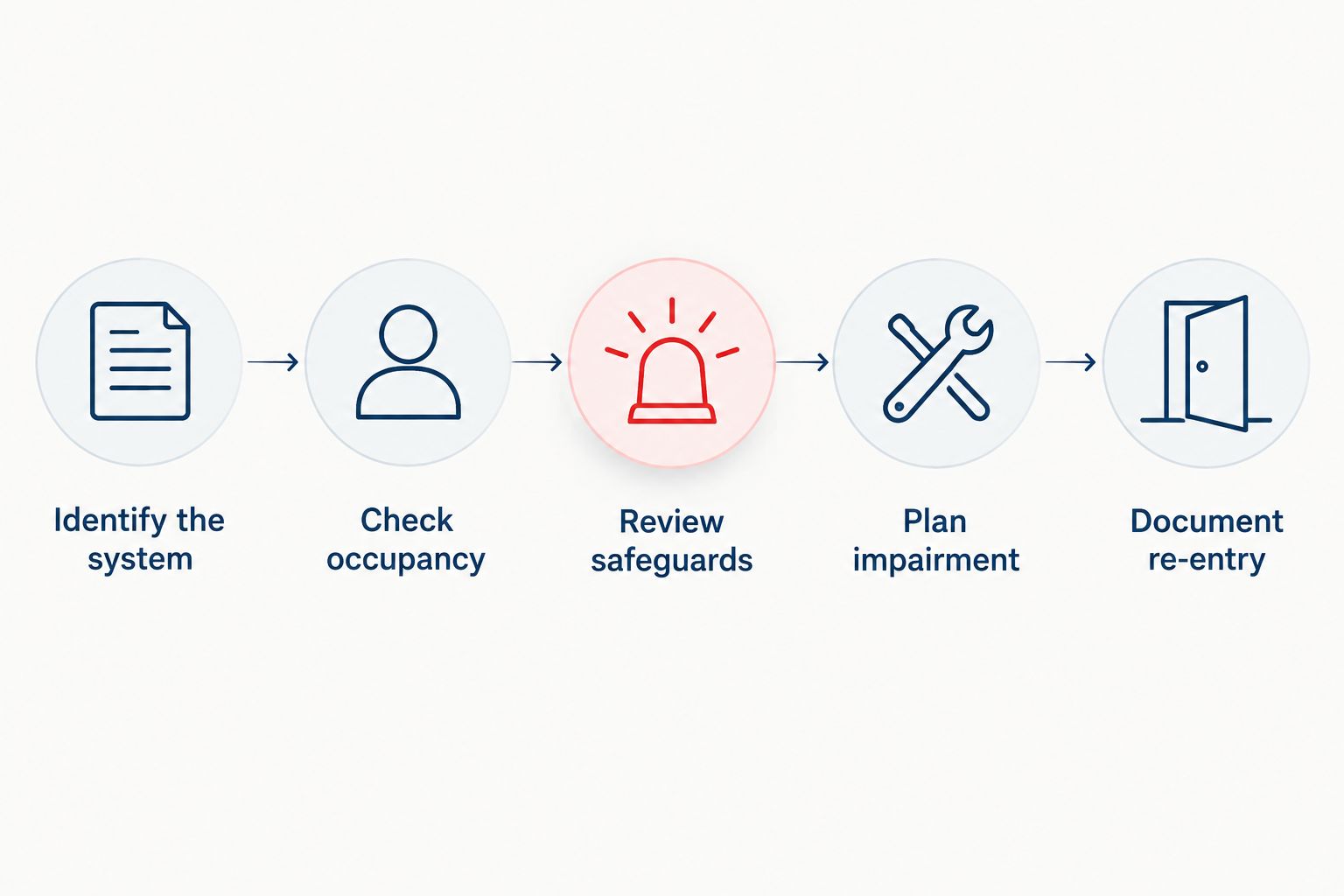
- Identify the system. Confirm the extinguishing agent, protected spaces, cylinder arrangement, and whether protection uses total flooding or a different application. Do not identify the agent from cylinder color alone.
- Check occupancy. Record who enters, what work happens inside, and whether people work alone. Include temporary maintenance and contractor access.
- Review safeguards. Have qualified personnel verify warnings, release logic, applicable lockout provisions, signage, and escape arrangements against the approved design.
- Plan impairment. If work requires taking protection out of service, establish the required notifications and temporary measures before the impairment begins.
- Document re-entry. Assign responsibility for ventilation, atmospheric assessment, authorization to enter, and returning the system to service.
Keep the resulting decisions with the system records. Staff need usable instructions, not just a drawing stored away from the room. Make sure temporary workers receive the access and evacuation instructions relevant to their tasks.
Never test the release sequence by causing a live discharge into an accessible room. Qualified personnel must use appropriate test methods and control the release hazard during servicing.
Can people stay inside if a pre-discharge alarm sounds?
No—people should leave immediately when a suppression pre-discharge alarm sounds. Do not use the warning period to finish a task, save files, collect tools, or search for the fire. Follow the posted evacuation procedure.
A delay is an escape safeguard, not permission to remain. Do not assume every system has the same delay or that a control will stop every release mode. Staff training must match the installed system's actual operation.
Does a room count as occupied if staff only enter occasionally?
Occasional entry still creates a personnel-exposure hazard. A room described as normally unoccupied can contain a technician when a release occurs. Its access procedures and safeguards must address that possibility.
Have the responsible designer determine the applicable occupancy classification and requirements. Do not change a room label to avoid dealing with workers who enter it.
When can you re-enter after a CO2 discharge?
Re-enter only after authorized personnel have established safe atmospheric conditions under the site's procedure. There is no universal waiting period that makes every server room safe. Opening a door or seeing the discharge cloud disappear is not proof.
Assessment must address carbon dioxide as well as oxygen and other fire-related hazards. If someone collapses inside, call emergency services and prevent unprotected entry. An improvised rescue can expose another person to the same atmosphere.
FAQ
Is CO2 fire suppression safe for an occupied server room?
No—CO2 total-flooding discharge is not safe for people to remain inside an occupied server room. Evaluate an alternative suitable for occupied spaces and have a qualified professional review the design.
Is CO2 dangerous even when the oxygen level looks normal?
Yes—carbon dioxide has direct physiological effects in addition to displacing oxygen. An oxygen reading alone cannot establish that a CO2-exposed room is safe to enter.
What's the NIOSH immediately dangerous concentration for carbon dioxide?
40,000 ppm is the NIOSH immediately dangerous to life or health concentration for carbon dioxide. It is not an acceptable occupied-space suppression concentration or a substitute for a re-entry assessment.
Is an inert-gas system automatically safe for server-room staff?
No—an inert-gas system requires an engineered review of oxygen reduction, exposure conditions, evacuation, and pressure relief. Naturally occurring gases are not automatically safe at fire-suppression concentrations.
Can I replace CO2 with a clean agent using the existing equipment?
Do not assume an agent substitution is acceptable in existing equipment. Cylinders, piping, nozzles, controls, and enclosure requirements must match the selected system's approved design.
Can I go back in after the CO2 alarm stops?
No—the alarm stopping does not prove the atmosphere is safe. Follow the site's authorized re-entry procedure, including the required atmospheric assessment.
Can Firstlinefire help with commercial fire protection?
Firstlinefire provides suppression systems, fire alarms, and safety training for commercial and industrial customers. Discuss the existing installation and room use before selecting an agent or changing protection.
One last thing
No residue does not mean no hazard. CO2 can leave equipment free of extinguishing-agent residue while making the surrounding air deadly. That distinction belongs in your 2026 purchasing specification, your maintenance procedures, and your contractor briefing.
Before approving a server-room suppression proposal, ask for the personnel-exposure basis in writing. It should explain the selected agent, design conditions, warning and evacuation arrangements, and re-entry controls. A claim that the agent is safe for electronics does not answer those questions.


