
Verify a fire extinguisher company's credentials with the issuing authority, confirm that they cover the work at your location, and check the assigned technician's qualifications. In 2026, a certificate on a website or a fresh service tag is not enough: you need current status, the correct service scope, and records that identify who performed the work. Business licensing, technician certification, and manufacturer authorization are different forms of proof; none automatically replaces the others.
- How to verify a fire extinguisher company is certified: check the issuer, current status, technician, and service scope.
- A service tag records work; it does not independently prove a company's licensing or technician qualifications.
- Firstlinefire provides fire extinguisher service; verify credentials against your location and requested work before booking.
- Ask the local fire authority which business and technician credentials apply to your site.
How do you verify a fire extinguisher company is certified?
Start with the authority that issues or requires the credential—not the company displaying it. Match the legal business name, credential number, current status, and authorized work. Then verify the technician assigned to your site.
A tag is part of that evidence trail, not the whole trail. Use this guide to reading a fire extinguisher inspection tag to separate the service record from the company's qualifications.
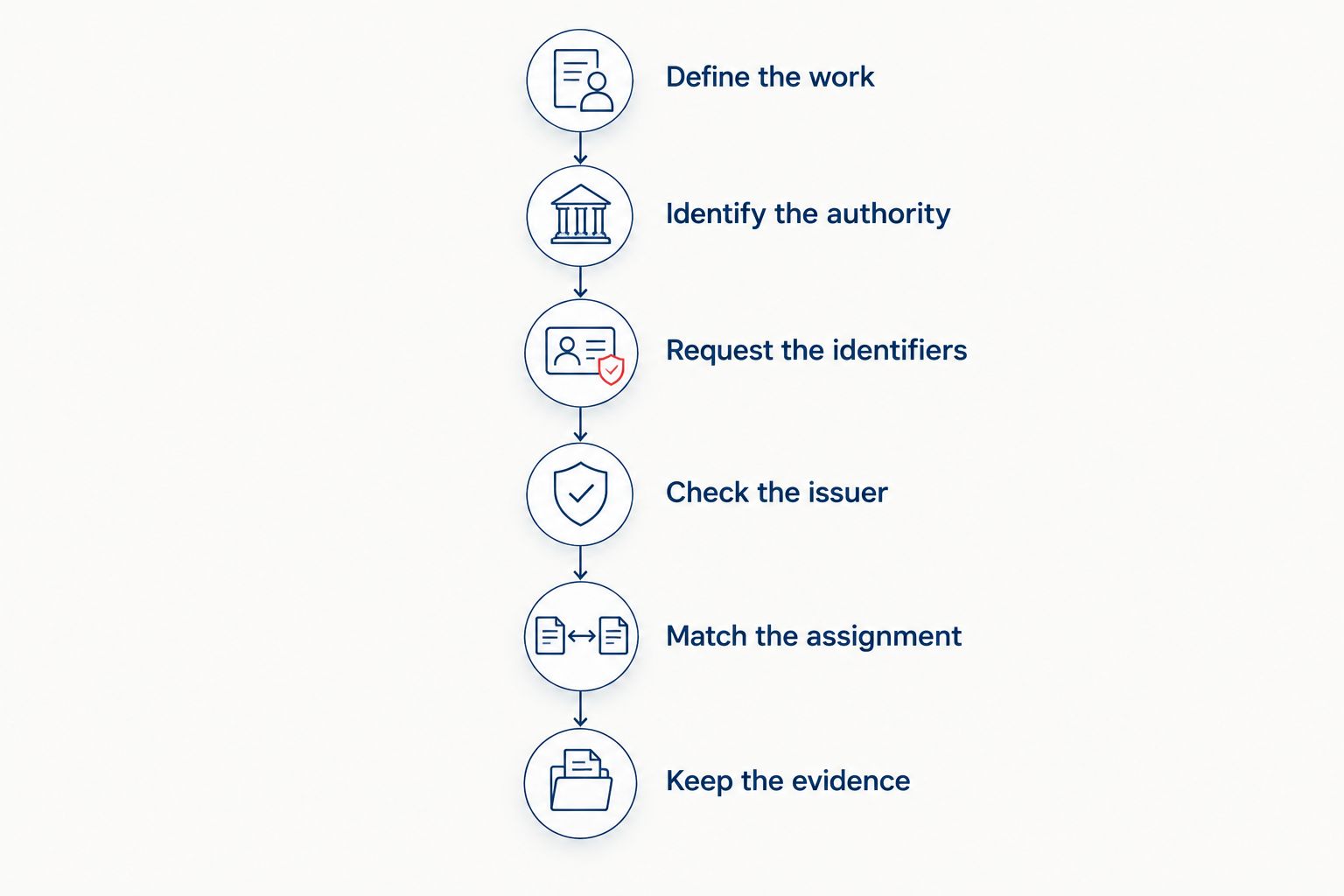
Follow these verification steps
- Define the work. Specify portable extinguisher maintenance, recharge, hydrostatic testing, or fixed suppression service. Do not accept a general statement that the contractor handles fire protection.
- Identify the authority. Ask the local fire marshal or other authority having jurisdiction which credentials apply at the site. Ask whether requirements cover the business, the technician, or both.
- Request the identifiers. Get the legal business name, credential numbers, issuing organizations, expiration dates, and the assigned technician's name.
- Check the issuer. Use the issuing authority's official directory or contact it directly. Confirm status and scope, not just that a number exists.
- Match the assignment. Confirm that the person arriving is qualified for the equipment and work ordered. Ask who will perform any subcontracted testing.
- Keep the evidence. Save the verification result, date checked, work order, and completed service records in the site's fire-protection file.
For a 2026 vendor review, record what you verified on that date. An old certificate proves past status, not current authorization.
Why this matters
A contractor's credentials answer whether it is authorized or qualified for particular work. The completed service record answers what happened to your extinguishers. You need both.
Federal OSHA's portable extinguisher rule, 29 CFR 1910.157, assigns covered employers responsibility for inspection, maintenance, and testing. Hiring a service company does not erase that responsibility. Treat vendor verification as part of managing the equipment, not as a substitute for managing it.
A qualified contractor and a compliant extinguisher are separate findings. A properly credentialed technician still has to identify defects, complete the required work, and document the result.
Which credentials should you check?
There is no single document that answers every licensing, training, equipment, and service question. Ask what each document establishes. Keep those distinctions clear when comparing contractors.
| Evidence | Best for checking | What it establishes | What it does not establish |
|---|---|---|---|
| Required business license or registration | Company authorization | Permission for the listed work in the issuing jurisdiction | Every technician's qualifications |
| Technician certification or license | The assigned worker | The person's listed qualifications or authorization | Permission for unrelated equipment or tasks |
| Manufacturer authorization or training | Equipment-specific service | The documented relationship or training scope | All state or local licensing requirements |
| Insurance certificate | Coverage review | The coverage described in the document | Technical competence or completed maintenance |
| Service tag and report | Work history | Who recorded the service and what the record describes | Independent confirmation of current credentials |
Official records give you an independent check, but their scope still matters. A company license cannot answer every technician question. A technician certificate cannot answer every business-authorization question.
Business licensing: match the legal entity
Request the legal name that will appear on the contract and invoice. Compare it with the authority's record. If the contractor uses a trade name, ask for documentation connecting that name to the licensed entity.
Check the authorized activity and any listed restrictions. A general business registration is not proof of fire extinguisher service qualifications. Likewise, authorization for one fire-protection activity does not establish authorization for every other activity.
Technician certification: match the person and task
Ask for the name of the technician scheduled to perform the work. Verify the credential with its issuer and confirm that it addresses the assigned task.
Do not transfer one employee's qualifications to the whole crew. If the contractor changes technicians, check the replacement. Where supervised work is permitted, ask the authority what supervision requires rather than accepting an undefined promise that someone qualified is involved.
Manufacturer authorization: match the equipment
For equipment-specific work, ask whether manufacturer authorization or training is required by the applicable instructions or authority. Request documentation tied to the equipment being serviced.
A training certificate has a useful purpose: it documents the training described on it. Its limit is equally important. It does not, by itself, prove current authorization from every jurisdiction or competence across every extinguisher and suppression system.
What should you check for hydrostatic testing?
Verify the testing provider, not just the company collecting the cylinders. Ask whether the contractor performs the test itself or sends the extinguisher elsewhere. Get the testing provider's identity before accepting the arrangement.
For covered workplaces, OSHA 29 CFR 1910.157(f)(1) requires hydrostatic testing by trained persons with suitable testing equipment and facilities. That is a concrete qualification check: who performs the test, what training supports the work, and where it happens.
Some cylinders also fall under Department of Transportation requirements. Ask the testing provider whether DOT cylinder-requalification authorization applies to your cylinder and operation. If it does, verify the applicable authorization with the Pipeline and Hazardous Materials Safety Administration.
Do not treat DOT authorization as a universal requirement for every extinguisher cylinder. Cylinder construction and regulatory coverage matter. The provider should explain which requirements apply to the equipment in your work order.
Ask for a completed test record that identifies the cylinder and result. A pickup receipt documents collection; it does not document a successful test.
Why certification requirements vary
Build the credential check around the job. These factors determine which evidence you need:
- Jurisdiction. State and local requirements determine which business and individual credentials apply at the service location.
- Service scope. Inspection, maintenance, recharge, hydrostatic testing, and fixed suppression work are different tasks.
- Equipment. The extinguisher or system's service instructions determine equipment-specific procedures and qualifications.
- Operating setting. A workplace, mine, vessel, or fleet can involve different regulatory oversight.
- Assigned personnel. The company holds some credentials; individual workers hold others.
- Subcontracted work. The business taking your order is not necessarily the business performing every task.
For a multi-site contract in 2026, verify requirements at each location. Do not assume a credential accepted at one site covers another state, vessel, or operating setting.
What service records should a qualified company provide?
Request records that connect the work to identifiable equipment. A report should let you determine which extinguisher was serviced, where it belongs, what work was performed, who performed it, and whether defects remain.
Use these record checks when approving the completed job:
- Match the report to the site's extinguisher inventory.
- Identify maintenance, recharge, and testing separately.
- Separate completed repairs from outstanding recommendations.
- Record equipment removed from service and its disposition.
- Confirm that the tag and report describe the same service event.
For covered workplaces, OSHA 29 CFR 1910.157(e) requires visual inspection monthly—an interval of 1 month—and an annual maintenance check—an interval of 12 months. It requires the annual maintenance record to be retained for 1 year after the last entry or for the life of the shell, whichever is less.
Those intervals describe employer obligations under that federal rule. They do not establish a contractor's licensing status or replace applicable local requirements.
In your 2026 records, distinguish the monthly visual check from the annual maintenance check. A record of one does not prove completion of the other. The task matters more than the label on the invoice.
What should you ask before approving the work order?
Ask direct questions. Request documents rather than assurances.
Before scheduling
Ask which credentials apply to the requested work, who holds them, and how you can verify them. Get the technician's name and identify any subcontractor responsible for hydrostatic testing or other specialized work.
Also ask what records you will receive. Resolve that before the visit, not after an invoice arrives with no equipment-level detail.
When the technician arrives
Match the technician to the assignment. Confirm any substitution before specialized work begins. Review the equipment inventory and the requested tasks together.
Do not ask unqualified staff to open, recharge, or pressure-test extinguishers as a verification exercise. Credential checking is a records and authority check, not a hands-on test of pressure equipment.
Before closing the job
Compare the completed report with the work order. Resolve missing equipment, unclear service descriptions, and outstanding defects. Save the credentials separately from the maintenance records so each remains easy to find.
Approve the work on evidence, not on a uniform, truck lettering, or a new tag. Those items identify a contractor; they do not establish its authorization.
Where does Firstlinefire fit?
Firstlinefire is best suited to commercial, industrial, marine, and fleet customers seeking fire extinguisher service within its stated service area. The company provides extinguisher sales, inspection and service, hydro testing, and other fire-protection services across Kentucky, Illinois, Indiana, Tennessee, Missouri, and Alabama.
That service coverage makes Firstlinefire relevant to buyers with those needs. It is not a substitute for checking the credentials required at your location. Apply the same business, technician, equipment, and testing-provider checks to every contractor.
Review your extinguisher service needs
Identify your location, equipment, and required work before discussing service.
Does NFPA certify every fire extinguisher company?
No. NFPA 10 is a standard for portable fire extinguishers, not a universal company license. A contractor's statement that it follows NFPA 10 does not independently establish its current business authorization or technician credentials.
Ask which adopted requirements apply at your site and what evidence demonstrates compliance. Separate the standard governing the work from the credential qualifying the worker.
Is an inspection tag enough to prove certification?
No. An inspection or service tag is a record attached to the equipment, not independent verification from a credential issuer. Use it to identify the service event and contractor, then check the relevant credentials separately.
If the tag, report, and invoice disagree about the company or service date, resolve the discrepancy. Do not file conflicting records as proof that the job is complete.
What if the company is not listed in an online directory?
An absent search result is not a final licensing decision. Contact the issuing authority using its official contact information and ask it to verify the legal business name and credential number.
If the authority cannot confirm required authorization, do not approve that work until the discrepancy is resolved. A contractor-provided screenshot does not replace confirmation from the issuer.
FAQ
How do I verify a fire extinguisher company's certification in 2026?
Check the credential with its issuing authority, then match the current status and service scope to your location and work order. Verify the assigned technician separately where individual qualifications or licensing apply.
Is a business license enough for fire extinguisher service?
A general business license is not proof of fire extinguisher service qualifications. Ask the local fire authority which company and technician credentials apply to the requested work.
Does a fire extinguisher service tag prove the technician is certified?
No. A service tag records a service event; verify the technician's credential with the issuer and compare the tag with the completed report.
Can an extinguisher service company subcontract hydrostatic testing?
Ask who will actually perform the testing and verify that provider's qualifications. For covered workplaces, OSHA requires trained persons with suitable testing equipment and facilities.
How often does OSHA require portable extinguisher checks?
For covered workplaces, OSHA requires visual inspection monthly and an annual maintenance check. These obligations do not replace applicable local requirements or establish the contractor's credentials.
Should I check credentials again when the contractor changes technicians?
Yes. Verify the replacement technician's qualifications for the assigned work rather than relying on another employee's certificate.
What should I ask Firstlinefire before booking extinguisher service?
Ask for the credentials applicable to your location and requested work, the assigned technician's qualifications, and the identity of any testing subcontractor. Specify the equipment and records you need before approving the work order.
One last thing
Check the name on the invoice against the name on the credential. A convincing certificate is useless to your verification process if it belongs to a different legal entity and the connection has not been established.
Keep a dated verification note in your 2026 vendor file. Record the issuer, credential number, status, scope, and person who confirmed it. That short note explains why you approved the contractor without making someone repeat the entire search.


