

You can tell whether a fire extinguisher inspection was done correctly by matching the record to the actual extinguisher, checking its condition and access, and confirming that required maintenance and testing are current. A fresh tag alone does not prove the work was done correctly; a green pressure gauge does not prove the extinguisher is ready.
- How to tell if a fire extinguisher inspection was done correctly: match the unit, condition, service scope, and records.
- OSHA requires monthly visual inspections and annual maintenance checks for covered workplace portable fire extinguishers.
- A current inspection tag does not replace required internal maintenance or hydrostatic testing.
- Firstlinefire provides fire extinguisher inspection and service for commercial, industrial, marine, and fleet customers.
How to tell if a fire extinguisher inspection was done correctly
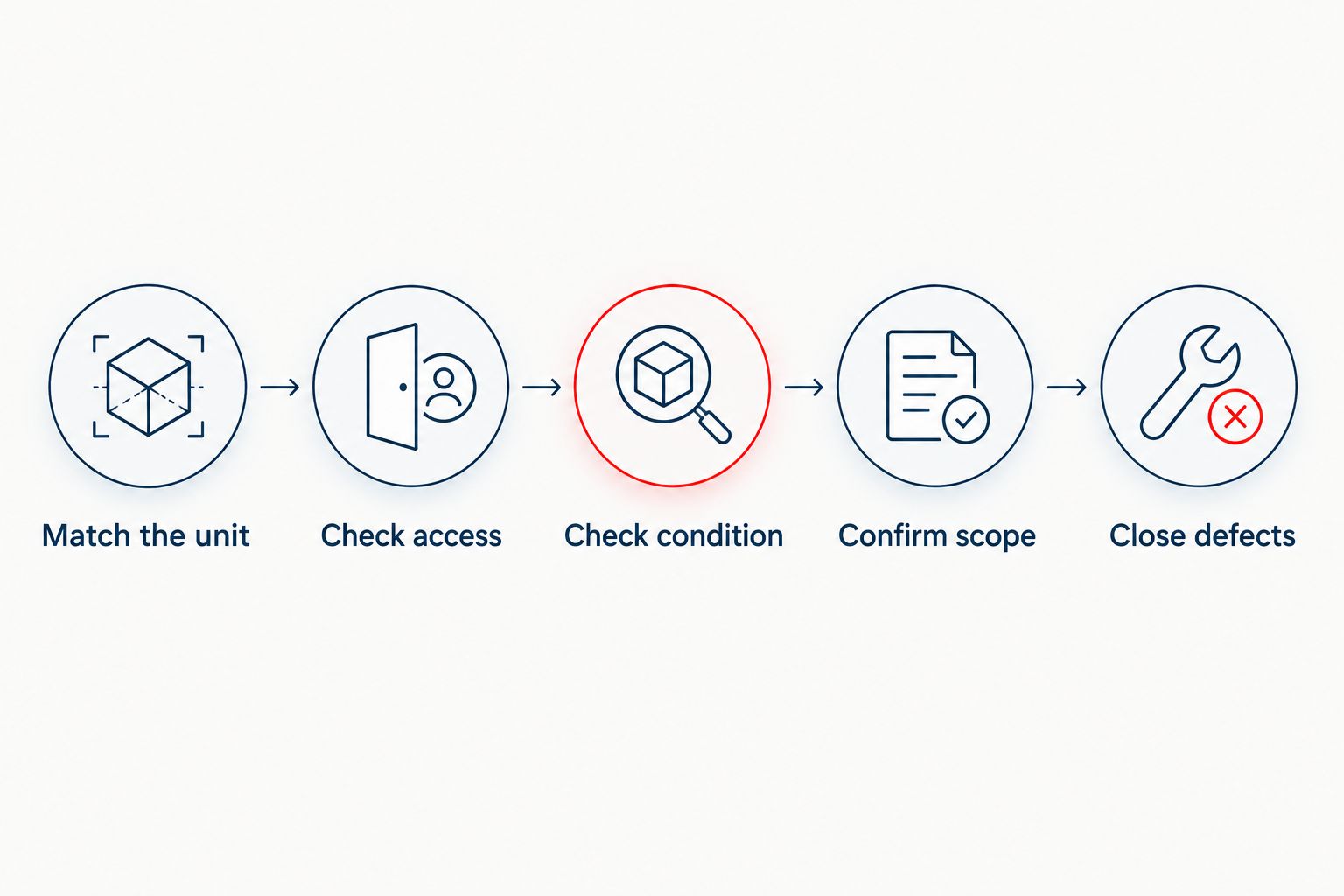
Start with the extinguisher, not the invoice. Follow these checks before accepting a service record as proof that the equipment is ready. For the markings themselves, use the guide to reading a fire extinguisher inspection tag.
1. Match the unit
Find the extinguisher's manufacturer label, serial number, and assigned location. Compare those details with the service report or equipment list. The record must identify the equipment it covers.
An internal asset number is useful, but it needs a reliable connection to the actual cylinder. If the report lists an extinguisher at a loading dock and that unit now sits in a maintenance room, reconcile the location before filing the paperwork. A location mismatch does not prove missed service, but it leaves the record unresolved.
2. Check access
Confirm that the extinguisher is in its designated place and that someone can reach it without moving stock, furniture, or equipment. Look at the approach to the extinguisher, not just the wall bracket. A visible cabinet does not help if a pallet blocks its door.
Check that the mounting or cabinet holds the extinguisher securely and allows removal. Do not treat a correctly dated tag as an answer to an access problem. The tag documents service; the obstruction still needs to be removed.
3. Check condition
Look for a missing pin, broken tamper seal, damaged handle, cracked hose, blocked nozzle, leaks, corrosion, or dents. Confirm that operating instructions remain legible and face outward. On units with a pressure gauge, check that the pointer sits within the marked operating range.
Not every extinguisher has a gauge. Carbon dioxide extinguishers, for example, require other checks to establish charge condition. Do not apply a gauge-only checklist to every extinguisher type.
4. Confirm scope
Read what the visit actually covered: a visual inspection, annual maintenance, recharge, internal maintenance, or hydrostatic testing. These are different tasks. A report that says only inspection does not establish that every other service requirement was completed.
Ask the service provider to explain the work applicable to that extinguisher type. Do not pull the pin, discharge the unit, or open the cylinder to verify the work yourself. Those actions can leave the extinguisher needing service.
5. Close defects
Compare each reported defect with its correction. A missing seal, damaged hose, or overdue test should have a clear disposition: corrected, replaced, removed from service, or scheduled for the required work with suitable protection maintained.
Ask who owns any unfinished action and how its completion will be recorded. An invoice marked paid is not a defect closeout. Accept the result only when the equipment condition and the paperwork agree.
Why this matters
A correct inspection checks the extinguisher as it stands at that time. It does not prevent someone from blocking it, moving it, or using it afterward. Keep the scheduled checks, but address a new defect when you find it.
For covered workplaces in 2026, OSHA's portable fire extinguisher rule, 29 CFR 1910.157(e), separates monthly visual inspection from annual maintenance. That distinction matters when you review a contractor's visit. Paying for annual maintenance does not remove the employer's responsibility for ongoing inspection and serviceability.
A walkthrough can expose obvious problems. It cannot prove the condition of hidden components or establish that a required pressure test occurred. Use physical checks and service records together rather than treating either as complete proof.
Monthly inspection: a visual check every month
OSHA 29 CFR 1910.157(e)(2) requires portable extinguishers covered by the rule to be visually inspected monthly. This is the recurring check for location, access, and obvious signs of trouble. It is not a substitute for maintenance.
A practical monthly check follows the same route each time. Confirm that each assigned extinguisher is present, accessible, and visibly serviceable. Record the check in a consistent way so missed locations and unresolved defects are easy to find.
Best for: finding missing equipment, blocked access, and visible damage between service visits. Limit: a visual check cannot establish internal condition or replace the maintenance required for the unit.
Do not mark every extinguisher acceptable from the doorway. Walk to each one. If you cannot inspect a unit because a room is locked or equipment blocks access, record that exception and finish the check when access is restored.
Annual maintenance: a check every year
OSHA 29 CFR 1910.157(e)(3) requires an annual maintenance check for covered portable extinguishers. The employer must record the annual maintenance date and retain that record for 1 year after the last entry or the life of the shell, whichever is less.
For your 2026 records, distinguish an annual maintenance entry from a monthly visual check. The annual record should make the service date clear. Request an equipment-level report that also identifies the units, work performed, defects, and disposition; that additional detail helps you verify the visit.
Best for: checking the maintenance requirements that a routine visual inspection does not cover. Limit: an annual maintenance date alone does not prove that a separate internal-maintenance or hydrostatic-test deadline is current.
Annual maintenance does not mean every extinguisher must be opened every year. The required procedure depends on its construction and applicable instructions. Ask what procedure was performed rather than judging the work by how long the technician stood beside the cylinder.
Internal maintenance: 6 years for specified dry chemical units
OSHA 29 CFR 1910.157(e)(4) requires stored-pressure dry chemical extinguishers that have a 12-year hydrostatic test interval to be emptied and subjected to applicable maintenance procedures every 6 years. Nonrefillable disposable dry chemical extinguishers are exempt from that requirement.
This is a specific rule, not a universal schedule for every extinguisher. Identify the type before applying the interval. An annual maintenance tag and an internal-maintenance record answer different questions.
Best for: documenting the scheduled internal maintenance of qualifying stored-pressure dry chemical extinguishers. Limit: this service does not replace hydrostatic testing when that test is due.
When qualifying extinguishers are recharged or hydrostatically tested, OSHA says the 6-year requirement begins from that date. Make sure the service history supports the next due date. Do not reset the schedule just because someone attached a new annual tag.
Hydrostatic testing: intervals depend on extinguisher type
Hydrostatic testing checks the pressure-containing cylinder under controlled conditions. OSHA 29 CFR 1910.157(f), Table L-1, lists intervals by extinguisher type: carbon dioxide extinguishers have a 5-year interval, while specified dry chemical extinguishers with mild-steel, brazed-brass, or aluminum shells have a 12-year interval.
Use those figures only for the types named in the table. The label, cylinder construction, manufacturer instructions, and applicable requirements determine the right schedule. Damage or corrosion also requires evaluation; a future scheduled test date is not permission to ignore a damaged cylinder.
Best for: establishing the required cylinder test history. Limit: passing a hydrostatic test does not establish correct placement, unobstructed access, or completion of every other maintenance task.
For a 2026 review, compare the recorded test date with the interval applicable to the actual unit. If the identity or test history is unclear, have the service provider resolve it. Do not infer a test from an annual tag.
Which record proves which work?
Use this comparison when a report bundles several tasks under the word inspection. Each service has a purpose and a limit.
| Task | Best for | Evidence to request | What it does not prove |
|---|---|---|---|
| Monthly visual inspection | Finding access and visible-condition problems | A consistent inspection log and defect entries | Internal condition or completed annual maintenance |
| Annual maintenance | Checking the unit's applicable maintenance needs | Dated maintenance record, identified equipment, and service findings | That a separate hydrostatic test was completed |
| Internal maintenance | Servicing qualifying units on their required schedule | Record identifying the unit, date, and work performed | Correct cylinder pressure-test status by itself |
| Hydrostatic testing | Verifying the required cylinder pressure test | Test record traceable to the cylinder | Correct placement or ongoing accessibility |
Do not accept a general service description as proof of a specific test. Ask for the record that answers the actual question. Keep separate tasks distinguishable even when the provider performs them during the same visit.
Why inspection scope varies
The inspection should match the equipment and its use. These factors determine what you need to verify:
- Extinguisher construction. A gauge check applies to units with gauges; other designs require different charge checks.
- Maintenance history. Annual service, internal maintenance, and hydrostatic testing run on distinct schedules.
- Physical condition. Damage, leakage, corrosion, or evidence of use requires attention even when the tag is current.
- Operating setting. A commercial building, industrial job site, fleet vehicle, and marine vessel do not share every applicable requirement.
- Service scope. An extinguisher visit does not automatically establish that a hood system, fire alarm, or vehicle suppression system was inspected.
For marine, vehicle, and coal-mining equipment, confirm the requirements governing that installation. Do not transfer a building's checklist to a vessel or truck without checking its applicability. Keep portable-extinguisher records separate from suppression-system records.
Is a green gauge enough to pass an extinguisher inspection?
No. A pointer in the marked operating range is one check, not proof that the hose is clear, the cylinder is sound, or required service is current. Inspect the entire unit and reconcile its maintenance history.
Does a new tag prove the technician completed annual maintenance?
No. A new tag records a service entry, but its date alone does not establish what work occurred. Compare the tag with the equipment-level report and ask the provider to resolve any mismatch.
What should I do if the inspection report and extinguisher disagree?
Treat the discrepancy as unresolved. Photograph the unit and its identification, note the location, and ask the provider to explain or correct the record. If the extinguisher is unserviceable, arrange suitable alternate protection while it is removed for service.
When to call the service provider
Call when you find damage, a missing or broken seal, evidence of discharge, an out-of-range gauge, or a service record that cannot be matched to the cylinder. Do not wait for the next scheduled visit to resolve an unserviceable extinguisher.
Firstlinefire fits commercial and industrial operators seeking fire extinguisher inspection and service across Kentucky, Illinois, Indiana, Tennessee, Missouri, and Alabama. Firstlinefire also serves coal-mining, marine, and vehicle/fleet customers and provides hydro testing.
Review Firstlinefire when you need those services. For any provider, request a clear scope and records tied to your equipment; the provider's name alone does not establish compliance. That is the same acceptance standard to apply to every service visit.
Arrange extinguisher service
Identify the unit, location, defect, and service record you need checked.
FAQ
How do I know a fire extinguisher inspection was done correctly?
Match the inspection record to the extinguisher, check access and visible condition, and confirm that applicable maintenance and test dates are current. Resolve defects and record mismatches before accepting the result.
How often does OSHA require fire extinguisher inspections?
OSHA 29 CFR 1910.157(e)(2) requires monthly visual inspection of covered portable fire extinguishers. Annual maintenance is a separate requirement under paragraph (e)(3).
Does every extinguisher need to be opened during annual maintenance?
No. The maintenance procedure depends on the extinguisher's type, construction, and applicable instructions. A correct annual maintenance check is not defined by opening every cylinder.
Can an extinguisher with a green gauge still need service?
Yes. A gauge in the operating range does not rule out a damaged hose, blocked nozzle, cylinder damage, or overdue maintenance. Check the full unit and its records.
Do all fire extinguishers need internal maintenance every 6 years?
No. OSHA's 6-year requirement applies to specified stored-pressure dry chemical extinguishers with a 12-year hydrostatic test interval. Nonrefillable disposable dry chemical extinguishers are exempt from that requirement.
Should I discharge an extinguisher to prove it works?
No. Discharging an extinguisher is not a routine visual-inspection step and can leave it needing service. Have a service provider evaluate concerns without improvising a test.
What should I do when an extinguisher is removed for maintenance?
Provide alternate equivalent protection while the extinguisher is removed for maintenance or recharging, as required by OSHA 29 CFR 1910.157(e)(5). Do not leave the protected area without the required coverage.
One last thing
A correct inspection is not a guarantee that the extinguisher stayed ready afterward. In 2026, keep monthly checks and act on defects between them. Before filing the annual report, walk the locations once more and confirm that serviced units are back in place, reachable, and matched to their records.


