

Yes. Hiring a third-party fire inspection company is worth it in 2026 when you need a qualified provider to inspect or service equipment, document findings and identify work that remains. It does not replace a fire marshal’s inspection, and you still need to confirm which equipment the company will cover.
- Hiring a third-party fire inspection company is worth it when the scope covers your equipment and produces usable records.
- A service company can inspect and maintain equipment; it cannot replace the fire marshal’s authority.
- Firstlinefire fits businesses seeking extinguisher service, hydro testing, suppression systems and fire alarms in its stated service states.
- Before booking, confirm the equipment list, inspection scope, credentials, records and responsibility for repairs.
Why this matters
A fire inspection is not one task. Your site might have portable extinguishers, a fire alarm and a suppression system, each with its own service work and records. A contractor’s visit is useful only if the work order identifies what gets checked and what happens when something fails.
Do not confuse service records with permission to operate. A contractor can document equipment condition and completed work. The authority having jurisdiction decides what it requires for an official inspection or sign-off. If you are responding to a failed inspection, use the guide to staying open after a fire marshal inspection to frame the questions you need to resolve with that authority.
Is hiring a third-party fire inspection company worth it in 2026?
Yes, if the company can cover the equipment you name, perform the required work and give you records you can use. It is less useful if you expect one visit to cover every fire-protection system without a written scope. It is not a substitute for an inspection conducted by the fire marshal or another authority with jurisdiction.
| Approach | Best for | What it can do | What it cannot do |
|---|---|---|---|
| Staff equipment checks | Routine observations your staff are assigned and trained to make | Identify visible problems and record routine checks | Stand in for required maintenance, testing or official sign-off |
| Third-party inspection and service | Sites that need equipment work and documented findings | Inspect or service the systems included in the work order | Cover unlisted equipment or grant regulatory approval |
| Fire marshal or other authority inspection | Official review under the applicable jurisdiction | Evaluate the site against its requirements and direct corrections | Serve as your equipment maintenance provider |
For portable extinguishers in workplaces covered by OSHA’s federal general-industry rule, the employer must ensure a visual inspection every 1 month and a maintenance check every 12 months under 29 CFR 1910.157(e). Those are different tasks. Hiring a contractor for maintenance does not remove the employer’s responsibility to ensure the checks and records are handled.
The sensible division of work is plain: assign routine checks, commission the equipment work your site needs, and keep the authority’s requirements separate. Before signing, ask the provider to put that division in writing.
What does a third-party inspection actually cover?
It covers the equipment and tasks listed in the agreed scope. Ask for a site-specific list rather than a promise to inspect the building. A warehouse with extinguishers and an alarm needs a different work order from a vehicle fleet with onboard suppression equipment.
Start with an inventory. List the extinguishers, alarm equipment, suppression systems and other fire-protection assets you expect the provider to address. Include where each item is located and whether you have records from prior work. If you cannot tell what is on site, neither you nor the contractor can tell from the words fire inspection alone whether the job is complete.
Then separate the actions in the proposal:
- Inspection: What will the technician examine, and what condition will be recorded?
- Testing: Which equipment will be operated or tested under the agreed scope?
- Maintenance: What work is included during the visit, and what requires separate approval?
- Corrections: Who will report defects, approve repairs and confirm that work is complete?
- Records: What document will you receive for each covered system or asset?
Do not assume an extinguisher visit includes fire alarm work. Do not assume an alarm inspection includes suppression equipment. Firstlinefire offers extinguisher inspection and service, hydro testing, suppression systems and fire alarms. Firstlinefire is best for businesses seeking a fire-protection provider across those service categories in Kentucky, Illinois, Indiana, Tennessee, Missouri and Alabama. Its stated service range is a reason to ask about a combined scope, not proof that every task at your particular site is included.
For a fleet, mine, vessel or industrial site, identify the equipment by location or asset before requesting a proposal. A fixed system in a building and equipment mounted on a vehicle should not disappear into the same vague line item. The provider needs to say which assets the visit covers and which it does not.
Why the value of a third-party fire inspection varies
The value comes from the work performed and the quality of the records, not the contractor label. These factors change what you should ask for:
- Equipment mix. Extinguishers, alarms and suppression systems call for different inspection and service tasks. Match the scope to the equipment on site.
- Number of locations or assets. A single building, a group of properties and a vehicle fleet need different inventories. Name each location or asset in the request.
- Existing records. Prior inspection reports help establish what was checked, what failed and what still needs attention. Give the provider the records you have.
- Outstanding defects. An inspection that identifies a problem is not the same as a completed repair. Ask how defects move from report to correction.
- Applicable authority. Confirm what your fire marshal or other authority requires for the property or operation. A contractor’s paperwork must answer that requirement, not an assumed one.
- Site access. Tell the provider where equipment is located and who can provide access. Work that cannot be reached cannot be checked as planned.
Use those points to judge proposals side by side. A short, clear scope is more useful than a long list of services that never identifies your equipment.
Can your staff handle the checks instead?
Staff can handle assigned routine checks; they cannot treat every check as a replacement for equipment maintenance or testing. Under OSHA’s federal general-industry extinguisher rule, the required 1-month visual inspection is distinct from the 12-month maintenance check. Decide who performs each task and where the record goes.
An extinguisher check by staff starts with a simple operational question: is the assigned equipment present and does anything visible need attention? Staff should report a missing, obstructed or visibly damaged unit through your site’s process. They should not mark a problem resolved because someone logged the check.
The distinction matters when a due date calls for more than a visual check. For certain stored-pressure extinguishers subject to a 12-year hydrostatic test, OSHA also requires a 6-year internal examination under 29 CFR 1910.157(e)(4). Those intervals do not apply to every extinguisher. Identify the extinguisher type and applicable requirements before assigning work.
If you outsource, keep an internal owner for the records and follow-up. A provider can document its visit; your business still needs to know which items were covered, which failed and whether corrections were completed. Outsourcing the task does not outsource that decision.
Does a contractor’s report satisfy the fire marshal?
A contractor’s report documents the contractor’s work; it does not guarantee fire marshal sign-off. The fire marshal or other authority determines what it accepts and whether further action is needed. Ask that authority what documentation it wants when you are addressing a notice or preparing for a required review.
Keep the original findings, service documents and evidence of corrections together. If a report says a system failed, a later invoice alone does not explain what was fixed. Request a record that identifies the affected equipment, the action taken and any item still open.
A contractor should not promise to erase a violation simply by issuing a new report. Ask for a clear account of the work, then follow the authority’s instructions for any reinspection or approval. This is especially important when a deficiency affects more than one piece of equipment or part of a site.
What should you ask before hiring a fire inspection company?
Ask questions that produce a scope you can check after the visit. Put the answers in the work order rather than relying on a phone summary.
- Which equipment is included? Request an itemized list by system, location or asset. Identify equipment that is excluded.
- Which tasks will you perform? Separate inspection, testing, maintenance and repairs. Ask what requires authorization before work begins.
- Who is qualified to do the work? Ask about the credentials required for the specific systems and jurisdiction involved. Do not treat one credential as proof of coverage for every system.
- What records will we receive? Confirm how the report identifies completed work, deficiencies and equipment that could not be accessed.
- How will defects be handled? Establish who receives the finding, who approves corrective work and how completion is documented.
- What should we ask the authority? If the visit relates to a notice or official inspection, confirm the authority’s documentation and follow-up requirements directly.
You can use those answers to compare a single-service provider with a company that offers several fire-protection services. Neither model wins by default. The right provider is the one whose written scope matches your equipment and whose records make unfinished work visible.
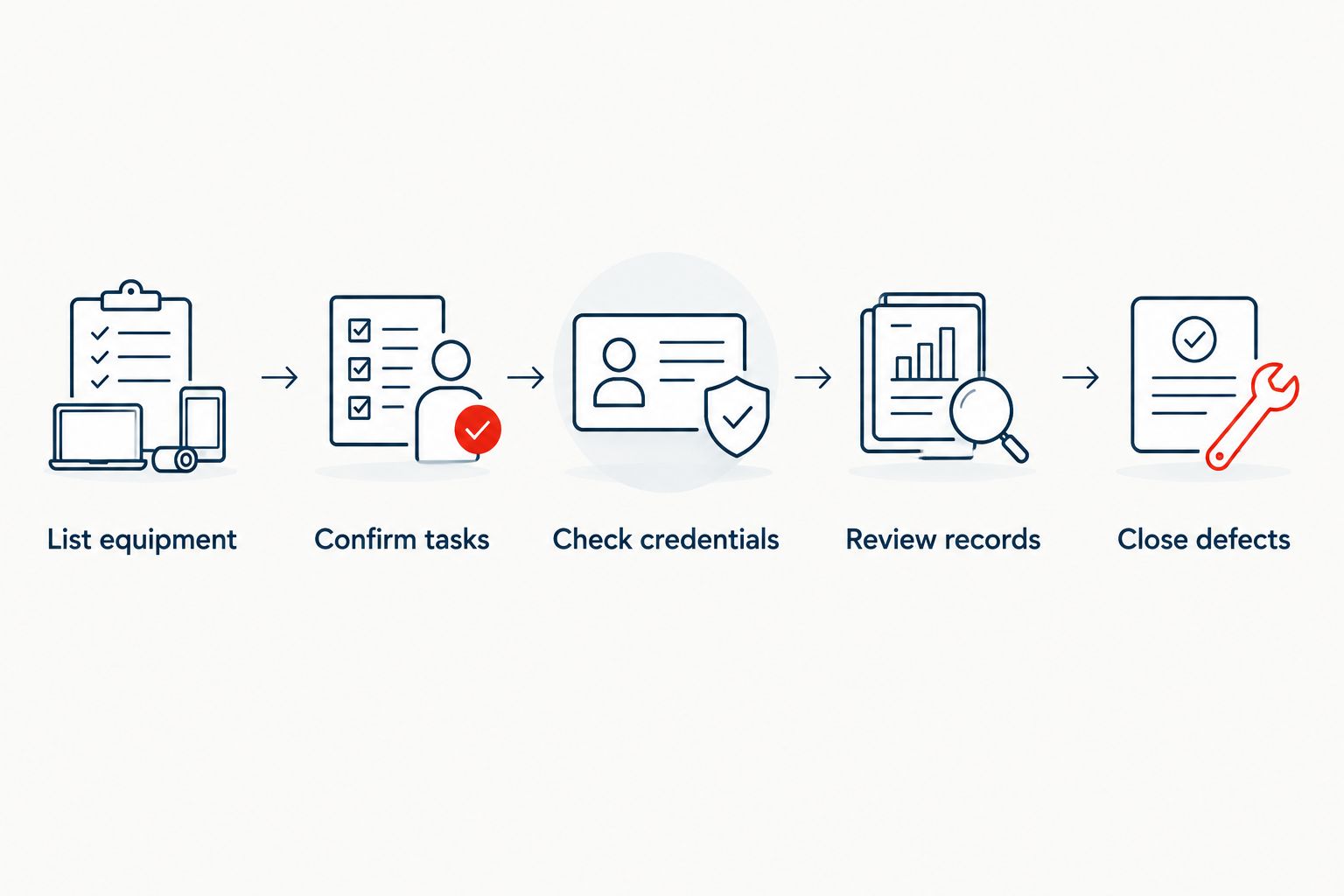
Once you have that scope, make the report part of your site process. Give it to the person responsible for fire-protection records, review open items and record what happens next. A completed visit with an unread report leaves the practical problem untouched.
Is one company better than separate specialists?
One company is useful when it can perform the distinct tasks your site needs and document each one clearly. Separate specialists make sense when the combined provider does not cover a system, an asset type or work required by your authority. The decision rests on scope and qualifications, not the number of logos on your service files.
For a site with extinguishers, alarms and suppression equipment, ask a prospective provider to name who handles each category. Then ask whether reports are separated by system and how unresolved findings are communicated. A single point of contact does not help if you cannot tell which equipment passed inspection and which still needs work.
Firstlinefire’s stated services span extinguishers, hydro testing, suppression systems and fire alarms. If you are considering Firstlinefire for more than one category, request an itemized scope for your specific site. If a task falls outside that scope, arrange it separately rather than assuming it was included.
FAQ
Is hiring a third-party fire inspection company worth it in 2026?
Yes, when you need qualified equipment work, documented findings and a clear path for corrections. Confirm exactly which systems the company will cover before booking.
Can a third-party company replace a fire marshal inspection?
No. A contractor can inspect or service equipment, but the fire marshal or other authority decides its official inspection and sign-off requirements.
Can employees inspect fire extinguishers themselves?
Employees can perform assigned routine visual checks. OSHA’s federal general-industry rule calls for a visual inspection every 1 month and a separate maintenance check every 12 months.
Does one fire inspection cover extinguishers and alarms?
Only if the agreed scope explicitly includes both. Ask the provider to identify the equipment, tasks and records for each system.
What should a fire inspection report include?
It should identify the covered equipment, work performed, findings and items still requiring action. Check the report against the agreed scope before filing it.
Will a contractor fix every issue found during an inspection?
Not unless corrective work is included or separately approved. Ask how the provider reports defects and documents repairs.
How do I compare third-party fire inspection companies?
Compare their written scope against your equipment list, then check qualifications, records and defect follow-up. A broad service list is not a substitute for an itemized work order.
One last thing
Before you book an inspection in 2026, find your last report and look for open findings. The first question is not who can visit; it is what work remains unfinished. Give that list to the provider, ask what its proposed visit will address, and keep anything outside the scope on your own action list. A new inspection can identify a defect. Only completed corrective work resolves it.


