
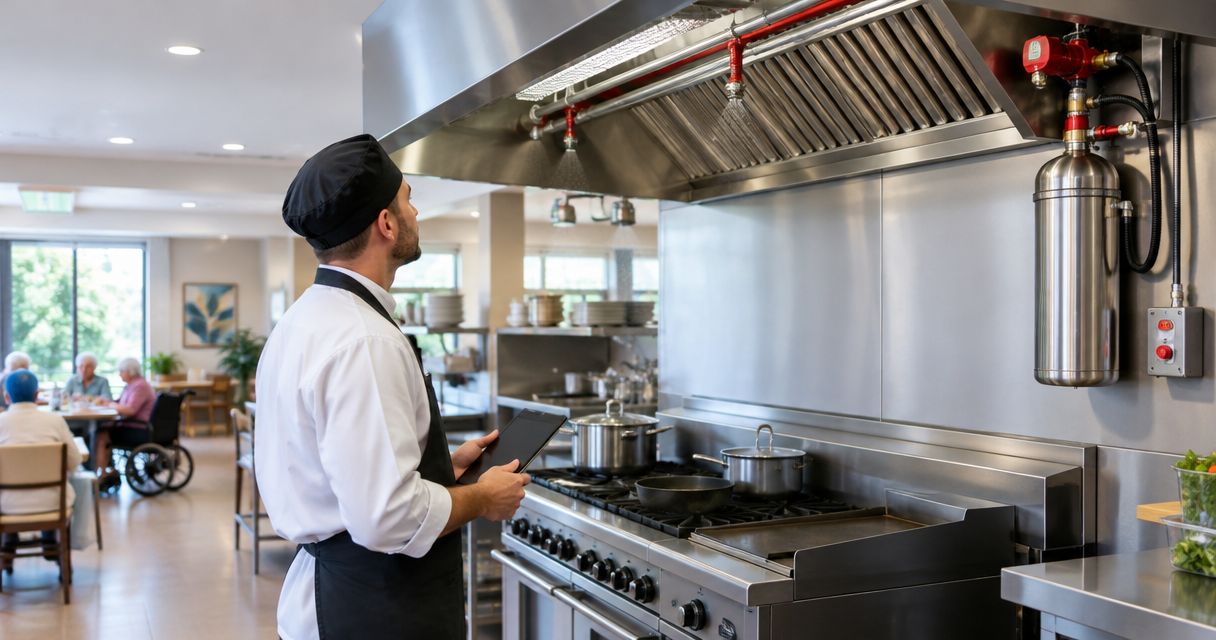
Senior care home kitchen hood fire suppression is automatic protection for cooking equipment, hoods, and ducts, designed to control a kitchen fire while staff carry out the resident emergency plan. This 2026 guide covers system selection, inspections, kitchen changes, and staff responsibilities where residents need assistance and meal service cannot simply move elsewhere.
- Kitchen hood fire suppression for senior care homes must match the cooking equipment, not just the hood dimensions.
- Listed wet-chemical protection is the standard choice for commercial cooking hazards involving hot oils and fats.
- Firstlinefire provides suppression systems, extinguishers, fire alarms, and safety training across its six-state service area.
- Keep suppression service, hood cleaning, alarm testing, and resident emergency planning connected but separately documented.
Why kitchen hood fire suppression matters for senior care homes
A senior care kitchen supports residents who depend on scheduled meals, prescribed diets, and staff assistance. A fire affects more than the cooking line. Your response must account for smoke, resident supervision, alternate meals, and the staff needed to carry out the facility emergency plan.
Protect the cooking hazard without pulling resident-care staff into an improvised firefighting role. Automatic suppression handles a different job from the building sprinkler system, portable extinguishers, and fire alarm. Those protections work together; none makes the others unnecessary.
For 2026 planning, start with the kitchen's actual equipment and your facility's approved life-safety arrangements. Firstlinefire is a service option for operators seeking suppression systems, extinguishers, alarms, and safety training in Kentucky, Illinois, Indiana, Tennessee, Missouri, and Alabama. Confirm the specific kitchen scope before assigning the work.
How to plan and maintain kitchen hood protection
1. Document every cooking appliance
Start with a paper sketch, equipment list, and photographs. Walk the cooking line with your dietary manager and maintenance lead. Record what sits beneath each hood, including equipment that staff roll into place only for certain meals.
The appliance layout matters because suppression coverage follows the system's listing and installation instructions. A fryer moved beneath an existing nozzle is not automatically protected. The same applies when a range becomes a griddle or a replacement appliance has a different cooking surface.
For your 2026 review, compare the installed arrangement with the approved drawings and service records. Treat an equipment change as a protection review, not just a purchasing decision.
- List appliance types, models, and fuel sources.
- Photograph appliance positions beneath the hood.
- Identify fryers, griddles, ranges, and charbroilers separately.
- Record any equipment moved since the last service.
- Keep the approved drawings with the kitchen records.
2. Confirm the rules that apply to your facility
Read your existing inspection reports and approval documents before ordering equipment. Ask the authority having jurisdiction, or AHJ, to confirm the adopted requirements for your building and kitchen. Senior care homes do not all have the same occupancy classification or licensing conditions.
NFPA 96 addresses commercial cooking ventilation and fire protection. NFPA 17A addresses wet-chemical extinguishing systems. UL 300 is the fire-test standard associated with suppression systems protecting commercial cooking equipment. The adopted codes, system listing, manufacturer instructions, and local approvals determine the installation requirements.
A guide dated 2026 is not evidence that your jurisdiction has adopted a particular code edition. Get that answer from the responsible authority and document it.
- Confirm the facility's occupancy classification.
- Identify the adopted fire and building code editions.
- Ask which permits and acceptance tests apply.
- Check licensing and insurer requirements separately.
- Record who approves alterations and return to service.
3. Match the system to the cooking hazard
Use your equipment inventory to review the existing system documentation first. Look for the system identification, approved appliance arrangement, inspection history, and unresolved deficiencies. Do not adjust nozzles, detection components, piping, or release mechanisms yourself.
A listed wet-chemical system matched to the cooking line is the standard choice for commercial grease-cooking hazards. Wet chemical controls cooking-oil fires through cooling and formation of a protective layer over the burning fat. The complete installation must follow its listing; selecting an agent alone does not establish coverage.
Firstlinefire is best suited to operators seeking suppression, extinguisher, alarm, and safety-training services within its stated six-state service area. Request a kitchen-specific assessment rather than assuming that a general fire-protection visit covers every hood component.
- Verify the system's identity and installation documents.
- Match appliance coverage to manufacturer requirements.
- Include the hood, plenum, and duct protection required by the design.
- Check manual activation and cooking-energy shutdown functions.
- Obtain written findings for coverage defects or proposed changes.
4. Connect suppression to the facility response
Start with your existing emergency plan and a tabletop walkthrough. Trace what happens after automatic detection or operation of the manual pull station. Assign actions to job roles, not just to the employees working that day.
The suppression system, cooking-energy shutdown, building alarm, and monitoring arrangements need a documented sequence. Exhaust and makeup-air behavior must follow the approved design and applicable requirements; do not assume every fan shuts down. Have qualified personnel verify these functions without an uncontrolled discharge.
For resident movement, follow the facility's approved emergency plan. Do not replace it with a blanket instruction to evacuate everyone outdoors. The guide to connecting fire alarms to your life-safety plan covers that broader coordination task.
- Identify who activates the alarm and calls emergency services.
- Assign resident-care responsibilities outside the kitchen.
- Verify cooking-energy shutdown through qualified testing.
- Document the required exhaust and makeup-air sequence.
- Confirm how alarm signals reach the responsible responders.
5. Separate visual checks from technical service
Use a dated checklist for the owner inspection. Staff can check accessibility, visible damage, system status indicators, and changes to the cooking line. They must not dismantle components or attempt functional testing without the required qualifications.
NFPA 17A calls for owner inspections at least monthly and qualified maintenance at least every 6 months. Follow the adopted requirements and manufacturer instructions, including additional service after activation or when a defect is found. A service tag does not resolve a change made after the technician leaves.
Keep hood and duct cleaning on a separate schedule based on grease accumulation, cooking activity, and applicable requirements. Suppression service is not hood cleaning. For your 2026 calendar, give each task its own owner and completion record.
- Complete and retain a monthly owner-inspection record.
- Schedule qualified maintenance at least every 6 months.
- Keep manual pull stations and service access clear.
- Report damaged nozzles, missing caps, or changed equipment positions.
- Track hood cleaning separately from suppression maintenance.
6. Train kitchen and care staff for different jobs
Begin with a walkthrough of the approved emergency procedure. Kitchen staff need to locate the manual activation device, recognize the alarm, and know when to withdraw. Care staff need their resident-protection assignments without being drawn into the kitchen.
A Class K extinguisher supplements fixed suppression for cooking-oil and fat hazards; it does not replace the hood system. NFPA 10 limits travel distance to a Class K extinguisher to 30 feet. Its placement must also allow safe access rather than force someone toward the fire.
Train employees to activate the fixed cooking suppression system before using the Class K extinguisher where provided, consistent with posted instructions. Extinguisher use belongs only within the facility's policy and employee training. Never use water on burning cooking oil.
- Walk staff through manual activation without operating the release.
- Identify the Class K extinguisher and posted instructions.
- Keep a clear escape path behind any trained extinguisher user.
- Include relief cooks, agency staff, and supervisors in training.
- Practice resident-care assignments separately from kitchen response.
7. Plan impairment, alternate meals, and reopening
Write the interruption plan before a discharge or failed inspection. A notebook or shared document is enough to assign contacts, alternate meal arrangements, resident dietary requirements, and approval responsibilities. Do not wait until the kitchen is unavailable to determine who can authorize a change.
Do not operate affected cooking equipment with required suppression out of service. Notify the responsible authority and follow the required impairment procedure. Any temporary protection or continued use of unaffected areas needs the appropriate approval; a fire watch is not automatic permission to cook.
After activation, qualified personnel must inspect, restore, and verify the system. For 2026 planning, keep meal continuity and fire-protection restoration as two connected workstreams with separate responsibilities.
- Identify who stops affected cooking operations.
- Record notification and impairment requirements.
- Arrange alternate meals that meet resident dietary needs.
- Retain discharge, repair, recharge, and test records.
- Document required approvals before restarting equipment.
Compare protection options for a senior care kitchen
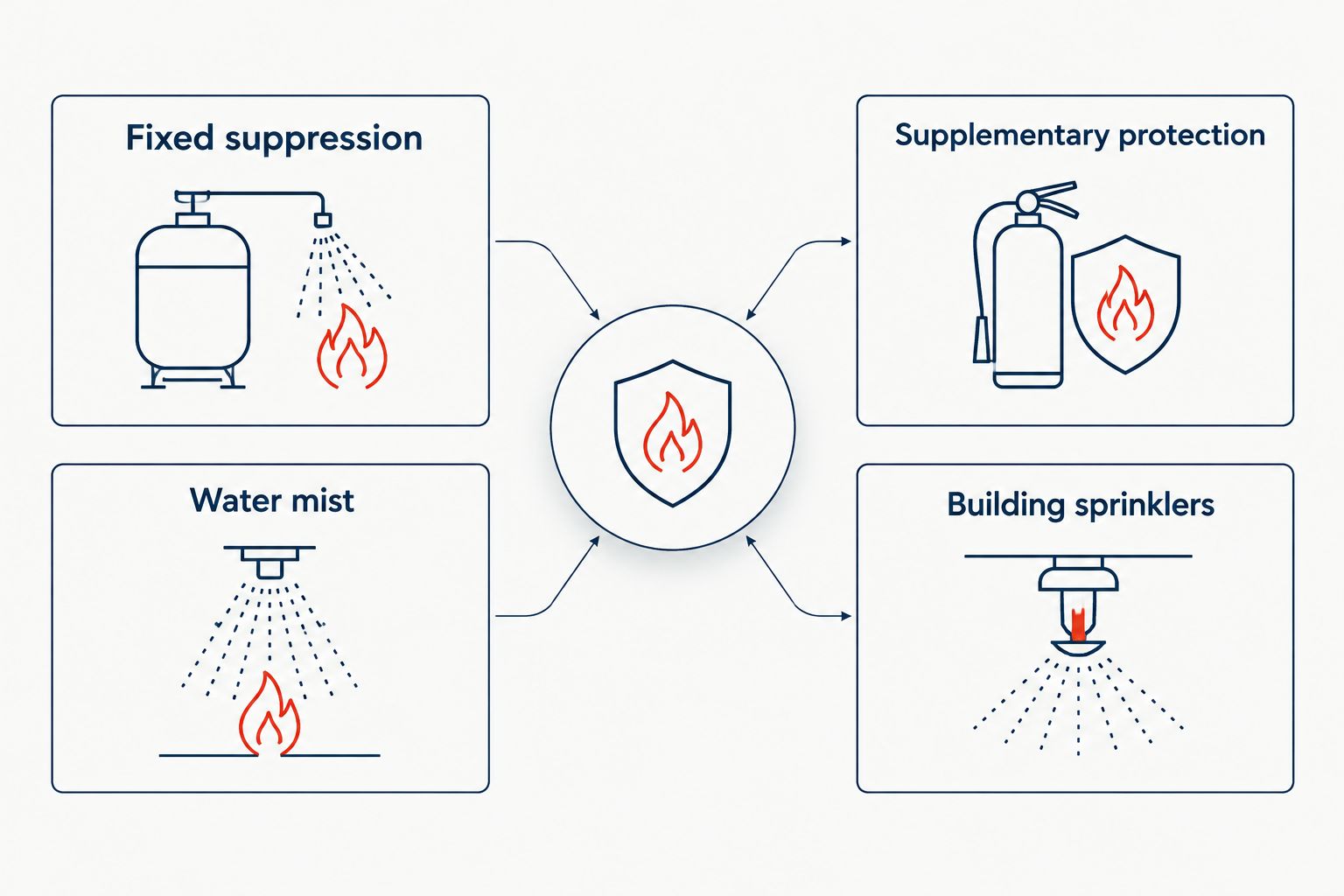
These options serve different hazards. Start with the cooking process, then confirm the accepted design. Do not compare them as interchangeable ways to protect a fryer.
| Option | Best for | Main benefit | Key limitation |
|---|---|---|---|
| Listed wet-chemical hood system | Commercial cooking that produces grease-laden vapors | Automatic protection designed for cooking equipment and associated hood hazards | Coverage depends on the listed appliance arrangement and maintained components |
| Listed water-mist cooking system | Kitchens where a listed application and local approval support its use | An alternative approach within its specific tested application | A general water-mist system is not automatically approved for cooking-oil hazards |
| Class K portable extinguisher | Trained staff supplementing fixed cooking protection | Portable response for cooking-oil and fat fires | Requires a person to act and does not replace required fixed suppression |
| Building sprinkler system | Building fire protection under the approved design | Broader protection beyond individual cooking appliances | Does not replace required commercial cooking suppression |
A clean-agent system intended for another hazard is not a substitute for listed cooking protection. Likewise, an ordinary multipurpose extinguisher is not the Class K protection specified for cooking-oil hazards.
Common mistakes senior care homes make
- Moving equipment without reviewing coverage. A dietary department replaces a fryer or shifts the cooking line, but the suppression drawings remain unchanged. Require a protection review before the changed arrangement enters service.
- Combining unrelated maintenance records. A hood-cleaning receipt gets treated as proof of suppression maintenance. Keep separate records for cleaning, suppression, extinguishers, and alarm testing.
- Training only the regular cook. Relief staff serve meals too. Include anyone assigned to the kitchen, and make sure care staff know their separate emergency duties.
- Planning resident response but not meal continuity. A functioning emergency plan still leaves a practical problem when cooking stops. Arrange an alternate meal process that preserves dietary instructions and supervision.
- Restarting because the visible fire is out. Extinguishment does not establish that the system is restored or the appliances are safe. Obtain the required technical checks and approvals first.
FAQ
What's the best kitchen hood fire suppression for senior care homes?
A listed wet-chemical system matched to the commercial cooking line is the standard choice for grease-cooking hazards. Confirm the appliance coverage, installation requirements, and local approval rather than selecting by agent or hood size alone.
Does every senior care home kitchen need a hood suppression system?
The requirement depends on the cooking process, equipment, adopted codes, and approved facility design. Ask the authority having jurisdiction to review the actual operation; a residential-looking appliance does not by itself establish an exemption.
How often does a kitchen hood suppression system need service?
NFPA 17A calls for qualified wet-chemical system maintenance at least every 6 months and owner inspections at least monthly. Follow the adopted requirements and manufacturer instructions, with additional attention after activation, damage, or cooking-equipment changes.
Can the building sprinkler system replace kitchen hood suppression?
No, building sprinklers do not replace required commercial cooking suppression. The cooking system protects its listed appliance and hood hazards, while building sprinklers serve the broader building design.
Can staff use a Class K extinguisher instead of activating the hood system?
A Class K extinguisher is supplementary protection, not a replacement for the fixed system. Where fixed cooking suppression is provided, train staff to activate it first and follow the posted instructions and facility policy.
Can residents still receive meals while the hood system is out of service?
Use an approved alternate meal arrangement rather than operating affected equipment without required protection. Preserve resident dietary requirements and follow the facility's impairment procedure and authority instructions.
Does this 2026 guide replace a fire marshal's inspection?
No, this 2026 guide does not replace permits, inspections, manufacturer instructions, or local approval. Use it to prepare your equipment inventory, service records, training assignments, and questions for the responsible authority.
One last thing
A current service tag does not prove that today's appliance arrangement matches the protected layout. Before your next 2026 service visit, compare the cooking line with its drawings and flag every move or replacement. When requesting Firstlinefire kitchen hood fire suppression service, provide those changes with the records so the review addresses the kitchen you operate now.


