
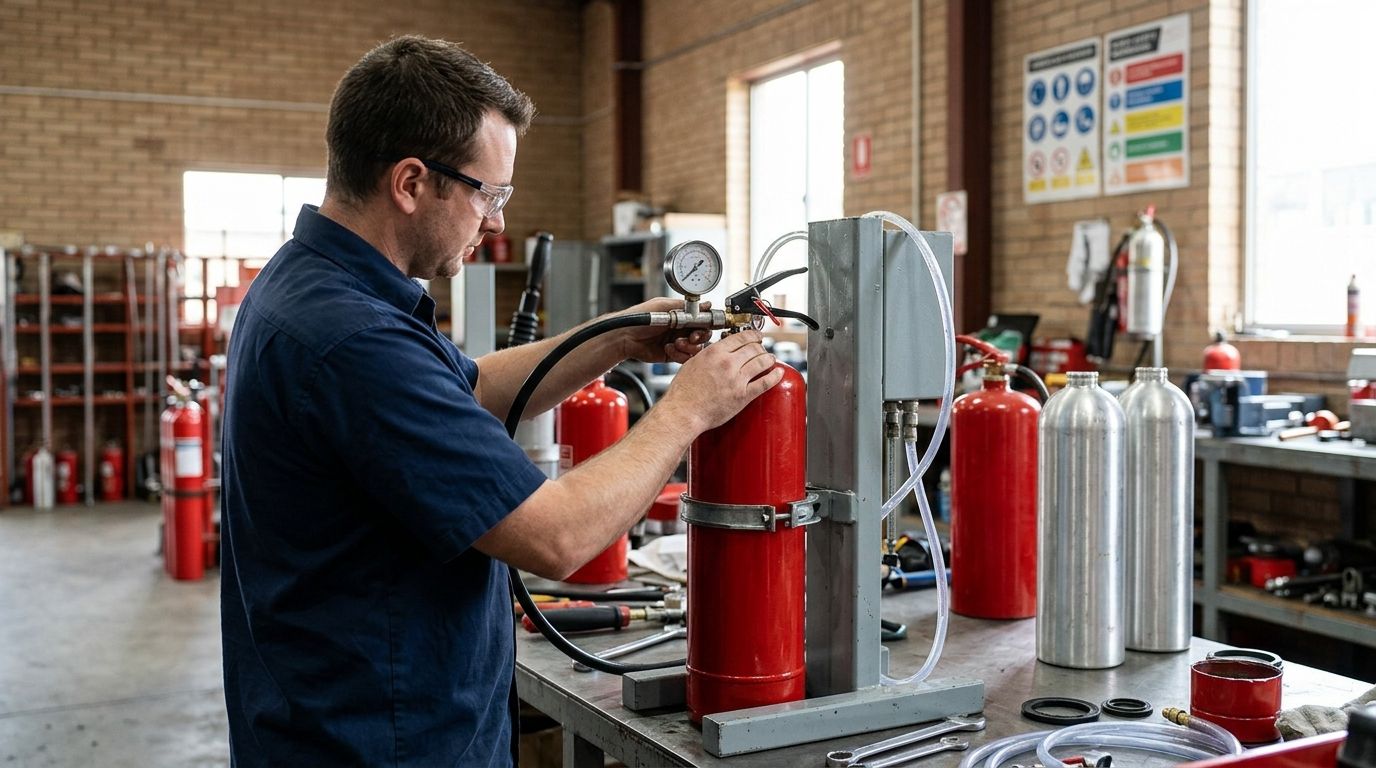
Extinguisher tags lapse for one reason: nobody is watching the hydro test clock until the inspector flags it during the annual walk-through. Instead of chasing overdue units after a citation, you can build a tracking and renewal workflow that flags fire extinguisher hydrostatic testing dates before they expire, routes the unit for testing, and updates the tag the same day service happens — so the paper trail never falls behind the equipment.
- Fire extinguisher hydrostatic testing runs on fixed NFPA 10 intervals: 5 years for water, foam and CO2 units, 12 years for dry chemical.
- A due-date tracker plus an auto-renew workflow catches overdue units weeks ahead instead of at the annual inspection.
- First-Line Fire ties hydro test scheduling to tag renewal so multi-site operators stop tracking due dates by memory.
- Best for facilities running 20 or more extinguishers across buildings, yards or fleet vehicles where a spreadsheet stops working.
Why this matters
An overdue hydrostatic test isn't a paperwork problem — it's a unit that no longer has a documented pressure rating, which means an inspector pulls it from service on sight. On a site with 40 or 60 extinguishers spread across buildings, floors and vehicles, tracking each unit's manufacture date, last test date and interval by memory or a static spreadsheet guarantees some units slip through. First-Line Fire sees the same pattern across coal prep plants, marinas and trucking fleets in Kentucky, Illinois, Indiana, Tennessee, Missouri and Alabama: the tag goes stale months before anyone notices, usually right before an audit.
The fix isn't a new inspection schedule. It's connecting the date you already have (last hydro test) to a trigger that fires automatically, instead of relying on someone remembering to check.
Before you start
- A current inventory list with serial number, manufacture date, extinguisher type, and last hydrostatic test date for every unit on site or in the fleet.
- A tagging method — paper tag, punch-card, or QR/barcode asset tag — that records test date and calculates the next due date without you doing it by hand.
- The gotcha: extinguishers with a stamped manufacture date that's faded, painted over, or missing can't be scheduled by "years since last test" alone — flag those units for physical inspection before you build your tracker, not after the tester shows up and can't verify the date.
Set up your due-date tracker
- Build one row per extinguisher with columns for Serial Number, Manufacture Date, Extinguisher Type, Last Hydro Test Date, and Next Due Date.
- Calculate Next Due Date using the NFPA 10 interval for that extinguisher type — 5 years for water, foam, wetting agent and CO2, 12 years for dry chemical stored-pressure and cartridge units.
- Add a Status field with three values: Current, Due in 60 Days, Overdue. This is the field your renewal trigger reads.
Expected result: every extinguisher on the list has a calculated due date and a status flag, no manual date math required going forward.
Configure the renewal trigger
- Set the trigger to fire when Status changes to Due in 60 Days — this gives enough lead time to schedule testing before the unit crosses into Overdue.
- Route the trigger to whoever schedules service: a facilities manager, a fleet coordinator, or directly to your fire protection provider if you've set up standing service dates.
- Confirm the trigger includes the extinguisher's Serial Number and Location so the technician pulls the right unit on the right visit, not a guess based on the building name alone.
Expected result: 60 days out, someone gets a specific, actionable notice — not a generic "inspection due soon" email.
Update the tag and log
- When hydrostatic testing is complete, record the new Last Hydro Test Date on the unit's tag and in the tracker on the same visit — same-day entry is what keeps the paper trail matching reality.
- Recalculate Next Due Date automatically from the new test date, not the old manufacture date.
- Reset Status to Current and archive the old tag record for audit purposes — most insurers and fire marshals want the last two test cycles on file, not just the current one.
Expected result: the tag on the extinguisher and the record in your tracker show the same date, and the next due date is already calculated for the following cycle.
Renewing tags across a vehicle fleet
Fleet extinguishers add a wrinkle: the unit doesn't stay in one place, so your tracker needs a Vehicle ID field in addition to serial number and location. Whenever a truck rotates yards or changes routes, the extinguisher's due date has to follow the vehicle, not the yard it started in.
Set the same 60-day trigger, but route it to whoever schedules DOT inspections rather than a facilities contact — bundling hydro testing with a scheduled maintenance stop cuts down on trucks getting pulled out of rotation just for an extinguisher swap. The trucking fleet inspection guide covers how to fold this into a broader DOT compliance check instead of running it as a separate errand.
Troubleshooting
- Due date looks wrong. Someone calculated it from the manufacture date instead of the last hydro test date — these only match on a unit's first test cycle.
- Serial number doesn't match the tag. Units get swapped between locations without updating the tracker; reconcile the physical inventory against the list at least once a year.
- Tag updated but tracker wasn't. Build the same-day update into the technician's visit checklist — a tag updated in the field and a spreadsheet updated a week later is exactly how units go overdue on paper even when they're compliant in reality.
- Mixed extinguisher types on one site confuse the interval. Water/CO2 units and dry chemical units on the same floor plan need separate interval columns — don't apply one blanket cycle to a mixed inventory.
- Vehicle extinguisher missing at inspection time. The truck rotated to another yard; the Vehicle ID field should travel with the unit in the tracker, not stay tied to a fixed location.
Get hydro testing scheduled before it's overdue
First-Line Fire tracks due dates and updates tags on the same visit.
Customize your workflow
Once due-date tracking and tag renewal are running, extend the same trigger logic to the step that usually follows a failed or overdue hydro test: recharge. A unit that fails hydrostatic testing gets pulled from service and needs a recharge or replacement before it goes back on the wall — the hydro test to recharge workflow walks through connecting that handoff so a failed test doesn't sit as an open item for weeks.
Property managers running the same tracker across several buildings should also connect it to annual inspection sign-off, so hydro test status and inspection status live in one place instead of two separate logs that can drift apart.
FAQ
How often does fire extinguisher hydrostatic testing need to happen?
Water, foam, wetting agent and CO2 extinguishers need hydrostatic testing every 5 years under NFPA 10. Dry chemical stored-pressure and cartridge units run on a 12-year cycle.
What happens if a hydro test date is missed?
An extinguisher past its hydro test due date is out of compliance and typically gets pulled from service by an inspector. It has to be tested or replaced before it can go back in use.
Can you calculate hydro test due dates from the manufacture date?
Only for the first cycle. After the first test, the due date resets from the last hydro test date, not the original manufacture date, which is the most common source of tracking errors.
Do fleet vehicles need the same hydro testing schedule as building extinguishers?
Yes, the NFPA 10 intervals apply regardless of where the unit is mounted. Fleet tracking just needs a vehicle identifier added so the due date follows the truck, not the yard.
Is hydrostatic testing the same as an annual inspection?
No. Annual inspection is a visual and functional check done every year; hydrostatic testing is a pressure test of the cylinder done every 5 or 12 years depending on extinguisher type.
Can an extinguisher tag be updated without a physical retest?
No. The tag date only changes when the actual hydrostatic test is performed and passed — updating a tag without the test is a compliance violation.
What triggers a fire extinguisher to be replaced instead of retested?
Illegible or missing manufacture dates, visible corrosion, and units that fail the hydrostatic test itself are the usual triggers for replacement instead of another test cycle.
One last thing
Most facilities that get flagged for expired hydro tags in 2026 aren't ignoring the requirement — they're tracking it against the wrong date. Pulling the due date from the manufacture stamp instead of the last hydro test date is the single most common error in the trackers First-Line Fire reviews on new accounts, and it silently pushes every subsequent cycle off by years.


