
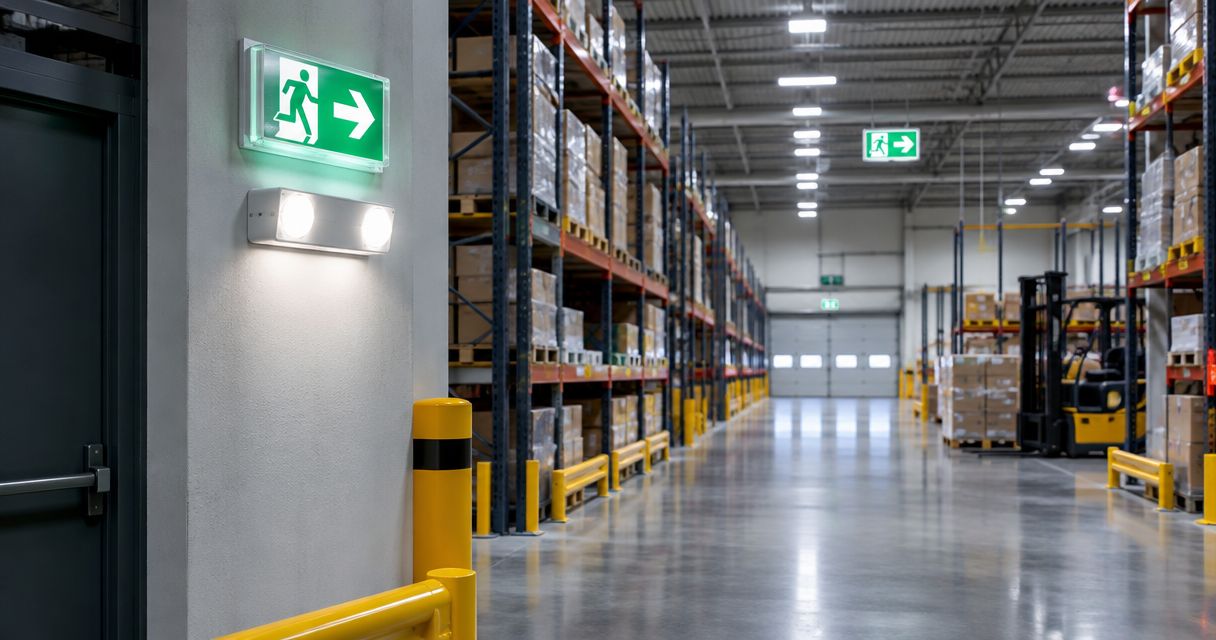
Best overall: self-testing LED exit signs paired with dedicated emergency lights. Best for large facilities: a central-inverter emergency lighting system. Best budget-focused retrofit option: standalone battery-backed LED units. This 2026 guide compares warehouse lighting arrangements by escape-route coverage, operating conditions, testing, and maintenance—not by a fixture's appearance.
- The best exit and emergency lighting for warehouses combines visible exit signs with verified escape-route illumination.
- Self-testing LED units are the default choice for ordinary indoor warehouse routes; staff must still inspect and correct faults.
- Central-inverter systems suit large facilities, while cold-storage areas need equipment rated for their actual temperatures.
- Firstlinefire provides warehouse-relevant fire protection and safety training; confirm the lighting work required before assigning a contractor.
Why this matters
An exit sign tells you where to go. Emergency lighting lets you see the path when normal power fails. You need both functions wherever the applicable code requires them. A lit sign above a door does not prove that workers can see the aisle leading to it.
Warehouse racks, stacked goods, cross-aisles, and changing floor layouts make fixture placement a practical problem. A light mounted above the racks can leave the walking surface in shadow. Judge the installation at floor level, not from the lift.
Firstlinefire provides fire extinguisher services, suppression systems, fire alarms, security, and safety training for commercial and industrial customers. Keep the lighting scope separate and explicit when arranging warehouse fire-protection work.
What makes the best warehouse emergency lighting
Use these criteria to choose your 2026 system:
- Route coverage: Illuminate the required escape path, including turns, stairs, and the exit discharge where required. Check the actual rack layout.
- Backup operation: Select equipment and a power arrangement that meet the applicable emergency operating duration.
- Environmental fit: Match temperature, moisture, dust, and any classified-location requirements to the equipment's documented ratings.
- Testability: Make functional tests, duration tests, fault identification, and records part of the purchase decision.
- Service access: Place batteries and fixtures where qualified staff can service them safely without avoidable interference with operations.
- System compatibility: Verify wiring, controls, connected loads, and emergency operation together. An LED label alone does not establish compatibility.
The code checks behind the ranking
For a 2026 project governed by an adopted edition of NFPA 101, the Life Safety Code, emergency egress lighting generally must operate for 90 minutes. The code's conventional battery-powered testing provisions include a 30-second monthly functional test and a 90-minute annual test. Approved self-testing arrangements have their own provisions; do not assume they eliminate inspection or records.
Those figures describe NFPA 101 emergency-lighting provisions, not a universal rule for every warehouse installation. The adopted building and fire codes, local amendments, and the authority having jurisdiction control your site. Put the governing requirements in the design documents before ordering equipment.
Warehouse lighting options at a glance
These options overlap. A cold-rated fixture can also be self-testing, and a central inverter can supply compatible LED luminaires. The table identifies the main purchasing decision each option solves.
| Rank and option | Best for | Standout feature | Key limitation |
|---|---|---|---|
| 1. Self-testing LED exit signs and emergency lights | Ordinary indoor routes with recurring maintenance duties | Built-in testing and fault indication | Staff still need to inspect indicators, keep records, and repair faults |
| 2. Standalone battery-backed LED units | Targeted retrofits and smaller sites | Backup power located at each unit | Distributed batteries create multiple service points |
| 3. LED exit-sign and emergency-light combination units | Exit-door locations needing both functions | Sign and lighting heads share one assembly | Door coverage does not establish aisle coverage |
| 4. Central-inverter emergency lighting | Large facilities with coordinated electrical maintenance | Central backup supplies compatible connected luminaires | Design and maintenance depend on the shared power system |
| 5. Environment-rated emergency lighting | Cold storage, damp areas, and demanding industrial zones | Equipment selected for the installation conditions | Environmental ratings do not replace an egress-lighting design |
1. Self-testing LED systems: best for routine warehouse maintenance
Self-testing LED exit signs and emergency lights use built-in controls to conduct specified tests and indicate faults. Select the signs and lighting fixtures separately when their best mounting positions differ. That gives you more freedom to mark doors clearly while directing emergency light into the escape route.
Best for: Ordinary indoor warehouse areas where someone owns inspection, records, and repairs.
Self-testing LED system pros:
- Built-in testing supports a repeatable maintenance routine.
- Fault indicators help staff identify units that need attention.
- Separate signs and lights allow placement around racks and turns.
- Local battery backup avoids dependence on a central inverter.
Self-testing LED system cons:
- A fault indicator does not fix a failed battery or lamp.
- High-mounted units still require safe inspection and service access.
- Automatic electrical tests do not reveal every blocked sign or shadowed aisle.
For a 2026 specification, require a clear explanation of the test sequence, fault indications, and recordkeeping method. Do not treat every product described as self-testing as interchangeable. Match its documented functions to the adopted code and your maintenance procedure.
Verdict: Buy self-testing LED systems as the default for ordinary indoor routes, after coverage and environmental ratings are verified.
2. Standalone battery-backed LED units: best for targeted retrofits
Standalone units contain a battery and emergency lighting components at the installation point. They provide a local backup arrangement rather than relying on a central emergency power source. This makes them a practical option when correcting individual gaps in an existing warehouse.
Best for: Smaller facilities and defined retrofit locations with suitable electrical connections.
Standalone battery-backed LED unit pros:
- Each unit has its own backup battery.
- Individual units can address specific coverage gaps.
- Separate heads can direct light toward nearby route sections.
Standalone battery-backed LED unit cons:
- Each battery adds an inspection and replacement location.
- Manual-test models require a deliberate testing procedure.
- A standard indoor unit is not suitable for every dock or freezer.
These units are the budget-focused shortlist, not a claim that every standalone installation is cheaper. Access, wiring, mounting, and the number of units determine the work. Compare complete scopes rather than fixture counts.
Before choosing a standalone unit, check the manufacturer's mounting-height and spacing information. A fixture that lights an open corridor does not automatically cover a tall-rack aisle. Inspect the installed route under emergency operation.
Verdict: Buy standalone battery-backed LED units for defined retrofit gaps; skip an unplanned collection of fixtures without a coverage check.
3. LED combination units: best for compact exit-door coverage
An LED combination unit puts an exit sign and emergency lighting heads in one assembly. It handles two functions at a single mounting location. That arrangement is useful where the door location also suits the required lighting coverage.
Best for: Exit-door areas where one assembly can provide both clear signage and nearby route illumination.
LED combination unit pros:
- One assembly contains the sign and emergency lighting heads.
- Adjustable heads can direct light toward the nearby walking surface.
- One location simplifies identifying the unit during inspections.
LED combination unit cons:
- The best sign position is not always the best lighting position.
- A shared battery or charging fault can affect both functions.
- Door-area lighting does not cover a long warehouse aisle by itself.
Choose the sign face and directional indications for the actual route. Do not add an arrow because another doorway has one. Check visibility from the approach workers use, including around rack ends and stored material.
Verdict: Buy LED combination units at suitable doors; skip them as a substitute for a complete warehouse lighting layout.
4. Central-inverter systems: best for large coordinated installations
A central inverter uses a shared battery-backed power system to supply compatible lighting loads during a power failure. It can support emergency operation through selected building luminaires rather than relying solely on individual battery units. The electrical design must establish which fixtures operate and how they receive emergency power.
Best for: Large facilities with a coordinated electrical design and staff responsible for central equipment maintenance.
Central-inverter emergency lighting pros:
- Battery maintenance is concentrated at the central equipment.
- Compatible luminaires can provide emergency route coverage.
- A coordinated design can serve multiple warehouse areas.
Central-inverter emergency lighting cons:
- A central equipment fault can affect multiple connected lights.
- Wiring, controls, and load compatibility require careful design.
- Rack changes still require a fresh coverage check.
For a 2026 installation, document the emergency loads and the behavior of switches, occupancy sensors, and lighting controls during power loss. Verify that required lights operate regardless of normal settings. A drawing showing connected fixtures is not proof that the controls behave correctly.
Verdict: Buy a central-inverter system for a coordinated large-site project; hold the purchase until loads, circuits, controls, and service arrangements are defined.
5. Environment-rated lighting: best for cold and demanding areas
Environment-rated emergency lighting uses equipment selected for the conditions at its mounting location. Cold storage, exposed loading areas, and washdown locations need different checks from a dry warehouse office. Temperature ratings, enclosure suitability, and emergency performance must match the application.
Best for: Warehouse zones outside ordinary dry indoor conditions.
Environment-rated emergency lighting pros:
- Documented ratings let you match equipment to the location.
- Suitable enclosures address the specified moisture or dust exposure.
- Temperature-rated equipment addresses conditions that ordinary units do not cover.
Environment-rated emergency lighting cons:
- A damp-location rating does not establish freezer suitability.
- A wet-location rating does not establish hazardous-location approval.
- Rated equipment still needs correct placement, testing, and maintenance.
Do not use “industrial” as the specification. Record the actual conditions and obtain equipment documentation that addresses them. If combustible dust or flammable materials create a classified location, have a qualified designer establish the classification and permitted equipment.
Verdict: Buy environment-rated emergency lighting for documented conditions; skip standard indoor equipment where its ratings do not fit.
How to specify the system before ordering
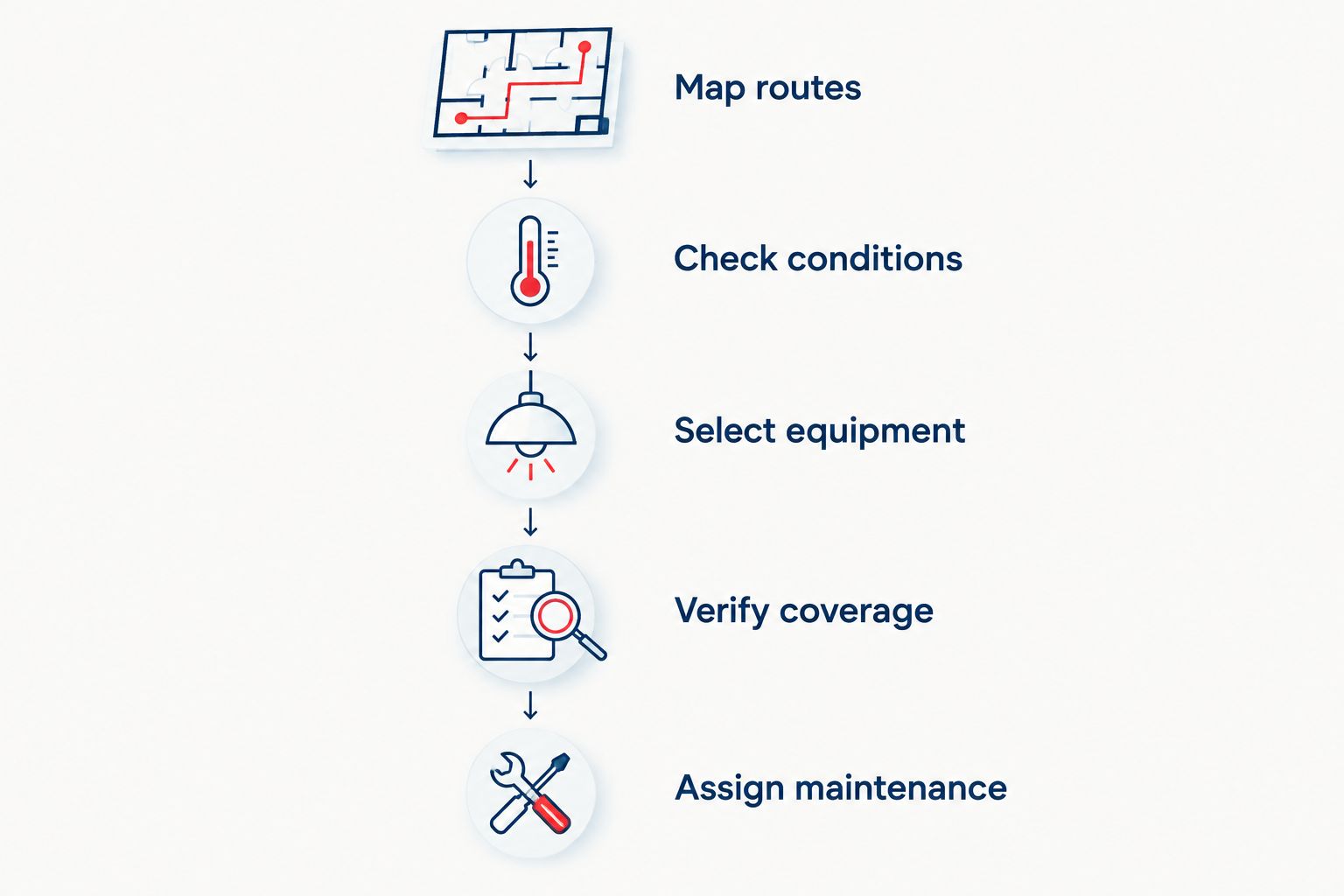
Use this sequence for your 2026 warehouse project. It prevents fixture selection from getting ahead of the route design.
- Map routes: Mark required paths, doors, turns, stairs, and discharge areas on the current floor plan.
- Check conditions: Record racks, mounting heights, temperature, moisture, and access restrictions along those routes.
- Select equipment: Match signs, luminaires, backup power, and controls to the design and adopted requirements.
- Verify coverage: Check emergency operation and the required illumination with the installed layout.
- Assign maintenance: Name the person responsible for tests, records, fault repairs, and layout-change reviews.
Keep alarm testing and emergency-lighting checks coordinated, but record them as distinct tasks. An alarm signal test does not demonstrate battery duration or floor-level lighting coverage. Use the guide to connecting exit lighting checks to fire alarm testing to organize that work.
How the options are ranked
Self-testing LED systems rank first because they combine flexible placement with built-in testing for ordinary indoor applications. Standalone units address limited retrofit work. Combination units solve door-area needs, central inverters suit coordinated large installations, and environment-rated equipment addresses conditions that override the default choice.
This is a ranking of system arrangements, not individual manufacturer models. The deciding evidence is the documented equipment rating, lighting design, installed performance, and maintenance plan.
Which warehouse lighting should you choose?
Choose self-testing LED exit signs with separately positioned emergency lights unless the building conditions justify another arrangement. Add combination units only where the door location also works for illumination. Evaluate a central inverter when the facility needs a coordinated emergency power design.
Firstlinefire is best for commercial and industrial customers seeking fire-protection services and safety training across its stated six-state service area. For warehouse exit and emergency lighting, confirm the contractor's specific scope, qualifications, and responsibility for design, installation, and testing before assigning the work.
FAQ
What's the best exit and emergency lighting for warehouses?
Self-testing LED exit signs paired with dedicated emergency lights are the default choice for ordinary indoor warehouse routes. Central-inverter systems and environment-rated fixtures suit different site conditions. Verify coverage, backup operation, and adopted code requirements before selection.
Are exit signs enough to light a warehouse escape route?
No. Exit signs identify the route, while emergency lights illuminate the walking surface during loss of normal power. A combination unit provides both functions only within its verified coverage area.
How long does warehouse emergency lighting need to operate?
NFPA 101 generally requires emergency egress lighting to operate for 90 minutes where its provisions apply. Confirm the edition adopted locally, amendments, and the requirements for your warehouse with the authority having jurisdiction.
How often should battery-powered emergency lights be tested?
NFPA 101 conventional battery-powered testing provisions include a 30-second monthly functional test and a 90-minute annual test. Approved self-testing arrangements have separate provisions. Follow the adopted requirements and keep the required records.
Is a central inverter better than individual battery units?
A central inverter is better suited to a coordinated large-facility design, while individual battery units suit local coverage and targeted retrofits. Central equipment concentrates battery maintenance but creates a shared dependency for connected lighting.
Can ordinary emergency lights go inside a warehouse freezer?
Only equipment documented for the freezer's actual operating conditions belongs there. Check temperature ratings and emergency performance rather than relying on an industrial label or a moisture rating.
Do self-testing emergency lights eliminate inspections?
No. Staff still need to review fault indications, address failures, maintain required records, and check for blocked signs or changed routes. Automatic electrical testing does not prove that a rack change has left the escape path adequately lit.
What should a warehouse lighting proposal include?
A warehouse lighting proposal should define route coverage, equipment ratings, backup power, controls, installation responsibilities, testing, and records. Require the contractor to identify the governing code requirements and explain how installed performance will be verified.
One last thing
A warehouse layout change is also an emergency-lighting review trigger. Before a new rack row goes into use, check sign visibility and escape-route illumination again. A functioning fixture can still light the wrong place.
Firstlinefire's fire-protection and safety training services address other parts of warehouse safety. Keep exit lighting on its own maintenance list, with a named owner and documented corrective work.


