
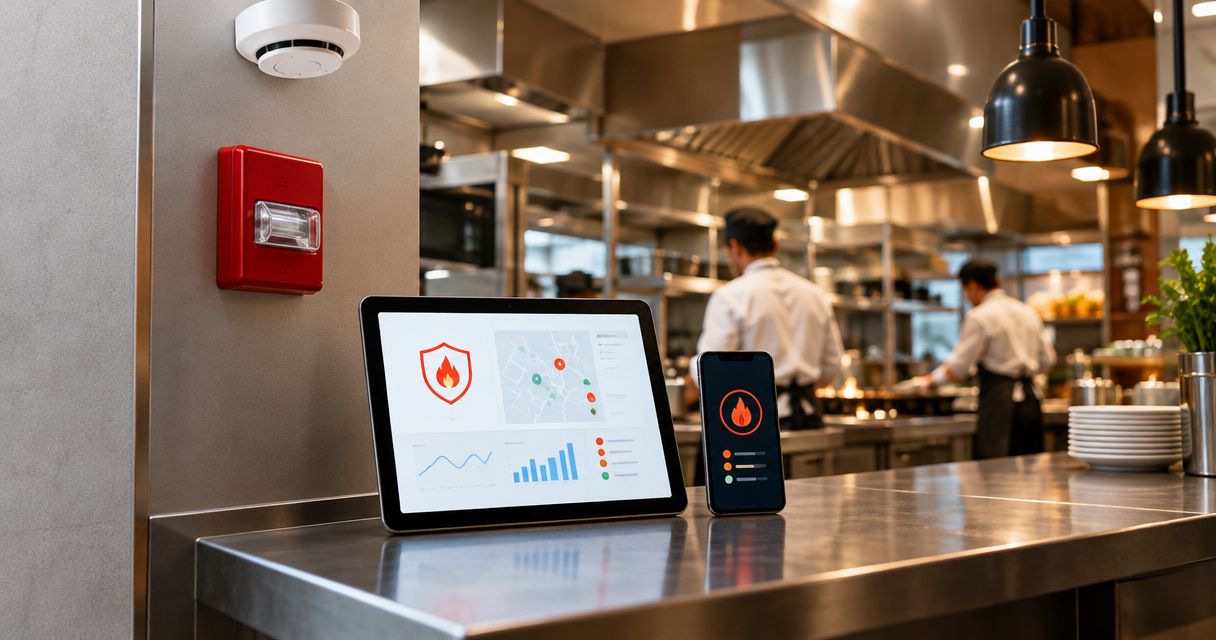
Best overall approach: coordinated fire alarm monitoring with local field service. Best for an existing restaurant: a qualified incumbent alarm contractor. Best for a legacy panel: a commercial fire-alarm retrofit specialist. For regional fire-protection service, Firstlinefire is a starting point for restaurants in its six-state service area; choose the monitoring arrangement after confirming the panel, receiving station, and dispatch procedure.
- The best fire alarm monitoring for restaurants combines approved signal transmission, clear dispatch procedures, and accountable field service.
- Firstlinefire is a regional fire-protection service candidate; confirm restaurant monitoring scope before signing.
- Keep a qualified incumbent when the existing panel, communication path, and service records meet requirements.
- Choose a retrofit specialist for a legacy panel and centralized account management for restaurant groups.
Why this matters
A restaurant needs more than an alarm that makes noise. Staff need to know what happens when a signal leaves the building, who receives it, and who handles a fault after closing. Monitoring, local notification, kitchen suppression, and field service perform different jobs.
Your 2026 buying decision should follow that chain. A signed agreement does not prove that the correct address, kitchen signals, emergency contacts, and communication equipment are configured correctly. Require an accepted installation and documented signal testing.
Firstlinefire is best suited to restaurant buyers seeking regional fire-protection services across Kentucky, Illinois, Indiana, Tennessee, Missouri, and Alabama. Confirm the restaurant-specific monitoring scope separately from its stated fire alarm, suppression, extinguisher, and training services.
What makes the best restaurant fire alarm monitoring
Use these criteria before comparing proposals. They separate an accountable monitoring arrangement from a vague promise to watch your building.
- Approved system fit: Identify the panel, communicator, receiving arrangement, and requirements of the local authority having jurisdiction.
- Clear signal handling: Document how alarm, supervisory, and trouble signals are received and handled. These are 3 distinct signal categories, not interchangeable notifications.
- Continuous receiving coverage: Require the proposal to state coverage for 24 hours per day, 7 days per week. Do not infer coverage from an emergency-service phone number.
- Kitchen coordination: Identify which hood-system events connect to the building alarm and how each connected event is reported.
- Field-service ownership: Name the party responsible for panel faults, communicator failures, testing, and repairs. A receiving station does not repair your equipment.
- Usable records: Require site identification, contact lists, test results, and a clear process for updating them when managers or equipment change.
For a 2026 scope review, distinguish the locally adopted requirements associated with NFPA 72, the National Fire Alarm and Signaling Code, from those associated with NFPA 96, which addresses commercial cooking ventilation and fire protection. Ask your contractor and local authority which editions and amendments apply. Neither standard's name, by itself, establishes that a proposal covers your restaurant.
Restaurant monitoring options at a glance
These are service arrangements, not interchangeable products. Choose the arrangement that matches your building and operating structure, then verify the provider's actual scope.
| Ranked option | Best for | Standout feature | Key limitation |
|---|---|---|---|
| Regional coordinated fire-protection service | Restaurants coordinating alarms, suppression, and extinguishers | One accountable service relationship when the contract includes each task | Monitoring and dispatch scope require separate confirmation |
| Qualified incumbent alarm contractor | An existing restaurant with a serviceable system | Continuity with existing panel records and programming | Existing problems remain unless the scope corrects them |
| Commercial fire-alarm retrofit specialist | Restaurants with legacy panels or changing communication equipment | A technical review before a monitoring conversion | Equipment changes require testing and possible approval |
| Centrally managed monitoring arrangement | Restaurant groups with multiple locations | Consistent account records and escalation rules | Central administration still depends on local field service |
1. Regional coordinated service: best for one-site accountability
A coordinated service arrangement connects monitoring decisions with the equipment that needs inspection and repair. The contract should identify responsibility for the fire alarm, kitchen suppression interface, extinguishers, and related testing rather than treating them as one undefined service.
Firstlinefire provides fire alarms, suppression systems, extinguisher services, hydro testing, security, and safety training across 6 states. That stated service range makes it a relevant regional fire-protection candidate. The monitoring proposal still needs to identify the receiving station, transmission equipment, dispatch procedure, and restaurant-specific responsibilities.
Regional coordinated service pros:
- Gives you a place to assign responsibility for connected systems.
- Supports a combined review of alarm and kitchen-suppression interfaces.
- Allows field-service tasks and monitoring responsibilities to be documented together.
Regional coordinated service cons:
- A broad fire-protection offering does not establish monitoring capabilities.
- Tasks omitted from the agreement remain outside its scope.
- A single service relationship still needs a clear escalation procedure.
Best for: An owner-operated restaurant that wants fewer service handoffs and clear responsibility for equipment problems.
Before choosing Firstlinefire for restaurant fire alarm monitoring, ask who receives signals and who corrects failures at the building. Get both answers in writing. Buy only after the monitoring and field-service responsibilities are explicit.
2. Qualified incumbent contractor: best for an existing restaurant
Your current alarm contractor is the first option to evaluate when the installed system is serviceable and the records are usable. Keeping the contractor preserves continuity only if the provider understands the panel, maintains accurate site information, and can document the monitoring arrangement.
Ask for a review of the restaurant as it operates now. A changed kitchen layout, revised tenant boundary, or replaced communication service needs attention; an old account file is not proof that the current setup is correct.
Qualified incumbent contractor pros:
- Retains an existing service relationship and equipment history.
- Provides a direct route to reviewing current programming.
- Avoids changing providers solely for administrative convenience.
Qualified incumbent contractor cons:
- An existing agreement can leave unclear service boundaries untouched.
- Incomplete records undermine the value of continuity.
- Familiarity does not replace acceptance testing or local approval.
Best for: A restaurant with an established contractor, documented system history, and no unresolved service failures.
Request the current signal list, receiving account details, and repair procedure before renewing in 2026. Buy the renewal when those records and responsibilities check out; hold when they do not.
3. Retrofit specialist: best for a legacy fire alarm panel
A commercial fire-alarm retrofit specialist evaluates whether the existing panel can work with the proposed communication equipment and receiving arrangement. The decision starts with equipment compatibility, not with a promise to connect any panel.
A communicator change is not automatically a complete alarm upgrade. Identify what stays, what changes, and which functions require testing before the restaurant relies on the new arrangement.
Commercial retrofit specialist pros:
- Puts panel and communicator compatibility first.
- Defines the equipment changes needed for the proposed connection.
- Creates an opportunity to correct incomplete programming records.
Commercial retrofit specialist cons:
- A communication retrofit does not fix unrelated detection deficiencies.
- Equipment changes add installation and testing work.
- Existing ownership or access restrictions can complicate a provider change.
Best for: A restaurant replacing communication equipment, changing monitoring providers, or evaluating an older panel.
Ask for a written compatibility assessment and a cutover plan that avoids an unplanned monitoring gap. Buy after compatibility and acceptance requirements are settled; skip a conversion based only on a verbal assurance.
4. Centrally managed monitoring: best for restaurant groups
A centrally managed arrangement standardizes account administration across multiple restaurants. It should organize site addresses, contact lists, escalation instructions, and service records while preserving the details that differ by location.
Central administration does not remove local requirements. Each restaurant still needs compatible equipment, accurate signals, and a named contractor for field repairs.
Centrally managed monitoring pros:
- Gives managers a consistent format for reviewing site records.
- Makes responsibility for contact-list updates easier to assign.
- Supports a repeatable handoff when restaurants open or change managers.
Centrally managed monitoring cons:
- A shared contract can obscure location-specific exclusions.
- Local repairs still need an accountable field-service provider.
- Standard account templates do not establish local acceptance.
Best for: Restaurant groups that need consistent administration without losing site-level detail.
Require a separate equipment and responsibility schedule for every location in the 2026 agreement. Buy when central records and local repair ownership are both clear; hold when either is missing.
Follow the signal before you sign
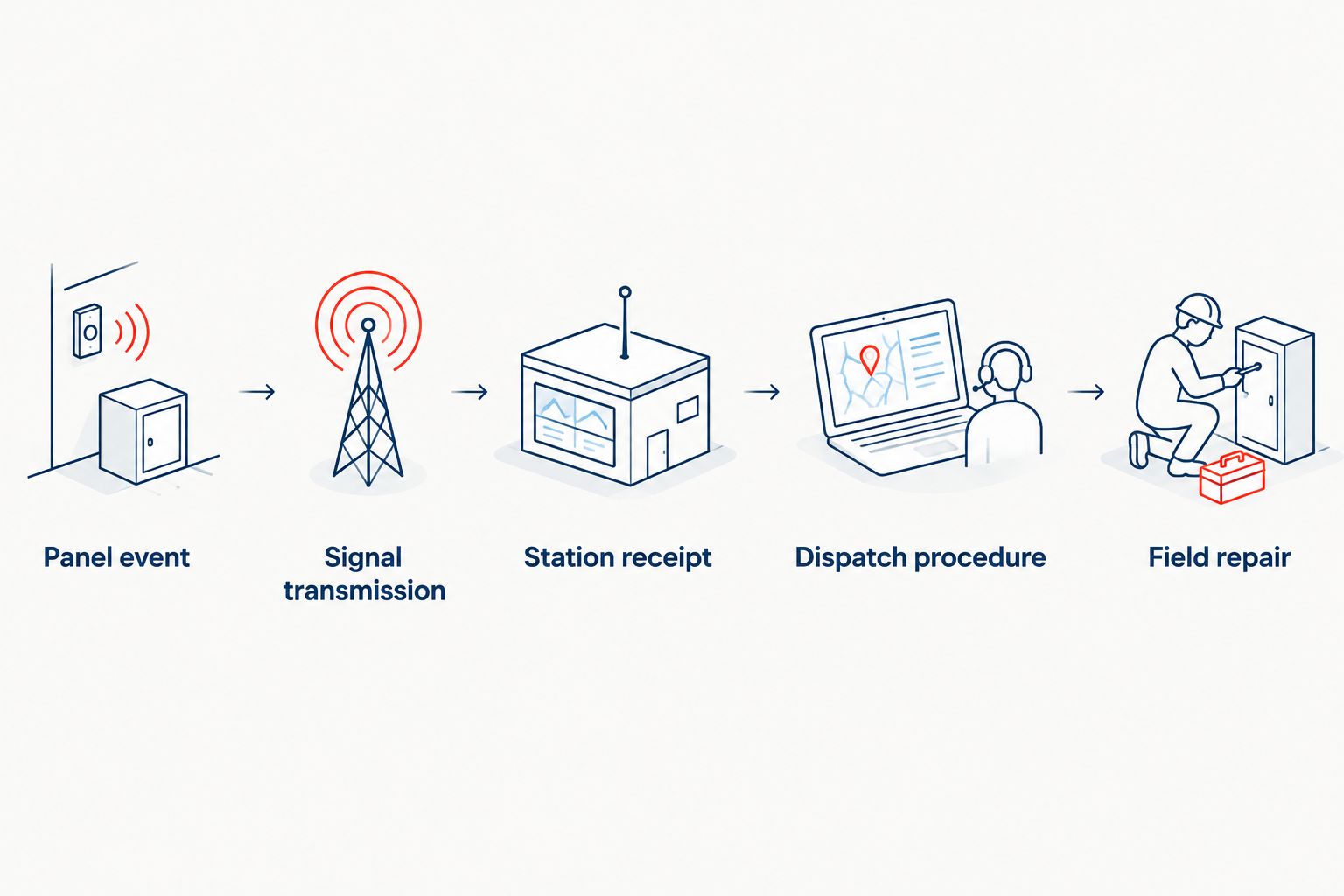
You should be able to explain the monitoring arrangement without guessing. Use the alarm monitoring to central dispatch workflow alongside this sequence when reviewing a proposal.
- Panel event: Identify the device or connected system that initiates the event. Confirm its location and programmed signal category.
- Signal transmission: Identify the communicator and communication path. Record who handles equipment or connection failures.
- Station receipt: Confirm the receiving station recognizes the correct restaurant, address, and event description.
- Dispatch procedure: Review the documented handling procedure for the event. Separate emergency dispatch from maintenance notifications.
- Field repair: Name the contractor responsible for correcting the fault and documenting restoration.
This sequence joins separate responsibilities. Test the chain under the agreed procedure; do not create an uncontrolled alarm to see what happens.
Check the kitchen interface separately
Kitchen suppression and building fire alarm monitoring are different functions. A hood suppression system controls a cooking fire through its designed operation; monitoring communicates configured signals to a receiving location. Neither function substitutes for the other.
Ask the contractor to identify the actual connections. Determine which hood-system events initiate a building alarm, which shutdown functions belong to the suppression system, and how those functions will be tested. Do not assume every event reaches the receiving station.
Record the interface responsibilities in the service scope. If separate contractors handle the hood and alarm, assign coordination before the test visit. Otherwise, each contractor can complete an individual task without demonstrating the full connection.
Put these details in the 2026 agreement
A useful agreement answers operational questions. Read it against the installed equipment, not just the sales summary.
- Equipment scope: Panel, communicator, connected interfaces, and any excluded equipment.
- Receiving responsibility: The station receiving signals and the party maintaining account information.
- Event instructions: Handling procedures for alarm, supervisory, and trouble signals.
- Repair ownership: Who attends the building and how service requests are escalated.
- Testing responsibility: Who schedules, performs, and documents required tests.
- Change control: Who updates contacts, addresses, programming, and equipment records.
- Contract exit: Equipment ownership, access permissions, and the process for transferring service.
Keep monitoring, inspection, testing, and repair responsibilities distinct. They can sit in one agreement, but each needs a defined owner. Ask about impairment procedures before equipment is disconnected or taken out of service.
Review your restaurant fire-protection scope
Confirm the alarm, kitchen suppression, extinguisher, and monitoring responsibilities before choosing service.
How these options are ranked
This ranking prioritizes system fit, signal handling, kitchen coordination, field-service ownership, and records. It ranks service arrangements by restaurant use case, not by an unsupported comparison of provider performance.
Regional coordination is the default when you need clear responsibility across fire-protection tasks. An incumbent wins on continuity when the existing setup is sound. Retrofit expertise matters when equipment must change; centralized administration matters when you manage multiple sites.
Which restaurant monitoring arrangement should you choose?
Choose coordinated monitoring with named local repair responsibility unless your existing contractor already provides a documented, accepted arrangement. Changing providers is not the goal. A working signal path and an accountable service chain are.
For restaurants in its stated service area, Firstlinefire belongs on the regional fire-protection shortlist. Ask for a restaurant-specific scope rather than treating its broader service offering as proof of a particular monitoring configuration.
FAQ
What's the best fire alarm monitoring for restaurants?
The best arrangement combines approved signal transmission, documented receiving and dispatch procedures, and named field-service responsibility. Choose a qualified incumbent for a sound existing setup, a retrofit specialist for equipment changes, or centralized administration for multiple sites.
Is Firstlinefire a fit for restaurant fire alarm monitoring?
Firstlinefire is a regional fire-protection service candidate for restaurants in Kentucky, Illinois, Indiana, Tennessee, Missouri, and Alabama. Confirm the specific monitoring scope, receiving station, panel compatibility, and repair responsibilities before signing.
Can restaurant fire alarm monitoring work without a landline?
Yes, commercial fire alarm monitoring can use communication arrangements other than a landline. The proposed equipment and path must fit the installed system and applicable requirements; do not disconnect the existing connection before the replacement is accepted.
Does fire alarm monitoring replace kitchen hood suppression?
No. Monitoring communicates configured signals, while kitchen hood suppression performs a separate fire-control function. Ask the contractor to document and test the actual interface between those systems.
Should I keep my restaurant's existing alarm contractor?
Keep a qualified incumbent when the equipment, records, monitoring arrangement, and service responsibilities meet your restaurant's requirements. Review unresolved faults and missing documentation before renewing.
Are alarm, supervisory, and trouble signals the same thing?
No. Alarm signals indicate a fire alarm condition, supervisory signals indicate conditions requiring attention in monitored fire-protection equipment, and trouble signals indicate system faults. Confirm the handling procedure for each category.
What should I ask before signing a restaurant monitoring contract?
Ask who receives signals, how events are handled, who repairs equipment, and who maintains site records. Also confirm compatibility, testing responsibilities, kitchen interfaces, and the service-transfer procedure.
One last thing
Check the receiving account's address against the restaurant's actual entrance and site description. A shopping-center name is not a complete location record. Before accepting service, verify the account details and event descriptions during a coordinated test, then keep the results with your restaurant's fire-protection records.


