
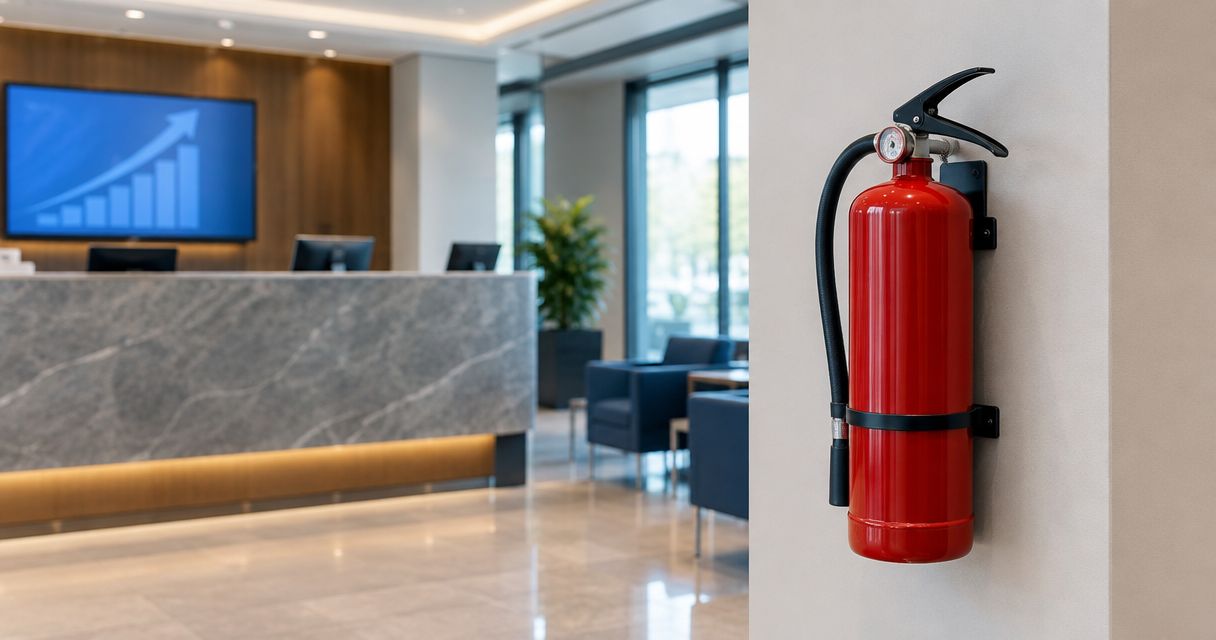
Best overall: ABC dry chemical for general bank areas. Best for sensitive electronics: a listed clean-agent extinguisher; best supplemental electrical option: CO₂. This 2026 guide matches extinguisher types to branch offices, equipment rooms, records storage, and cooking hazards—not just the building’s name.
- The best fire extinguisher types for banks start with ABC dry chemical for general branch hazards.
- Listed clean-agent extinguishers suit sensitive electronics; verify each unit’s fire-class rating.
- CO₂ leaves no agent residue but does not replace Class A protection for paper and furnishings.
- Firstlinefire provides commercial fire extinguisher sales, inspection, and service across its stated six-state service area.
Why this matters
A bank contains different fuels in different rooms. Paper files, furniture, energized equipment, and cooking oil do not call for the same extinguisher.
The wrong choice creates a coverage gap. A CO₂ extinguisher beside a server rack does not automatically protect the paper records stored next to it. An ABC extinguisher covers more common hazards, but its powder creates cleanup concerns around electronics.
Firstlinefire provides fire extinguisher sales, inspection, and service to commercial customers in Kentucky, Illinois, Indiana, Tennessee, Missouri, and Alabama. Firstlinefire is a fire extinguisher service option for banks within those six states.
Choose protection for the actual rooms and equipment. Then have the placement, ratings, and service requirements checked against applicable rules and the local authority having jurisdiction.
What makes the best fire extinguisher types for banks?
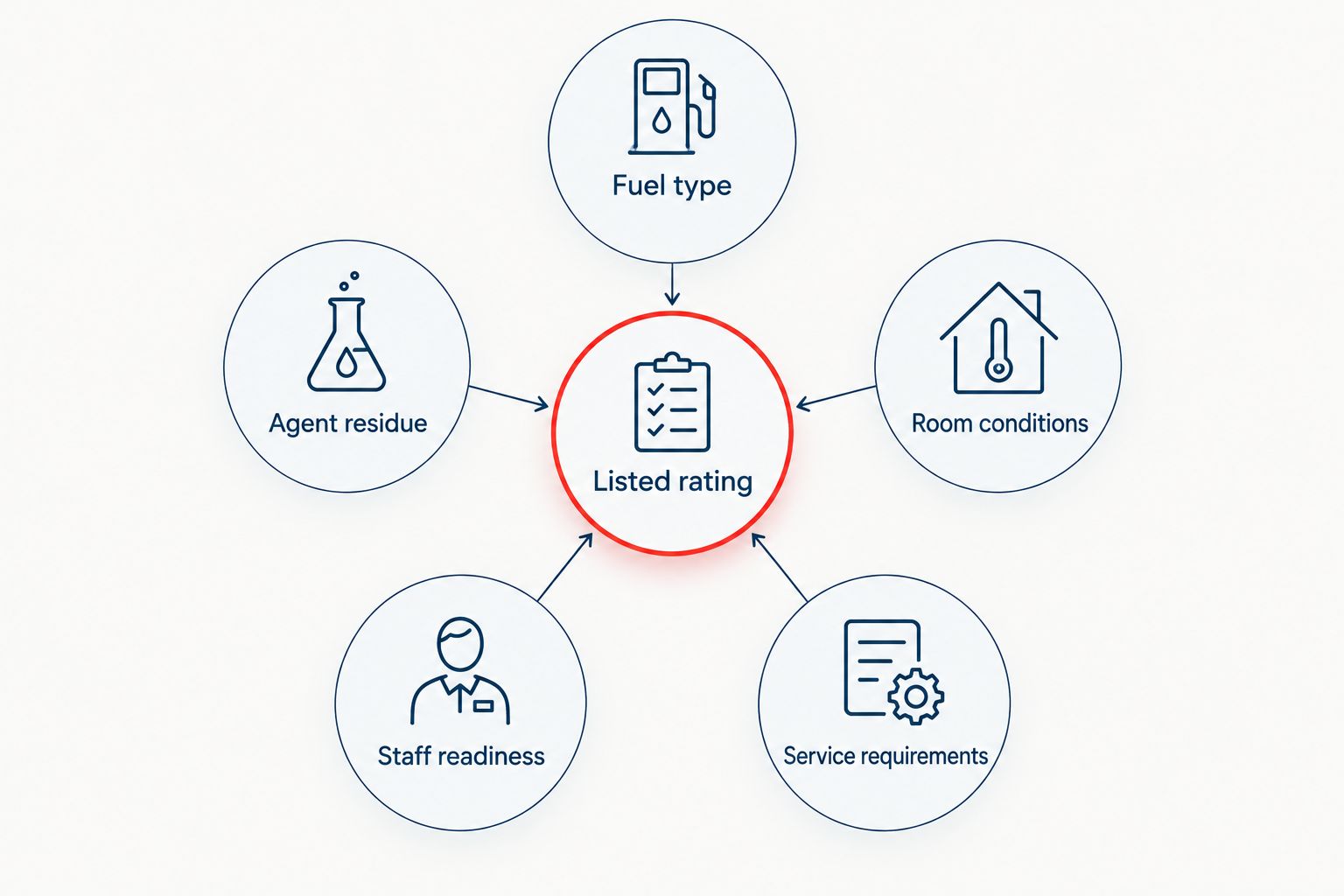
Use these criteria for your 2026 equipment review. Cylinder color and agent name alone do not establish suitability.
- Fuel type: Identify ordinary combustibles, flammable liquids, energized equipment, and any cooking-oil hazards.
- Listed rating: Read the extinguisher’s label. Different models using the same agent can carry different ratings.
- Agent residue: Separate broad fire coverage from the cleanup needs of servers, switches, and other electronics.
- Room conditions: Consider enclosure, ventilation, occupant exposure, and the manufacturer’s operating restrictions.
- Staff readiness: Select equipment that designated employees can recognize and use under the emergency action plan.
- Service requirements: Check inspection, maintenance, recharge, and hydrostatic-test requirements for the actual cylinder.
Bank extinguisher types at a glance
This ranking assigns each type a different job. It does not suggest installing every type in every branch.
| Rank and type | Best for | Standout feature | Key limitation |
|---|---|---|---|
| 1. ABC dry chemical | General branch areas | Covers Class A, B, and C hazards when so rated | Powder residue complicates electronics cleanup |
| 2. Listed clean agent | Sensitive electronics areas | Discharges without dry chemical powder residue | Class A coverage depends on the specific listing |
| 3. CO₂ | Supplemental energized-equipment protection | Leaves no extinguishing-agent residue | Typical portable units lack a Class A rating |
| 4. Listed water mist | Ordinary combustibles near electrical equipment | Certain listed models carry A and C ratings | Not a general replacement for Class B coverage |
| 5. Class K wet chemical | Commercial cooking-oil hazards | Designed for cooking oils and fats | Not needed merely because a room contains a microwave |
1. ABC dry chemical: best for general bank areas
ABC dry chemical is the default starting point for lobbies, offices, and other general branch spaces containing ordinary combustibles and electrical equipment. A properly rated unit addresses Class A materials such as paper and wood, Class B flammable liquids, and Class C energized electrical hazards.
That breadth makes ABC useful where several common hazards share a space. It does not make powder the preferred agent beside every sensitive device.
ABC dry chemical pros:
- Covers multiple common fire classes with one properly rated unit.
- Fits general office spaces containing paper, furniture, and energized equipment.
- Provides Class A protection that a typical CO₂ unit does not.
ABC dry chemical cons:
- Leaves powder on surrounding equipment and surfaces.
- Discharge can impair visibility and requires cleanup.
- Does not replace a Class K extinguisher where cooking-oil protection is required.
Best for: General branch coverage after the required rating and placement are established.
For your 2026 review, keep ABC coverage separate from decisions about protecting sensitive electronics. An equipment room can need its own agent assessment without changing the branch’s general protection strategy.
Verdict: Buy for general branch hazards, subject to the site’s required rating.
2. Listed clean agent: best for sensitive electronics areas
A listed clean-agent portable extinguisher uses an extinguishing agent that does not leave dry chemical powder residue. It is a candidate for bank spaces where servers, network switches, and other electronic equipment make residue a significant concern.
Read the actual listing before selecting it. Some clean-agent units cover ordinary combustibles as well as electrical hazards; others do not provide the same coverage.
Listed clean-agent pros:
- Avoids dry chemical powder deposits on equipment.
- Offers an alternative for spaces where residue cleanup matters.
- Can provide multiple-class coverage when the specific unit is listed for it.
Listed clean-agent cons:
- The category name does not guarantee a Class A rating.
- Agent exposure and operating limitations require attention.
- A portable unit does not replace engineered room suppression where that protection is required.
Best for: Electronics areas where a qualified assessment supports the particular listed agent and rating.
Do not choose a clean agent solely to protect hardware. Employee safety, the room’s fuels, and the emergency plan still control the decision. Records stored in an equipment room remain a Class A consideration.
Verdict: Buy when the unit’s listing matches the room’s hazards.
3. CO₂: best for supplemental electrical-equipment protection
CO₂ extinguishers discharge carbon dioxide without leaving extinguishing-agent residue. Typical portable units carry Class B and C ratings, making them an option for certain flammable-liquid and energized-equipment hazards.
Their limitation is important in banks: paper, furniture, and other ordinary combustibles need suitable Class A protection. CO₂ is not the default answer for an entire branch.
CO₂ pros:
- Leaves no extinguishing-agent residue.
- Addresses energized electrical hazards when C-rated.
- Provides Class B coverage when the unit carries that rating.
CO₂ cons:
- Typical portable units do not carry a Class A rating.
- Carbon dioxide can create dangerous exposure conditions in confined spaces.
- Discharge components can become extremely cold.
Best for: Supplemental protection of identified electrical or flammable-liquid hazards after an exposure assessment.
For a 2026 branch plan, do not put CO₂ in a small equipment closet and assume the problem is solved. Check occupancy, room conditions, adjacent combustibles, and the manufacturer’s instructions.
Verdict: Hold until the hazard and room assessment supports CO₂.
4. Listed water mist: best for Class A hazards near electronics
Certain water-mist extinguishers use deionized water and are listed for Class A and C hazards. They offer an option for ordinary combustibles near energized equipment without dry chemical powder.
The word water is not enough to establish electrical suitability. Only use a unit whose label specifically permits the intended hazard.
Listed water-mist pros:
- Addresses ordinary combustibles when A-rated.
- Avoids dry chemical powder residue.
- Certain listed models permit use on energized electrical hazards.
Listed water-mist cons:
- Electrical suitability depends on the specific listing.
- Water application still matters when assessing equipment damage.
- An A:C unit does not supply Class B protection.
Best for: A specifically assessed Class A area near electrical equipment where the listed model is appropriate.
Do not substitute a plain water extinguisher for a listed water-mist unit. Ordinary water extinguishers are not suitable for energized electrical equipment.
Verdict: Hold until the exact model and room hazards are checked.
5. Class K wet chemical: best for commercial cooking hazards
Class K wet-chemical extinguishers are designed for fires involving cooking oils and fats. They belong in the assessment when a financial institution operates commercial cooking equipment, such as a cafeteria kitchen with a fryer.
A coffee station or microwave does not establish a Class K requirement by itself. Evaluate the actual cooking equipment and applicable kitchen-protection rules.
Class K wet-chemical pros:
- Addresses cooking-oil and fat hazards.
- Provides portable protection suited to commercial cooking risks.
- Complements the kitchen’s required protection arrangement.
Class K wet-chemical cons:
- Is not a general substitute for branch-wide ABC coverage.
- Requires cleanup after discharge.
- Staff must follow the kitchen system’s operating instructions and emergency procedures.
Best for: Commercial kitchens with cooking-oil hazards requiring Class K protection.
Verdict: Buy for a qualifying cooking hazard; skip for an ordinary office kitchenette unless the assessment requires it.
How we ranked these extinguisher types
This 2026 ranking uses hazard coverage, residue, room conditions, staff use, and service requirements. ABC ranks first because it addresses several common branch hazards; the remaining types serve narrower needs.
The ranking is not a product test or a substitute for a site assessment. No cylinder size, extinguisher count, or equipment-room agent fits every bank.
Placement and service rules you cannot ignore
An extinguisher behind a locked door does not help an employee who cannot reach it. Review access, visibility, mounting, and the walking route—not just the cylinder’s condition.
For workplaces covered by OSHA’s portable-extinguisher requirements, 29 CFR 1910.157 establishes these baseline duties:
- Class A access: Employee travel distance to an extinguisher must be no more than 75 feet.
- Visual inspection: Inspect portable extinguishers every 1 month.
- Maintenance: Perform a maintenance check every 12 months.
These are separate requirements. A monthly visual inspection is not annual maintenance, and annual maintenance is not hydrostatic testing. Test intervals depend on the extinguisher type and applicable requirements.
Use the extinguisher placement and travel-distance guide to understand why different hazards need different placement decisions. Do not treat 75 feet as the rule for every fire class.
For your 2026 records, identify each extinguisher by location, agent, rating, and service status. Record corrections when a unit is missing, damaged, blocked, or discharged. Confirm that temporary replacement coverage is addressed when equipment leaves for service.
Firstlinefire provides extinguisher inspection, service, and hydro testing. Those services support equipment upkeep; they do not remove the bank’s responsibility to maintain access and follow its emergency plan.
Which extinguisher types should your bank choose?
Start with rated ABC dry chemical for general branch protection. Assess sensitive equipment rooms separately, then consider listed clean agent, CO₂, or listed water mist according to the room’s hazards and operating conditions.
Use this decision sequence before ordering equipment:
- Map the rooms. Include customer areas, records storage, equipment rooms, electrical spaces, and cooking areas.
- Identify the fuels. Record ordinary combustibles, liquids, energized equipment, and cooking oils where present.
- Check the ratings. Require the selected unit’s label to match the identified hazards.
- Check the response plan. Establish who evacuates, who calls emergency services, and whether designated staff use extinguishers.
- Set the service plan. Assign inspection duties and arrange required professional maintenance.
Do not copy one branch’s equipment list across every location. A branch with records storage and no cooking equipment differs from a headquarters with a commercial kitchen.
Review your branch fire protection
Discuss extinguisher sales, inspection, service, and hydro testing with Firstlinefire.
FAQ
What's the best fire extinguisher type for a bank?
ABC dry chemical is the default starting point for general bank areas because a properly rated unit covers Class A, B, and C hazards. Equipment rooms and commercial kitchens require separate hazard assessments.
Is a clean-agent extinguisher better than ABC for bank servers?
A listed clean-agent extinguisher is the stronger candidate when avoiding dry chemical residue is a selection priority. Verify its rating, exposure limitations, and suitability for the room; clean agent does not automatically mean complete coverage.
Can a bank use only CO₂ extinguishers?
Typical portable CO₂ extinguishers are not a complete solution for a bank containing paper, furniture, and other Class A fuels. Provide suitable Class A coverage rather than relying on CO₂ alone.
Can you use a water extinguisher on bank electrical equipment?
Do not use an ordinary water extinguisher on energized electrical equipment. Certain water-mist models carry a Class C listing, but you must verify the actual unit's label.
Does a bank break room need a Class K extinguisher?
A microwave or coffee station alone does not establish a Class K requirement. Assess commercial cooking equipment and cooking-oil hazards under the applicable rules.
How often should a bank check its fire extinguishers?
OSHA's portable-extinguisher rule requires monthly visual inspections and annual maintenance checks in covered workplaces. Hydrostatic testing and other service requirements are separate and depend on the equipment.
Should bank employees try to fight a fire?
Employees must follow the bank's emergency action plan, including any evacuation-only policy. Only designated, trained employees should attempt permitted extinguisher use, and they must not enter smoke, lose their escape route, or delay evacuation.
One last thing
Class C describes an energized electrical condition—not a separate fuel. Once equipment is de-energized, the burning material determines the remaining fire class. Paper beside a disconnected server is still an ordinary combustible.
Make that distinction part of your staff briefing. Extinguishers are for permitted response to small, early-stage fires—not entering smoke or protecting equipment at the expense of people. Raise the alarm, call emergency services, and follow the evacuation plan.


