
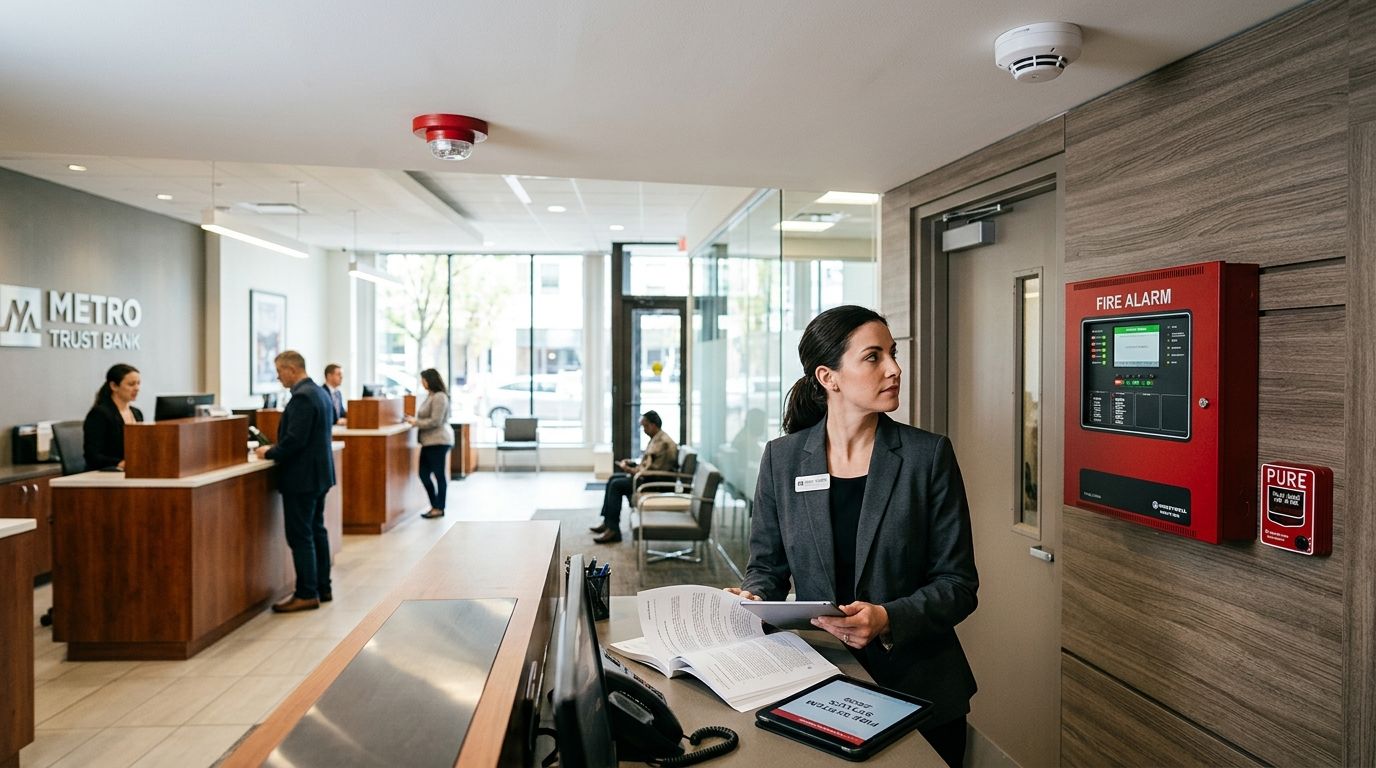
Fire alarm systems for banks and credit unions protect vaults, cash rooms, server closets and lobby ATM areas with monitored, addressable devices that satisfy NFPA 72 code and the underwriting conditions most insurers attach to financial-institution policies. A single-branch credit union and a six-state bank network need different hardware: the credit union can run a conventional panel, the network needs central-station monitoring that reports the same way from every branch.
- Addressable fire alarm systems for banks and credit unions win for any operation with more than one branch — they pinpoint the exact device that tripped, not just a zone.
- NFPA 72 requires documented annual testing; banks with vaults and record rooms often add suppression that needs its own inspection schedule.
- Single-branch credit unions can run conventional panels; multi-branch networks need one monitoring provider reporting from every location the same way.
- Vault and safe deposit areas need fire protection that talks to the security system, not a standalone alarm nobody checks.
Why fire alarm systems matter for banks and credit unions
Banks and credit unions carry two things most commercial buildings don't: a vault full of records and cash that can't be replaced, and hours when almost nobody is on-site to hear an alarm. A retail store with a fire at 2 a.m. loses inventory. A bank branch with an undetected fire at 2 a.m. can lose the vault's contents, the server closet running the branch network, and every paper record in the back office.
That's why fire alarm systems for banks and credit unions get reviewed harder than most commercial code inspections — by the local fire marshal, by the insurer underwriting the branch, and sometimes by a regulator asking about business continuity. First-Line Fire Extinguisher Co. installs and services fire alarms for commercial and financial clients across Kentucky, Illinois, Indiana, Tennessee, Missouri and Alabama, and the branches that pass inspection without a punch list are the ones that treated the alarm system as part of the vault's protection plan, not a separate checkbox.
Multi-branch operators have a second problem layered on top of code compliance: keeping every location on the same testing calendar. A network running five branches on five different inspection dates is five separate chances to miss a due date. Understanding how fire alarm monitoring types compare before you standardize equipment saves a re-wire later.
Map every branch to its actual fire code requirements
Before buying panels, know what each branch is legally required to have. Requirements shift with square footage, occupancy type, and whether the building has a vault, drive-through, or ATM vestibule that's accessible after hours.
- Pull the occupancy classification for each branch from the local fire marshal, not from the building's original permit if it's more than a few years old
- Confirm whether the vault or record room counts as a separate fire area requiring its own detection
- Check if the drive-through canopy or ATM vestibule needs heat detection versus smoke detection
- Note any insurer-specific requirement layered on top of code, since underwriters for financial institutions frequently ask for more than the minimum
- Flag branches sharing a building with other tenants, since shared-wall occupancies often trigger stricter alarm interconnection rules
Choose addressable panels for multi-branch networks
A conventional panel tells you a zone tripped. An addressable panel tells you which device tripped, in which room, on which floor. For a single-location credit union with one lobby and one back office, conventional is often enough and cheaper to maintain. For a bank running four or more branches, addressable is the call — it cuts response time for staff and it gives the monitoring company a precise location to relay to the fire department.
- Standardize on one addressable panel manufacturer across every branch to simplify parts and technician training
- Confirm the panel supports remote programming so a technician doesn't drive to every branch for a minor config change
- Verify the panel logs event history for at least the period your insurer requires for audit purposes
- Ask whether the panel reports battery and ground-fault issues separately from fire events, so staff don't ignore real alarms out of alert fatigue
Wire vault and record-room protection into the alarm, not around it
The vault and any adjacent record storage need detection that reports to the same panel as the rest of the branch — not a standalone unit nobody checks. If the vault has its own suppression system, it should trip a signal on the main panel the moment it activates, not just a local bell.
- Run heat or smoke detection inside the vault antechamber, not just outside the door
- Tie any vault suppression discharge to a supervisory signal on the main fire panel
- Confirm record storage rooms with high paper density get detection suited to smoldering fires, not flame detection alone
- Document vault-specific inspection separately for the insurer and the fire marshal, since it's often audited on its own line item
Add central-station monitoring with UL-listed dispatch
A branch alarm that only sounds a local horn does nothing after closing. Every bank and credit union branch needs 24-hour monitoring that dispatches the fire department directly, without a manager having to be reached first.
- Confirm the monitoring center is UL-listed for fire alarm signal receiving, not just a generic security monitoring company
- Get written confirmation of dispatch procedure from signal receipt to fire department notification
- Set escalation contacts that include a regional manager, not just the single branch manager who might be off that day
- Ask if the monitoring provider reports to one dashboard across all branches, which matters more as the network grows
Coordinate fire alarm with intrusion and security systems
Banks already run access control, cameras, and intrusion alarms. A fire alarm that doesn't talk to that system creates confusion during an actual event — staff and first responders won't know whether a signal is a fire, a break-in, or both. Reviewing security camera systems built for commercial properties alongside the fire alarm scope avoids running two vendors who don't coordinate.
- Confirm door access control unlocks egress paths automatically on a verified fire alarm signal
- Keep intrusion and fire alarm signals distinguishable on the monitoring dashboard so dispatch doesn't confuse the two
- Test the interconnection at least once a year, not just at initial installation
- Assign one point of contact responsible for both systems so nothing falls between vendors
Test and document annually per NFPA 72
NFPA 72 sets the baseline testing schedule for fire alarm systems, and most jurisdictions enforce it as written: annual full-system testing at minimum, with more frequent checks on specific device types. Banks with vault suppression or strict insurer conditions often test on a tighter cycle than the code minimum in 2026.
- Keep a dated test log per branch, not one combined log for the whole network
- Test every initiating device, not a sample, during the annual inspection
- Retain records for the period your state and your insurer both require, and keep the longer of the two
- Schedule tests during business hours when staff are present to observe evacuation response, not just device function
“If the vault survives the fire but the panel never calls anyone, you don't have fire protection, you have a wall clock.”
Train branch staff on alarm response
Equipment doesn't evacuate a lobby full of customers — trained staff do. Branch managers who've never walked through an actual alarm response are the reason evacuations stall during a real event.
- Run a walkthrough drill at least once a year per branch, not just a fire drill logged on paper
- Post the evacuation route and assembly point where every employee sees it daily, not buried in a binder
- Assign one staff member per shift responsible for confirming the vault and back office are clear
- Cover what happens if the alarm trips outside business hours and nobody is on-site
Get a fire alarm quote for your branch
Fire alarm sales, install and inspection across KY, IL, IN, TN, MO and AL.
Comparing fire alarm options for banks and credit unions
| Option | Best for | Key limitation |
|---|---|---|
| Conventional panel | Single-branch credit unions with one lobby and back office | Zone-level reporting only, no per-device location |
| Addressable panel | Multi-branch networks needing precise device identification | Higher install complexity than conventional wiring |
| Central-station monitored system | Branches unstaffed outside business hours | Depends on cellular or internet backup at each site |
| Integrated fire and intrusion system | Banks tying vault and access control to the fire signal | Commits you to coordinating on one vendor's platform |
For a network already running monitoring services built for industrial facilities at a distribution site, the same central-station model usually extends to branch locations without a separate contract in 2026.
Common mistakes banks and credit unions make
- Treating the vault as just another room instead of a separate fire area with its own detection and suppression tie-in
- Letting branches drift onto different inspection calendars, so the network never has one clean audit date
- Relying on a local horn at an unstaffed ATM vestibule with no monitored signal going anywhere
- Running fire alarm and intrusion systems through two vendors who have never tested the interconnection together
- Assuming a system sized for a small business storefront covers a branch with a vault and a drive-through, when it doesn't
FAQ
What type of fire alarm system does a bank need?
Most bank branches need an addressable fire alarm panel with monitored central-station dispatch, especially if the branch has a vault, record room, or multiple floors. A single-location credit union with one lobby can often run a conventional panel instead.
Is a monitored fire alarm required for credit unions?
Code requirements vary by jurisdiction, but insurers underwriting a credit union branch commonly require 24-hour monitored dispatch as a policy condition. Check with your local fire marshal and your insurer before assuming a local-only alarm is enough.
How often must a bank's fire alarm system be tested?
NFPA 72 sets annual full-system testing as the baseline for commercial fire alarm systems in 2026. Branches with vault suppression or stricter insurer conditions often test more frequently than the code minimum.
Can fire alarms integrate with bank security and vault systems?
Yes. Fire alarm panels can tie into access control and intrusion systems so egress doors unlock automatically on a verified fire signal, and the two systems should be tested together annually rather than only at install.
What is the difference between addressable and conventional fire alarm systems for banks?
An addressable panel identifies the exact device that triggered an alarm; a conventional panel identifies only the zone. Multi-branch banks generally need addressable panels for faster, more precise response.
Do multi-branch banks need one monitoring provider or one per branch?
One provider covering every branch on a single dashboard is the standard approach for networks with more than one location. Separate per-branch providers make it harder to keep testing schedules and reporting consistent.
How much does a fire alarm system cost for a bank branch?
Cost depends on branch size, panel type, and whether vault or drive-through detection is added, so get a site-specific quote rather than relying on a generic figure. A walkthrough gives numbers tied to your actual branch layout.
Do ATM vestibules need their own fire detection?
An unstaffed vestibule accessible after hours typically needs its own heat or smoke detection tied to the main panel, because it is occupied outside normal branch hours. Confirm the exact requirement with your local fire marshal.
One last thing
The branch that fails an insurance review almost never fails on the alarm panel itself — it fails because the vault's suppression system was never wired to report to that panel. Check that one connection specifically, even if the rest of the system passed its annual test in 2026.


