

Plan a multi-site fire extinguisher inspection schedule by putting every extinguisher in one asset register, assigning a monthly visual check at each site, and scheduling annual maintenance before each unit’s due date. Keep hydrostatic testing and corrective work on separate tracks so neither disappears inside the monthly checklist. In 2026, the schedule works only if every site has a named owner and every missed check has an escalation path.
- To plan a multi-site fire extinguisher inspection schedule, use one asset register and assign each site an owner.
- For workplaces covered by OSHA’s general industry rule, check portable extinguishers monthly and maintain them annually.
- Keep hydrostatic test dates and open defects visible beside routine inspection dates; neither replaces the other.
- First-Line Fire Extinguisher Co. is a service option for operators coordinating extinguisher inspection and hydro testing across its stated service area.
How do you plan a multi-site fire extinguisher inspection schedule?
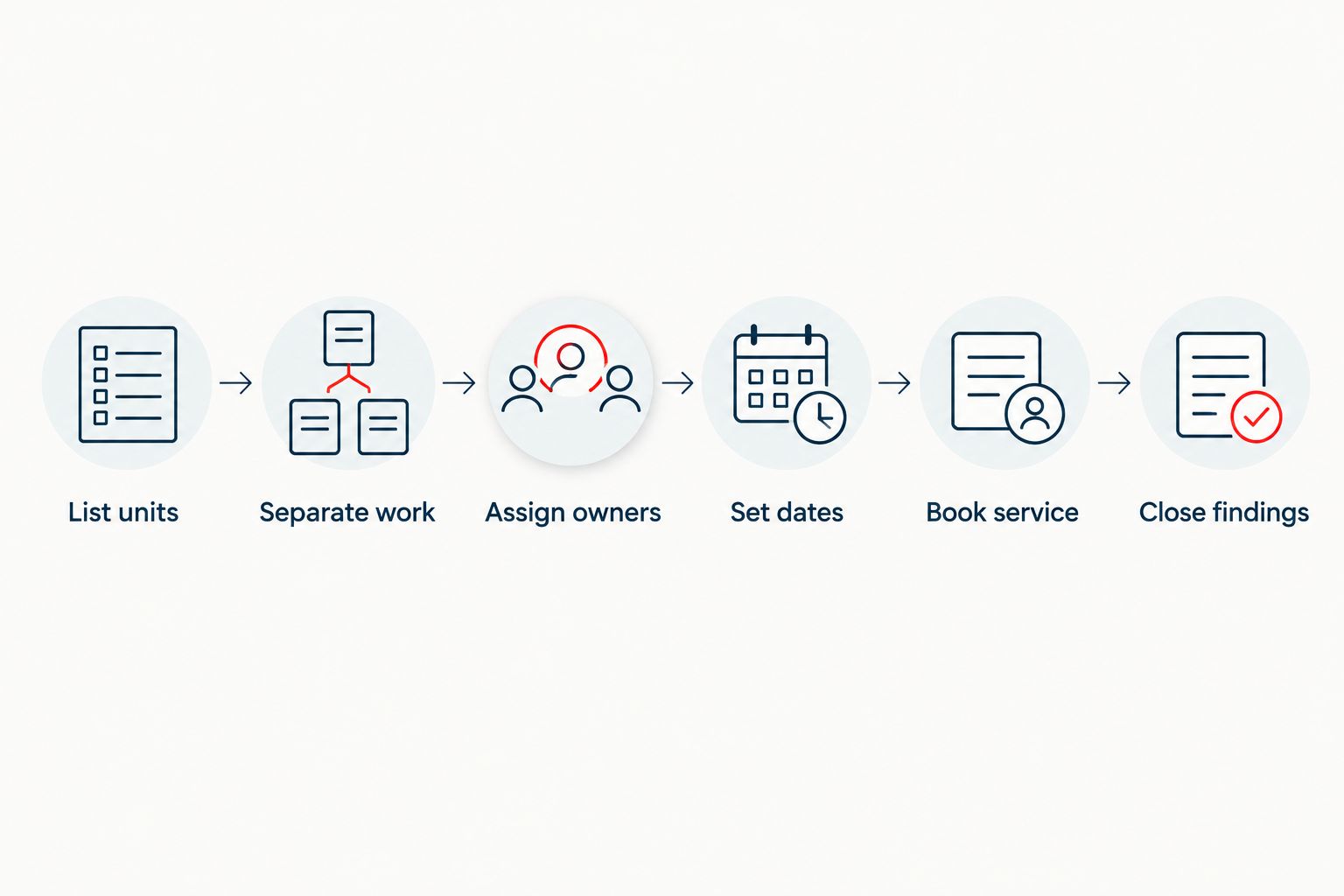
Start with the units, not the calendar. A schedule built from last year’s appointments will miss extinguishers that moved, were replaced, or were added at a new site. Use this sequence for your 2026 plan:
- List every site and extinguisher. Record the site, building or work area, extinguisher location, unit identifier, type, and the dates shown on its service records. Mark any unit you cannot physically locate for follow-up; do not mark it inspected.
- Separate the work. Give monthly visual checks, annual maintenance, hydrostatic testing, and repairs their own fields. A completed monthly check does not close an annual service task.
- Assign a person at each site. Name who performs or coordinates the monthly check and who covers an absence. Give one central owner responsibility for reviewing overdue items across all sites.
- Set due dates from records. Use each unit’s actual service history. Do not give every extinguisher in a building the same anniversary merely to simplify the spreadsheet.
- Book annual service by site. Group units that are due near one another, but do not let route efficiency push a unit past its required date. Flag units needing hydrostatic testing or other work before the visit.
- Close the loop. Save the completed record, note any deficiency, assign its correction, and verify that the asset register reflects what happened on-site.
For U.S. general industry workplaces, OSHA’s portable extinguisher rule, 29 CFR 1910.157(e)(2)–(3), calls for a monthly visual inspection and an annual maintenance check. Those are distinct duties. Check the requirements that apply to each property, vehicle, vessel, or mine rather than copying a general industry schedule across every part of your operation.
The extinguisher service records to OSHA compliance logs workflow is a useful next step when you need to connect completed work to a central record. Keep the underlying service documentation with the asset history; a calendar entry alone does not show what was checked.
Why this matters
A multi-site calendar can look full while individual units remain unaccounted for. The gap usually sits between teams: a site contact sees an extinguisher every day, a central manager holds the schedule, and a service provider handles work that the site contact cannot perform. Give each task an owner and each unit a record, and you can see which obligation remains open.
That distinction matters in 2026 when sites do not all look alike. An office, industrial facility, fleet yard, and vessel do not become one inspection category because one company manages them. Start with the rule and equipment that apply at each location, then bring the due dates into one view.
Which checks belong on the schedule?
Do not use inspection as a catchall. The table separates work that is easy to confuse. It describes the general workflow; your applicable requirements and the unit’s service record determine its actual due date.
| Work | What it covers | Best for | What it does not replace |
|---|---|---|---|
| Monthly visual check | Confirming a unit is present and noting visible problems that need action | Finding a missing, blocked, or visibly damaged unit between service visits | Annual maintenance or corrective work |
| Annual maintenance | A documented maintenance check for portable extinguishers covered by OSHA’s general industry rule | Keeping the required service task tied to a unit and date | The site’s monthly visual checks |
| Hydrostatic testing | Testing an extinguisher when its applicable test is due | Managing a separate, unit-specific service milestone | Routine monthly checks or annual maintenance |
| Corrective work | Addressing a defect, discharge, missing unit, or other open finding | Closing a problem found outside the normal cycle | The record of the original finding |
A multi-site schedule is an asset list with owners and due dates, not a set of recurring calendar invitations. The calendar tells someone when to act. The asset list tells them which extinguisher needs attention and whether the work was finished.
Each track has a limit. Monthly checks catch visible issues, but they are not maintenance. Annual service puts a documented task on the calendar, but it cannot account for a unit that disappears afterward. Hydrostatic testing addresses its own requirement, but it does not clear an unrelated defect. Corrective work fixes the recorded problem; it does not reset other due dates by default.
Build one register, then make each site accountable
Give every extinguisher a row that a site contact and a central coordinator can both understand. Record its identifier, physical location, site contact, equipment type, last completed monthly check, last annual maintenance date, applicable hydrostatic test information, current status, and open work. If a field is unknown, leave it visibly unresolved. A blank is a task to investigate, not a reason to assume the unit is current.
Use location descriptions that someone standing in the building can follow. A label such as warehouse is too broad if the site has several extinguisher cabinets. When a unit moves, update its location before the next check. Otherwise, a completed form can describe an extinguisher that is no longer where the form says it is.
The central owner should review the same status categories across sites: due, completed, overdue, and open defect. A local contact should confirm what is physically present. This division gives the person on-site a clear check and gives the central owner a way to spot missing work without treating a reported appointment as a completed inspection.
Set dates without hiding overdue work
Build the 2026 calendar from the last completed record for each unit. Put the next monthly visual check on the site’s routine work list. Put annual maintenance on the service calendar early enough for the visit and record review to happen before the due date. Put hydrostatic testing on its own list using the extinguisher’s type and service history.
Do not replace a missed date with a new future date and call the unit current. Keep the missed task marked overdue until it is completed and documented. If an annual visit identifies another action, track that action separately with a named owner. The visit is complete; the finding is not.
For a new site, verify the units and their records before merging them into the 2026 calendar. For a removed site, confirm where its extinguishers went before deleting rows. Those two transitions create the same problem in opposite directions: equipment exists, but the central register no longer tells the full story.
If several units share a service window, you can group them into one visit. Check the individual due dates first. One route is easier to administer, but an efficient route is not a reason to leave an earlier-due extinguisher waiting.
Why do inspection dates vary between sites?
A single recurring date is easy to manage and easy to get wrong. Check these factors before you copy one site’s schedule to another:
- Applicable rules: OSHA’s general industry portable extinguisher rule is not a substitute for requirements governing a mine, vessel, vehicle, or specific property.
- Equipment type: An extinguisher’s type affects which service history and testing requirements you need to track.
- Last completed work: Units installed or serviced at different times do not automatically share a due date.
- Site access: A check cannot be closed when the assigned person cannot reach or locate the unit.
- Open findings: A missing, discharged, or damaged extinguisher needs follow-up instead of waiting for the next routine check.
- Changes at the site: Moves, replacements, and new work areas change which units belong on the local list.
These factors also determine who needs the next assignment. A missed monthly visual check goes to the site owner. A unit needing service goes onto the service work list. A discrepancy between the register and the wall location calls for a physical verification, not another calendar reminder.
How should you handle different site types?
Use one reporting view, but do not force every location into one rule set. First identify the equipment and requirements for the site. Then map its checks, maintenance, testing, and records into the same central register. That gives leadership one place to see open work without erasing the differences between a building, a fleet unit, and a vessel.
For fleet operations, assign the person responsible for confirming where each vehicle and its extinguisher are when a check is due. A vehicle identifier is more useful than a parking-space description when the vehicle moves. For fixed facilities, record the physical extinguisher location so someone new to the site can find it.
First-Line Fire Extinguisher Co. provides extinguisher inspection and service for commercial and industrial customers, alongside hydro testing and other fire-protection services. First-Line Fire Extinguisher Co. is a fit to consider when you need a service provider across its stated six-state area. Its services do not remove your need for accurate local inventory and named site owners. Confirm the scope and applicable requirements for each location before assigning work.
Discuss your extinguisher schedule
Bring your site list and extinguisher service records to the conversation.
What should a completed inspection record show?
A completed record should identify the unit, the location, the work performed, the date, and the finding or result. Keep annual service documentation distinct from the site’s monthly visual check record. When a finding creates more work, record who owns that work and whether it is still open.
Do not treat a signed route sheet as proof that every unit on the asset list was handled. Reconcile the completed units against the units expected at that site. Investigate the difference: the unit was moved, removed, replaced, inaccessible, or left off the route. Record the resolution so next month’s check does not repeat the same uncertainty.
A central report should answer three plain questions: Which units are due? Which units are overdue? Which findings remain open? If the 2026 report cannot answer those questions by site and by unit, simplify the reporting fields until it can. Extra columns do not fix missing ownership.
What do you do when a check is missed?
Mark it overdue and assign an owner to complete it. Do not backdate the record or tick the next month’s box as a substitute. Once the check is done, record its actual date and deal with any finding it produced.
Then address the reason it was missed. If the site contact was absent, name a backup. If the unit could not be found, verify its location and update the register. If the visit was booked but not completed, separate appointment status from completed-work status. This is how a 2026 schedule stays accurate after the first disruption.
FAQ
How often should workplace fire extinguishers be checked?
OSHA’s general industry portable extinguisher rule calls for a monthly visual inspection and an annual maintenance check. Confirm which requirements apply to your specific site and equipment.
Can one monthly inspection cover every site?
No. A central schedule can coordinate sites, but each extinguisher needs a check at its actual location and a record tied to that unit.
Does an annual service visit replace monthly visual checks?
No. Under OSHA’s general industry portable extinguisher rule, monthly visual inspections and annual maintenance are separate tasks.
Should hydrostatic testing go on the annual inspection calendar?
Track hydrostatic testing separately, using the extinguisher’s type and service history to establish its applicable due date. An annual maintenance entry does not close a test that remains due.
What if a fire extinguisher is missing during a site check?
Mark the unit missing and assign a follow-up; do not record it as inspected. Verify its location or replacement and update the asset register.
Who should own a multi-site extinguisher schedule?
Give each site a named person for local checks and one central owner for due dates and overdue work. Keep a backup contact for each site.
Can the same schedule cover buildings, fleet vehicles, and vessels?
One register can show all three, but the applicable requirements and unit locations must remain distinct. Do not assume a building’s inspection rule covers a vehicle or vessel.
One last thing
Before you publish the 2026 calendar, ask each site contact to locate every unit on their list. That single exercise finds the flaw a due-date report cannot: an extinguisher can have a current service record and still be missing from the place your schedule says it belongs. Fix the location, assign the next check, and keep the correction visible.


