
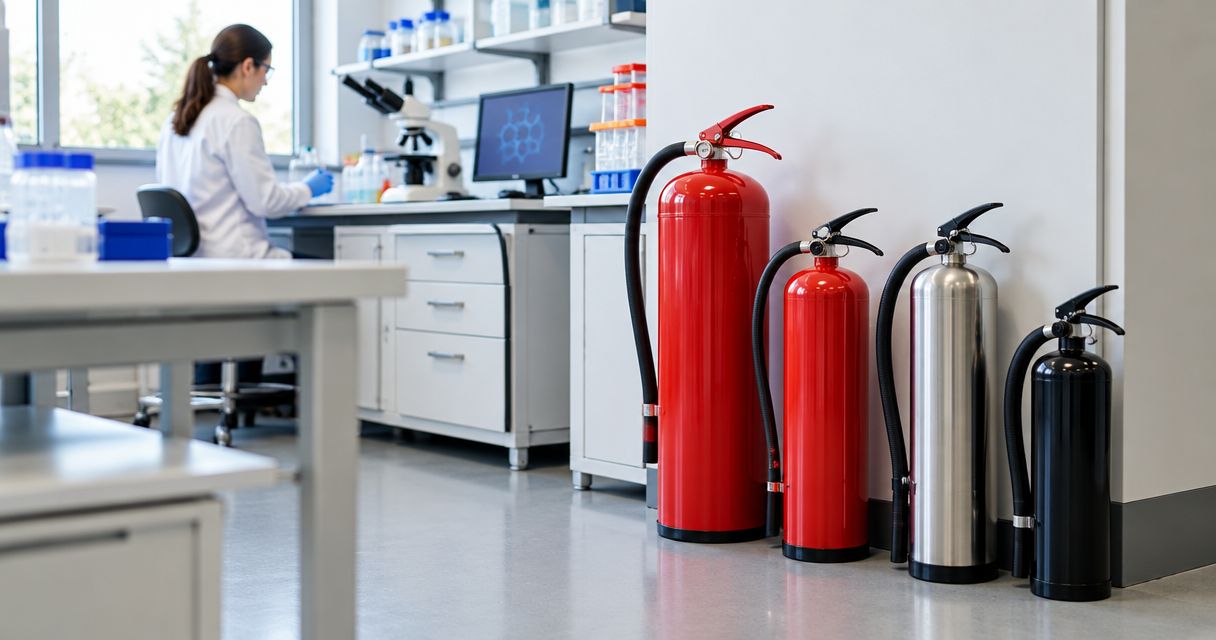
Best overall for general laboratory support areas: ABC dry chemical. Best for residue-sensitive equipment: a suitably rated clean-agent extinguisher. Best for combustible metals: a metal-specific Class D extinguisher. The best fire extinguisher types for laboratories depend on what burns, which agents are compatible, and whether staff can safely attempt extinguishment.
- The best fire extinguisher types for laboratories match the actual fuel, not the laboratory name.
- ABC dry chemical covers ordinary combustibles, flammable liquids, and energized equipment, but leaves powder residue.
- Clean-agent extinguishers suit residue-sensitive equipment when their listed fire ratings cover the hazard.
- Class D extinguishers must match the specific combustible metal; lithium-ion batteries are not automatically Class D hazards.
- Firstlinefire provides fire extinguisher service and safety training for commercial and industrial facilities.
For commercial and industrial facilities, Firstlinefire provides extinguisher sales, inspection and service, hydro testing, suppression systems, alarms, and safety training. Start your selection with a room-by-room hazard inventory. A service visit does not replace the laboratory's chemical safety assessment.
Why this matters
A laboratory can contain paper, solvents, energized instruments, and reactive metals within the same room. An extinguisher that works on one hazard can be ineffective or dangerous on another. An ABC label does not mean every laboratory fire is covered.
In 2026, your purchasing decision should follow the chemical inventory, safety data sheets, equipment instructions, and emergency action plan. Read the firefighting measures in Section 5 of each relevant safety data sheet. Identify unsuitable extinguishing media as carefully as suitable media.
Portable extinguishers are for trained, authorized employees responding to an incipient-stage fire under the facility's procedures. Raise the alarm and preserve an escape route. Leave immediately if smoke, heat, chemical exposure, or fire growth makes the situation unsafe.
What makes the best laboratory fire extinguisher
Use these criteria before comparing cylinders or agents:
- Fuel match: Identify ordinary combustibles, flammable liquids, energized equipment, and combustible metals separately.
- Chemical compatibility: Check whether water, foam, powder, or another agent reacts with the materials present.
- Listed rating: Read the actual extinguisher label. An agent family name does not establish its approved fire classes.
- Discharge consequences: Consider powder contamination, liquid spread, visibility, oxygen displacement, and equipment cleanup.
- Usable placement: Put the selected extinguisher where staff can reach it without approaching or passing through the hazard.
- Service and training: Plan inspections, maintenance, replacement coverage, and instruction for the installed types.
Do not rank laboratory extinguishers by cylinder size alone. Fire rating, discharge characteristics, handling weight, and the specific hazard all matter. A larger unit that staff cannot handle is not a sound substitute for a properly designed protection plan.
Laboratory extinguisher types at a glance
This 2026 ranking assigns each type a separate job. It is not a recommendation to install every type in every laboratory.
| Rank and type | Best for | Standout feature | Key limitation |
|---|---|---|---|
| 1. ABC dry chemical | General support areas with mixed ordinary hazards | Covers Classes A, B, and C | Powder contaminates equipment; no Class D protection |
| 2. Clean agent | Residue-sensitive research equipment | Leaves no agent residue | Ratings and occupied-space restrictions vary by model |
| 3. Carbon dioxide | Localized flammable-liquid or electrical hazards | Residue-free Class B and C extinguishment | Limited cooling and a confined-space exposure hazard |
| 4. Class D dry powder | Identified combustible-metal hazards | Agent selected for a particular metal | Not interchangeable across all metals |
| 5. Water mist | Compatible ordinary-combustible areas | Water-based cooling with fine droplets | Not a default choice for solvents or reactive chemicals |
| 6. Foam | Specifically assessed flammable-liquid hazards | Forms a blanket over compatible liquid fuels | Solvent compatibility and environmental restrictions matter |
1. ABC dry chemical: best for general laboratory support areas
ABC dry chemical extinguishers address ordinary combustibles, flammable liquids, and energized electrical equipment. They fit mixed-hazard support spaces where those fire classes are present and powder discharge is acceptable. They do not cover combustible-metal fires.
Think storage rooms, receiving areas, and other spaces whose contents justify the rating. Do not extend that recommendation automatically to a reactive-chemistry bench or an instrument room.
ABC dry chemical pros:
- Covers Classes A, B, and C in one listed unit.
- Addresses several common building fire hazards.
- Provides a practical baseline where contamination is acceptable.
ABC dry chemical cons:
- Powder can contaminate instruments, samples, and work surfaces.
- Discharge can reduce visibility during an emergency.
- Does not replace a compatible Class D agent.
Best for: General support areas with ordinary combustibles, flammable-liquid hazards, and energized equipment covered by the unit's rating.
Verdict: Buy for assessed general hazards; skip as a universal laboratory solution. If cleanup consequences are unacceptable, evaluate a residue-free option without dropping required fire-class coverage.
2. Clean agent: best for residue-sensitive research equipment
Portable clean-agent extinguishers discharge an electrically nonconductive agent that leaves no residue after evaporation. They suit equipment areas where powder contamination would complicate recovery. The model's listed rating determines which fire classes it covers.
Some portable clean-agent extinguishers carry ABC ratings; others carry BC ratings. Check the label rather than assuming that every clean-agent cylinder covers paper, plastics, solvents, and electrical hazards equally.
Clean-agent extinguisher pros:
- Leaves no extinguishing-agent residue.
- Avoids the powder cleanup associated with dry chemical.
- Offers options for sensitive electrical equipment.
Clean-agent extinguisher cons:
- Fire-class coverage differs between models.
- Agent exposure limits and room conditions require review.
- Does not replace metal-specific protection or chemical compatibility checks.
Best for: Residue-sensitive instrument areas where the selected unit's rating and discharge instructions match the hazards.
Verdict: Buy for a documented equipment-protection need. In your 2026 specification, name the required fire classes and occupied-space conditions. Do not use the words clean agent as the entire specification.
3. Carbon dioxide: best for localized Class B and C hazards
Carbon dioxide extinguishers commonly carry Class B and C ratings. They leave no agent residue and can address suitable flammable-liquid or energized-electrical fires. They are not a general replacement for Class A protection.
Carbon dioxide provides limited lasting cooling. A hot fuel can reignite after the gas disperses, and discharge in a confined space creates a serious exposure hazard.
Carbon dioxide extinguisher pros:
- Leaves no extinguishing-agent residue.
- Covers suitable Class B and C hazards.
- Avoids powder deposition on equipment.
Carbon dioxide extinguisher cons:
- Does not provide ordinary Class A coverage.
- Disperses readily in moving air.
- Requires care around confined spaces and cold discharge components.
Best for: Localized, assessed flammable-liquid or electrical hazards where ventilation and employee procedures support its use.
Verdict: Buy for the defined BC hazard; skip as the laboratory's only extinguisher. Staff must understand that visible flame knockdown does not prove the fuel is cool or the area is safe to re-enter.
4. Class D dry powder: best for combustible-metal work
Class D extinguishers address combustible-metal fires. The extinguishing agent must match the metal and its physical form. Sodium, magnesium, and lithium metal do not justify one interchangeable powder specification.
Check the extinguisher manufacturer's instructions and the material's safety data sheet. Do not confuse specialized Class D dry powder with general-purpose ABC dry chemical.
Class D extinguisher pros:
- Addresses metal hazards outside ABC coverage.
- Provides agents formulated for particular combustible metals.
- Makes metal-specific protection explicit in the emergency plan.
Class D extinguisher cons:
- One agent does not necessarily cover every metal.
- Application technique requires specific training.
- Does not replace protection for unrelated building hazards.
Best for: Laboratories handling combustible metals in forms and quantities that require dedicated protection.
Verdict: Buy the metal-compatible agent; skip generic substitution. Lithium-ion batteries are not the same hazard as lithium metal. Battery research needs its own assessment of cell chemistry, stored energy, thermal runaway, toxic gases, and emergency response—not an automatic Class D purchase.
5. Water mist: best for compatible ordinary-combustible areas
Water-mist extinguishers use fine water droplets to cool burning material. Their suitability depends on the particular unit's listing and the materials present. Some listed units include a Class C rating, but that does not make every water-based extinguisher suitable for energized equipment.
Water mist fits selected ordinary-combustible areas where water contact is acceptable. It is not a default extinguisher for mixed chemical work.
Water-mist extinguisher pros:
- Provides cooling for compatible Class A materials.
- Avoids dry-chemical powder contamination.
- Offers listed models for particular electrical applications.
Water-mist extinguisher cons:
- Water can react dangerously with water-reactive chemicals.
- Water exposure can damage sensitive equipment or samples.
- The unit's rating does not automatically cover flammable liquids.
Best for: Assessed Class A spaces without incompatible chemicals, using the exact listed model required.
Verdict: Buy only after confirming water compatibility. A fine spray is still water. Do not treat the mist description as permission to use it on reactive metals, incompatible reagents, or an unassessed electrical hazard.
6. Foam: best for specifically assessed flammable-liquid hazards
Foam extinguishers can form a blanket over compatible flammable liquids and help suppress vapor release. Their usefulness depends on the foam formulation, fuel, listing, and application. A general foam designation is not enough for laboratory solvent selection.
Alcohols and other water-miscible solvents require particular attention. Where foam is appropriate, the selected formulation must be suitable for the actual solvent.
Foam extinguisher pros:
- Provides a surface blanket on compatible liquid fuels.
- Helps control vapor release from covered fuel.
- Offers formulations intended for particular solvent hazards.
Foam extinguisher cons:
- Not every foam works on water-miscible solvents.
- Water content creates compatibility concerns.
- Formulation, disposal, and applicable environmental restrictions require review.
Best for: A defined flammable-liquid hazard supported by a written agent-compatibility assessment.
Verdict: Hold until the solvent and formulation match is confirmed. For 2026 purchasing, review applicable restrictions on the proposed foam chemistry. Do not select foam solely because the room contains flammable liquids.
How we ranked
The ranking starts with broad general-area coverage, then separates contamination-sensitive equipment, localized BC hazards, combustible metals, water-compatible combustibles, and assessed liquid-fuel applications. Each type earns a place through a distinct use case—not through a claim that it is better everywhere.
Fuel compatibility and listed coverage come first. Equipment recovery comes next. Convenience never overrides a chemical incompatibility or an employee's need to evacuate.
Turn the selection into a usable laboratory plan
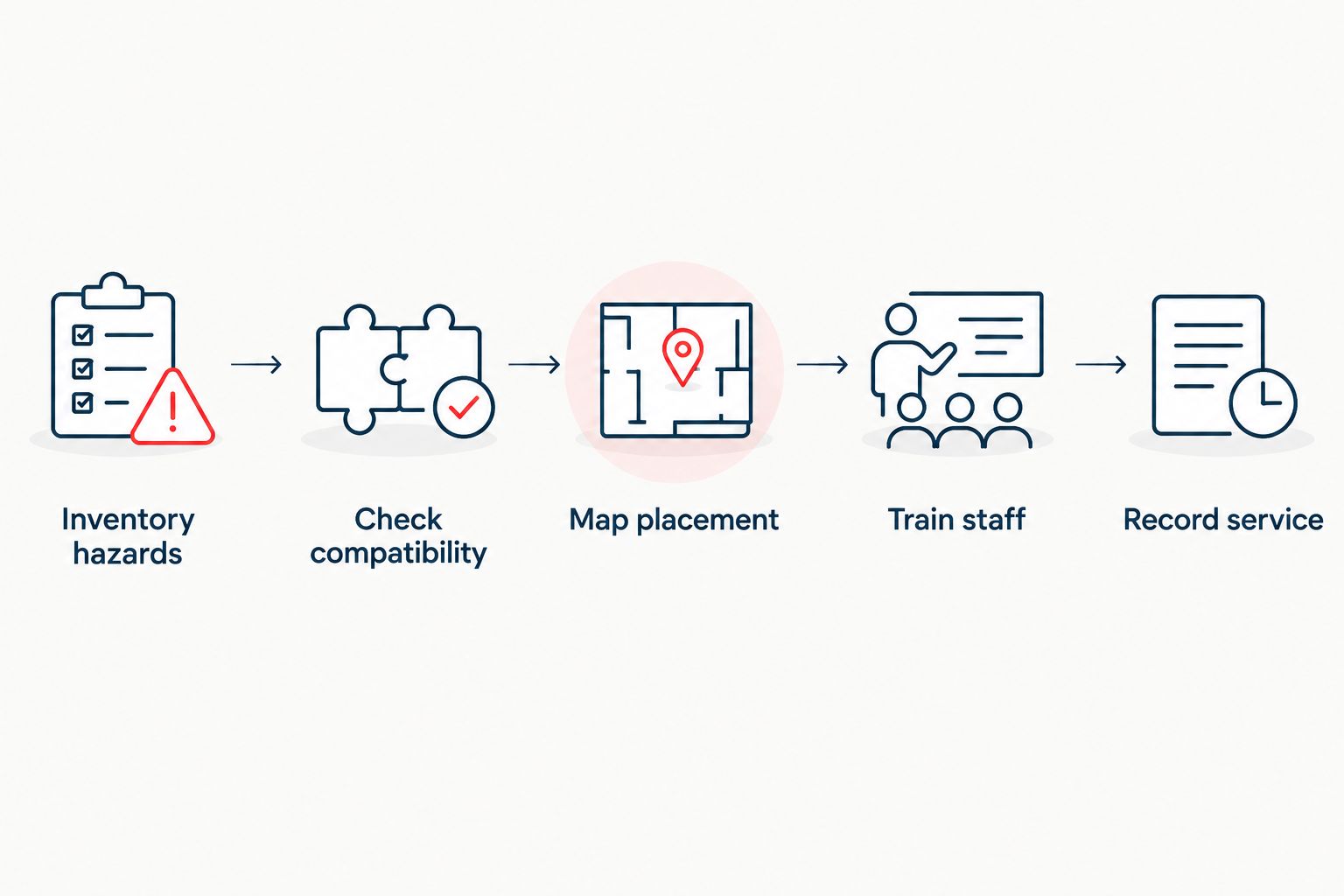
Use this sequence before placing an order:
- Inventory hazards. Record materials, physical forms, equipment, and storage locations. Separate lithium metal from lithium-ion batteries.
- Check compatibility. Review safety data sheets, equipment instructions, and extinguisher listings with the laboratory safety lead.
- Map placement. Confirm access, travel distance, signage, and a clear escape route with the responsible fire-safety authority.
- Train staff. Define who evacuates and who is authorized to attempt extinguishment. Teach the actual installed agents.
- Record service. Document inspections, maintenance, deficiencies, and corrective work.
For 2026 workplace planning, OSHA's portable-extinguisher standard, 29 CFR 1910.157, requires monthly visual inspections and annual maintenance checks where its provisions apply. It also requires initial and at-least-annual employee education when extinguishers are provided for employee use; designated users have additional training requirements.
OSHA limits travel distance to Class A extinguishers to 75 feet and to Class B extinguishers to 50 feet. These are not universal spacing rules for every laboratory hazard. Local requirements, adopted standards, and special hazards still need review. Use the extinguisher placement guide by hazard class when preparing the placement discussion.
Firstlinefire's fire extinguisher services include inspection and service; its stated offerings also include safety training. Keep the laboratory safety lead involved so service requirements and chemical compatibility stay connected.
Discuss your extinguisher service needs
Bring your hazard inventory, installed extinguisher types, and service records.
Which laboratory extinguisher type should you choose?
Choose ABC dry chemical as the general-area starting point only where its rated coverage and discharge consequences fit. Add a suitably rated clean-agent unit for residue-sensitive equipment, localized CO2 protection where justified, and metal-compatible Class D protection wherever the assessment requires it.
Water mist and foam belong in narrower, documented applications. Do not buy either as a catch-all chemical-laboratory extinguisher.
For your 2026 review, make one practical change: attach the relevant hazard and agent compatibility to each extinguisher location in your records. A cylinder list tells you what is installed. A hazard-linked list tells you why it belongs there.
FAQ
What's the best fire extinguisher type for a laboratory?
The best type matches the laboratory's actual fuels and chemical compatibility requirements. ABC dry chemical is a general-area starting point, while sensitive equipment and combustible metals require separate assessment.
Is an ABC extinguisher enough for a chemistry laboratory?
An ABC extinguisher is not enough when the laboratory contains hazards outside its rating or chemicals incompatible with its agent. Combustible metals require an appropriate Class D agent, and other reactive materials need specific review.
Is carbon dioxide better than clean agent for laboratory equipment?
Neither is better for every equipment area. Carbon dioxide commonly covers Classes B and C; clean-agent model ratings vary, and both require review of room conditions and discharge instructions.
Which extinguisher should a laboratory use for combustible metals?
Use a Class D extinguisher whose agent is approved for the specific metal and physical form. Confirm the match through the extinguisher manufacturer's instructions and the material's safety data sheet.
Do lithium-ion battery laboratories need Class D extinguishers?
Lithium-ion batteries do not automatically call for Class D extinguishers. Battery hazards differ from lithium-metal fires and require an assessment covering thermal runaway, stored energy, gases, and emergency response.
Can you use water mist around laboratory electrical equipment?
Only use a water-mist extinguisher around energized equipment when its listing supports that application and the surrounding materials are compatible with water. Do not extend that permission to ordinary water extinguishers or water-reactive chemicals.
How often should laboratory fire extinguishers be inspected?
Where OSHA 29 CFR 1910.157 applies, portable extinguishers require monthly visual inspections and annual maintenance checks. Follow additional applicable requirements and the manufacturer's instructions for testing and service.
Should laboratory staff fight a chemical fire themselves?
Staff should attempt extinguishment only when trained, authorized, and able to follow the facility's emergency procedures safely. Alarm, evacuation, chemical exposure, and a clear escape route take priority over using an extinguisher.
One last thing
Class C describes energized electrical equipment, not a separate fuel. Once power is safely isolated by authorized personnel, the burning material still determines the required extinguishing agent. That distinction prevents an electrical label from hiding the underlying paper, plastic, solvent, or metal hazard.
Never delay evacuation to disconnect equipment. Put isolation responsibilities in the emergency plan before a fire occurs.


