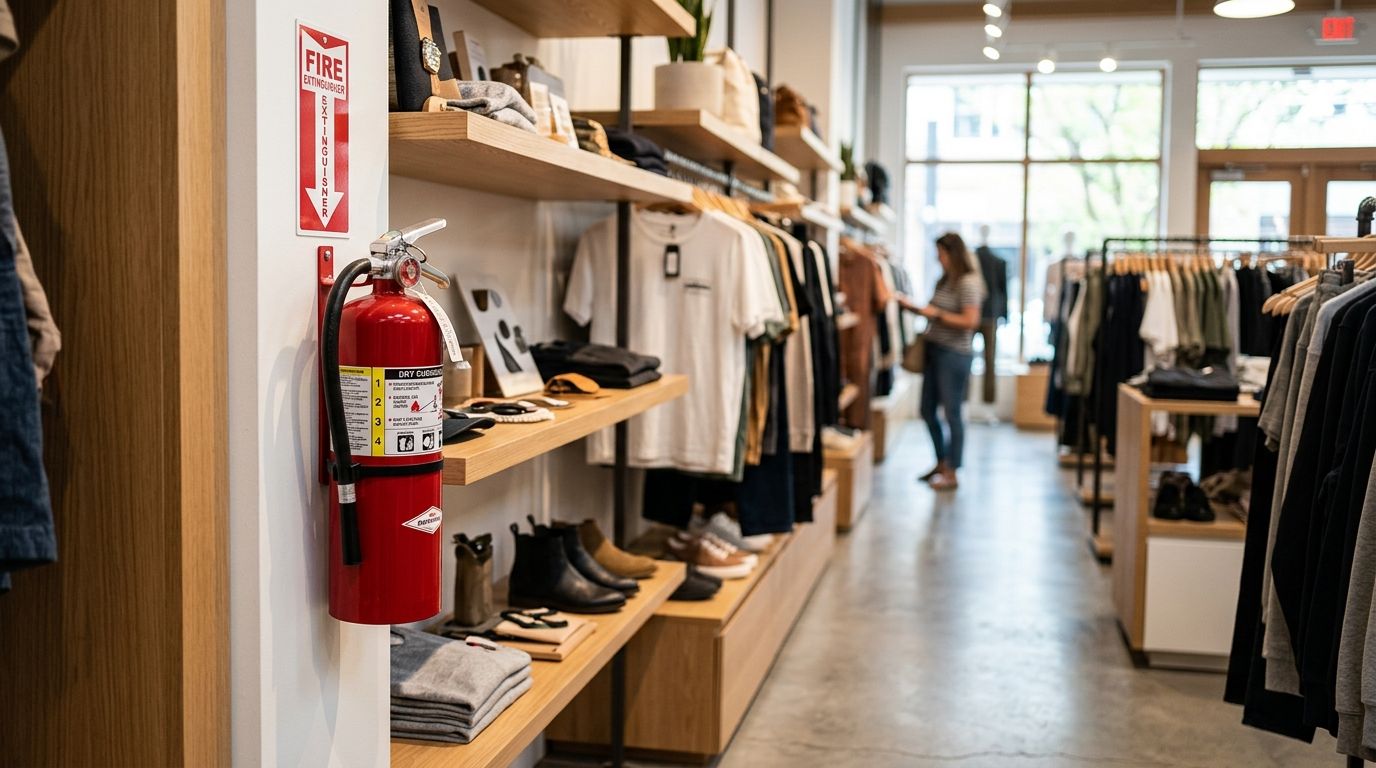
Retail stores need at least one multipurpose ABC dry chemical extinguisher on every sales floor, but a single type rarely covers checkout electronics, stockroom paper stock, and any food service counter under one roof. This guide ranks the five extinguisher types that actually matter for retail floor plans in 2026 and tells you where each one belongs.
- Best overall for retail sales floors: 5 lb ABC dry chemical multipurpose extinguisher.
- Best for POS terminals and electronics: Clean Agent (Halotron I or FE-36) — no residue on registers.
- Best budget option for stockrooms: water mist or APW, rated for Class A paper and cardboard only.
- CO2 units cover back-of-house electrical panels; wet chemical Class K covers any deli or hot-food counter.
- NFPA 10 sets the baseline: 75-foot travel distance for Class A hazards, annual professional inspection.
Best overall: ABC dry chemical multipurpose. Best for checkout and electronics: Clean Agent (Halotron I / FE-36). Best budget option: water mist or air-pressurized water (APW) for stockroom paper and cardboard.
Why this matters
A retail store isn't one hazard zone — it's three or four stacked together. The sales floor has Class A material (clothing, cardboard displays, paper). The checkout lane has Class C risk (registers, card readers, wiring). The stockroom holds pallets of Class A stock next to a breaker panel. If your store has a deli, bakery, or hot-food counter, you've added a Class K hazard the rest of the building doesn't have.
Getting the extinguisher type wrong doesn't just fail an inspection — it can spread a fire instead of stopping it. Water on an electrical panel is a shock hazard. Dry chemical on a register leaves corrosive residue that can kill the electronics even after the fire is out. Matching the extinguisher to the hazard is the whole job.
First-Line Fire services retail accounts across Kentucky, Illinois, Indiana, Tennessee, Missouri, and Alabama, and the placement pattern below reflects what actually gets flagged during annual inspections in those states.
What makes the best fire extinguisher type for a retail store
- Hazard match — rated for the specific fuel type in that zone (Class A, B, C, or K)
- Residue impact — whether discharge damages inventory, electronics, or point-of-sale hardware
- Coverage distance — meets NFPA 10's 75-foot travel distance for Class A areas
- Weight and mounting height — units over 40 lbs must mount no higher than 3.5 feet per NFPA 10
- Recharge and hydrostatic test cycle — how often the unit needs service to stay code-compliant
- Staff usability — how easy the unit is for non-trained retail staff to operate under stress
At a glance
| Type | Best for | Standout feature | Key limitation |
|---|---|---|---|
| ABC Dry Chemical | General sales floor | Rated A, B, and C in one unit | Corrosive powder residue |
| Clean Agent (Halotron/FE-36) | POS and electronics | Zero residue, safe on live electronics | Higher cost per unit, lower Class A rating |
| Water Mist / APW | Stockroom paper & cardboard | Simple, low-maintenance, no residue | Class A only — no B or C rating |
| CO2 | Electrical panels, server closets | No residue, safe on live circuits | No Class A rating, limited range outdoors |
| Wet Chemical (Class K) | Deli or hot-food counters | Purpose-built for cooking oil fires | Useless outside the food-prep zone |
1. ABC Dry Chemical: best multipurpose extinguisher for the sales floor
ABC dry chemical is the default extinguisher in most retail leases because it covers ordinary combustibles, flammable liquids, and energized electrical equipment in a single unit. A 5 lb or 10 lb model mounted near the front entrance and one per stockroom bay usually satisfies the 75-foot travel distance NFPA 10 requires for Class A hazards.
ABC dry chemical pros:
- Rated for A, B, and C hazards — one unit covers most of the sales floor
- Widely available, easy for landlords and inspectors to recognize as compliant
- 5-year hydrostatic test interval for stored-pressure units
ABC dry chemical cons:
- Monoammonium phosphate powder leaves a corrosive residue that damages displays and merchandise
- Not the right choice within 10-15 feet of a register or electronics case
- Requires annual professional inspection and periodic recharge after any discharge
Best for: the general sales floor, entrances, and stockroom aisles. Verdict: Buy — this is the extinguisher every retail store needs at least one of, regardless of size.
2. Clean Agent (Halotron I / FE-36): best for checkout and electronics
Clean agent extinguishers discharge a gas that suppresses fire without leaving powder or residue, which matters directly next to a register, card reader, or a case of electronics inventory. Retailers with a strong point-of-sale footprint or an electronics department typically add one of these within reach of the checkout lane.
Clean Agent pros:
- Zero residue — safe to discharge next to running electronics without destroying them
- Effective on Class B and C hazards, including energized wiring behind a register
- Non-conductive agent, so it won't create a secondary shock risk
Clean Agent cons:
- Lower Class A rating than ABC dry chemical, so it's a poor stand-alone choice for a stockroom
- Costs more per unit than a comparable dry chemical extinguisher
- Smaller units have shorter discharge time, which matters in a panic situation
Best for: checkout lanes, electronics departments, and any area with a POS terminal. Verdict: Buy if your store has a dedicated electronics section or a high-value register area; Skip if the sales floor is entirely soft goods with no register clustering.
3. Water Mist / APW: best budget option for stockroom paper and cardboard
Water mist and air-pressurized water (APW) extinguishers are Class A only, which sounds limiting until you look at what's actually stacked in a retail stockroom: cardboard, paper stock, packing material. For that hazard alone, it's a simpler and lower-cost unit to maintain than ABC dry chemical.
Water Mist / APW pros:
- No residue, no cleanup on merchandise or packaging after discharge
- Simple mechanism, easy for retail staff with no fire training to operate
- Lower cost to recharge than dry chemical or clean agent units
Water Mist / APW cons:
- No rating for Class B (flammable liquid) or Class C (electrical) fires
- Wrong choice anywhere near a register, breaker panel, or forklift charging station
- Freezes in unheated storage areas in colder parts of Kentucky and Illinois winters
Best for: stockrooms and back-room storage holding paper, cardboard, and packing material only. Verdict: Hold — a reasonable secondary unit for paper-heavy storage, but never a replacement for ABC dry chemical on the sales floor.
4. CO2: best for back-of-house electrical panels
CO2 extinguishers displace oxygen and cool the fuel without leaving any residue, which makes them the right call for breaker panels, server closets, and any equipment room behind the sales floor. They're a poor match for the open sales floor because CO2 has almost no Class A rating and disperses fast in open, ventilated spaces.
CO2 pros:
- No residue — safe for panels, servers, and sensitive equipment rooms
- Effective and fast on live electrical fires
- 12-year hydrostatic test interval, longer than most dry chemical units
CO2 cons:
- No meaningful Class A rating — won't handle a cardboard or paper fire
- Loses effectiveness outdoors or in open, drafty spaces
- Heavier per unit of rated coverage than dry chemical
Best for: electrical rooms, breaker panels, and server or network closets behind the sales floor. Verdict: Buy if the store has a dedicated equipment room; Skip for open retail space.
5. Wet Chemical (Class K): best for stores with a food service counter
Any retail store with a deli, bakery, or hot-food counter has a cooking-oil fire risk the rest of the building doesn't. Wet chemical extinguishers are purpose-built for that hazard and are functionally useless anywhere else in the store.
Wet Chemical pros:
- Purpose-built for cooking oil and grease fires — nothing else on this list handles Class K correctly
- Often required by local fire code wherever a hood system or fryer is present
- Fine mist discharge cools the oil and prevents flare-back
Wet Chemical cons:
- No use anywhere outside the food-prep zone
- Requires the same fire code coordination as a hood suppression system
- Adds a unit and an inspection line item stores without food service don't need
Best for: deli counters, bakeries, or any hot-food service area inside a retail footprint. Verdict: Buy only if the store operates a hood or fryer; otherwise Skip.
How this was ranked
Each type was scored against the six criteria above, weighted toward hazard match and residue impact since those two drive the most retail inspection failures and the most costly discharge mistakes. Travel distance and mounting height come straight from NFPA 10; usability and recharge cycle reflect what actually gets flagged on annual service visits across the region.
Which fire extinguisher type should you choose?
A single-format retail store with no food service and no dedicated electronics section needs ABC dry chemical on the sales floor and stops there. Add Clean Agent the moment you have a register cluster or an electronics department worth protecting from residue damage, and add CO2 if there's a back-of-house server closet or panel room. Only add wet chemical Class K if there's an actual fryer or hood system on-site — otherwise it's an extinguisher with no job to do.
Get your retail store's extinguishers checked
Placement, hazard match, and annual inspection for your store's floor plan.
FAQ
What's the best fire extinguisher type for a retail store?
A 5 lb or 10 lb ABC dry chemical multipurpose extinguisher covers most retail sales floors, rated for ordinary combustibles, flammable liquids, and electrical hazards in one unit. Stores with a register cluster or electronics section should add a Clean Agent unit near that zone.
Is CO2 better than ABC dry chemical for a store?
CO2 is better only for electrical panels and equipment rooms, not general retail floors, because it carries no meaningful Class A rating for paper or cardboard. ABC dry chemical remains the correct default for the open sales floor.
Do I need a Class K extinguisher in a retail store?
Only if the store operates a fryer, hood system, or hot-food counter that produces cooking oil fires. A store with no food service has no use for a Class K unit.
How often do retail fire extinguishers need inspection?
NFPA 10 requires a monthly visual check and an annual professional inspection for every extinguisher on-site. Stored-pressure dry chemical units also need hydrostatic testing every 5 years.
Can I use ABC dry chemical near a register or POS terminal?
It's not the ideal choice — dry chemical powder leaves corrosive residue that can damage electronics even after the fire is out. A Clean Agent unit like Halotron I or FE-36 is the better fit near checkout equipment.
How far can a fire extinguisher be from any point on the sales floor?
NFPA 10 sets a 75-foot maximum travel distance for Class A hazards, which covers most standard retail floor plans with a single unit per zone. Larger footprints need additional units to keep every point within that distance.
What size extinguisher does a small retail store need?
A 5 lb ABC unit is standard for a small store under roughly 3,000 square feet, with additional units added as square footage or hazard zones increase. Store layout and stockroom size ultimately determine unit count and placement.
One last thing
Extinguishers mounted above 3.5 feet from the floor are a common inspection failure in retail once the unit weighs over 40 lbs fully charged — check mounting height before you check anything else. It's the single fastest way to fail an annual walkthrough that has nothing to do with which extinguisher type you picked.