
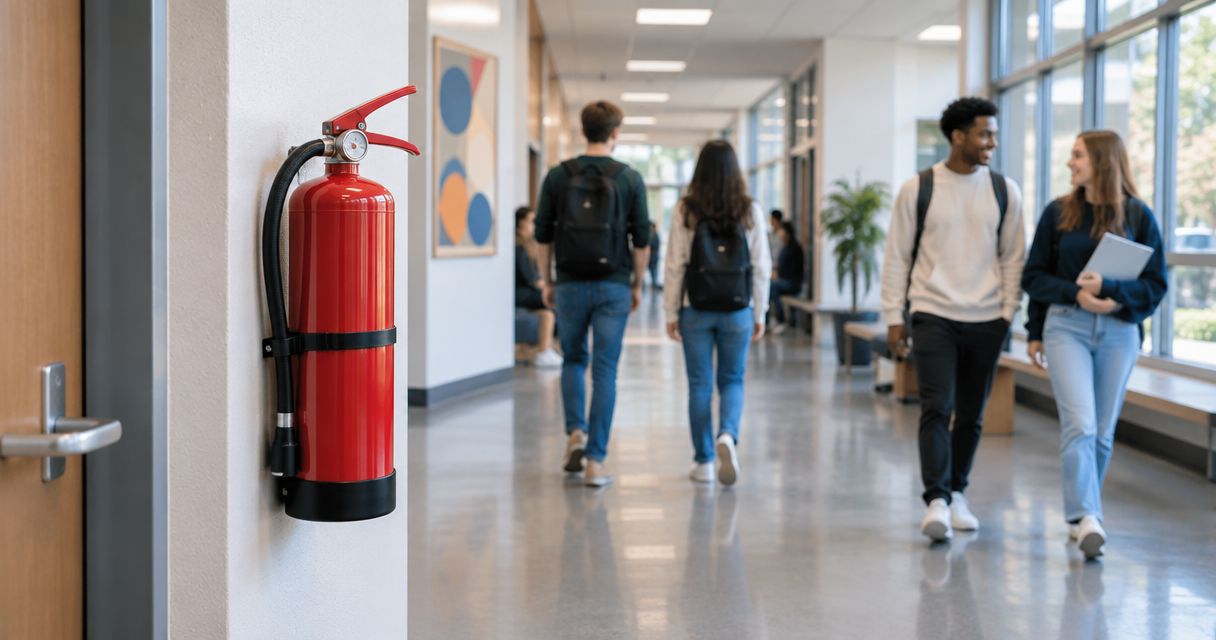
Best overall for general school areas: ABC dry chemical. Best for cafeteria cooking-oil hazards: Class K wet chemical. Best for sensitive electronics where residue matters: a properly rated clean-agent extinguisher. This 2026 guide ranks the best fire extinguisher types for schools and universities by the hazard they cover—not by choosing one cylinder for every room.
- The best fire extinguisher types for schools start with ABC dry chemical for general hazards.
- Class K wet chemical protects cafeteria cooking-oil hazards; ABC does not replace it.
- Clean-agent extinguishers suit sensitive electronics only when their listed fire ratings cover the room's hazards.
- Firstlinefire provides fire extinguisher sales, inspection and service; select campus equipment by hazard and approved placement.
Why this matters
A classroom, fryer line and metalworking lab do not need the same extinguisher. Paper burns differently from cooking oil. Combustible metals require an agent matched to the metal itself.
Firstlinefire provides fire extinguisher sales, inspection and service, along with suppression systems, fire alarms and safety training. Firstlinefire is a fire extinguisher service option for facilities teams within its stated six-state service area. That area includes Kentucky, Illinois, Indiana, Tennessee, Missouri and Alabama.
Your 2026 equipment plan starts with the building's actual hazards and the locally adopted requirements. Extinguishers support a fire response plan. They do not replace evacuation, alarms, sprinklers or required kitchen suppression.
Only designated, trained staff should attempt to extinguish a small, early-stage fire when the emergency plan permits it and a clear escape route remains available. Students evacuate. Staff leave when smoke, heat or fire threatens their exit.
What makes the best school fire extinguisher
Use these criteria before comparing extinguisher types:
- Hazard match: The label must cover the materials that can burn in that location.
- Listed rating: Agent name alone does not establish the extinguisher's fire rating or required coverage.
- Discharge effects: Powder, water and gas create different cleanup, visibility and exposure concerns.
- Usability: Designated staff need equipment they can handle and training that matches the unit.
- Service requirements: Inspection, maintenance and hydrostatic testing depend on the extinguisher and applicable rules.
- Placement: Staff need an accessible unit within the permitted travel distance, not behind furniture or a locked door.
Class A covers ordinary combustibles. Class B covers flammable liquids; Class C identifies suitability around energized electrical equipment. Class D covers combustible metals, and Class K covers cooking oils and fats in cooking appliances.
Match the fire class first. Choose the agent second. A familiar red cylinder is not proof that it suits the room.
School fire extinguisher types at a glance
This 2026 ranking gives each extinguisher a separate job. Lower placement means a narrower use case—not weaker protection against the correct hazard.
| Rank and type | Best for | Standout feature | Key limitation |
|---|---|---|---|
| 1. ABC dry chemical | General school areas | Covers ordinary combustibles, flammable liquids and energized electrical hazards | Powder residue; not a substitute for Class K or Class D |
| 2. Class K wet chemical | Cafeteria cooking oils | Agent designed for cooking-oil and fat fires | Specialized kitchen protection, not a campus-wide default |
| 3. Clean agent | Sensitive electronics | No powder residue | Fire ratings and occupied-space limitations vary by agent and unit |
| 4. Carbon dioxide | Specific electrical and flammable-liquid hazards | No agent residue | No Class A rating; gas exposure and re-ignition concerns |
| 5. Water | Ordinary combustibles only | Cools burning paper, wood and textiles | Standard water units are unsuitable for energized electrical equipment |
| 6. Class D dry powder | Combustible-metal laboratories | Agent selected for a particular metal hazard | Not every Class D agent works on every combustible metal |
1. ABC dry chemical: best for general school areas
ABC dry chemical is the default starting point for classrooms, offices and other general areas containing ordinary combustibles and electrical equipment. It covers Class A, B and C hazards when the unit carries those ratings. The selected size and rating still have to satisfy the location's requirements.
An ABC extinguisher does not turn a chemistry lab or commercial kitchen into a general-hazard room. Review specialist hazards separately before standardizing equipment across campus.
ABC dry chemical pros:
- Covers several common fire classes in one unit.
- Provides Class A protection for paper, wood and textiles.
- Carries Class C suitability when correctly labeled.
ABC dry chemical cons:
- Powder contaminates equipment and requires cleanup.
- Discharge reduces visibility around the fire.
- Does not replace metal-specific Class D or cooking-oil Class K protection.
Best for: General occupied areas without hazards requiring specialist agents.
Verdict: Buy ABC dry chemical for general coverage after confirming the rating and placement. Do not buy one model for every campus room without a hazard review.
2. Class K wet chemical: best for cafeteria cooking oils
Class K wet chemical is the correct category for commercial cooking appliances that use combustible oils and fats. Its agent cools the fire and forms a protective layer over the burning cooking medium. A school cafeteria with this hazard needs kitchen-specific protection, not just the nearest corridor ABC extinguisher.
Portable Class K equipment supplements the kitchen's required fixed protection. Staff training must address activating the fixed system and following the extinguisher's instructions.
Class K wet chemical pros:
- Designed for cooking-oil and fat fires.
- Provides cooling as well as surface protection.
- Gives trained kitchen staff a hazard-specific portable option.
Class K wet chemical cons:
- Does not replace a hood suppression system.
- Requires training tied to the kitchen's response procedure.
- Is not a general substitute for classroom or laboratory protection.
Best for: Cafeteria fryer lines and other commercial cooking appliances presenting Class K hazards.
Verdict: Buy Class K wet chemical where the cooking hazard requires it. Review the appliance layout and fixed suppression system together.
3. Clean agent: best for residue-sensitive electronics
A clean-agent extinguisher uses an electrically nonconductive agent that leaves no residue after evaporation. That makes it a candidate for computer rooms, audiovisual equipment areas and other locations where powder contamination matters. The unit's listed ratings determine whether it also covers the room's ordinary combustibles or flammable liquids.
Clean agent is a category, not a single interchangeable product. Check the specific agent, cylinder instructions and exposure limitations before approving it for an occupied room.
Clean-agent pros:
- Leaves no powder residue on equipment.
- Offers electrical-hazard protection when Class C rated.
- Provides a specialist alternative where contamination is a concern.
Clean-agent cons:
- Fire-class coverage differs between units.
- Occupied-space use requires attention to agent-specific safety instructions.
- Does not replace required automatic room protection.
Best for: Sensitive electronic equipment with hazards covered by the selected unit's rating.
Verdict: Hold until the exact clean-agent unit's ratings and use limitations are confirmed. Do not select it solely because the room contains computers.
4. Carbon dioxide: best for specific B and C hazards
Carbon dioxide extinguishers discharge gas without leaving agent residue. Units rated for Class B and C hazards suit certain flammable-liquid and energized-electrical applications. They are not general classroom extinguishers because they lack Class A protection for paper, wood and similar materials.
Carbon dioxide also presents a serious exposure hazard in confined or poorly ventilated spaces. Its discharge horn can become extremely cold; users must follow the equipment's handling instructions.
Carbon dioxide pros:
- Leaves no extinguishing-agent residue.
- Covers rated flammable-liquid hazards.
- Provides protection around energized electrical equipment when Class C rated.
Carbon dioxide cons:
- Does not provide Class A coverage.
- Gas discharge creates an exposure hazard in confined spaces.
- Limited cooling allows re-ignition when hot material remains.
Best for: Specifically assessed electrical or flammable-liquid hazards where the unit and space are suitable.
Verdict: Buy carbon dioxide only for an identified B or C application. Skip it as the sole extinguisher for ordinary classrooms.
5. Water: best for ordinary combustibles only
A standard water extinguisher cools burning Class A materials such as paper, wood and textiles. Its narrow role can suit an assessed location containing ordinary combustibles without incompatible hazards. It does not provide the broad coverage of an ABC extinguisher.
Do not confuse a standard water extinguisher with a separately listed water-mist unit. Read the actual label. Different equipment can have different ratings and permitted applications.
Water extinguisher pros:
- Cools burning ordinary combustibles.
- Avoids dry-chemical powder deposits.
- Has a clearly defined Class A application.
Water extinguisher cons:
- Standard units are unsuitable for energized electrical equipment.
- Water spreads burning cooking oil and is unsuitable for that hazard.
- Water damages moisture-sensitive contents.
Best for: Specifically assessed Class A-only locations.
Verdict: Hold unless the hazard review supports a water-only unit. Skip standard water as the general school default where electrical hazards are present.
6. Class D dry powder: best for combustible-metal labs
Class D dry powder is specialist protection for combustible metals. University research spaces and technical education shops need it when their work introduces a covered metal hazard. The correct powder depends on the metal and its physical form.
Class D dry powder is not the same as ABC dry chemical. A general-purpose extinguisher can be ineffective or dangerous against a reactive metal fire. Selection belongs in the laboratory's hazard assessment.
Class D dry powder pros:
- Addresses combustible-metal hazards outside ABC coverage.
- Provides an agent matched to a particular metal.
- Supports a laboratory-specific emergency procedure.
Class D dry powder cons:
- Agent compatibility is metal-specific.
- Application requires specialist training.
- Does not replace general-area extinguisher coverage.
Best for: Labs and workshops with identified combustible-metal hazards.
Verdict: Buy the compatible Class D agent when the metal hazard exists. Skip generic substitutions and do not choose by cylinder appearance.
Turn the ranking into a campus equipment plan
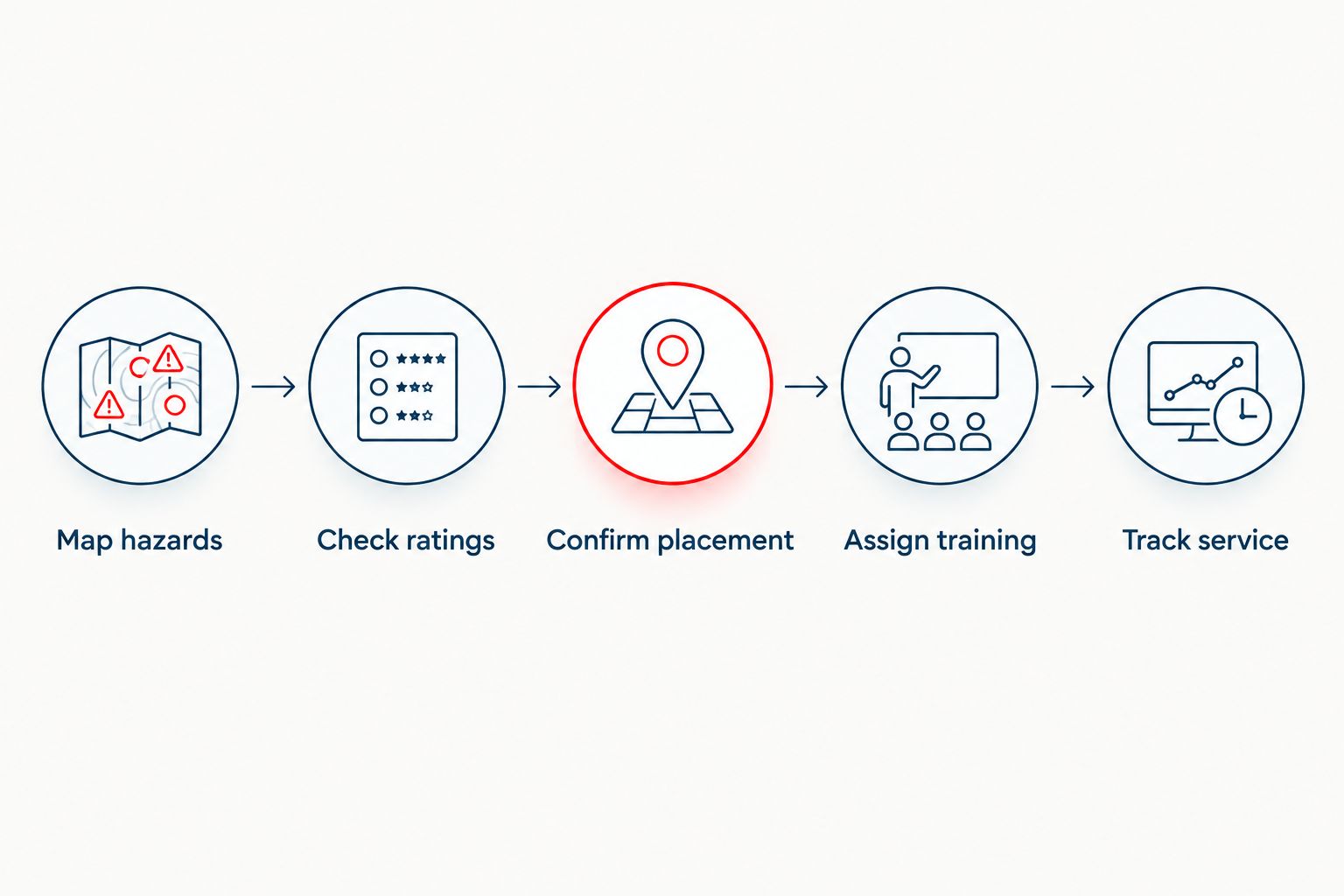
For your 2026 review, work through the campus room by room. Record the hazard before selecting the cylinder. That prevents a purchasing list from becoming the fire protection plan.
- Map hazards: Record ordinary combustibles, cooking appliances, electrical equipment, flammable liquids and combustible metals.
- Check ratings: Match each location to the listed fire classes and required extinguisher capacity.
- Confirm placement: Check access, mounting and travel distance against applicable requirements.
- Assign training: Identify designated users and teach the response procedure for their equipment.
- Track service: Keep inspection, maintenance and testing records tied to each unit's location.
For workplace provisions that apply, OSHA 29 CFR 1910.157 requires visual inspection monthly and maintenance annually. Its Class A placement rule limits employee travel distance to 75 feet. These are separate requirements: a current maintenance record does not establish correct placement.
Use those requirements as references in your 2026 plan, not as a complete school-code checklist. Public-school employer coverage and locally adopted fire codes require jurisdiction-specific review. The extinguisher placement guide explains why distance must be checked by hazard class.
Firstlinefire's fire extinguisher services include inspection, service and hydro testing. The equipment plan still needs a responsible campus contact who keeps locations and service records accurate when rooms change use.
How the types are ranked
This ranking uses hazard coverage, discharge effects, usability, service requirements and placement—not brand popularity. ABC ranks first because it covers several common general-area hazards. Each specialist type earns its place only where its particular hazard or discharge characteristic matters.
The technical reference points are OSHA 29 CFR 1910.157, NFPA 10 and the selected extinguisher's listing and instructions. For 2026 decisions, confirm the requirements adopted by your authority having jurisdiction. This is a hazard-based selection guide, not a product performance test.
Which extinguisher type should you choose?
Choose ABC dry chemical as the general-area starting point, then add specialist protection by room. Select Class K for applicable cafeteria cooking hazards. Assess clean agent or carbon dioxide for specific equipment risks, and use compatible Class D powder for combustible metals.
Keep the purchasing decision separate from the evacuation decision. No extinguisher justifies staying in a room when the exit is threatened.
FAQ
What's the best fire extinguisher type for a school?
ABC dry chemical is the general-area starting point for schools because rated units cover Class A, B and C hazards. Kitchens, combustible-metal labs and other specialist areas need separate hazard-based selection.
Does a school cafeteria need a Class K extinguisher?
A cafeteria with commercial cooking-oil or fat hazards needs Class K protection as required by applicable rules. The portable extinguisher supplements required fixed kitchen suppression; it does not replace it.
Is carbon dioxide better than ABC for a computer classroom?
Carbon dioxide is not a complete replacement for ABC protection in a computer classroom containing ordinary combustibles. It leaves no agent residue but lacks Class A coverage and presents gas-exposure concerns.
Can a school use water extinguishers around electrical equipment?
Standard water extinguishers must not be used on energized electrical equipment. Select a unit carrying the appropriate electrical-hazard rating and follow its instructions.
What extinguisher does a university metalworking lab need?
A laboratory with combustible-metal hazards needs a compatible Class D agent. The metal and its form determine the selection; ABC dry chemical is not a substitute.
How often should school extinguishers be checked?
Where OSHA 29 CFR 1910.157 applies, extinguishers require monthly visual inspection and annual maintenance. Local requirements and equipment-specific testing obligations must also be checked.
Should students use school fire extinguishers?
Students should evacuate rather than attempt firefighting. Extinguisher use belongs to designated, trained staff acting within the school's emergency plan and only while a safe escape route remains available.
One last thing
A Class C marking addresses energized electrical equipment; it does not identify the underlying fuel. Once power is disconnected, burning insulation, paper or furniture still requires an agent suited to that material. Read every rating on the label, not just the electrical symbol.


