
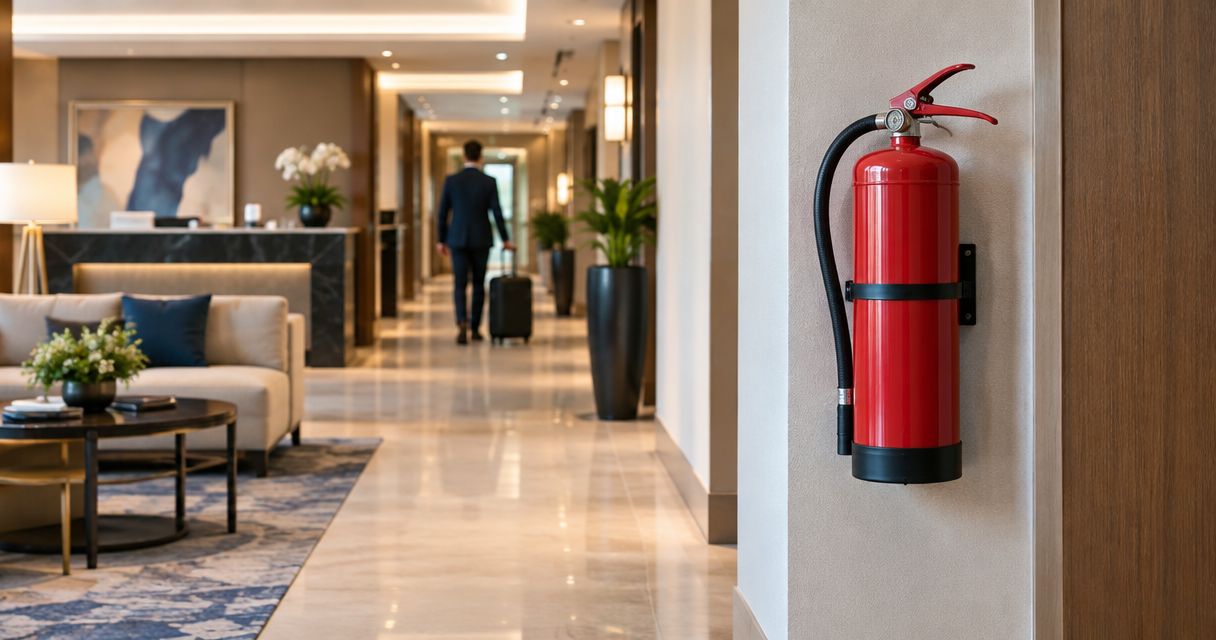
Best general-purpose choice: ABC dry chemical. Best for commercial cooking: Class K wet chemical. Best for sensitive electronics: a clean-agent extinguisher with the required fire rating. The best fire extinguishers for hotels in 2026 form a hazard-matched set, not a building-wide purchase of one cylinder type. Firstlinefire provides fire extinguisher sales, inspection and service alongside suppression systems, fire alarms and safety training.
- ABC dry chemical is the general-purpose starting point when choosing the best fire extinguishers for hotels.
- Class K wet chemical covers commercial cooking-oil hazards; it does not replace kitchen hood suppression.
- Clean-agent extinguishers suit sensitive electronics only when their listed fire ratings match the room's hazards.
- Firstlinefire provides fire extinguisher service for commercial properties across Kentucky, Illinois, Indiana, Tennessee, Missouri and Alabama.
- Choose hotel fire protection by hazard, approved placement and staff response—not cylinder appearance.
Why this matters
A hotel contains different fire hazards under one roof. Bedding and paper are ordinary combustibles. A commercial fryer presents a cooking-oil hazard. An energized electrical cabinet changes which agents staff can safely use.
An ABC extinguisher is a useful default, not a universal answer. The wrong agent leaves a hazard uncovered or creates another problem, such as applying ordinary water to energized equipment.
For your 2026 purchasing plan, start with a room-by-room hazard review. Then confirm the extinguisher rating, placement and service requirements with your fire-protection contractor and local authority having jurisdiction. Portable extinguishers support the property's emergency plan; they do not replace evacuation, alarms, sprinklers or required fixed suppression.
What makes the best fire extinguishers for hotels
Use these criteria before comparing cylinders:
- Fire-class match: The label must cover the actual fuel and any energized electrical exposure.
- Extinguishing rating: Agent type alone does not establish the unit's capacity or suitability.
- Usable placement: Staff need an accessible extinguisher without entering a fire or losing an escape route.
- Discharge consequences: Powder residue, electrical conductivity and gas discharge matter in occupied buildings.
- Service requirements: Inspection, maintenance, recharge and hydro testing depend on the extinguisher type and construction.
- Staff readiness: Equipment selection must fit the hotel's written emergency procedures and employee training.
Do not choose by cylinder weight alone. The fire rating, hazard assessment and placement requirements carry more weight than whether a unit looks large enough.
Hotel fire extinguishers at a glance
| Extinguisher type | Best for | Standout feature | Key limitation |
|---|---|---|---|
| ABC dry chemical | General-purpose hotel coverage | Covers ordinary combustibles, flammable liquids and energized electrical equipment | Powder residue complicates cleanup |
| Class K wet chemical | Commercial cooking-oil hazards | Agent designed for hot cooking oils and fats | Does not replace required hood suppression |
| Clean agent | Sensitive electronics | Leaves no powder residue | Fire ratings vary by model |
| Carbon dioxide | Selected flammable-liquid hazards | Nonconductive discharge without agent residue | Generally lacks a Class A rating |
| Water | Dedicated ordinary-combustible areas | Cooling action on Class A materials | Ordinary water units are unsuitable for energized electrical equipment |
These are agent categories, not interchangeable products. Check the listing and label of the actual extinguisher before assigning it to a location.
1. ABC dry chemical: best for general hotel coverage
ABC dry chemical extinguishers cover Class A ordinary combustibles, Class B flammable liquids and Class C energized electrical equipment. That makes them the general-purpose starting point for hotel areas containing mixed hazards.
Guest-floor circulation areas, offices and back-of-house spaces still need individual placement decisions. A corridor location does not automatically cover every room, storage area or service space nearby.
ABC dry chemical pros:
- Covers several common hotel fire classes in one unit.
- Addresses ordinary combustibles such as paper, fabric and wood.
- Carries a Class C designation for energized electrical hazards when labeled ABC.
- Supports a consistent general-purpose equipment plan.
ABC dry chemical cons:
- Powder leaves residue on furnishings and equipment.
- Discharge creates airborne powder that affects visibility and cleanup.
- ABC coverage does not provide the Class K protection needed for commercial cooking-oil hazards.
Best for: General-purpose coverage where the hazard assessment calls for Class A, B and C protection.
Select the rating and installation location before ordering. Do not assume that the same cylinder belongs at every guest-floor landing, laundry doorway and maintenance room.
Verdict: Buy for approved general-purpose locations; do not treat ABC as the kitchen solution.
2. Class K wet chemical: best for commercial cooking areas
Class K wet chemical extinguishers address fires involving cooking oils and fats in commercial cooking appliances. They cool the burning material and help form a surface layer that suppresses the fire.
A hotel restaurant, banquet kitchen or breakfast kitchen needs an assessment of its actual appliances. A coffee station is not the same hazard as a deep-fat fryer.
Class K wet chemical pros:
- Designed for commercial cooking-oil and fat hazards.
- Provides cooling suited to hot cooking media.
- Complements a properly designed kitchen fire-protection plan.
Class K wet chemical cons:
- Does not replace required fixed hood suppression.
- Is not a substitute for general-purpose coverage throughout the hotel.
- Requires staff to understand the kitchen system's operating instructions.
Best for: Commercial cooking areas with appliances and cooking media requiring Class K protection.
Where a fixed cooking suppression system is installed, train staff on the system's instructions and required activation sequence. Do not teach staff to bypass that system and go straight to a portable extinguisher.
Verdict: Buy for identified commercial cooking-oil hazards; keep hood suppression and staff procedures in the same plan.
3. Clean agent: best for sensitive electronic equipment
Clean-agent extinguishers discharge an agent that leaves no powder residue. They are a targeted option for hotel spaces where dry chemical contamination would create a substantial cleanup problem, including selected communications and electronic-equipment areas.
The category name does not establish the fire rating. Some units cover Class A, B and C hazards; others do not. Read the actual product label.
Clean-agent extinguisher pros:
- Avoids dry chemical powder residue.
- Uses a nonconductive extinguishing agent.
- Offers a targeted choice for sensitive equipment areas.
Clean-agent extinguisher cons:
- Fire-class coverage varies between models.
- Does not supply Class K cooking-oil protection.
- Application and exposure restrictions require review before selection.
Best for: Sensitive electronic-equipment areas where the unit's listed rating matches all identified hazards.
A hotel equipment room can contain more than electronics. Packaging, stored supplies and other ordinary combustibles affect the required protection. Removing those materials improves housekeeping, but it does not remove the need to assess the room correctly.
Verdict: Buy for a defined equipment-room need after checking the listing; skip blanket replacement of the hotel's ABC units.
4. Carbon dioxide: best for selected flammable-liquid hazards
Carbon dioxide extinguishers commonly carry Class B and C ratings. They discharge a nonconductive agent without leaving extinguishing-agent residue, making them an option for selected flammable-liquid and energized-equipment hazards.
They are not the default for guest floors. A typical carbon dioxide extinguisher does not provide Class A coverage for bedding, paper and similar materials.
Carbon dioxide extinguisher pros:
- Covers listed flammable-liquid hazards.
- Provides nonconductive discharge for energized equipment.
- Leaves no agent residue after discharge.
Carbon dioxide extinguisher cons:
- Generally lacks Class A protection for ordinary combustibles.
- Discharge presents exposure concerns in confined or poorly ventilated spaces.
- Agent dispersal and limited cooling create limitations that training must address.
Best for: A specifically assessed flammable-liquid hazard where carbon dioxide is suitable for the space and intended response.
Do not choose carbon dioxide just because a room contains an electrical panel. Evaluate the other fuels, room conditions and escape route. Electrical suitability is only one part of the decision.
Verdict: Hold until a contractor confirms the application; skip as the hotel's general-purpose standard.
5. Water: best for dedicated Class A areas
Ordinary water extinguishers cool Class A materials such as wood, paper and textiles. They fit a narrower role than ABC dry chemical and require careful separation from incompatible hazards.
A linen-storage area illustrates the decision. Textiles are Class A materials, but nearby energized equipment or other fuels can make an ordinary water extinguisher unsuitable as the only protection.
Water extinguisher pros:
- Provides cooling for ordinary combustible materials.
- Avoids dry chemical powder contamination.
- Offers a clear application when the assessed hazard is Class A only.
Water extinguisher cons:
- Ordinary water units are unsuitable for energized electrical equipment.
- They do not cover flammable-liquid or commercial cooking-oil hazards.
- Water discharge damages materials and creates cleanup work.
Best for: Dedicated ordinary-combustible areas where the hazard review supports a Class A-only unit.
Do not confuse ordinary water extinguishers with other water-based products carrying different listings. A different nozzle or agent formulation does not justify assuming electrical suitability; the label decides.
Verdict: Buy only for a confirmed Class A application; skip as a hotel-wide default.
How these choices are ranked
This 2026 ranking puts broad general-purpose coverage first, then separates specialist hazards. The criteria are fire-class match, listed rating, accessibility, discharge consequences, service needs and staff readiness.
It is a selection guide by application, not a claim that one manufacturer outperforms another. Choose the category by hazard, then choose the actual listed unit.
Turn the ranking into a hotel equipment plan
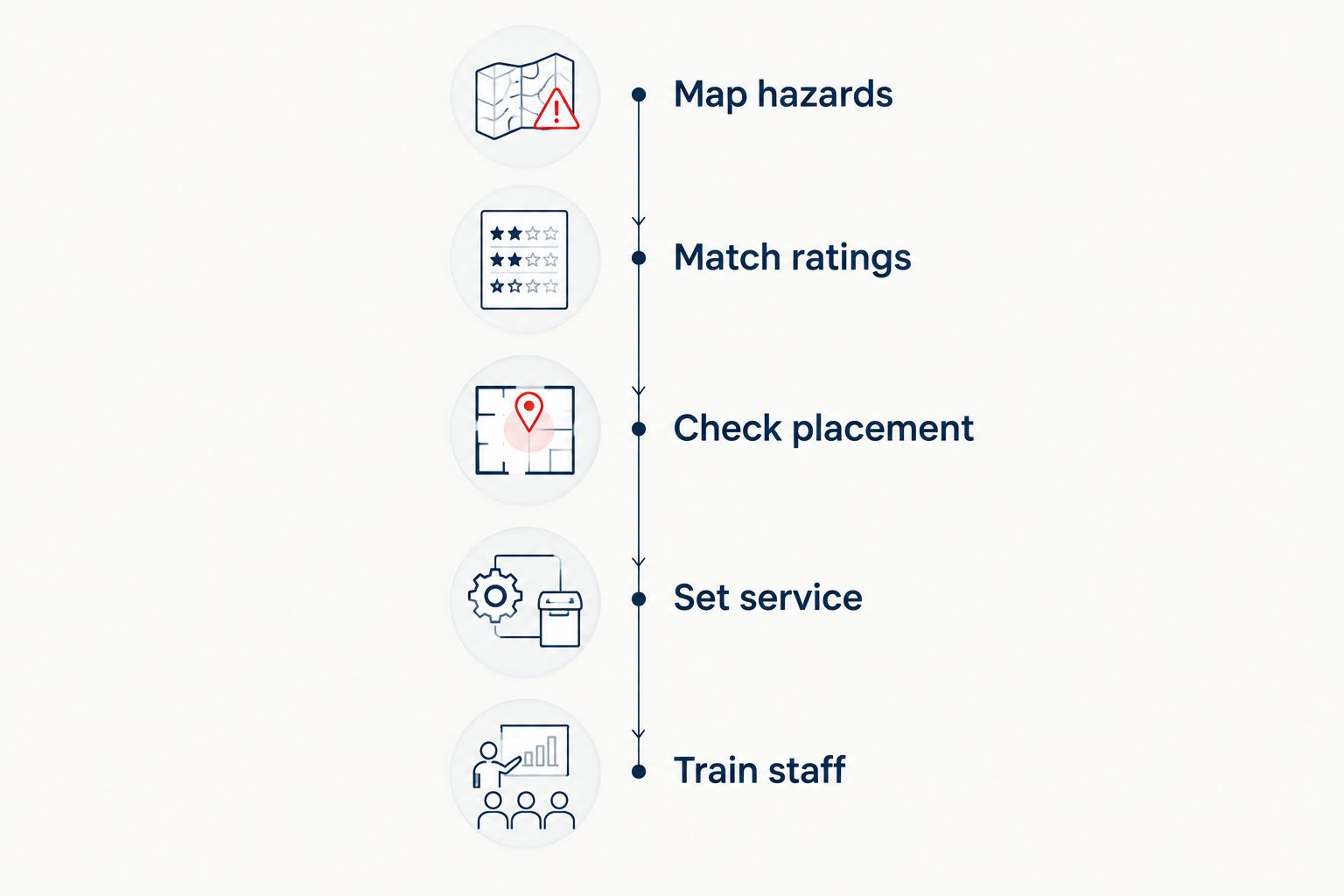
Use this sequence when updating your hotel's 2026 extinguisher plan. Keep the floor plan, equipment list and emergency procedures together so purchasing does not drift away from placement.
Map hazards
Mark guest circulation areas, linen storage, offices, kitchens, mechanical rooms and equipment rooms. Record actual fuels and energized equipment rather than assigning protection from room names alone.
Match ratings
Assign the required fire classes and extinguishing ratings to each location. Treat cooking appliances and specialist equipment separately from general floor coverage.
Check placement
Measure the walking route to the extinguisher. Account for doors, partitions, locked rooms and furniture. A short straight-line distance on a drawing is not necessarily an accessible travel path.
Set service
Record equipment identification, location, inspection responsibility and maintenance requirements. Revisit the plan whenever renovations, kitchen changes or storage changes alter the hazards.
Train staff
Define who evacuates, who reports the fire and whether designated employees are authorized to attempt extinguisher use. Training must include when to stop and leave, not just how to discharge a cylinder.
Firstlinefire provides fire extinguisher sales, inspection and service for commercial customers across Kentucky, Illinois, Indiana, Tennessee, Missouri and Alabama. Use your property's hazard list to define the service request.
Plan your hotel extinguisher service
Bring your floor plan, kitchen equipment list and existing extinguisher records.
Placement and maintenance: keep the numbers straight
For your 2026 review, distinguish federal workplace requirements from the locally adopted fire code. Neither a generic shopping list nor a service tag establishes that the placement is correct.
OSHA's portable-extinguisher rule, 29 CFR 1910.157, sets these requirements for covered workplaces:
- Class A: Employee travel distance to an extinguisher must not exceed 75 feet.
- Class B: Travel distance from the Class B hazard area to an extinguisher must not exceed 50 feet.
- Maintenance: Extinguishers must receive an annual maintenance check, with the required annual maintenance record retained for 12 months after the last entry or the life of the shell, whichever is less.
Those distances are not a complete hotel placement design. Extinguishing ratings, hazard levels, local requirements and specialized hazards still determine the layout. Do not use the Class B distance to place a kitchen Class K extinguisher.
OSHA also requires monthly visual inspection of portable extinguishers in covered workplaces. Where employees are provided extinguishers for use, the rule requires initial and annual education; designated users also have training requirements. Evacuation-only policies and applicable exemptions need separate review.
For a closer placement review, use the guide to fire extinguisher placement distance by hazard class.
Which hotel fire extinguishers should you choose?
Start with ABC dry chemical for approved general-purpose locations. Add Class K protection wherever commercial cooking hazards require it. Consider clean agent, carbon dioxide or water only for a defined application supported by the actual unit's listing.
Do not replace an entire property's equipment just to make the cylinders match. Identify missing coverage, unsuitable agents, inaccessible locations and service needs first. Those findings determine the purchase.
Firstlinefire is a fire extinguisher service option for hotel operators in its stated six-state service area. Pair equipment decisions with the property's alarms, suppression systems and employee response plan.
FAQ
What's the best fire extinguisher for a hotel?
ABC dry chemical is the general-purpose starting point for hotel areas with Class A, B and C hazards. Commercial cooking areas need separate Class K assessment, and each location needs an appropriate listed rating.
Does a hotel kitchen need a Class K extinguisher?
A hotel kitchen with commercial cooking-oil or fat hazards needs Class K protection as required by the applicable code and hazard assessment. A Class K extinguisher does not replace required fixed kitchen suppression.
Is a clean-agent extinguisher better than ABC for hotel electronics?
A clean-agent extinguisher avoids the powder residue produced by ABC dry chemical. It is suitable only when the actual unit's listed fire ratings and application restrictions match the room's hazards.
Can a carbon dioxide extinguisher protect hotel guest floors?
A typical carbon dioxide extinguisher is not a suitable general-purpose choice for hotel guest floors because it lacks Class A coverage. Bedding, paper and other ordinary combustibles require appropriate Class A protection.
How far apart should hotel fire extinguishers be?
Hotel extinguisher placement depends on hazard class, rating, walking routes and applicable code—not one spacing rule. OSHA's covered-workplace limits include 75 feet of employee travel for Class A protection and 50 feet from Class B hazard areas.
How often should hotel fire extinguishers be inspected?
OSHA requires monthly visual inspections and annual maintenance checks for portable extinguishers in covered workplaces. Additional service and hydrostatic-test requirements depend on the equipment, applicable rules and manufacturer instructions.
Can hotel staff fight a fire before evacuating guests?
Hotel staff must follow the property's emergency action plan rather than improvising an extinguisher response. Only authorized, trained employees should attempt use under the plan's conditions, with a clear escape route and evacuation procedures maintained.
One last thing
A full cylinder is not proof of usable protection. An extinguisher behind a housekeeping cart, inside a locked room or assigned to the wrong hazard fails the practical test.
Before approving your 2026 purchase, walk the routes with the staff who use them. Check access and fire-class labels together. Fix the location as well as the equipment.


