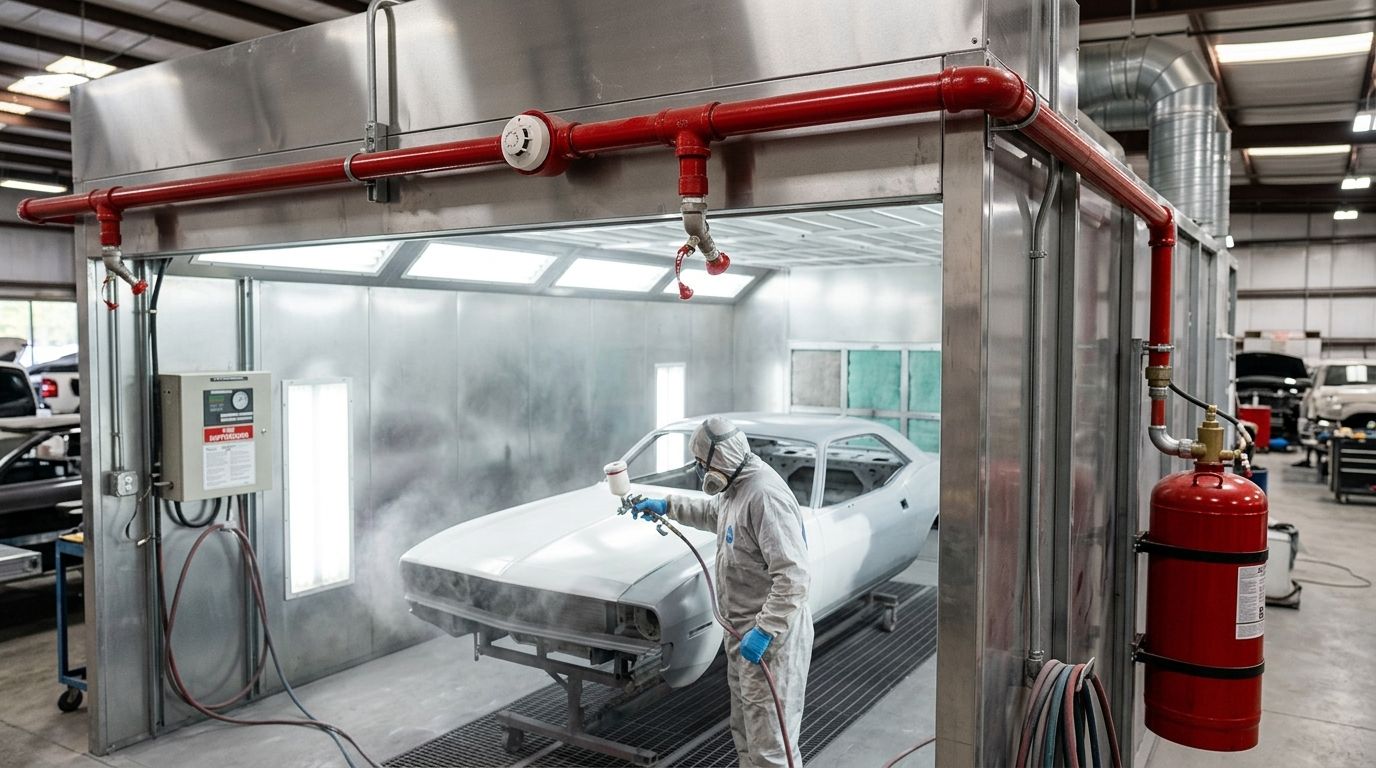
Paint booths burn fast: atomized coating, solvent vapor, and overspray buildup on filters give a stray spark everything it needs. Picking the right suppression system means matching the hazard type in the booth to a system that shuts it down before the whole enclosure is involved, and this guide ranks the five system types that actually get installed in commercial and industrial spray booths in 2026.
Best overall for paint booth interiors: Dry Chemical Automatic Suppression. Best for continuous conveyorized lines: Water Wash-Down/Deluge Systems. Best for booths running robotics, electrostatic bells, or other sensitive electronics: CO2 Flooding Systems paired with a Clean Agent System on the control panel. Best for large open-floor booths with heavy solvent-based coating volume: Foam-Water Systems.
- Dry chemical automatic suppression is still the standard pick for best fire suppression systems for paint booths in 2026.
- Water wash-down/deluge systems suit continuous lines that can't stop production for post-discharge cleanup.
- CO2 flooding protects booths with robotics or electrostatic equipment without leaving residue behind.
- Foam-water systems handle large open-floor booths with heavy solvent-based coating loads.
- Clean agent systems protect the control panel next to the booth, not the coating zone itself.
Why this matters
Spray booths concentrate three things fire loves: fuel (overspray residue, solvent vapor, filter media), an ignition source (static discharge, lighting, motor sparks), and airflow that spreads flame fast through the plenum and exhaust duct. NFPA 33 governs spray application using flammable and combustible materials and, in most jurisdictions across Kentucky, Illinois, Indiana, Tennessee, Missouri and Alabama, requires automatic fire-extinguishing equipment on spray booths and spray rooms above a certain size or hazard classification.
Insurance carriers increasingly condition commercial coverage on a documented, inspected suppression system, not just an extinguisher hanging near the door. A full assessment of your booth's protection tells you which system actually fits the coating chemistry and airflow you run, not just what was installed when the building was built.
What makes the best fire suppression system for a paint booth
- NFPA 33 compliance and AHJ sign-off — the system has to satisfy your local fire marshal, not just the manufacturer's spec sheet.
- Full hazard coverage — booth interior, plenum, exhaust duct, and filter bank all need nozzle coverage, not just the spray zone.
- Detection method — fusible link, linear heat detection, or UV/IR optical detection, matched to how fast your process can flash over.
- Automatic shutdown on discharge — fans, conveyors, and spray guns need to stop the moment the system fires, or it just keeps feeding the fire air and fuel.
- Cleanup and downtime after activation — dry chemical residue takes longer to clear than a clean agent or CO2 discharge.
- Coating chemistry compatibility — solvent-based and waterborne coatings behave differently under each agent type.
At a glance
| System | Best for | Standout feature | Key limitation |
|---|---|---|---|
| Dry Chemical Automatic Suppression | General-purpose booth interiors and plenums | Fast knockdown, broad coating compatibility | Corrosive residue coats every surface it touches |
| Water Wash-Down/Deluge | Continuous conveyorized production lines | Rinses overspray while suppressing fire | High water volume, needs drainage capacity |
| CO2 Flooding | Booths with robotics or electrostatic equipment | Leaves zero residue on electronics | Displaces oxygen, requires evacuation before discharge |
| Foam-Water | Large open-floor booths, heavy solvent loads | Blankets pooled solvent to stop reignition | Bulkier tank and piping footprint |
| Clean Agent (control panel) | Electrical cabinets adjacent to the booth | Non-conductive, no cleanup | Not rated for open coating overspray zones |
1. Dry Chemical Automatic Suppression: best for spray booth interiors and plenums
This is the default system on most production and downdraft paint booths installed since the 1990s, and it's still the one most AHJs expect to see. Nozzles cover the booth interior, the plenum chamber, and the exhaust duct, and a fusible-link or heat-detection network trips the whole zone at once. Discharge is a fine dry chemical powder that smothers the flame chemically and knocks down heat almost instantly.
Dry Chemical pros:
- Broad compatibility with both solvent-based and waterborne coatings
- Fast, proven knockdown across the full hazard area
- Widely accepted by AHJs and insurance underwriters
Dry Chemical cons:
- Residue is mildly corrosive and coats filters, ductwork, and the booth floor
- Full cleanup and filter replacement can take a full shift or more
- Requires a complete recharge and inspection after every discharge
Best for: general-purpose spray booths running standard production schedules. Verdict: Buy.
2. Water Wash-Down/Deluge System: best for continuous production lines
Deluge systems flood the booth with water on activation, which suppresses the fire and simultaneously rinses overspray off the walls and floor. Plants running multi-shift conveyorized lines like this because it minimizes the gap between a discharge event and getting the line back up.
Water Wash-Down pros:
- Doubles as overspray cleaning, reducing fuel buildup between shifts
- No corrosive residue left on equipment
- Handles high-volume booths with continuous throughput
Water Wash-Down cons:
- Needs floor drainage and water reclamation built into the booth design
- Not compatible with every coating chemistry — check with your booth manufacturer
- Water damage risk to nearby electrical components without proper isolation
Best for: continuous conveyorized lines that can't absorb long downtime after an event. Verdict: Buy if your booth already has drainage capacity; Hold if it doesn't.
3. CO2 Flooding System: best for booths with robotics or electrostatic equipment
Booths running electrostatic bells, robotic arms, or other electronics inside the spray zone need an agent that won't leave conductive or corrosive residue behind. CO2 floods the enclosed space, displacing oxygen fast enough to stop combustion without touching a single circuit board.
CO2 Flooding pros:
- Zero residue on robotics, control wiring, or electrostatic equipment
- Effective in fully enclosed booth designs
- No secondary cleanup cost after discharge
CO2 Flooding cons:
- Oxygen displacement makes the space unsafe for anyone inside during discharge
- Requires pre-discharge alarms and evacuation time delays
- Less effective in booths with significant open ventilation
Best for: fully enclosed booths with robotics or electrostatic application equipment. Verdict: Buy for enclosed automated lines; Skip for open manual booths.
4. Foam-Water System: best for large open-floor booths with heavy solvent loads
Foam-water systems blanket pooled solvent and overspray residue, cutting off vapor release and stopping reignition after knockdown. They fit larger open-floor booths where solvent-based coatings accumulate across a wide surface area rather than a single enclosed chamber.
Foam-Water pros:
- Suppresses reignition better than dry chemical on pooled solvent
- Covers wide, open floor areas efficiently
- Compatible with high-solvent coating operations
Foam-Water cons:
- Larger tank and piping footprint than dry chemical or CO2
- Foam concentrate needs periodic testing and replacement
- Cleanup involves foam residue in addition to coating overspray
Best for: large, open-floor booths running solvent-heavy coating volumes. Verdict: Buy for high-volume solvent operations; Hold for smaller booths where dry chemical does the job.
5. Clean Agent System: best for the control panel, not the coating zone
A clean agent system doesn't belong inside the coating overspray zone itself, but it's the right call for the electrical control cabinet mounted next to the booth. It discharges a non-conductive agent that leaves no residue, protecting the panel that runs the whole line without shutting down the booth's primary suppression system.
Clean Agent pros:
- Non-conductive, safe for direct application on live electrical panels
- No cleanup, no corrosive residue
- Fast discharge protects sensitive controls before damage spreads
Clean Agent cons:
- Not rated or sized for open coating overspray areas
- Adds a second system and inspection schedule alongside the primary booth suppression
- Coverage is limited to the enclosed cabinet, not the room
A closer breakdown of agent types and coverage limits is in this clean agent fire suppression system comparison. Best for: control panels and electrical cabinets mounted next to the booth. Verdict: Buy as a companion system, never as a standalone booth solution.
How we ranked these
Each system was weighed against the six criteria above: NFPA 33 compliance, full hazard coverage, detection method, automatic shutdown, cleanup time, and coating compatibility. Dry chemical wins overall because it's the only system that checks every box for a standard-use booth without requiring special drainage or evacuation protocols. The other four earn their spot by solving a problem dry chemical doesn't — continuous throughput, sensitive electronics, high solvent volume, or a control panel that needs its own protection. Booths in auto body shops and vehicle repair bays often face a near-identical hazard profile; see the auto shop and garage fire suppression rankings if that's closer to your operation.
Which fire suppression system should you choose?
If you run a standard-use paint booth without continuous conveyorized production, robotics, or unusual coating chemistry, dry chemical automatic suppression is the default answer in 2026 — it's proven, broadly compatible, and what most AHJs expect to see on inspection. Move to water wash-down only if your line truly can't stop for cleanup, to CO2 only if robotics or electrostatic equipment sit inside the booth, and to foam-water only if solvent volume is genuinely high. Add a clean agent system on the control panel regardless of which primary system you pick — it's cheap insurance for the one component that can't tolerate dry chemical residue or water.
Get your booth's suppression system assessed
An on-site look tells you which system fits your coating process and airflow.
FAQ
What's the best fire suppression system for a paint booth?
Dry chemical automatic suppression is the best overall pick for most paint booths in 2026 because it covers the interior, plenum, and exhaust duct with one proven, UL-listed system. Booths with special conditions — continuous lines, robotics, or heavy solvent volume — often need a different system instead.
Is CO2 or dry chemical better for spray booths?
Dry chemical suits most general-purpose spray booths, while CO2 is better when robotics or electrostatic equipment sit inside the enclosure and can't tolerate residue. CO2 also requires evacuation protocols dry chemical doesn't need.
Does NFPA 33 require automatic fire suppression in paint booths?
NFPA 33 governs spray application using flammable and combustible materials and generally requires automatic fire-extinguishing equipment on spray booths and spray rooms. Local AHJ requirements vary, so confirm the specific threshold with your fire marshal.
How much cleanup does a dry chemical discharge require?
A dry chemical discharge coats the booth interior, ductwork, and filters in powder residue that needs full cleanup before the line restarts. Plants typically budget a full shift or more for cleanup, recharge, and inspection after activation.
Can water-based systems be used on solvent-based paint booths?
Water wash-down and deluge systems can work with some solvent-based operations, but compatibility depends on the specific coating chemistry and booth drainage design. Check with your booth manufacturer before assuming a water-based system fits.
How often does a paint booth suppression system need to be inspected?
Suppression systems need periodic inspection on a schedule set by the system type, local code, and manufacturer requirements, in addition to a full recharge after any discharge. Skipping scheduled inspection is one of the most common findings in fire marshal citations.
What is a pre-engineered dry chemical system and why does it matter for paint booths?
A pre-engineered dry chemical system is a UL-listed package sized and tested for a specific hazard area, which is why most paint booth installations use one rather than a custom-engineered design. It matters because the listing is what satisfies AHJ approval and insurance requirements.
Do paint booth suppression systems need to shut down the ventilation fans?
Yes — automatic shutdown of fans, conveyors, and spray guns on discharge is a core requirement, because a running exhaust fan feeds fresh air to a fire the system is trying to smother. Every system type on this list ties into that shutdown sequence.
One last thing
The system most facilities get wrong isn't the primary booth suppression — it's forgetting the control panel next to it. A dry chemical or water discharge that reaches an unprotected electrical cabinet can take out the line's controls even after the fire itself is out, which is why pairing a clean agent system on the panel is standard practice on well-protected booths, not an upsell.