
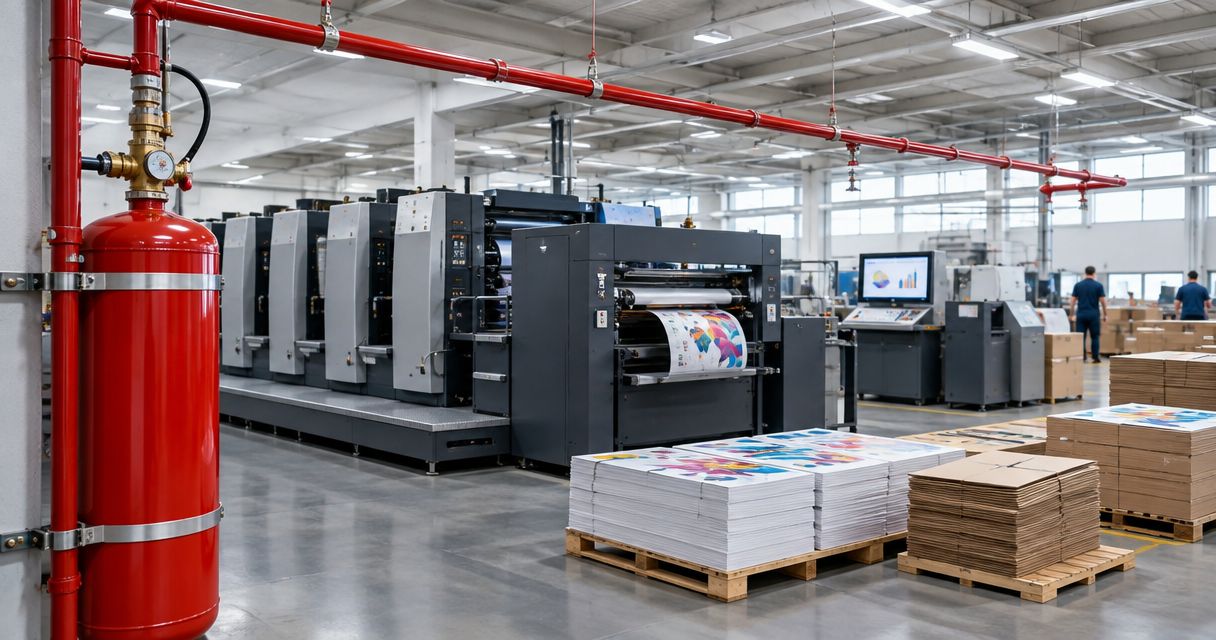
Best overall for paper and carton areas: properly designed automatic sprinklers. Best for dedicated flammable-liquid hazards: engineered foam-water protection where approved. Best for enclosed electronics: clean-agent suppression. This 2026 guide compares the best fire suppression systems for printing facilities by the hazard each system protects—not by manufacturer name.
- The best fire suppression systems for printing facilities match paper storage, solvent handling, and electronics to separate protection requirements.
- Automatic sprinklers are the default starting point for paper and packaging areas, with storage-specific engineering.
- Clean-agent suppression suits enclosed electronics; it does not replace protection for the production floor.
- Firstlinefire provides fire-protection services for commercial and industrial customers across Kentucky, Illinois, Indiana, Tennessee, Missouri, and Alabama.
Why this matters
A printing plant is not one fire hazard. Paper rolls, corrugated cartons, solvent-based materials, electrical cabinets, and finishing equipment need different protection decisions. Start with what burns, where it sits, and what keeps feeding the fire.
Firstlinefire is a fire-protection service option for commercial and industrial printers within its six-state service area. Firstlinefire provides suppression systems, fire alarms, extinguisher services, and safety training. The system categories below are selection guidance, not a claim that the company supplies every configuration listed.
For a 2026 project, separate building protection from equipment protection. A system around a press does not automatically protect the paper warehouse. A sprinkler system overhead does not automatically address every enclosed machine hazard.
What makes the best printing-facility suppression system
Judge the proposed design against these criteria before comparing equipment:
- Fuel match: Identify ordinary combustibles, flammable liquids, energized equipment, and any combustible-dust hazards. Use safety data sheets, not assumptions about ink or coatings.
- Storage match: Record commodity classification, storage height, rack arrangement, and ceiling conditions. Packaging material and storage configuration affect sprinkler design.
- Equipment match: Identify enclosed cabinets, open presses, dryers, conveyors, and ventilation paths. Agent delivery must reach the actual hazard.
- People protection: Check occupancy, evacuation, discharge warnings, and exposure risks. An agent that extinguishes a fire can still endanger workers.
- Service access: Require an inspection plan, accessible components, documented shutdown functions, and a way to manage protection during repairs.
Reject any recommendation that names an agent before describing the hazard. Ask the designer to show the applicable system listing, design basis, and approval requirements. The local authority having jurisdiction and your insurer belong in that discussion.
Printing-facility suppression systems at a glance
| System category | Best for | Standout feature | Key limitation |
|---|---|---|---|
| Automatic sprinklers | Paper, cartons, and general building protection | Water application and cooling for ordinary combustibles | Design must match storage, occupancy, and available water |
| Foam-water protection | Dedicated flammable-liquid process or storage hazards | Suitable foam formulations suppress vapor release from compatible liquids | Fuel compatibility, containment, and environmental requirements govern selection |
| Clean-agent suppression | Enclosed electrical and control rooms | Suppression without agent residue | Enclosure integrity and agent suitability are essential |
| Water-mist suppression | Equipment hazards covered by a specific tested application | Fine water droplets provide cooling through an application-specific design | Not interchangeable with sprinklers or other mist systems |
| Carbon dioxide suppression | Restricted, normally unoccupied industrial enclosures | Nonconductive agent that leaves no residue | Discharge creates a life-threatening exposure hazard |
These are distinct use-case slots. None is a universal replacement for the others, and the order does not mean carbon dioxide is an acceptable fallback when another system is inconvenient.
1. Automatic sprinklers: best for paper and carton areas
Automatic sprinklers are the default starting point for protecting ordinary combustible materials throughout a printing or packaging building. Water cools burning paper and packaging. The sprinkler design must account for the actual storage and process conditions, not merely the building's square footage.
A 2026 review should compare the current layout with the approved design. Taller stacks, different plastics, new racks, or a changed ceiling arrangement can change the protection requirements even when the sprinkler piping stays untouched.
Automatic sprinkler pros:
- Provide cooling for paper, cardboard, and other ordinary combustibles.
- Cover building areas rather than only a single machine enclosure.
- Support storage-specific designs under NFPA 13, the sprinkler installation standard.
Automatic sprinkler cons:
- Water discharge can damage stock and equipment.
- Protection depends on the water supply and correct design.
- Changed storage arrangements require review; existing heads alone do not prove adequacy.
Best for: Paper storage, carton converting, finished packaging, and general production areas where the design supports the hazard.
Verdict: Buy properly engineered sprinkler protection as the building-level starting point. Do not select sprinkler type or spacing from a general buying guide.
2. Foam-water protection: best for dedicated solvent hazards
Foam-water protection belongs in a separate engineering discussion when a facility handles flammable liquids. Suitable foam can form a protective blanket over compatible liquid fuel, while water contributes cooling. The fuel, discharge arrangement, and system approval determine whether that approach fits.
Do not treat every ink room as a foam application. Water-based materials, solvent mixtures, open containers, transfer equipment, and storage arrangements present different conditions. Provide the designer with safety data sheets and details of actual handling practices.
Foam-water protection pros:
- Addresses vapor release from compatible flammable-liquid surfaces.
- Supports engineered protection for defined process or storage hazards.
- Combines foam application with water-based cooling.
Foam-water protection cons:
- Foam suitability depends on the liquid, including solvent compatibility.
- Discharge containment and disposal require planning.
- Fluorinated and fluorine-free formulations are not interchangeable without design review.
For a 2026 specification, check applicable restrictions on the proposed concentrate and the manufacturer's approved application. Do not substitute concentrates because the containers look similar.
Best for: Dedicated flammable-liquid handling or storage areas where a qualified design establishes foam-water suitability.
Verdict: Hold until the fuel, listing, containment, and approval requirements are documented. Foam is a hazard-specific choice, not the default for the entire pressroom.
3. Clean-agent suppression: best for enclosed electronics
Clean-agent suppression is a strong candidate for enclosed control rooms and other suitable electrical spaces where agent residue is undesirable. The agent must achieve and maintain the required concentration. That makes enclosure integrity part of the system, not an optional finishing detail.
An open production floor is not equivalent to a sealed control room. Door openings, cable penetrations, ventilation, and room changes affect the design. Review electrical isolation and ventilation shutdown with the suppression sequence.
Clean-agent suppression pros:
- Leaves no agent residue to remove after discharge.
- Uses electrically nonconductive agents for suitable applications.
- Supports targeted protection for enclosed, sensitive equipment spaces.
Clean-agent suppression cons:
- Leakage can prevent the required concentration from being maintained.
- Occupant exposure limits and discharge safeguards require attention.
- Does not replace building protection for paper storage or deep-seated combustible fires.
Require the proposed agent and application to meet the applicable requirements of NFPA 2001. A generic promise of equipment protection is not a design basis.
Best for: Enclosed electrical, control, or data rooms with an appropriate hazard assessment and enclosure design.
Verdict: Buy for a suitable enclosed electronics hazard; skip as a blanket replacement for pressroom sprinklers.
4. Water-mist suppression: best for validated equipment applications
Water-mist systems discharge fine droplets through purpose-designed nozzles. Their performance depends on the tested application, nozzle arrangement, water delivery, enclosure conditions, and hazard. Select a specific approved design—not water mist as a general idea.
For a printing machine or dryer, ask whether the proposed system's test evidence covers that equipment arrangement and fuel. An approval for one machine configuration does not establish suitability for a different press or conveyor.
Water-mist suppression pros:
- Provides water-based cooling in suitable applications.
- Offers targeted protection where the tested design supports the equipment hazard.
- Gives designers another option when standard approaches do not fit the application.
Water-mist suppression cons:
- Listings and test limits constrain where a system can be used.
- Ventilation and obstructions affect agent delivery.
- Specialized components require system-specific maintenance.
NFPA 750 addresses water-mist systems, but citing the standard does not establish that a particular system fits your machine. Ask for the application evidence and design limits.
Best for: Machinery or enclosed process hazards that match a specific tested and approved water-mist application.
Verdict: Hold until the supplier demonstrates an application match. Skip proposals that claim all mist systems perform alike.
5. Carbon dioxide suppression: best for restricted industrial enclosures
Carbon dioxide suppresses fire by reducing the oxygen concentration around the hazard. It leaves no agent residue and is electrically nonconductive. Its discharge also creates a serious threat to anyone exposed.
Treat carbon dioxide as a specialized industrial option, not a routine choice for occupied printing areas. Worker access, maintenance entry, migration into adjacent spaces, alarms, lockout provisions, and rescue planning require explicit review.
Carbon dioxide suppression pros:
- Leaves no agent residue on protected equipment.
- Suits certain industrial hazards under an engineered design.
- Supports total-flooding or local-application arrangements where appropriate.
Carbon dioxide suppression cons:
- Exposure can cause unconsciousness and death.
- Gas can migrate into adjacent or low-lying spaces.
- Maintenance access demands strict safeguards.
Use NFPA 12 and applicable occupational-safety requirements as part of the design review. Do not infer safety from a room being empty during normal production; technicians still enter equipment spaces.
Best for: Restricted, normally unoccupied industrial enclosures where the hazard and safety assessment justify the system.
Verdict: Skip for routinely occupied production spaces; hold for specialist review elsewhere.
How the systems are ranked
This 2026 ranking prioritizes fuel match, storage conditions, equipment configuration, occupant safety, and serviceability. Automatic sprinklers come first because paper and packaging require building-level protection. The remaining systems occupy narrower, separate applications.
No manufacturer performance scores or installation results are claimed here. The deciding evidence is the site survey, system listing, engineering documentation, and approval—not a brand position in a list.
Turn the shortlist into a site-specific decision
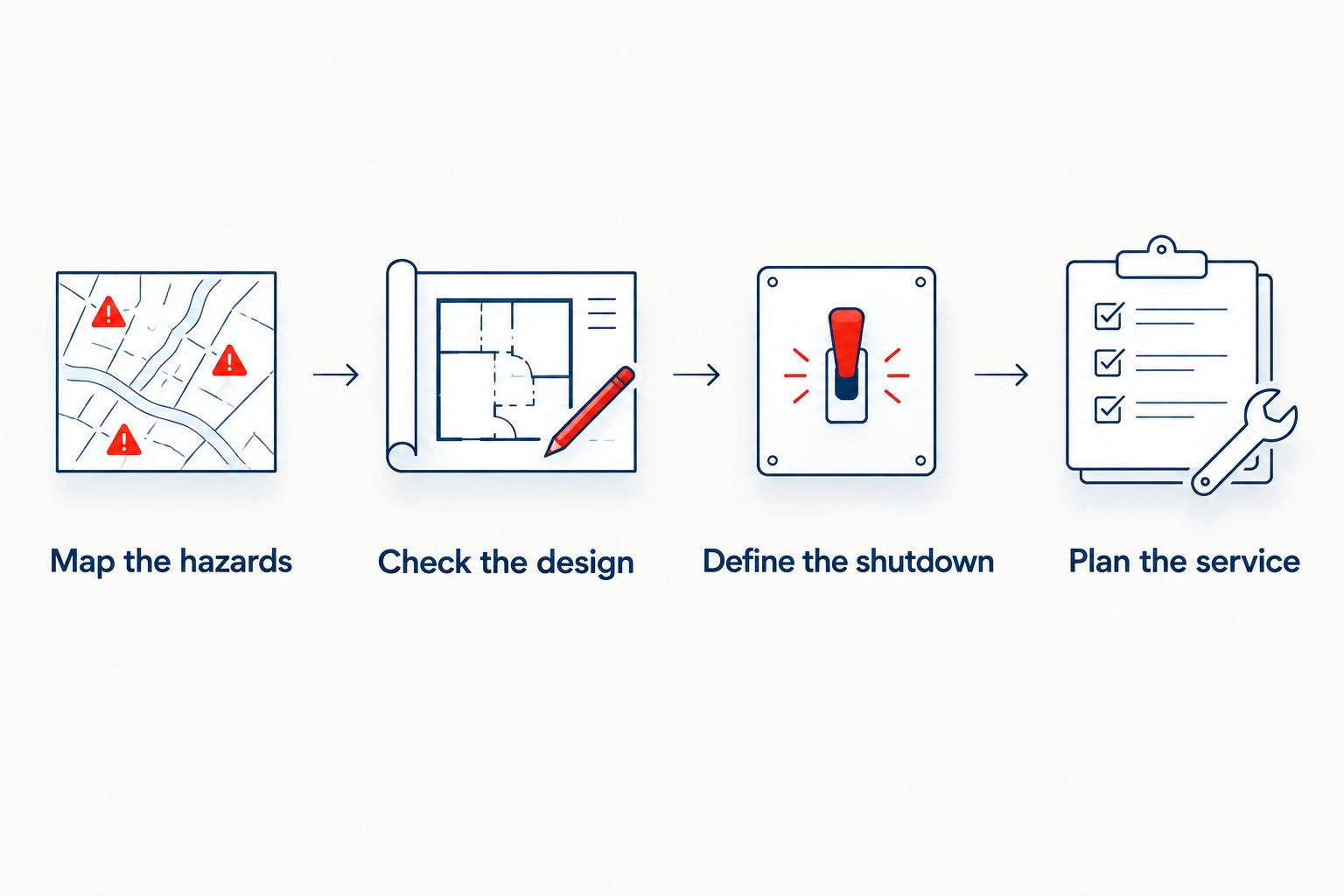
Before requesting a proposal, assemble the information that determines the design. Use this sequence with your facilities lead, production team, and fire-protection designer:
- Map the hazards: Mark paper storage, finished cartons, solvent handling, electrical rooms, and enclosed equipment. Identify any dust-producing processes for separate assessment.
- Check the design: Gather existing drawings, water-supply information, system records, and storage limits. Compare those documents with the actual floor layout.
- Define the shutdown: Identify the fuel feeds, ventilation, conveyors, and equipment functions that need coordinated control. Leave the final sequence to the qualified design team.
- Plan the service: Specify access, inspection responsibilities, impairment procedures, and recordkeeping before accepting the installation scope.
Keep staff duties separate from technician work. Employees need to recognize alarms, report blocked equipment, and follow the evacuation plan. They do not need to improvise a suppression-system adjustment.
For portable extinguishers, OSHA's workplace requirements include visual inspection every 1 month and a maintenance check every 12 months. Where employees are provided extinguishers for use, OSHA requires initial education and repeat education at least every 12 months. Those are extinguisher requirements, not a substitute for system-specific suppression inspections.
Use the fire safety training for warehouse staff guide to support the storage-side discussion. Tie training to your actual evacuation policy and employee responsibilities.
Which suppression system should you choose?
Choose properly designed sprinklers as the default starting point for paper and packaging areas. Then evaluate separate protection for solvent hazards, enclosed electronics, and machinery. Do not force one agent to cover incompatible applications.
For a 2026 project, ask Firstlinefire about its suppression-system services and the scope your site requires. Provide the storage layout, process information, existing protection records, and safety data sheets. Confirm who handles design, permitting, installation, and ongoing service before approving the work.
A useful proposal states what it protects, what it excludes, and what changes invalidate its assumptions. Reject an equipment-only quote that leaves those questions unanswered.
Discuss your facility's fire protection
Bring your storage layout, process hazards, and existing system records to the discussion.
FAQ
What's the best fire suppression system for a printing facility?
Properly designed automatic sprinklers are the default starting point for paper, cartons, and general building protection. Solvent handling, enclosed electronics, and machinery require separate hazard assessments and, where needed, additional protection.
Is clean-agent suppression better than sprinklers for printing equipment?
Clean-agent suppression is better suited to appropriate enclosed electronics spaces than to open paper-handling areas. Sprinklers provide water-based cooling for ordinary combustibles; clean agents do not replace the building's required protection.
Do solvent-based inks require foam suppression?
Solvent-based inks do not automatically require foam suppression. The liquid's properties, quantities, handling arrangements, applicable codes, and approved system design determine the protection approach.
Can water mist replace an existing sprinkler system?
Water mist is not a general drop-in replacement for sprinklers. A replacement requires an approved design whose tested application covers the actual hazard and satisfies the authority having jurisdiction.
Is carbon dioxide suppression safe around printing staff?
Carbon dioxide discharge can kill exposed workers. Its use requires specialist design and strict safeguards, especially where people enter equipment enclosures or gas can reach adjacent spaces.
How often should printing-facility fire extinguishers be inspected?
OSHA requires workplace portable extinguishers to receive visual inspection monthly and a maintenance check annually. Additional servicing and testing depend on extinguisher type and applicable requirements; fixed suppression systems have separate inspection rules.
Can Firstlinefire help with printing-facility fire protection?
Firstlinefire provides suppression systems, fire alarms, extinguisher services, and safety training for commercial and industrial customers across Kentucky, Illinois, Indiana, Tennessee, Missouri, and Alabama. Confirm the scope of services needed for your printing or packaging facility before selecting equipment.
One last thing
A storage change can matter as much as a machine change. Before moving racks, raising paper stacks, or changing packaging materials, check the fire-protection design. A system that matched the previous layout does not automatically match the new one.
Put that review into your change-approval process. Production should not discover a protection mismatch after the stock has already moved.


