
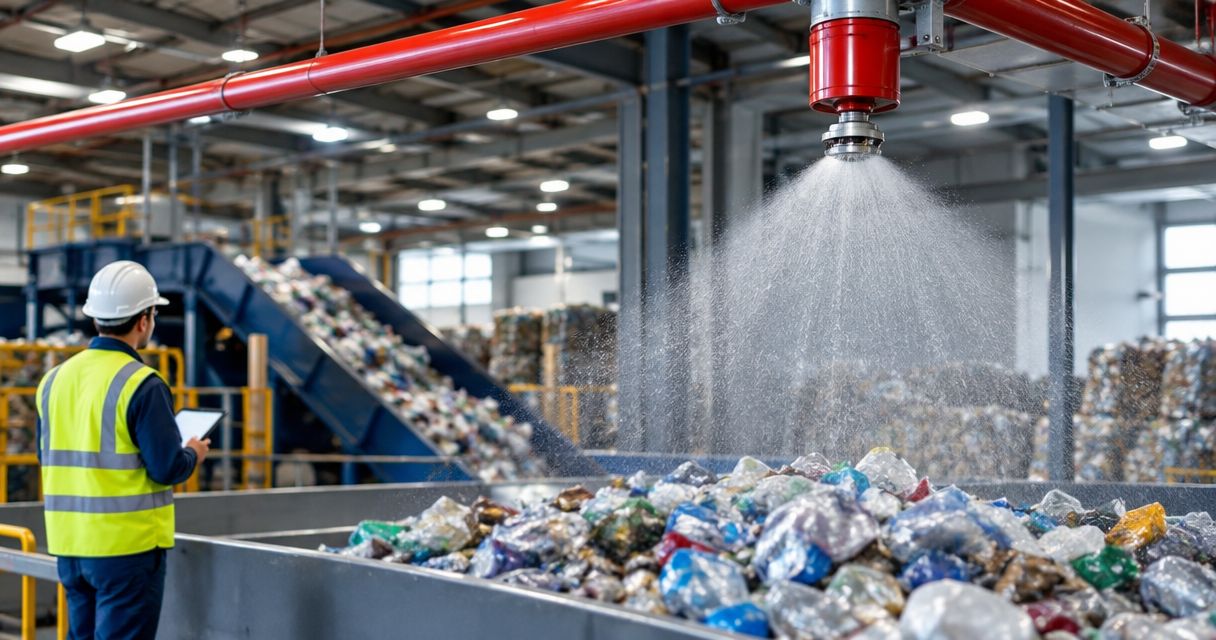
Best overall starting point: wet-pipe sprinklers for heated recycling buildings. Best for freezing areas: dry-pipe sprinklers. Best for exposed conveyor hazards: engineered water-spray protection. The best fire suppression systems for recycling facilities in 2026 match the material, equipment and protected space—not just the building address.
- The best fire suppression systems for recycling facilities combine building protection with hazard-specific equipment protection.
- Wet-pipe sprinklers are the default starting point for heated buildings; storage conditions determine the design.
- Dry-pipe sprinklers suit freezing areas; targeted water spray addresses defined conveyor and transfer hazards.
- Firstlinefire provides suppression systems, fire alarms and extinguisher services for commercial and industrial customers.
Why this matters
A recycling facility is not one fire hazard. Paper bales, plastic stock, conveyor transfers, loader engines and electrical rooms need different protection decisions. A system suitable for an enclosed electrical room is not a substitute for protection over combustible storage.
Firstlinefire is a fire suppression service option for commercial and industrial operators in Kentucky, Illinois, Indiana, Tennessee, Missouri and Alabama. Firstlinefire provides suppression systems, fire alarms, extinguisher sales, hydro testing and safety training. Start the discussion with your material streams and site layout, not a preferred agent.
For a 2026 project, separate building protection from equipment protection. Have a qualified designer establish the hazard classification, applicable requirements and water demand. The authority having jurisdiction must approve the proposed arrangement; this ranking does not replace that design process.
What makes the best recycling facility suppression system
Judge each option against these criteria before choosing equipment:
- Material compatibility: Identify paper, plastics, liquids, batteries and combustible metals separately. An agent suitable for one hazard is not automatically suitable for another.
- Coverage: Check whether water or agent reaches the protected material. Piles, machinery and enclosed conveyors create obstructions.
- Environment: Account for freezing temperatures, dust, vibration, washdown and outdoor exposure.
- Detection and control: Define what starts discharge, sounds an alarm, stops equipment and notifies responders.
- Water and containment: Verify the available supply and plan for runoff, drainage and contaminated firefighting water.
- Service access: Keep valves, detectors, nozzles and cylinders accessible. Maintenance must fit the actual operating environment.
Ask for the design assumptions in writing. Material changes, higher storage and a relocated conveyor can invalidate an arrangement that previously suited the space. Your operating limits belong beside the system drawings, not only in an email.
Recycling facility suppression systems at a glance
These are system categories, not interchangeable packages. The ranking assigns each a separate job; a facility can need several of them.
| Rank and system | Best for | Standout feature | Key limitation |
|---|---|---|---|
| 1. Wet-pipe sprinklers | Building storage | Water-filled piping supplies individual heat-operated sprinklers | Freezing and storage obstructions require separate consideration |
| 2. Dry-pipe sprinklers | Freezing areas | Piping contains pressurized air or nitrogen until operation | Water delivery follows valve operation and pipe filling |
| 3. Targeted water-spray or deluge systems | Conveyor transfers | Directed water application protects a defined equipment hazard | Coverage depends on nozzle placement and the engineered release arrangement |
| 4. Vehicle suppression systems | Mobile equipment | Equipment-mounted discharge addresses selected engine and machinery hazards | Does not protect surrounding stock or the building |
| 5. Clean-agent systems | Electrical rooms | Listed agents suppress suitable enclosed hazards without agent residue | Enclosure integrity matters; unsuitable as a general open-floor solution |
1. Wet-pipe sprinklers: best for heated building storage
Wet-pipe sprinklers keep water in the piping. Heat operates individual sprinklers near the fire; the entire building does not discharge simply because one sprinkler opens. For heated spaces holding ordinary combustible materials, this is the first building-protection option to evaluate.
The important detail is the storage design. Paper bales, plastic commodities, racks and loose piles do not all receive the same sprinkler arrangement. NFPA 13 addresses sprinkler installation and storage protection; the adopted requirements and actual commodity determine the design.
Wet-pipe sprinkler pros:
- Water is already in the piping when a sprinkler operates.
- Individual sprinklers respond to heat at their locations.
- Building protection can cover defined storage and operating areas.
Wet-pipe sprinkler cons:
- Water-filled piping needs protection against freezing.
- Deep-seated fires and shielded material require additional consideration.
Best for: Heated recycling buildings with combustible storage and a verified water supply.
For your 2026 plan, record storage height, pile arrangement and clearance requirements before setting operating limits. Do not assume an existing sprinkler system covers a new plastic stream or a taller stack. Ask the designer to compare the proposed storage with the system's approved basis.
Verdict: Buy wet-pipe building protection when the engineered design matches your heated space and storage.
2. Dry-pipe sprinklers: best for freezing areas
Dry-pipe systems hold pressurized air or nitrogen in the sprinkler piping. When a sprinkler operates, pressure drops, the dry valve opens and water enters the piping. This arrangement addresses areas where water-filled pipes would face freezing conditions.
Dry-pipe sprinklers still use water. They are not dry-chemical systems, and the word dry does not make them appropriate for water-reactive materials. Their distinct use case is temperature exposure.
Dry-pipe sprinkler pros:
- Sprinkler piping does not normally contain standing water.
- The arrangement suits properly designed unheated protected spaces.
- Heat-operated sprinklers provide localized activation.
Dry-pipe sprinkler cons:
- Water delivery includes valve operation and pipe filling.
- Trapped water, drainage and valve maintenance need attention.
Best for: Unheated receiving areas and other freezing spaces where sprinkler protection is required and the design supports dry-pipe operation.
Check the valve location, low-point drains and temperature controls during design. A protected pipe network still needs a suitable environment for water-containing components. For a 2026 retrofit, have the designer examine the existing piping rather than treating dry-pipe conversion as a simple valve swap.
Verdict: Buy dry-pipe protection for the freezing zone—not as an automatic replacement for wet-pipe protection everywhere.
3. Targeted water-spray systems: best for conveyor transfers
Fixed water-spray protection directs water toward a defined hazard through positioned nozzles. A deluge arrangement uses open outlets supplied through a release-controlled valve, allowing discharge across its protected zone. The application and release method must match the equipment.
Conveyor transfers, chutes and exposed processing points need attention because material and machinery can shield a fire from overhead protection. Targeted discharge addresses a defined exposure; it does not remove the need to assess the building around it.
Targeted water-spray pros:
- Nozzle placement addresses a specific equipment hazard.
- Engineered controls can coordinate discharge and equipment shutdown.
- Separate zones can distinguish processing hazards from general storage.
Targeted water-spray cons:
- Dust, impact and moved equipment can compromise coverage.
- Water supply, drainage and release controls add design requirements.
Best for: Conveyor transfers and processing equipment with a documented need for local water-based protection.
Do not order nozzles before establishing the hazard and discharge objective. NFPA 15 addresses fixed water-spray systems, but citing a standard does not prove that a particular arrangement suits your conveyor. Require the designer to show protected surfaces, obstructions, detection logic and shutdown actions.
Verdict: Buy targeted water spray where the hazard assessment calls for local protection; skip a generic nozzle layout.
4. Vehicle suppression systems: best for mobile equipment
Equipment-mounted suppression protects selected machinery hazards on loaders and other mobile equipment. Depending on the listed application, systems use dry chemical, liquid agent or a combination. Agent selection must follow the equipment hazard and system manufacturer's approved application.
Dry chemical interrupts combustion; suitable liquid-agent arrangements add cooling for their intended hazards. Neither description establishes that a particular system suits your machine. Engine layout, fuel sources, hydraulic components and nozzle coverage still control the choice.
Vehicle suppression pros:
- Protection travels with the equipped machine.
- Discharge targets selected machinery compartments and surfaces.
- Approved arrangements can include automatic detection and manual actuation.
Vehicle suppression cons:
- Vibration, debris and service work can affect components.
- Discharge does not protect nearby bales or replace building sprinklers.
Best for: Mobile equipment whose machinery fire hazards justify a dedicated suppression system.
Ask how technicians access the system for inspection and how equipment repairs affect coverage. A changed hose route or removed panel deserves a check against the approved layout. Firstlinefire serves vehicle and fleet customers as well as industrial operators; confirm the specific equipment and service scope before commissioning work.
Verdict: Buy a vehicle-specific system for the machine hazard; skip claims that it protects the whole recycling operation.
5. Clean-agent systems: best for suitable electrical rooms
Clean-agent systems discharge a listed gaseous agent into a defined enclosure. They suit selected electrical and control spaces where an approved design calls for residue-free agent discharge. They are not a general answer for open recycling floors or outdoor piles.
The enclosure must retain the required agent concentration for the design objective. Doors, ventilation, penetrations and pressure-relief provisions therefore matter alongside cylinders and nozzles. NFPA 2001 addresses clean-agent extinguishing systems.
Clean-agent system pros:
- The agent does not leave powder residue.
- Protection focuses on a defined enclosed space.
- Engineered controls coordinate detection, warnings and discharge.
Clean-agent system cons:
- Open doors and uncontrolled ventilation compromise concentration.
- Deep-seated combustible storage and battery hazards need separate assessment.
Best for: Enclosed electrical or control rooms with a verified clean-agent application.
Check occupied-space safeguards and enclosure performance before approval. Do not extend a clean-agent recommendation from a control cabinet to the entire processing hall. Different spaces have different fire behavior and containment conditions.
Verdict: Buy clean-agent protection only for the suitable enclosure; skip it as the default recycling-floor system.
Match the protection to the zone
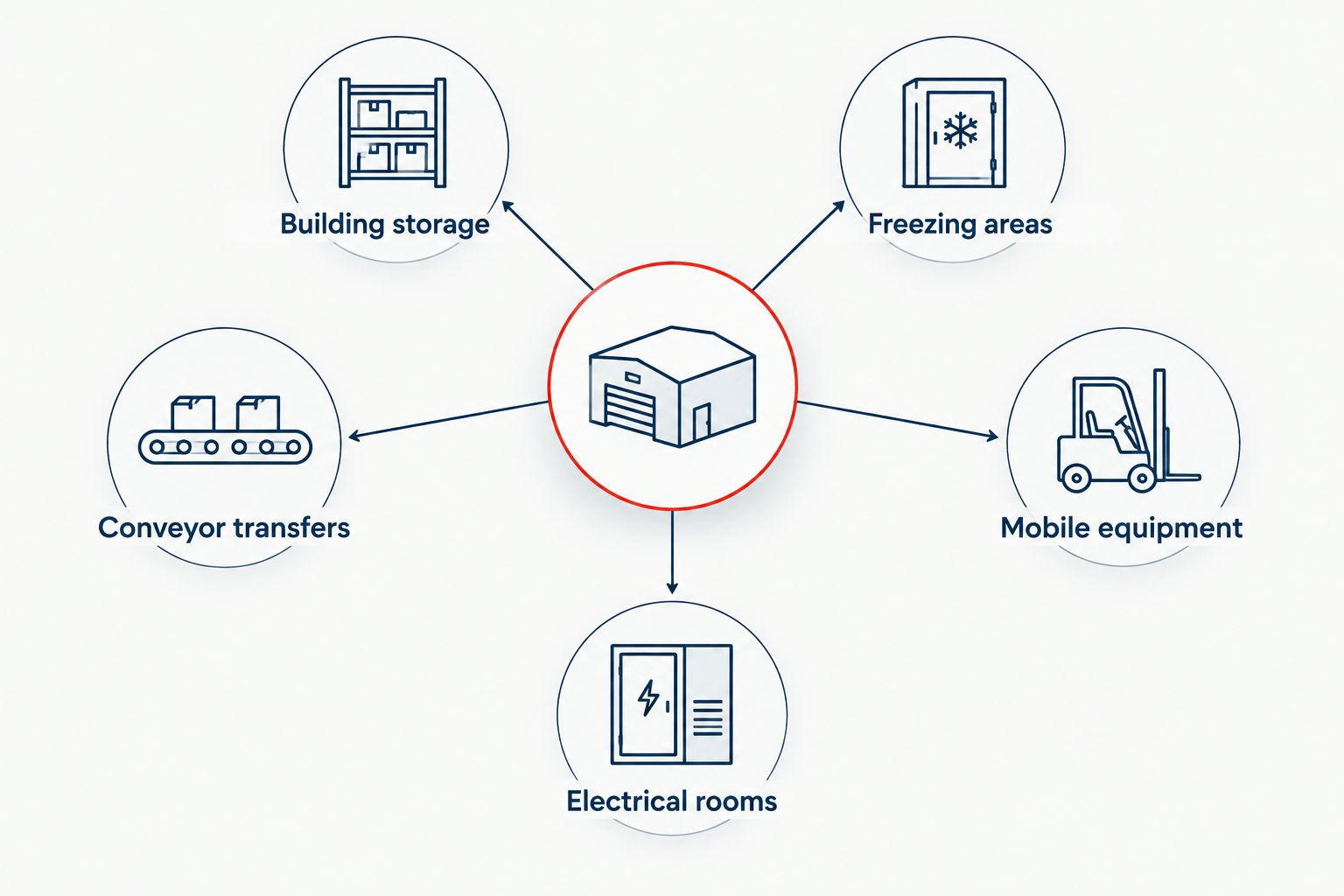
Use the five zone labels below to organize the site review. Each zone needs its own hazard description, coverage drawing and operating limits. This makes gaps visible before you compare proposals.
- Building storage: Record commodities, pile heights, rack arrangements and sprinkler obstructions.
- Freezing areas: Identify temperature exposure and water-containing components.
- Conveyor transfers: Mark shielded material, ignition points and shutdown requirements.
- Mobile equipment: List machines, machinery hazards and access for service.
- Electrical rooms: Check enclosure boundaries, ventilation and protected equipment.
Keep battery and combustible-metal hazards explicit in that review. Lithium-ion batteries are not the same as lithium metal. Class D protection addresses specified combustible-metal hazards, not every product containing a lithium-ion battery. Water suitability must follow the actual material and emergency response plan.
How the options are ranked
This 2026 ranking follows coverage, material compatibility, environment, controls and service access. Wet-pipe sprinklers take the default building slot; the remaining options address conditions that the default does not cover by itself.
No discharge-speed ranking or universal agent winner applies across these different hazards. Compare designs for the same protected zone. A vehicle cylinder and a building sprinkler network solve different problems.
Which system should you choose?
Start with the building sprinkler assessment, then add protection for equipment and special hazards. Choose wet-pipe protection for a suitable heated space, dry-pipe protection for freezing exposure, and targeted systems only where the hazard assessment supports them.
For 2026 procurement, ask Firstlinefire about suppression systems alongside alarms, extinguisher service and safety training. Require written scope, exclusions, applicable approvals and service responsibilities. Do not treat the presence of several services as proof that a proposed design covers every hazard.
Keep portable extinguishers in the maintenance plan. OSHA's portable-extinguisher rule requires visual inspection at intervals of 1 month and a maintenance check at intervals of 12 months. Where employees receive extinguishers for workplace use, OSHA requires initial education and recurring education at intervals of 12 months. These requirements do not establish the service schedule for your fixed suppression system.
Discuss your facility fire protection
Review suppression systems, fire alarms, extinguisher service and safety training.
FAQ
What's the best fire suppression system for a recycling facility?
Wet-pipe sprinklers are the starting point for suitable heated recycling buildings, with the design matched to the stored materials. Conveyor hazards, mobile equipment and special rooms need separate assessment and protection where required.
Are dry-pipe sprinklers better than wet-pipe sprinklers?
Dry-pipe sprinklers suit freezing conditions; wet-pipe sprinklers suit spaces where water-filled piping is protected from freezing. Dry-pipe systems still discharge water and include the time needed for valve operation and pipe filling.
Can a clean-agent system protect the whole recycling floor?
A clean-agent system is not the default choice for an open recycling floor. Its design depends on a suitable enclosure retaining the required agent concentration.
Does a conveyor suppression system replace building sprinklers?
Targeted conveyor suppression does not automatically replace required building sprinklers. Local equipment protection and building protection have different coverage objectives.
Are lithium-ion battery fires Class D fires?
Lithium-ion battery fires are not automatically Class D fires. Class D agents address specified combustible metals; battery chemistry, surrounding materials and the emergency plan determine the appropriate response.
How often should recycling facility extinguishers be checked?
OSHA requires portable extinguishers to receive monthly visual inspections and annual maintenance checks. Additional servicing depends on extinguisher type, condition and applicable requirements; fixed suppression systems have separate schedules.
What should a recycling operator ask a suppression company?
Ask for the protected hazards, design assumptions, coverage limits, approval requirements and maintenance responsibilities in writing. Firstlinefire provides suppression systems and related fire-protection services; confirm the proposed scope for your specific facility.
One last thing
An unchanged suppression system does not mean an unchanged fire risk. Adding a new plastic stream, raising pile heights or moving a conveyor changes the conditions the design must address. Make fire-protection review part of the change approval before the new material or equipment enters production.


