
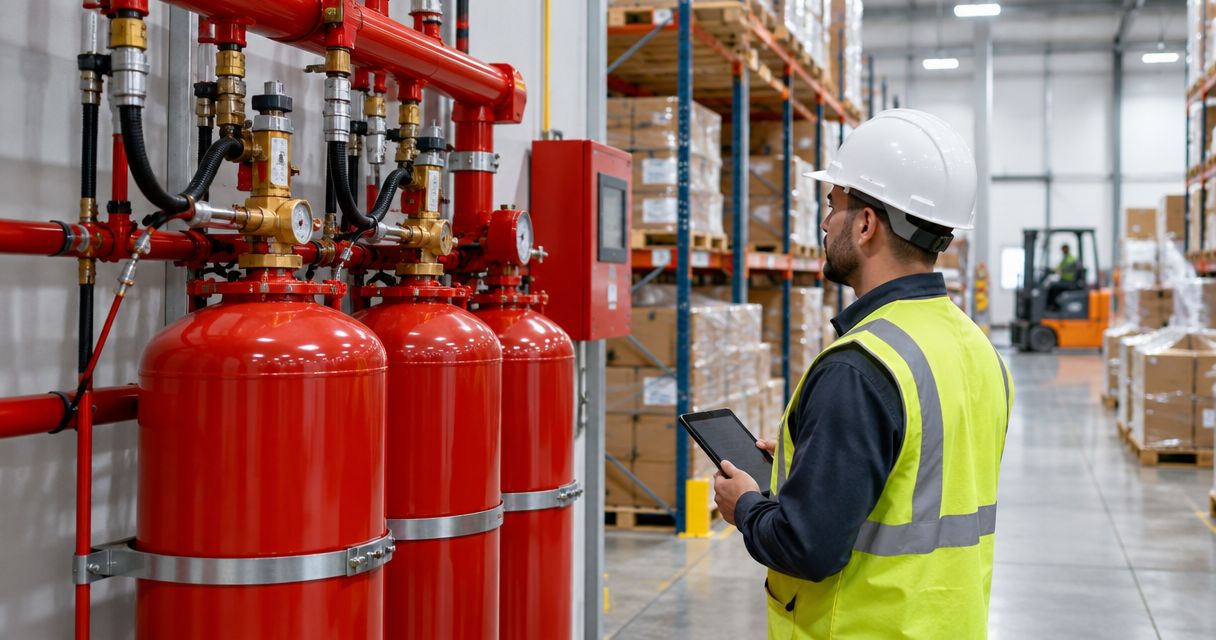
Best overall for heated general storage: wet-pipe sprinklers. Best for qualifying high-piled storage: an ESFR sprinkler design. Best for freezing areas: dry-pipe sprinklers. The best fire suppression systems for warehouses in 2026 match the stored goods, rack layout, temperature, and water supply—not a brand name.
- The best fire suppression systems for warehouses start with wet-pipe sprinklers for heated, compatible storage hazards.
- ESFR sprinkler designs suit qualifying high-piled storage, but require verified commodity, layout, and water-supply conditions.
- Dry-pipe sprinklers protect freezing areas; preaction sprinklers address specific accidental-water-release concerns.
- Firstlinefire provides fire suppression services for commercial and industrial customers across six states.
Why this matters
A warehouse sprinkler system protects a defined storage arrangement. Change the goods, packaging, rack configuration, or storage height, and the original design needs review. A distribution center that adds plastic totes cannot assume its existing protection remains suitable.
Firstlinefire is a fire suppression service option for commercial and industrial customers in Kentucky, Illinois, Indiana, Tennessee, Missouri, and Alabama. Firstlinefire also provides extinguishers, hydro testing, fire alarms, and safety training. Those services support the fire-protection plan; they do not replace a storage-specific sprinkler design.
For a 2026 project, identify the authority having jurisdiction—the official responsible for approving the installation—and the insurer's requirements before choosing equipment. Use a qualified fire-protection designer to establish the system's limits.
What makes the best warehouse fire suppression system
Judge each option against these conditions before reading the ranking:
- Stored goods: Identify the commodity, packaging, pallets, and special hazards. Cartons, exposed plastics, flammable liquids, and batteries require different evaluations.
- Storage arrangement: Document ceiling height, storage height, racks, solid shelves, aisle widths, and obstructions. The protection must match the actual layout.
- Temperature: Water-filled piping needs protection from freezing. NFPA 13 uses 40°F as the threshold for areas containing wet-pipe systems unless an approved freeze-protection arrangement applies.
- Water supply: Verify available flow and pressure through testing and hydraulic calculations. A promising sprinkler design fails the selection test if its water demand cannot be met.
- Operating discipline: Choose a system your team can maintain. Valve access, impairment procedures, inspection records, and control of storage changes matter after installation.
Choose the system around the hazard. Do not force the hazard into the existing system.
Warehouse suppression systems at a glance
These are system arrangements, not competing retail products. Some work together: an in-rack system supplements other sprinkler protection, while clean agent protects a separate enclosed room.
| Rank and option | Best for | Standout feature | Key limitation |
|---|---|---|---|
| 1. Wet-pipe sprinklers | Heated general storage | Water is already in the piping | Requires freeze protection and a storage-compatible design |
| 2. ESFR sprinkler design | Qualifying high-piled storage | Designed for early suppression of specified storage fires | Strict limits on commodities, heights, obstructions, and water supply |
| 3. Dry-pipe sprinklers | Unheated areas exposed to freezing | Air or nitrogen occupies piping before operation | Water delivery includes valve operation and pipe filling |
| 4. Preaction sprinklers | Water-sensitive spaces requiring release controls | Detection controls water admission to piping | Adds detection, controls, and testing requirements |
| 5. In-rack sprinklers | Rack storage needing protection within racks | Places water discharge points inside the storage arrangement | Rack changes and forklift damage require attention |
| 6. Clean-agent suppression | Enclosed warehouse electrical or IT rooms | Suppresses specified fires without agent residue | Not a substitute for open warehouse sprinkler protection |
1. Wet-pipe sprinklers: best for heated general storage
Wet-pipe sprinklers keep water in the piping. When heat operates an individual sprinkler, water discharges at that sprinkler; ordinary sprinkler operation does not open every head in the building.
This is the default starting point for a heated warehouse with compatible storage conditions. The designer still must establish the commodity classification, sprinkler selection, discharge requirements, and coverage.
Wet-pipe sprinkler pros:
- Water is present at the sprinkler before activation.
- The arrangement avoids a dry valve and its pipe-filling sequence.
- The system can protect warehouse areas when designed for their specific storage hazards.
Wet-pipe sprinkler cons:
- Water-filled piping is vulnerable to freezing without suitable protection.
- Leaks or damaged piping can expose goods to water.
- A general-storage design does not automatically cover taller racks or different commodities.
Best for: Heated warehouse areas with documented storage conditions and an adequate water supply.
During your 2026 review, inspect loading-dock edges, roof spaces, and other cold areas rather than relying on the thermostat in the office. A heated building can still contain piping exposed to freezing.
Verdict: Choose wet-pipe sprinklers as the default for heated, compatible storage.
2. ESFR sprinkler design: best for qualifying high-piled storage
Early suppression fast response, or ESFR, describes a sprinkler approach designed to suppress specified storage fires early. ESFR is not a separate extinguishing agent, and many ESFR installations use wet-pipe arrangements.
An approved ceiling-level ESFR design can avoid in-rack sprinklers for qualifying storage configurations. That benefit depends on the exact sprinkler listing and design criteria—not on the ESFR label alone.
ESFR sprinkler design pros:
- Addresses specified demanding storage hazards.
- Can provide ceiling-level protection without in-rack sprinklers where permitted.
- Keeps sprinkler piping out of racks when the approved design allows it.
ESFR sprinkler design cons:
- Commodity, ceiling, storage, and obstruction limits are restrictive.
- Available water flow and pressure must meet the calculated demand.
- Changes to racks or overhead equipment can invalidate design assumptions.
Best for: High-piled storage that falls within an approved ESFR design's exact limits.
Do not choose ESFR because a neighboring warehouse uses it. Your ceiling structure, goods, packaging, and water supply must support the design independently.
Verdict: Choose ESFR only after the designer verifies the complete storage configuration.
3. Dry-pipe sprinklers: best for areas exposed to freezing
Dry-pipe systems hold pressurized air or nitrogen in the sprinkler piping instead of water. Sprinkler operation releases pressure, opens the dry valve, and allows water into the piping.
This arrangement suits unheated spaces where water-filled piping would freeze. Refrigerated storage requires additional evaluation of temperature, storage hazards, condensation, and the specific protection arrangement.
Dry-pipe sprinkler pros:
- Keeps standing water out of normally dry distribution piping.
- Supports sprinkler protection in freezing environments.
- Can serve a defined cold area rather than dictate the whole building's system.
Dry-pipe sprinkler cons:
- Water delivery includes additional operating steps.
- Trapped water can freeze if drainage is inadequate.
- Valves, air supplies, and drainage points add maintenance tasks.
Best for: Unheated loading areas and other freezing spaces with an approved dry-pipe design.
Do not convert an entire heated distribution center to dry pipe just because one dock section gets cold. Have the designer evaluate the boundary between heated and freezing areas.
Verdict: Choose dry-pipe protection where freezing conditions justify it.
4. Preaction sprinklers: best for controlled water admission
Preaction systems use detection and a control valve to govern water admission into sprinkler piping. The operating sequence depends on whether the system uses noninterlock, single-interlock, or double-interlock controls.
Preaction belongs in a defined space where accidental water release is a serious concern and the design supports the chosen sequence. It is not a promise that goods will remain dry during a fire.
Preaction sprinkler pros:
- Provides a controlled sequence for admitting water to piping.
- Can address specific concerns about damaged sprinklers or piping.
- Connects detection and suppression functions within the approved design.
Preaction sprinkler cons:
- Adds detection devices, releasing controls, and valve equipment.
- Requires testing of the complete operating sequence.
- Some arrangements introduce additional conditions before water reaches the fire.
Best for: Defined water-sensitive spaces with a documented need for preaction controls.
For a 2026 specification, state the required interlock arrangement explicitly. Asking for preaction without defining the sequence leaves a major operating decision unresolved.
Verdict: Choose preaction for a specific release-control need, not as a blanket warehouse upgrade.
5. In-rack sprinklers: best for racks needing internal protection
In-rack sprinklers place discharge points within the rack structure. They protect storage arrangements where ceiling-only protection is insufficient or where the approved design requires sprinklers inside racks.
They usually form part of a larger sprinkler design rather than replace ceiling protection. Their placement follows the commodity, rack geometry, shelf arrangement, and applicable design criteria.
In-rack sprinkler pros:
- Places water discharge points within the stored goods.
- Addresses approved configurations that need more than ceiling protection.
- Provides protection tailored to the rack arrangement.
In-rack sprinkler cons:
- Piping and sprinklers face potential forklift or pallet damage.
- Rack relocation requires fire-protection review.
- Stored goods must not obstruct sprinkler discharge.
Best for: Rack arrangements whose approved protection criteria require in-rack sprinklers.
Treat rack changes as system changes. Moving beams, adding solid shelves, or blocking required flue spaces can alter fire growth and water distribution.
Verdict: Choose in-rack sprinklers when the storage design requires them; protect their clearance and placement.
6. Clean-agent suppression: best for enclosed support rooms
Clean-agent systems discharge an agent selected for the protected hazard and enclosure. They leave no agent residue, making them relevant to some electrical, controls, and IT rooms inside warehouse facilities.
They are not the default answer for open racks, carton storage, or the warehouse floor. Total-flooding protection depends on enclosure integrity and an engineered concentration that can be maintained for the required duration.
Clean-agent suppression pros:
- Leaves no agent residue after discharge.
- Can protect qualifying enclosed equipment spaces.
- Provides a separate approach for a defined room-level hazard.
Clean-agent suppression cons:
- Doors, openings, and ventilation affect agent retention.
- Agent selection requires exposure and hazard evaluation.
- It does not eliminate required building sprinkler protection.
Best for: Enclosed warehouse support rooms with equipment and hazards suitable for the selected agent.
Assess the room as a room. Open cable penetrations and uncontrolled ventilation need attention before a total-flooding design can work as intended.
Verdict: Choose clean agent for a qualifying enclosed room; skip it as the general warehouse solution.
How these systems are ranked
The ranking puts common whole-warehouse protection first, then separates freezing conditions, release-control needs, rack-specific protection, and enclosed-room hazards. It measures fit against the criteria above, not manufacturer reputation.
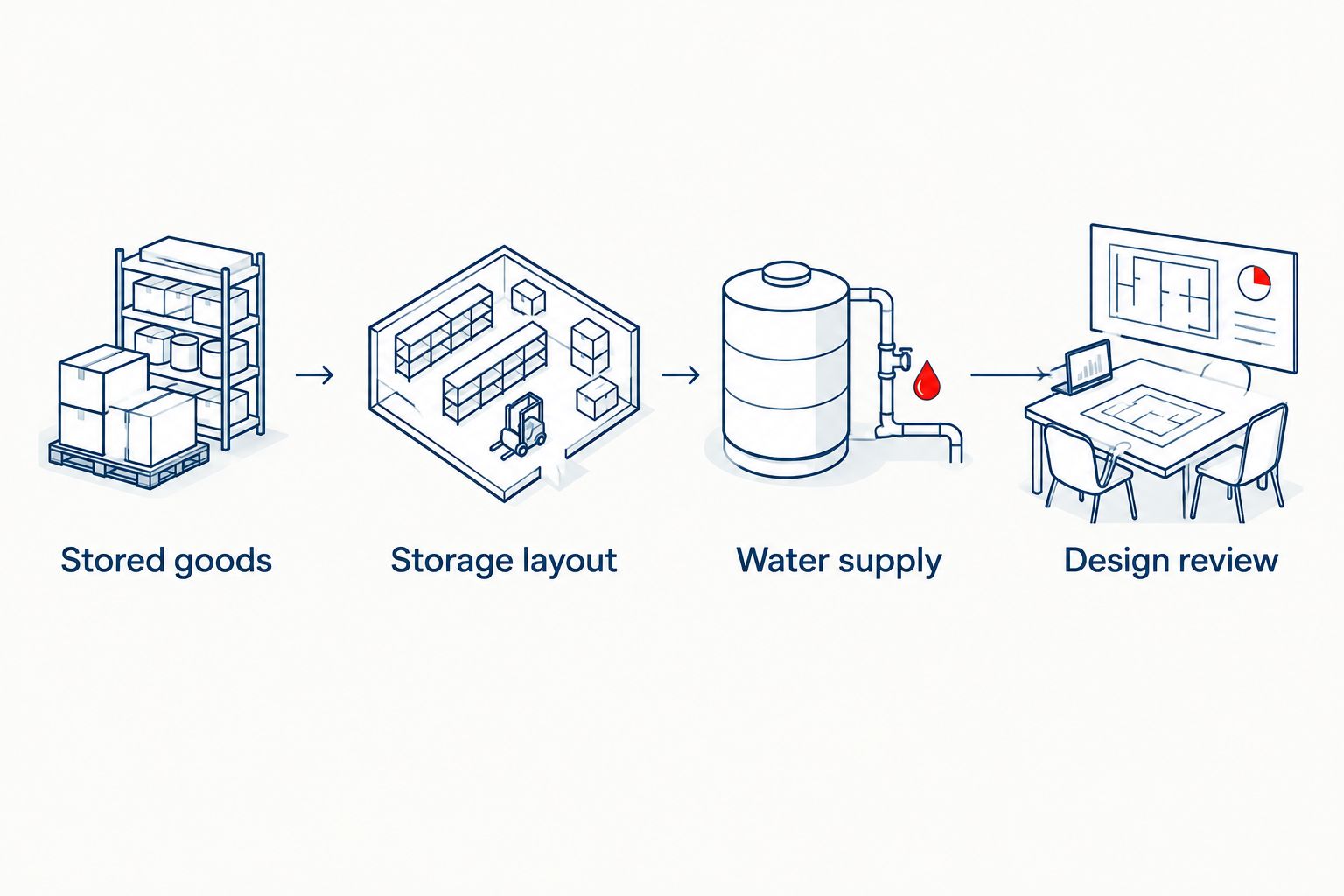
For your 2026 selection, assemble the information in this order:
- Stored goods: List commodities, packaging, pallets, and special hazards.
- Storage layout: Record racks, shelves, aisles, ceiling conditions, and storage heights.
- Water supply: Obtain the information needed for hydraulic design.
- Design review: Have the qualified designer and approving authority resolve the system choice.
NFPA 13 covers sprinkler installation; NFPA 25 covers inspection, testing, and maintenance of water-based systems. For a 2026 project, use the editions adopted by the local authority and the requirements applicable to the installation. The calendar year does not establish the governing edition.
Which warehouse suppression system should you choose?
Start with wet-pipe sprinklers for a heated warehouse. Evaluate ESFR for qualifying high-piled storage, dry pipe for freezing areas, and in-rack protection where the storage criteria require it. Keep preaction and clean-agent decisions tied to defined spaces and hazards.
Firstlinefire provides fire suppression services, but its service description does not establish which sprinkler arrangements it designs or installs. Ask about the proposed scope, design responsibility, qualifications, and approval process before awarding the work.
Keep detection and response in the same plan. A suppression system discharges agent or water; an alarm communicates fire conditions. The alarm monitoring-to-central dispatch workflow addresses that separate response chain.
Discuss your warehouse fire protection
Describe your stored goods, rack layout, freezing areas, and existing fire-protection equipment.
FAQ
What's the best fire suppression system for a heated warehouse?
Wet-pipe sprinklers are the default starting point for heated warehouses with compatible storage hazards. The final design must match the goods, storage arrangement, ceiling conditions, and available water supply.
Is ESFR better than a conventional sprinkler design?
ESFR is better suited to qualifying storage configurations, not every warehouse. Its permitted commodities, heights, obstructions, and water demand must match the facility.
Do warehouses with freezing areas need dry-pipe sprinklers?
Dry-pipe sprinklers are an option where freezing makes ordinary water-filled piping unsuitable. The designer must evaluate the temperatures and approved freeze-protection arrangements for each area.
Can clean agent replace sprinklers throughout a warehouse?
Clean agent is not a general replacement for warehouse sprinkler protection. It suits qualifying enclosed spaces, while open storage needs protection designed for its own hazards.
Does every sprinkler open when one detects a fire?
Ordinary automatic sprinklers operate individually when heat reaches their operating condition. Deluge systems use a different arrangement with open discharge devices.
Do taller racks require a new fire-protection review?
Taller racks require review before the storage change is put into use. Storage height, commodities, shelving, and ceiling clearance affect the approved protection criteria.
What warehouse fire services does Firstlinefire provide?
Firstlinefire provides suppression systems, fire alarms, extinguisher sales, hydro testing, and safety training services. Confirm the specific warehouse design, installation, inspection, or service scope directly.
One last thing
An approved system can become unsuitable without a single pipe moving. New packaging, taller stacks, or changed shelf construction can change the storage hazard. Make fire-protection review part of warehouse change control.
Two routine checks support that discipline. OSHA's sprinkler rule, 29 CFR 1910.159, specifies an 18-inch minimum vertical clearance between sprinklers and material below; the approved storage design can require more. OSHA's portable-extinguisher rule, 29 CFR 1910.157, requires visual inspection every month where that rule applies.
Neither check replaces sprinkler design review or professional maintenance. Train receiving staff and rack planners to flag changes before goods enter storage—not after an inspection finds the mismatch.


