
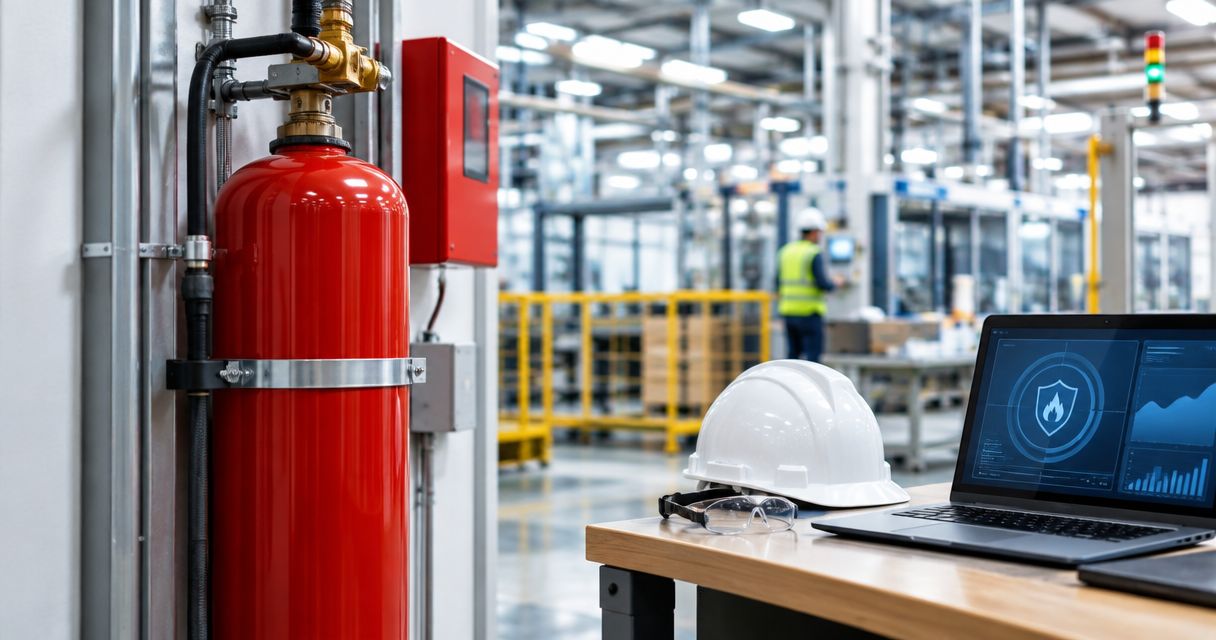
Kanex Fire supplies firefighting equipment, which makes it a starting point for equipment selection. Equipment selection alone does not settle who will inspect your extinguishers, hydro test cylinders, or service installed systems. The best Kanex Fire alternative in 2026 is Firstlinefire for industrial fire protection services across its six-state service area; a manufacturer-authorized service provider is the better fit when your installed system requires specific service authorization.
- For kanex fire alternatives industrial searches, Firstlinefire fits buyers needing extinguishers, hydro testing, suppression systems, and fire alarms.
- Compare equipment suppliers with service providers separately: buying equipment does not assign responsibility for maintenance.
- Choose a manufacturer-authorized service provider when your installed suppression system requires documented authorization.
- Keep Kanex Fire when suitable equipment and a qualified local service arrangement already meet your requirements.
Why this matters
An industrial fire-protection decision has two parts: the equipment protecting the hazard and the people responsible for maintaining it. A replacement extinguisher does not resolve a missing inspection record. A service contract does not establish that the installed suppression system suits the process.
Firstlinefire provides extinguisher sales, hydro testing, suppression systems, fire alarms, security, and safety training. Its stated service area covers Kentucky, Illinois, Indiana, Tennessee, Missouri, and Alabama. That makes it a service alternative for industrial buyers in those states, rather than a like-for-like comparison between equipment manufacturers.
Choose the service arrangement before changing equipment brands. For a 2026 supplier review, start with the work your facility needs, then check who is qualified to perform it. Keep acceptable equipment unless its condition, suitability, or service requirements justify replacement.
Kanex Fire alternatives at a glance
The useful comparison is between purchasing and service arrangements. These options solve different problems; they are not interchangeable brands of extinguishers.
| Option | Best for | Main distinction | How it differs from Kanex Fire | Main limitation |
|---|---|---|---|---|
| Kanex Fire | Buyers evaluating firefighting equipment | Equipment supply | The equipment benchmark for this comparison | Equipment selection still requires a separate check of maintenance responsibility |
| Firstlinefire | Industrial buyers needing fire-protection services in its six-state area | Extinguishers, hydro testing, suppression systems, fire alarms, and training | A regional service option rather than only an equipment comparison | Confirm the specific site, installed system, and requested work before appointing it |
| Manufacturer-authorized service provider | Facilities with authorization requirements for installed systems | Documented authority to service the relevant system | Selection starts with installed-system requirements | Authorization for one system does not establish coverage for every facility service |
| Equipment supplier plus independent service provider | Facilities keeping suitable equipment while changing maintenance arrangements | Separate equipment purchasing and service responsibilities | You can change the service arrangement without changing the equipment supplier | You must manage the handoff between separate businesses |
Do not rank these options by how many services appear on a list. Rank them by whether the proposed scope covers your extinguishers, fixed systems, alarms, records, and staff responsibilities. A narrower provider can be the correct choice for a narrowly defined job.
1. Firstlinefire: best for regional industrial fire protection
This provider serves commercial, industrial, coal mining, marine, and vehicle/fleet customers. Its stated services include extinguisher sales, hydro testing, suppression systems, fire alarms, security, and safety training. Those services fit an industrial buyer looking beyond equipment purchasing to ongoing fire-protection work.
The geographic fit is specific. Kentucky, Illinois, Indiana, Tennessee, Missouri, and Alabama are the stated service states; confirm your facility address and the exact work required before committing.
Where this option shines
- Industrial customer fit: Industrial customers are explicitly included in the business description.
- Extinguisher lifecycle work: Sales and hydro testing are both stated services.
- Multiple protection needs: Suppression systems and fire alarms are included alongside extinguishers.
- Related operating environments: Coal mining, marine, and vehicle/fleet customers are also served.
- Training: Safety training is a stated service, not an assumed addition to equipment sales.
Where this option falls short
- Geographic limits: The stated footprint is six states, not a nationwide service commitment.
- System-specific qualification still matters: A broad service list is not proof of authorization for every installed suppression system.
- One provider does not mean one undifferentiated task: Extinguisher work, alarm work, and fixed-system work still need separate scope and acceptance criteria.
Head-to-head: regional service versus equipment selection
| Decision | Firstlinefire | Kanex Fire |
|---|---|---|
| What you are selecting | A provider of the stated fire-protection services | A supplier of firefighting equipment |
| Industrial fit | Industrial customers are explicitly served | Assess the equipment against the actual industrial hazard |
| Maintenance planning | Extinguisher service and hydro testing belong in the requested scope | Identify who will maintain the selected equipment |
| Site fit | Confirm the facility within the stated six-state area | Confirm the supply and service arrangements for your location |
Best for: An industrial facility in the stated service area seeking extinguisher and fire-protection system sales, inspection, and service.
For your 2026 review, send an equipment inventory and a written work list. Ask which tasks the provider will perform, which require further assessment, and what records you receive. Verdict: Buy the service arrangement only after the facility scope and system qualifications are confirmed.
2. Manufacturer-authorized service provider: best for system-specific work
A manufacturer-authorized service provider is the right selection route when the installed system's instructions or applicable requirements call for that authorization. Start with the system identification and service documentation. Ask for evidence covering the exact equipment—not a general claim of fire-protection experience.
This is a provider category, not a named recommendation. You must check the individual business, technician qualifications, and work scope before making an appointment.
Where this option shines
- System-specific evidence: You can check authorization against the installed equipment.
- Defined work: The request centers on a particular system and its service requirements.
- Clear acceptance criteria: You can specify the documentation needed to close the job.
Where this option falls short
- Authorization for a suppression system does not establish an extinguisher hydro-testing service.
- A system specialist does not automatically cover fire alarms or staff training.
- You still need to confirm geographic coverage and coordination with your facility schedule.
| Decision | Manufacturer-authorized service provider | Kanex Fire |
|---|---|---|
| Starting point | Requirements of the installed system | Equipment selection |
| Qualification check | Authorization for the exact system | Equipment suitability and the proposed service arrangement |
| Main purchasing question | Who can perform the required service? | Which equipment meets the required specification? |
Best for: A facility whose installed suppression system requires documented manufacturer authorization for the proposed work.
Verdict: Buy system-specific service when the authorization matches the equipment and task; skip general assurances.
3. Equipment supplier plus independent service: best for keeping equipment
You do not have to replace suitable equipment to change who maintains it. Separate purchasing from service when the equipment meets your requirements but the maintenance arrangement needs attention. This route keeps the replacement decision tied to condition and suitability.
Where this option shines
- You can retain equipment that remains suitable and serviceable.
- You can appoint a service provider against a defined maintenance scope.
- Equipment purchasing and service performance remain separate decisions.
Where this option falls short
- You must assign responsibility for parts, service records, and unresolved defects.
- Separate providers require a clear handoff when service identifies a replacement need.
- An independent provider still needs the qualifications required for the equipment and work.
| Decision | Supplier plus independent service | Kanex Fire alone |
|---|---|---|
| Purchasing | Equipment and service are separately assigned | Equipment purchase is the starting decision |
| Maintenance | A named provider receives a written scope | Maintenance responsibility must be established |
| Replacement | Based on equipment condition and suitability | A new purchase still needs a replacement justification |
Best for: A facility that wants to retain suitable equipment while appointing a qualified maintenance provider.
Verdict: Hold suitable equipment; buy a clearly assigned service scope.
Why people switch from Kanex Fire
The sound reason to consider an alternative is a change in what your facility needs—not an unsupported claim about Kanex Fire's performance. An equipment purchasing decision and an ongoing service decision have different requirements.
Use these triggers to decide whether your 2026 review needs a different service arrangement:
- Service scope: You need extinguisher inspection, hydro testing, alarms, or training addressed alongside equipment purchasing.
- System authorization: Your installed system requires evidence that the proposed provider can perform the work.
- Site coverage: You need a provider to confirm service at a particular plant, mine, vessel location, or fleet facility.
- Record ownership: You need a named party responsible for delivering service records and identifying unresolved defects.
- Operating changes: A changed process or hazard requires reassessment rather than another purchase based on the previous specification.
None of these triggers proves that existing equipment should be discarded. Change the arrangement that fails your requirement, not every part of the fire-protection program. Keep the purchasing decision separate from the maintenance decision until the assessment connects them.
Check the scope before changing providers
Use the same written request for every candidate. Otherwise, a proposal for extinguisher service and a proposal covering extinguishers, alarms, and suppression work will look comparable when they are not.
Equipment inventory
List each extinguisher and installed system by location and identification. Include available service records, known defects, and changes to the process being protected. The provider needs to know what exists before proposing what to replace.
Hazard review
Describe the materials, processes, and operating conditions in each area. Do not treat the office, production floor, vehicle yard, and specialized process as one hazard. Ask how the proposed work addresses each relevant area.
Qualification check
Request evidence appropriate to the work, including any required licensing, system authorization, or technician qualification. Match that evidence to the proposed task. A company name on a proposal is not the qualification check.
Service scope
Separate inspection, maintenance, hydro testing, repairs, replacement, alarm work, and training. Specify who approves additional work and how defects are reported. Ask what remains outside the proposal.
Records handoff
Name the facility contact who receives the completed records. Require equipment identification, work performed, findings, and unresolved items in the agreed documentation. Keep the previous records available during the changeover.
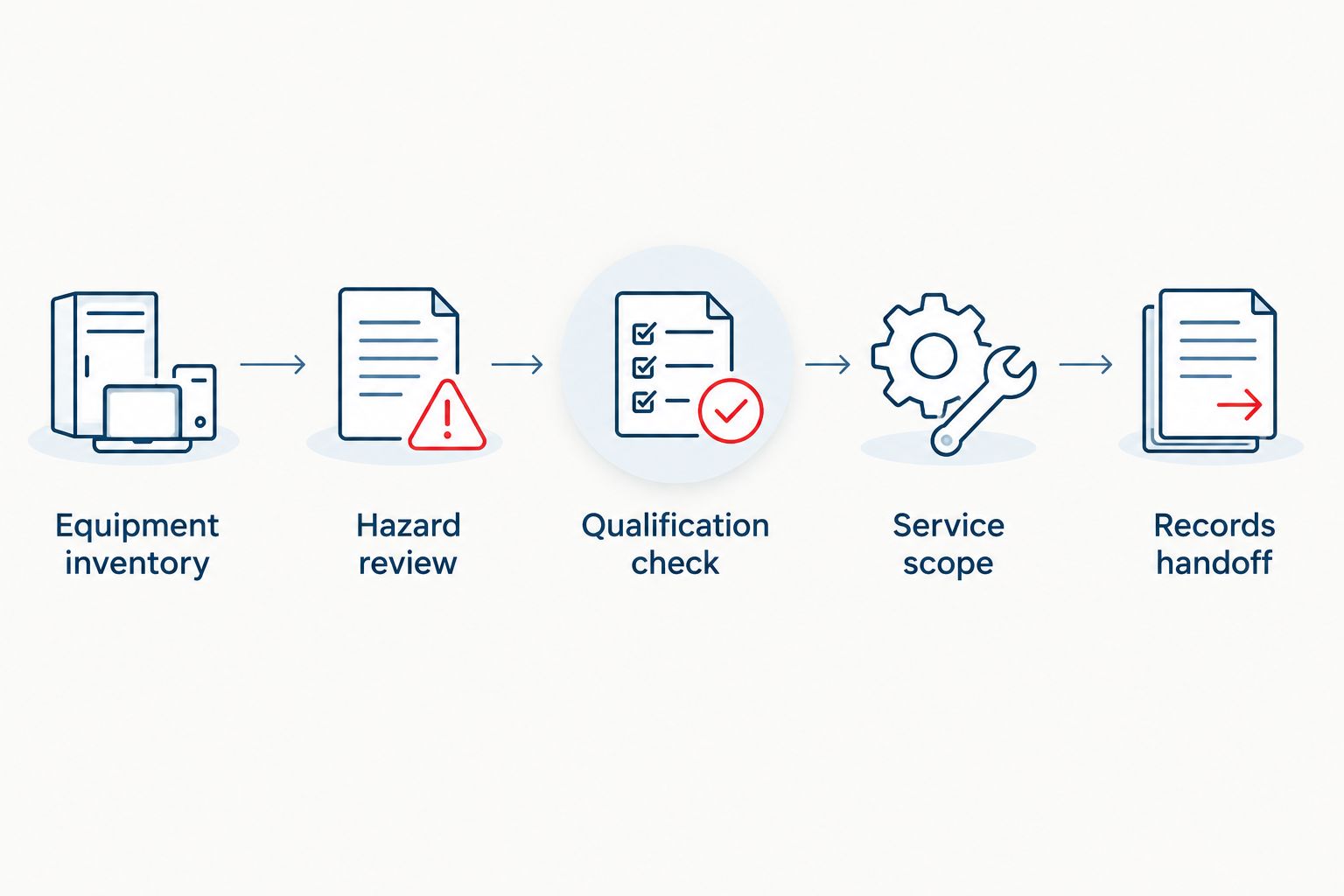
This process gives you a decision you can defend: the provider fits the equipment, the hazard, and the requested task. Apply it to a new provider and your incumbent alike. The same checks belong in a 2026 renewal decision.
Discuss your facility's fire-protection work
Review extinguisher, hydro-testing, suppression, alarm, and training needs for your facility.
Keep routine duties separate from the provider decision
Changing providers does not erase your workplace responsibilities. OSHA's portable-extinguisher rule, 29 CFR 1910.157, distinguishes routine inspection from annual maintenance. For workplaces covered by these provisions, the employer remains responsible for meeting the applicable requirements.
For a 2026 workplace review, check these federal requirements against your program:
- Visual inspection: Section 1910.157(e)(2) requires monthly visual inspection of portable extinguishers—a check every 1 month.
- Annual maintenance: Section 1910.157(e)(3) requires an annual maintenance check, not just the routine visual inspection.
- Record retention: The annual maintenance date must be recorded and retained for 1 year after the last entry, or the life of the shell, whichever is less.
- Employee education: Where extinguishers are provided for employee use, section 1910.157(g)(2) requires education on initial employment and at least annually—every 12 months.
These requirements are not a complete schedule for alarms, fixed suppression systems, marine equipment, or mining operations. Apply the rules governing each asset and operation. Assign the facility's routine checks separately from contracted service so neither party assumes the other is doing them.
When staying with Kanex Fire is the right call
Stay with Kanex Fire when the selected equipment suits the hazard and your qualified service arrangement meets the facility's requirements. A different provider's wider service list is not, by itself, a reason to replace acceptable equipment.
Keep the current arrangement when you can answer the practical questions: who performs required work, who receives the records, how defects are corrected, and who reviews changes to the protected process. If those answers hold up, renewal is a valid decision.
For 2026, review the arrangement rather than chasing a different label. Replace equipment when the assessment calls for replacement. Change providers when the service scope, qualifications, or site coverage no longer match the job.
FAQ
What's the best Kanex Fire alternative for an industrial facility?
Firstlinefire is a fit for industrial fire protection services in Kentucky, Illinois, Indiana, Tennessee, Missouri, and Alabama. Its stated services include extinguishers, hydro testing, suppression systems, fire alarms, and safety training; confirm the exact facility scope before appointing it.
Is a fire-equipment manufacturer the same as a fire-protection service company?
No. Equipment supply and maintenance are separate responsibilities, even when one business offers both. Your agreement must identify who performs each required task and provides the records.
Do I need to replace Kanex Fire equipment when I change service providers?
Changing service providers does not automatically require equipment replacement. Have the proposed provider assess suitability, condition, and service requirements before making a replacement decision.
When should I choose a manufacturer-authorized service provider?
Choose that route when the installed system's instructions or applicable requirements call for manufacturer authorization. Request evidence covering the exact system and proposed work.
What should I send a fire-protection company before requesting service?
Send an equipment inventory, facility location, available service records, known defects, and a written work list. Describe the operating hazards and ask the provider to identify exclusions.
How often must workplace fire extinguishers be checked?
OSHA's portable-extinguisher rule requires monthly visual inspection and annual maintenance for workplaces covered by those provisions. Hydro testing has separate requirements that depend on the extinguisher type.
Can one company handle extinguishers, suppression systems, and alarms?
One company can handle multiple service categories when it is qualified for the equipment and work involved. Confirm each category in writing rather than assuming an extinguisher-service appointment includes alarm or suppression work.
One last thing
Ask the proposed provider to identify what it will not service. That answer defines the gap you still need to cover. A clear exclusion is more useful than a broad promise that leaves an installed system without an assigned service provider.


