
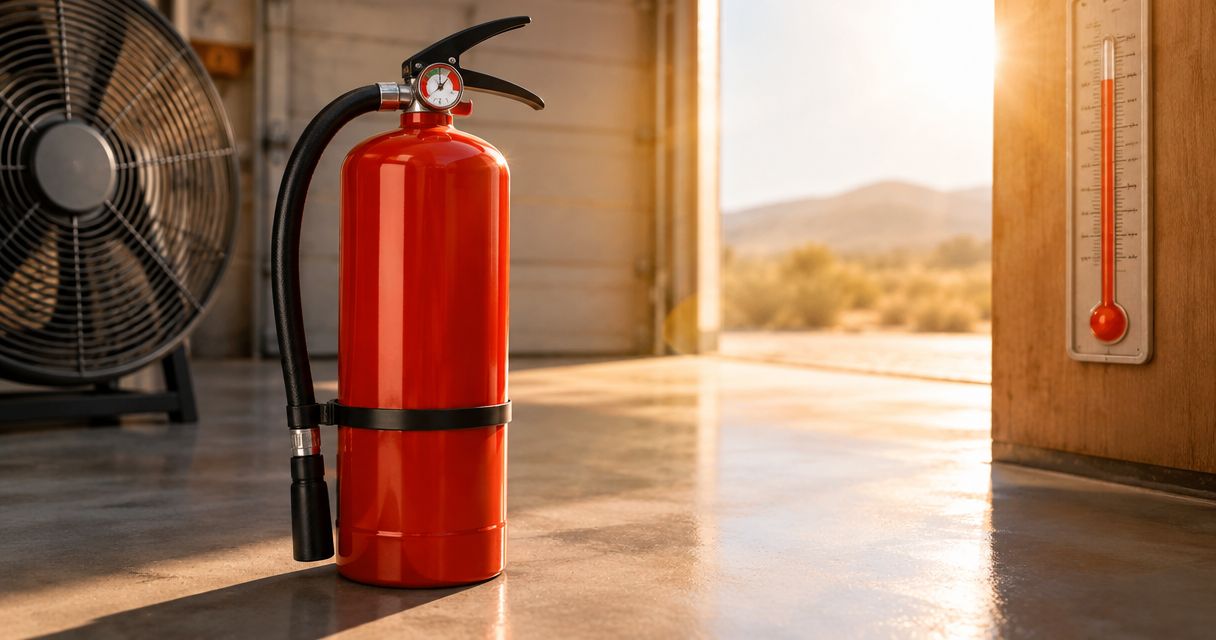
Yes. A fire extinguisher can rupture violently in extreme heat because heat raises internal pressure and can weaken the cylinder. Exceeding the temperature limit on its label does not mean it will immediately explode, but an extinguisher exposed to fire or excessive heat needs professional evaluation—not a test discharge or a return to its bracket.
- Can a fire extinguisher explode in extreme heat? Yes—pressure and cylinder damage can cause violent rupture.
- The extinguisher’s label sets its temperature limits; a green gauge does not prove a heat-exposed cylinder is safe.
- Keep people away from a hot, hissing, bulging, or fire-exposed extinguisher. Do not move or discharge it.
- Firstlinefire provides fire extinguisher service for commercial, industrial, marine, and fleet operators.
Why this matters
Your extinguisher must survive its storage location before it can help during a fire. A truck cab, equipment enclosure, or wall beside a furnace needs more thought than an empty bracket.
Choose the location around the extinguisher’s temperature rating, accessibility, and mounting instructions. Firstlinefire provides fire extinguisher sales, inspection, and service for businesses managing those requirements. For your 2026 safety review, check the installed equipment—not just the purchase record.
Can a fire extinguisher explode if stored in extreme heat?
Yes. An extinguisher is a pressure vessel, and excessive heating can lead to pressure release or cylinder rupture. The failure is mechanical; the extinguishing agent does not need to burn for the cylinder to become dangerous.
Use this sequence when you suspect heat exposure:
- Check for an immediate hazard from a safe distance. Fire exposure, bulging, hissing, or visible damage means keep people away. Do not approach to read the label.
- Call emergency services when danger is immediate. Tell responders that a pressurized fire extinguisher is involved. Do not carry it outside yourself.
- For a cool unit with no immediate warning signs, identify the model and rating. Read the temperature limits and consult the manufacturer’s instructions without operating or dismantling it.
- Report the exposure to your fire-protection service provider. Give the location, heat source, observed damage, and anything known about the exposure.
- Maintain required fire protection. Have a suitable replacement provided when an extinguisher is removed from service. Do not leave the required station empty.
The storage rating is not an explosion temperature. It defines the conditions the manufacturer permits, not a point at which every cylinder fails.
What temperature is too hot for a fire extinguisher?
The limit printed on your extinguisher controls. Many portable dry-chemical extinguishers have an upper operating limit of 120°F (49°C), but that example is not permission to apply the same limit to every model or agent.
Read the actual label and manual. Check whether the manufacturer distinguishes operating conditions from storage conditions, and follow both where specified. If the label is missing or unreadable, identify the unit through your service provider rather than assigning it a familiar rating.
For a 2026 storage review, record the model, permitted temperature range, and location together. A list of extinguisher serial numbers alone does not tell you whether the installation suits the environment.
Do not use a weather forecast as the temperature at the extinguisher. Sunlight, nearby hot surfaces, and enclosed spaces change the conditions at the cylinder. An outdoor air reading does not establish the temperature inside a parked cab or metal cabinet.
Why heat-related failure risk varies
Heat exposure is not a single condition. These factors determine what your service provider needs to evaluate:
- Temperature rating. Different extinguisher models have different permitted environments. Match the installed unit to its own instructions.
- Heat intensity and duration. A brief warm environment and prolonged exposure to a furnace or fire are not equivalent.
- Direct heating. Sunlight, radiant heat, exhaust components, and hot equipment can heat the cylinder independently of surrounding air.
- Cylinder condition. Corrosion, dents, and other damage affect the vessel’s integrity. A sound-looking paint finish does not establish its condition underneath.
- Extinguisher design. Agent, cylinder construction, valve assembly, and pressure-relief provisions differ. Do not assume every extinguisher behaves alike.
- Mounting and enclosure. A location must meet temperature, access, and restraint requirements together. An enclosure is not automatically a cooler environment.
A passed inspection does not authorize a later heat exposure. If the storage conditions change after service, the earlier inspection does not answer whether the new conditions are acceptable.
Where should you store an extinguisher in hot conditions?
Choose a location that stays within the manufacturer’s limits, keeps the extinguisher accessible, and supports the required mounting arrangement. Moving a unit away from heat must not make it harder to find or reach during an emergency.
The following options have different uses and drawbacks. None overrides the extinguisher’s instructions or applicable placement requirements.
| Storage option | Best for | Benefit | Limitation |
|---|---|---|---|
| Accessible indoor mounting away from heat sources | Fixed building locations | Separates the cylinder from direct weather exposure | Furnaces, process equipment, and sunlight through glass still need checking |
| Approved vehicle bracket in a suitable location | Fleet and mobile equipment | Restrains the extinguisher during vehicle movement | The cab or compartment still needs a temperature assessment |
| Manufacturer-compatible protective cabinet | Locations needing physical or weather protection | Shields the extinguisher from specified environmental exposure | A cabinet does not automatically provide temperature control |
Best for a building: an accessible mounting location away from local heat sources. Verify the actual environment before approving the spot. A convenient wall beside hot equipment is still the wrong wall if conditions exceed the rating.
Best for a vehicle: a suitable location with the correct restraint. Do not leave the extinguisher loose on a seat or floor. Mounting security and heat suitability are separate checks; passing one does not satisfy the other.
Best for exposed locations: a compatible enclosure selected for the conditions. Check the enclosure instructions as well as the extinguisher instructions. Never assume a closed metal box protects against heat simply because it protects against rain.
How do you check a hot storage location?
Make the assessment at the extinguisher location, not at the nearest thermostat. If your work involves seasonal heat or changing process conditions, include those conditions in the review.
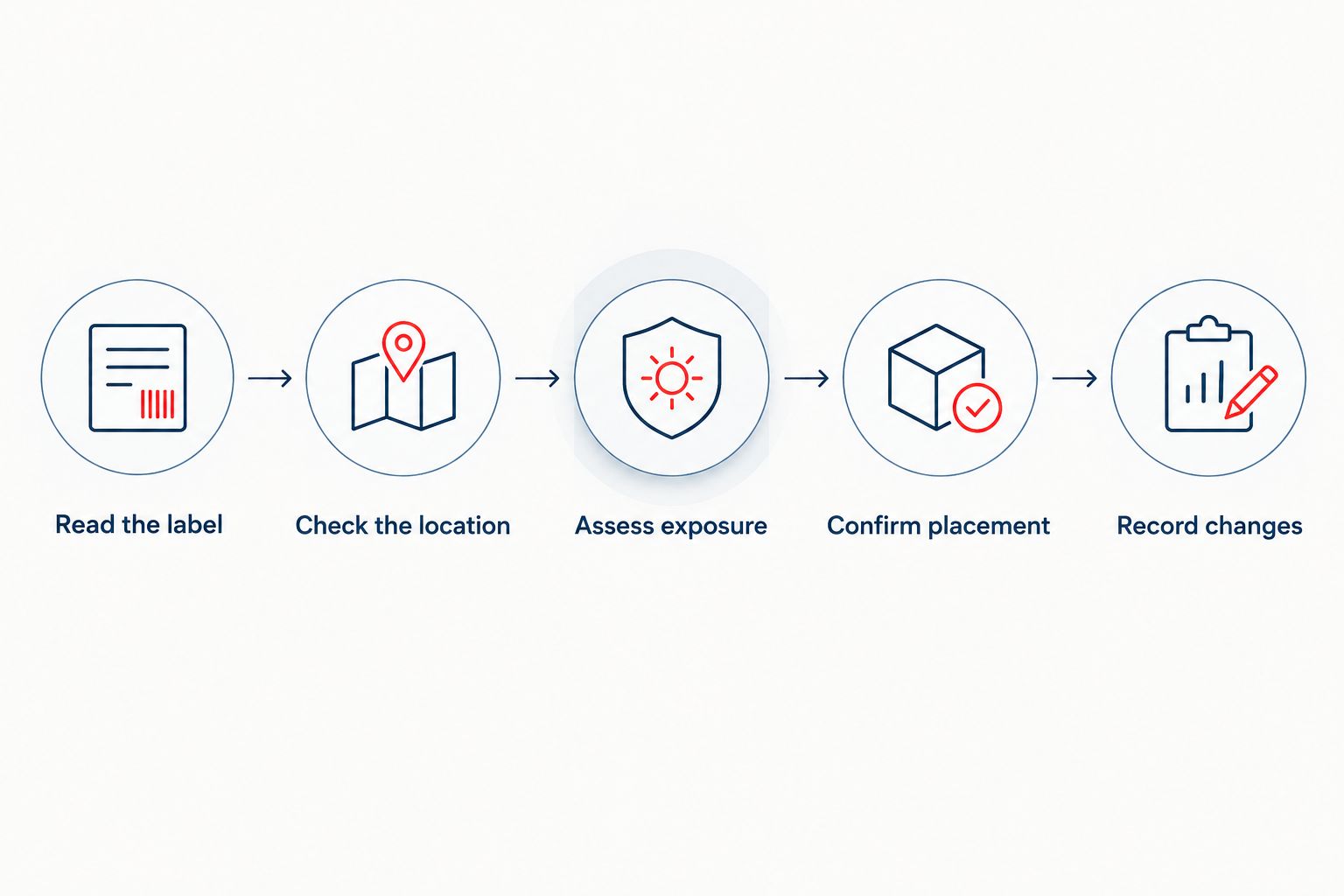
- Read the label. Record the manufacturer’s temperature limits and installation instructions.
- Check the location. Identify direct sun, nearby equipment, exhaust, hot pipework, and enclosed air spaces.
- Assess exposure. Use suitable temperature measurement and qualified advice to establish conditions during the relevant operating cycle.
- Confirm placement. Check that any proposed relocation preserves required access, visibility, and fire coverage.
- Record changes. Update the location record and tell the people responsible for inspections and emergency response.
A single reading on a cool morning does not establish the hottest conditions. For your 2026 fleet review, include parked conditions as well as normal vehicle operation; the relevant exposure does not stop when the driver leaves.
Do not put a worker beside a suspect cylinder to take measurements. Assess normal storage conditions before an incident; let emergency responders manage an immediate pressure-vessel hazard.
Does a green pressure gauge mean a heated extinguisher is safe?
No. A green gauge indicates pressure within the gauge’s marked operating zone; it does not certify cylinder strength, valve condition, or the absence of heat damage. Some extinguisher types do not have a pressure gauge at all.
Pressure changes with temperature. A gauge reading therefore needs the manufacturer’s instructions and the extinguisher’s condition as context, not a quick green-equals-safe decision.
Do not use the gauge to clear a fire-exposed extinguisher for service. OSHA’s portable-extinguisher requirements address exposure to fire separately from routine pressure checks. Tell the service provider about the exposure even if the needle appears normal afterward.
Can you keep an extinguisher in a truck during summer?
Yes, if the extinguisher is suitable for the actual temperature conditions and is properly mounted. Summer alone does not determine suitability, and neither does the fact that the extinguisher fits behind the seat.
Check the model’s temperature range, the vehicle manufacturer’s guidance where relevant, and applicable vehicle requirements. Keep the unit away from locations where loose cargo can strike it or access becomes blocked.
For fleet operators, fire extinguisher inspection for trucking fleets connects the storage decision with recurring checks. Include changed brackets, replacement units, and vehicle reassignment in your 2026 review rather than assuming the original installation remains suitable.
What should you do after an extinguisher has been overheated?
Keep a suspect extinguisher out of service until a qualified provider determines the proper disposition. Do not assume cooling restores its strength, and do not assume hydrostatic testing is always an acceptable way to return it to service.
OSHA’s workplace requirements, in 29 CFR 1910.157(f)(2), identify exposure to fire among the conditions requiring removal from service. That is different from ordinary warmth within the manufacturer’s permitted range.
Give the provider facts, not a diagnosis:
- Where the extinguisher was installed.
- What heated it and whether flames were involved.
- Whether it discharged, leaked, hissed, or changed shape.
- Whether the exposure temperature or duration is known.
- Whether the label, valve, hose, paint, or bracket shows damage.
Do not loosen the valve, puncture the cylinder, or discharge it to reduce pressure. Do not pack a hot or damaged unit into a vehicle for delivery. Get handling instructions first.
Firstlinefire is a fire extinguisher service option for commercial and fleet operators. The company also provides hydro testing; whether testing, replacement, or another action is appropriate depends on the extinguisher and its condition.
Arrange fire extinguisher service
Discuss heat exposure, extinguisher condition, and the next service step.
What belongs on your routine inspection list?
Routine checks help you find changed conditions before an emergency. They do not replace a specific response to suspected overheating or fire exposure.
For workplaces covered by OSHA’s portable-extinguisher rule, 29 CFR 1910.157(e)(2) requires monthly visual inspection, and 1910.157(e)(3) requires an annual maintenance check. Those are separate tasks, not interchangeable signatures on a tag.
Add storage conditions to your 2026 inspection checklist:
- The extinguisher remains in its designated, accessible location.
- Its bracket or cabinet remains suitable and secure.
- New equipment or stored material has not introduced a heat source.
- The label remains readable, including temperature instructions.
- The cylinder, hose, and valve show no apparent damage or leakage.
- Any suspected heat exposure has been reported rather than silently dismissed.
Record a problem when you find it. Waiting for the next annual visit leaves the condition unresolved, and a new inspection tag will not fix an unsuitable location.
FAQ
Can a fire extinguisher explode in extreme heat?
Yes. Extreme heat can raise internal pressure and weaken the cylinder enough to cause violent rupture. Follow the extinguisher’s temperature limits, and keep away from a unit that is hot, damaged, hissing, or exposed to fire.
What is the maximum temperature for storing a fire extinguisher?
The maximum temperature is the limit specified for your extinguisher by its manufacturer. Many portable dry-chemical units have an upper operating limit of 120°F (49°C), but that is not a universal storage limit or an explosion threshold.
Is a fire extinguisher safe in a parked truck?
A truck installation is suitable only when the extinguisher stays within its permitted temperature conditions and has the correct mounting. Check the actual cab or compartment conditions rather than relying on outdoor air temperature.
Can I use an extinguisher after it cools down?
Cooling alone does not establish that an overheated extinguisher is safe to use. Report the exposure to a qualified service provider, and do not return a fire-exposed unit to service based on appearance or gauge position.
Should I discharge an overheated extinguisher to release pressure?
No. Do not operate, dismantle, puncture, or move a hot or visibly damaged extinguisher to release pressure. Keep people away and contact emergency services when there is an immediate hazard.
Can Firstlinefire help with extinguisher inspection and hydro testing?
Firstlinefire provides fire extinguisher inspection, service, and hydro testing. Describe the heat exposure before arranging handling or transport; hydro testing is not automatic clearance for every damaged cylinder.
One last thing
An extinguisher cabinet can solve a weather problem without solving a heat problem. Check what the enclosure is designed to do before treating it as protection from high temperatures.
For your next 2026 site walk, pair each extinguisher’s temperature label with its actual location. If the conditions do not fit, correct the installation without sacrificing access or required fire coverage.


