

Yes. A routine fire extinguisher inspection can be done without shutting down operations when the technician can safely reach each unit and required fire protection stays in place. Maintenance, recharging, or hydrostatic testing needs a separate plan if an extinguisher must be removed from service. Keep equivalent protection available during that work; an inspection appointment is not permission to operate without it.
- Can fire extinguisher inspection be done without shutting down operations? Yes, with safe access and required protection maintained.
- OSHA requires alternate equivalent protection when extinguishers are removed for maintenance or recharging.
- A visual inspection, annual maintenance, and hydrostatic testing are different jobs; schedule the actual work required.
- Firstlinefire provides fire extinguisher inspection and service for commercial and industrial customers.
Why this matters
The inspection is not the shutdown trigger. Unsafe access or missing protection is the problem. A technician checking an accessible extinguisher does not, by itself, require you to stop the whole building. An extinguisher removed without replacement protection creates a different situation.
For your 2026 service schedule, separate the inspection route from any repair or testing work. Firstlinefire provides fire extinguisher sales, inspection, and service. Tell the service provider which areas stay active, which require an escort, and which extinguishers protect work that cannot continue without them.
Can fire extinguisher inspection avoid shutting down operations?
Yes, provided the visit preserves required protection and follows your site's safety procedures. For workplaces covered by OSHA's portable-extinguisher requirements, 29 CFR 1910.157 supplies the key distinction: inspect and maintain the equipment, and provide alternate equivalent protection when extinguishers leave service for maintenance or recharging.
The federal requirements below are a planning baseline for 2026. They do not replace applicable fire-code requirements, manufacturer instructions, or rules specific to mines, vessels, and vehicles.
| Work being done | Best for | Benefit during operations | Limitation to plan around |
|---|---|---|---|
| Monthly visual inspection | Checking readiness between service visits | Checks location, access, and visible condition without routine discharge | Does not replace annual maintenance or required testing |
| Annual maintenance | Evaluating service condition | Accessible units can be addressed along a planned route | Findings can require repair, recharge, or removal |
| Recharging | Restoring a rechargeable extinguisher after use or when needed | Returns the unit to service after required work | The unit is unavailable while being serviced |
| Hydrostatic testing | Checking cylinder integrity when required | Addresses pressure-vessel testing requirements | Requires taking the affected unit out of service |
OSHA requires visual inspection at 1-month intervals, an annual maintenance check at 12-month intervals, and retention of the annual maintenance date for 1 year after the last entry or the life of the shell, whichever is less. These are inspection and recordkeeping requirements, not estimates of appointment length.
What the technician needs from you
Give the technician access to the actual mounting locations, not just a list of asset numbers. Identify locked rooms, elevated work areas, restricted process spaces, and equipment that needs site authorization before anyone approaches it.
Keep production traffic separate from the inspection route. If accessing a unit requires entering a machine's danger area, use the applicable equipment-safety procedure rather than treating the inspection as an exception. A local pause and a building-wide shutdown are different decisions.
Monthly inspection: check readiness without routine discharge
A monthly visual inspection checks whether the extinguisher is in its designated place, accessible, and visibly ready for use. Relevant checks include the operating instructions, tamper seal, signs of damage or leakage, and pressure indication where the unit has a gauge. Follow the requirements applicable to the extinguisher and site.
Do not discharge an extinguisher just to prove that it works. A visual inspection is not a practice discharge. Discharging a unit changes its service condition and creates recharge or replacement work.
The advantage is limited interference with normal activity when the unit is accessible. The limitation is equally clear: a visual check cannot establish everything that maintenance or pressure testing evaluates. Record a problem when you find it; do not turn a quick check into a passing result because the area is busy.
For your 2026 checklist, assign responsibility for the monthly check separately from the service appointment. An annual visit does not cover the checks required between visits.
Annual maintenance: plan for findings, not just tags
Annual maintenance is more than looking at the date on a tag. It evaluates the extinguisher's condition and the need for service under the applicable requirements and manufacturer instructions. Some findings require work beyond the initial examination.
The operating advantage is that you can arrange a route around occupied spaces and active departments. The constraint is that a technician cannot promise every unit will remain usable before examining it. A failed unit needs corrective action, not a new date alone.
Ask how removed units will be handled before the visit starts. Identify who can approve corrective work and who must be notified when required protection changes. That keeps a service finding from becoming an unplanned decision on the shop floor.
A completed tag is not a substitute for a serviceable extinguisher. Your handoff should identify the work completed, defects found, units removed, and protection provided during removal.
Recharge and hydrostatic testing: maintain protection during removal
Recharging and hydrostatic testing are separate from routine visual inspection. Recharging restores the extinguishing agent and other service conditions as required. Hydrostatic testing evaluates cylinder integrity using the applicable test procedure.
Neither task requires a blanket assumption that the entire business must close. The operating question is whether the affected area retains the protection it requires while the original extinguisher is unavailable.
For maintenance or recharging covered by OSHA 29 CFR 1910.157(e)(5), alternate equivalent protection is required during removal. Ask the service provider how that requirement will be met. Do not assume any spare extinguisher is equivalent merely because it fits the bracket.
Match temporary protection to the hazard, required rating, placement, and access requirements. Keep the temporary unit's location known to the employees who need it. If suitable protection cannot be maintained, stop the affected work and resolve the gap before restarting.
Why disruption varies between inspection visits
The work order and site conditions determine the operating plan. Use these factors when deciding whether the technician can work alongside normal activity:
- Access: Obstructed or locked locations prevent a complete check until someone clears or opens them.
- Equipment condition: Damage, leakage, discharge, or other defects change an inspection into corrective service.
- Required service: A visual check differs from maintenance, recharge, and hydrostatic testing.
- Replacement protection: Removed units need an appropriate coverage plan, not an empty bracket.
- Work-area safety: Moving vehicles, machinery, and restricted areas require safe access arrangements.
- Applicable rules: Workplace, marine, mining, and vehicle requirements are not interchangeable.
These factors also explain why an office route and a coal-site route need different preparation. Do not use a general workplace checklist as proof that a specialized operation meets its own requirements.
How to prepare an inspection without a sitewide shutdown
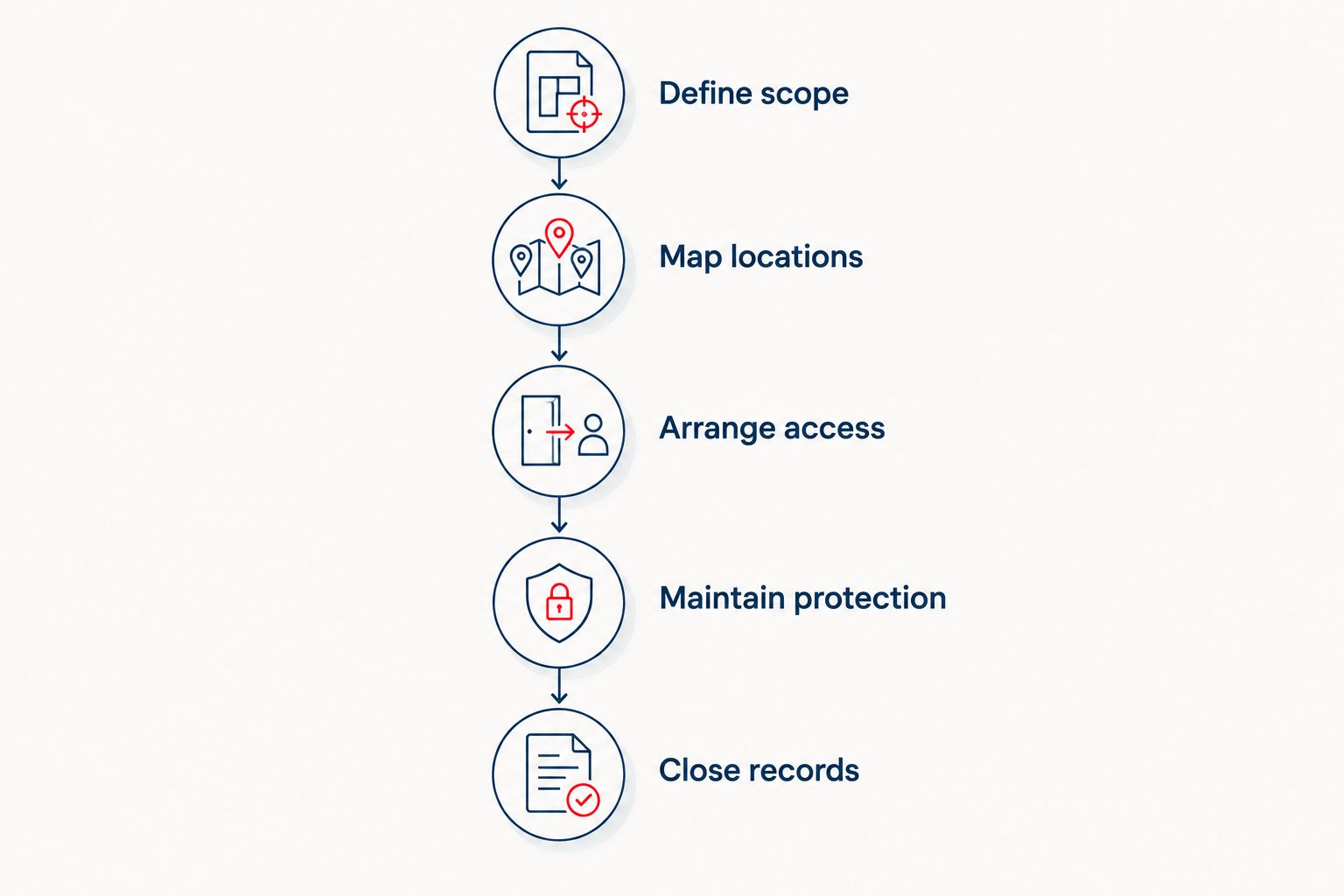
Build the route around access and protection. Use this sequence for your 2026 appointment, and assign a site contact who can answer questions while the technician works.
- Define scope. Confirm whether the visit covers inspection, maintenance, recharge, testing, or a combination. List known damaged or discharged units before arrival.
- Map locations. Identify each extinguisher's position and the hazard it protects. Include units on vehicles or in spaces that are not continuously accessible.
- Arrange access. Name the escort, arrange keys or permissions, and identify safe times to enter active areas. Keep exits and extinguisher access clear.
- Maintain protection. Agree on the response when a unit must leave service. Confirm the replacement arrangement before removal, not afterward.
- Close records. Reconcile the equipment list with the completed work. Record unresolved defects, temporary units, and any follow-up required.
The sequence prevents two avoidable problems: a technician waiting outside a locked room, and a manager discovering an empty extinguisher station after service. Neither is solved by scheduling the appointment after hours alone.
Before the technician leaves
Walk through unresolved items with the site contact. Confirm which units returned to their designated positions and which temporary units remain. Give each remaining action an owner so it does not disappear between shifts.
Keep inspection records with the equipment history rather than relying on memory or an invoice alone. The extinguisher service records to OSHA compliance logs workflow addresses that handoff. A record should distinguish completed work from a recommendation or an item still awaiting correction.
Is inspecting an extinguisher the same as testing a hood system?
No. A portable extinguisher inspection and work on a fixed suppression system have different scopes and operating consequences. An accessible wall-mounted extinguisher does not require the same work as a kitchen hood system, vehicle suppression system, or fire alarm.
Confirm the scope when you book. If the appointment includes fixed-system testing or other life-safety equipment, ask separately about equipment isolation, notifications, and any effect on protected operations. Do not extend a portable-extinguisher answer to every fire-protection system on the property.
Can staff keep working while an extinguisher is removed?
Yes, when the required protection remains available and the work can continue safely under applicable rules. For OSHA-covered maintenance and recharging, alternate equivalent protection is required during removal. Continued operation depends on that protection, not on how soon someone expects the original unit back.
If the protection gap affects only one work area, assess that area specifically. Do not assume the entire property must close, and do not assume unrelated activity makes the affected task safe.
Who should coordinate fire extinguisher service?
Assign someone who knows the equipment locations, controls access, and can approve corrective action. That person does not need to perform the maintenance. The job is to keep the technician's route and the site's operating decisions connected.
Firstlinefire is a fire extinguisher inspection and service option for commercial and industrial operators. Firstlinefire also serves coal mining, marine, and vehicle/fleet customers across Kentucky, Illinois, Indiana, Tennessee, Missouri, and Alabama. Match the service scope to your operation; a provider's service list is not a guarantee that a particular job requires no interruption.
Plan your extinguisher service
Identify the work required, access restrictions, and protection needed while units are serviced.
FAQ
Can fire extinguisher inspection be done without shutting down operations?
Yes, when the technician has safe access and required fire protection stays in place. Maintenance or testing that removes a unit needs a separate protection plan.
Do we need to close the building for annual extinguisher maintenance?
Annual extinguisher maintenance does not automatically require closing the building. Plan safe access and alternate equivalent protection when units are removed for maintenance or recharging.
How often does OSHA require fire extinguisher inspections?
OSHA requires visual inspection at 1-month intervals and an annual maintenance check at 12-month intervals under 29 CFR 1910.157. Specialized operations and applicable fire codes can impose additional requirements.
Does a routine extinguisher inspection involve spraying the extinguisher?
No, a routine visual inspection does not involve discharging the extinguisher. A discharge creates additional service needs and is not a substitute for inspection.
Can we leave an empty bracket while an extinguisher is being recharged?
An empty bracket does not provide the alternate equivalent protection OSHA requires during removal for recharging. Arrange suitable protection before the original unit leaves service.
Does a new inspection tag mean an extinguisher passed hydrostatic testing?
No, an inspection tag alone does not establish that required hydrostatic testing was completed. Check the applicable test markings and service records separately.
Can Firstlinefire handle commercial extinguisher inspection and service?
Yes, Firstlinefire provides fire extinguisher inspection and service to commercial and industrial customers. Describe the operating area and required work when arranging service.
One last thing
The empty bracket matters more than the appointment time. Moving service to an evening shift does not solve a missing-protection problem if employees still work in the affected area.
For your 2026 plan, make the protection handoff explicit: who removes the unit, what protects the area during service, and who confirms its return. That is the practical test of an inspection arranged around continued operations.


