
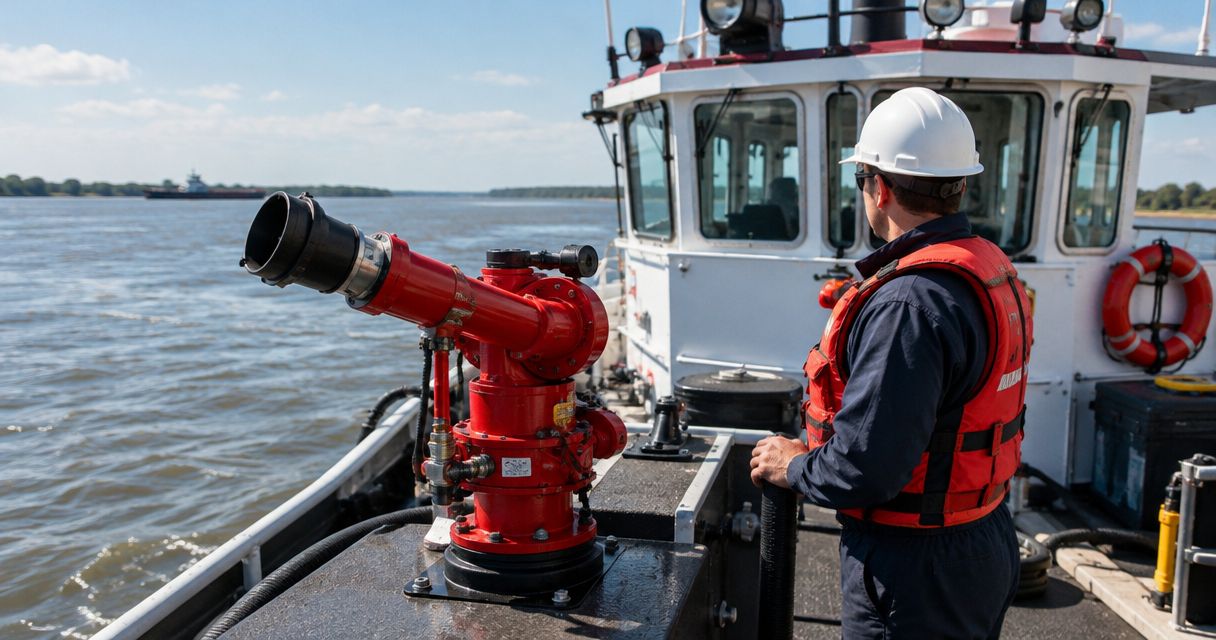
A towboat cannot lawfully operate without the fire protection required for that vessel, including Coast Guard-approved equipment where the applicable rules require it. But that does not mean every towboat must have the same fixed suppression system: the answer depends on the vessel’s regulatory requirements and any specifically permitted alternative. An impaired required system is not something an operator can waive by adding extinguishers or assigning a fire watch.
- Can a towboat operate without Coast Guard approved fire suppression? Not when that protection is required for the vessel.
- U.S. Coast Guard towing-vessel requirements distinguish required fire protection from a universal requirement for fixed suppression.
- Portable extinguishers do not automatically replace a required fixed system.
- Resolve missing or impaired protection with the responsible Coast Guard office before assuming the vessel can sail.
Why this matters
A working extinguisher is not proof that the vessel’s fire-protection arrangement complies. Equipment approval, installation, maintenance, and operating authorization are separate questions. You need answers to all of them.
For a 2026 departure decision, start with the vessel’s Certificate of Inspection, applicable regulations, and outstanding deficiencies—not a supplier’s description of a system as suitable for boats. The towboat Coast Guard fire-safety inspection guide addresses the broader inspection preparation that sits around this decision.
The practical distinction is simple. Buying equipment addresses a hardware need; confirming that the vessel can operate requires checking the rules and conditions that apply to that particular boat.
Can a towboat operate without Coast Guard-approved suppression?
No, if the missing protection is required. A vessel without a fixed system is a different question from a vessel without compliant fire protection. Do not treat those situations as interchangeable.
For towing vessels subject to Subchapter M, the federal framework is in Title 46 of the Code of Federal Regulations. Part 142 addresses fire protection, including extinguishing equipment, machinery-space protection, and inspection and maintenance requirements. Part 136 addresses certification; Part 137 addresses vessel compliance through inspection and survey arrangements.
For a 2026 review, use the current requirements applicable to the vessel rather than a general recreational-boating equipment list. Recreational-boat guidance does not establish what an inspected commercial towing vessel must carry.
| Vessel condition | What it means | Next move |
|---|---|---|
| Required fire protection is missing | The vessel does not meet that requirement merely because other equipment is aboard | Report and resolve the deficiency through the applicable Coast Guard process |
| A required system is impaired | Installed equipment is not the same as serviceable protection | Identify the impairment and obtain direction on repairs and operation |
| No fixed system is installed | Compliance depends on whether a fixed system is required or another arrangement is permitted | Check the vessel-specific regulatory basis |
| Equipment is advertised as marine-rated | Marketing language does not establish regulatory acceptance | Check approval documentation and installation requirements |
| Required protection is serviceable and documented | The fire-protection issue is supported by equipment and records | Check remaining inspection conditions and operating restrictions |
A service company’s invoice does not replace a Coast Guard decision. Neither does an internal maintenance entry that says a repair is scheduled.
Fixed suppression and permitted alternatives are different paths
Do not choose between fixed suppression and portable equipment as though they are interchangeable purchases. Start with the required arrangement. Only then select equipment and service work that satisfy it.
The comparison below explains their different functions. It does not establish eligibility for an alternative on your vessel.
| Protection arrangement | Best for | Benefit | Limitation |
|---|---|---|---|
| Required fixed suppression | Vessels and spaces whose requirements call for an installed system | Provides the installed protection specified for the protected space | Requires correct installation, maintenance, and associated operating procedures |
| Specifically permitted alternative arrangement | Vessels whose applicable requirements expressly allow that arrangement | Meets the requirement through the permitted configuration | Cannot be assumed acceptable because another vessel uses it |
| Portable extinguishers | Crew response to suitable incipient-stage fires, within training and safe escape limits | Can be carried to an accessible fire | Do not automatically replace required machinery-space protection |
Best for compliance: the arrangement the vessel is actually required or authorized to use. More extinguishers are not a substitute for checking that basis.
Likewise, do not assume a fixed system eliminates portable-extinguisher requirements. Different equipment addresses different parts of the vessel’s fire-protection obligations.
Why towboat fire-protection requirements vary
The same answer does not fit every vessel. Use these factors to organize a 2026 compliance review:
- Regulatory coverage. Establish which towing-vessel rules apply before selecting equipment or interpreting an inspection finding.
- Vessel status. Requirements can distinguish existing vessels from new vessels. Age alone does not establish an exemption.
- Machinery and space arrangement. Identify the machinery spaces, equipment, and hazards addressed by the applicable provisions.
- Existing approvals. Review the documented protection arrangement and any accepted alternatives rather than relying on crew recollection.
- Equipment condition. A required system that is installed but inoperative creates a different problem from a serviceable system with a missing record.
- Inspection conditions. Read outstanding deficiencies, operating restrictions, and instructions issued for the vessel.
These factors determine which questions need answers. They do not give the operator authority to create an exception.
Check the vessel before deciding to sail
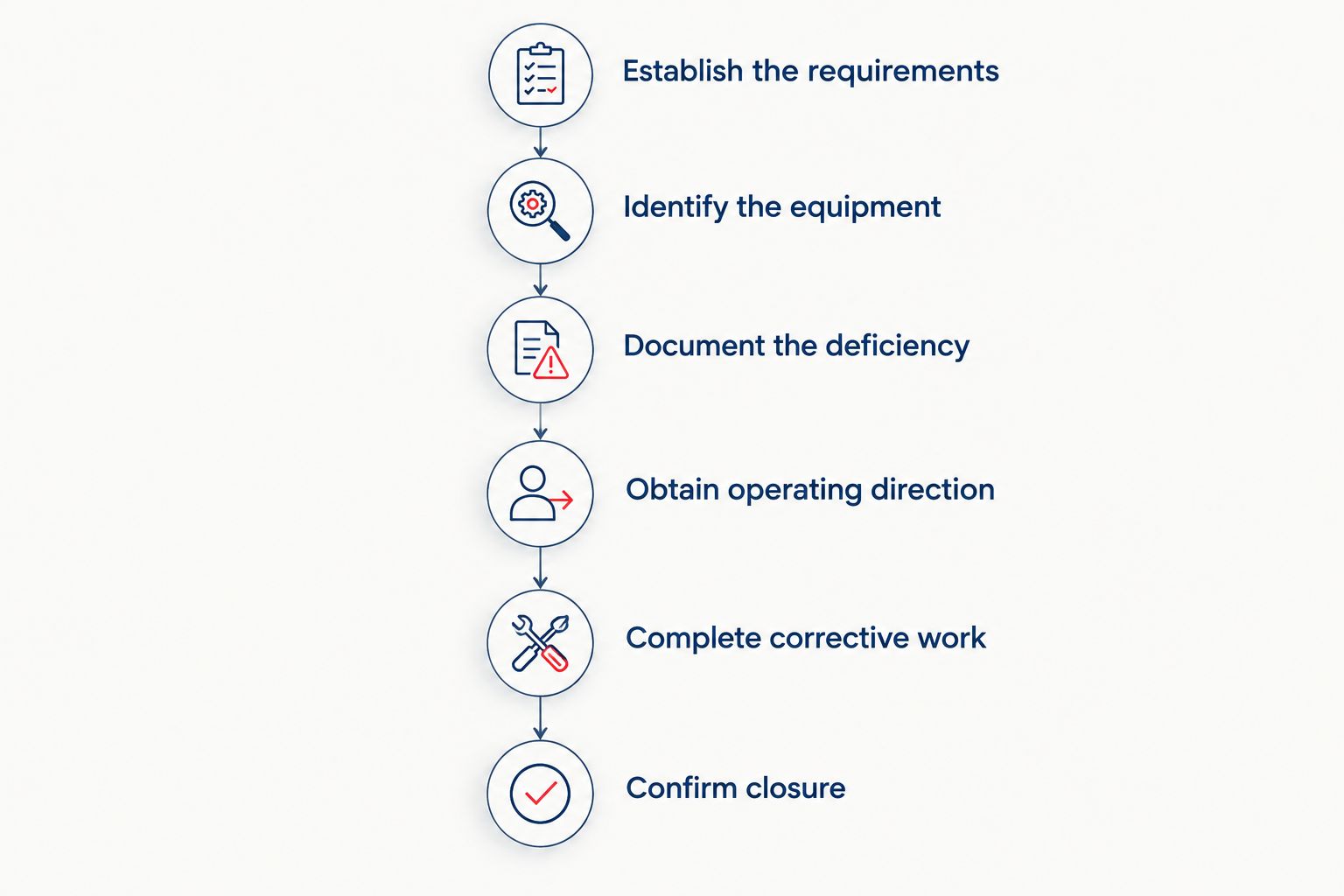
Use this sequence when required suppression is missing, its approval is uncertain, or a system has failed a service check. Keep the maintenance decision separate from the operating decision.
1. Establish the requirements
Gather the Certificate of Inspection, applicable fire-protection requirements, system documentation, and relevant inspection or survey findings. Identify the spaces the system protects and the equipment the vessel must carry.
Write down the actual issue. Missing approval documentation, overdue maintenance, a discharged cylinder, and a disconnected release control are different findings. A vague description such as a suppression problem makes the repair scope and regulatory discussion harder.
2. Identify the equipment
Record the manufacturer, model, serial numbers, extinguishing agent, and approval markings where applicable. Compare the installed arrangement with the system documentation.
Do not stop at the cylinder. The protected space, distribution components, release controls, alarms, and associated shutdown arrangements can matter to the system’s operation. Check the relevant instructions rather than assuming a charged cylinder proves readiness.
3. Document the deficiency
Describe what failed, how it was found, and which required function is affected. Keep photographs, service findings, and prior records together so the responsible parties are discussing the same condition.
Avoid calling equipment operational when testing or inspection has not established that. A pressure indication alone does not demonstrate every function of an installed suppression system.
4. Obtain operating direction
For a deficiency affecting required fire protection, contact the responsible Coast Guard Officer in Charge, Marine Inspection, through the vessel’s established reporting process. Involve the third-party organization when the vessel operates under the Towing Safety Management System option and its procedures require that involvement.
Ask directly whether the vessel can operate, under what conditions, and what documentation is required. A repair appointment is not permission to sail. Do not assume that a pending survey or service visit answers the operating question.
5. Complete the corrective work
Have the equipment serviced or replaced according to the applicable requirements and manufacturer instructions. Define the work scope before the visit so the technician has the right system information.
If components or the protected-space arrangement have changed, address the effect on the installation—not just the part being replaced. Keep the resulting service and test documentation tied to the correct vessel and system.
6. Confirm closure
Check that corrective work, required testing, records, and any Coast Guard follow-up are complete. If an operating restriction was imposed, establish that the responsible authority has addressed it before treating the vessel as unrestricted.
File the evidence where the master and responsible shore personnel can retrieve it. For your 2026 vessel file, retain the deficiency report and its resolution together; an isolated invoice does not explain the whole event.
Does an older towboat get an automatic exemption?
An older towboat does not get an automatic exemption from required fire protection. Existing-vessel provisions must be checked against the applicable rule and the vessel’s documented circumstances.
Do not use the fact that equipment was accepted during an earlier inspection as the only basis for a 2026 decision. Check whether the current arrangement matches the documented arrangement and whether later changes affect it.
An engine replacement, machinery-space alteration, or suppression-system modification deserves a review of the relevant requirements. Do not assume the original installation paperwork describes the vessel as it stands today.
Can portable extinguishers replace a fixed system?
Portable extinguishers do not automatically replace a required fixed suppression system. They serve a different response function and rely on a person reaching and using them safely.
If the applicable requirements permit an alternative arrangement, document the exact basis for using it. If they do not, adding portable extinguishers does not resolve the missing fixed protection.
Keep crew safety separate from equipment substitution. A crew member should not enter an unsafe machinery space simply because portable extinguishers are aboard. Training must address the vessel’s equipment, reporting procedures, escape routes, and limits on firefighting attempts.
Can a fire watch keep a towboat operating during repairs?
A fire watch is not an operator-issued waiver of required suppression. Extra personnel and patrols do not, by themselves, establish permission to operate with impaired required protection.
Bring any proposed temporary measures to the responsible Coast Guard office. Describe the actual deficiency, the proposed operation, and the planned corrective work.
Follow the direction issued for that vessel. Do not copy temporary measures from a warehouse, truck fleet, or another towboat and assume they provide the same regulatory result.
Get service support without confusing it with approval
Firstlinefire is a fit for marine operators seeking fire extinguisher service, hydro testing, and suppression-system support. Those services are relevant when you need to define corrective work and gather equipment records.
Firstlinefire serves marine customers alongside commercial, industrial, coal mining, and vehicle/fleet customers across Kentucky, Illinois, Indiana, Tennessee, Missouri, and Alabama. State the vessel location, equipment details, and known deficiency when discussing the work.
The boundary matters: Firstlinefire’s fire-protection service does not replace Coast Guard operating authority. Ask for the service scope and resulting documentation, then handle regulatory acceptance through the vessel’s responsible compliance contacts.
FAQ
Can a towboat operate without Coast Guard approved fire suppression?
A towboat cannot lawfully operate without the fire protection required for that vessel. Whether a fixed suppression system is required depends on the applicable vessel requirements and any specifically permitted alternative.
Does every towboat need a fixed engine-room suppression system?
Do not assume every towboat has identical fixed-system requirements. Check the applicable towing-vessel rules, vessel status, and documented protection arrangement before deciding whether a fixed system is required.
Can extra extinguishers make up for a broken fixed system?
Extra extinguishers do not automatically replace an impaired required fixed system. Report the deficiency through the applicable process and obtain direction from the responsible Coast Guard office.
Does a marine-rated label mean the Coast Guard approves the system?
A marine-rated description does not establish Coast Guard approval or acceptance for a particular installation. Check the equipment’s approval documentation, intended application, and installation requirements.
Who decides whether the towboat can sail with a suppression deficiency?
The responsible Coast Guard authority addresses regulatory operating restrictions and any conditions it imposes. A service contractor’s repair schedule or invoice does not supply that authorization.
What should I send a fire-protection service company?
Send the vessel location, equipment identification, system documentation, and a clear description of the deficiency. Firstlinefire serves marine customers with fire extinguisher, hydro testing, and suppression-system services.
Does passing the last inspection prove the suppression system is compliant now?
Passing a previous inspection does not establish the system’s present condition. Check current equipment condition, maintenance records, modifications, and outstanding deficiencies.
One last thing
Ask what proves the entire arrangement works—not just whether the cylinder is charged. A system depends on more than its extinguishing agent, and paperwork must match the equipment actually installed.
Before the next departure, compare the vessel name, protected space, equipment identification, service findings, and unresolved restrictions across your records. Correct mismatches before they become an argument at the dock. A clear file does not repair a system, but it lets the master, technician, and Coast Guard discuss the same facts.


