
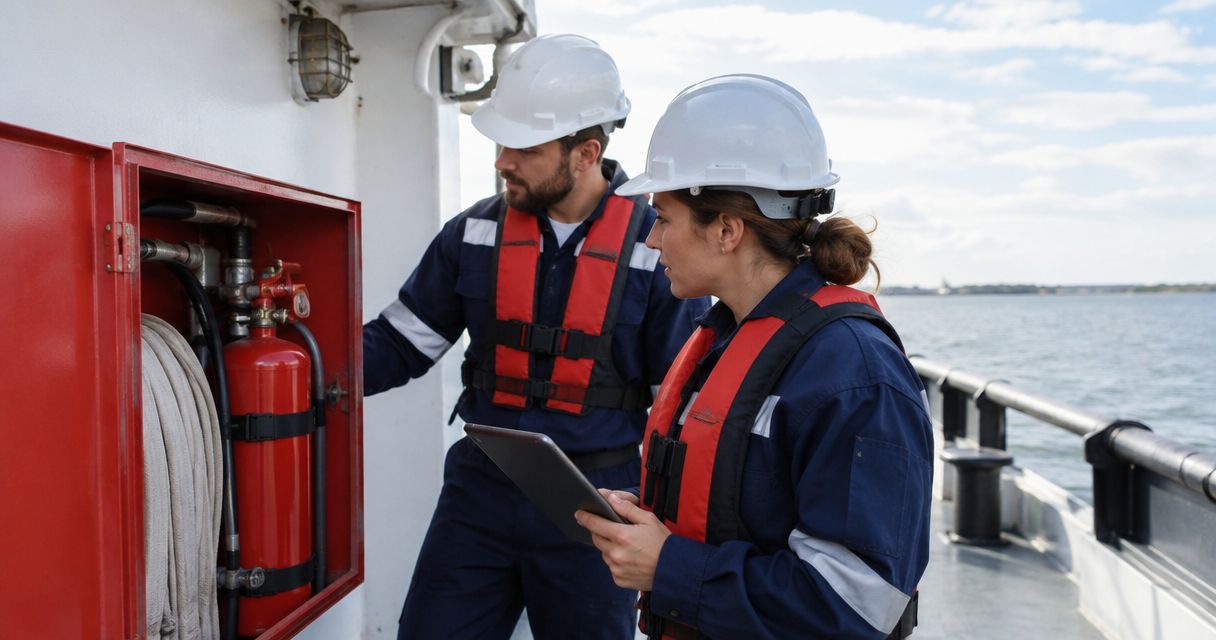
To pass a Coast Guard fire safety inspection on a towboat in 2026, match the vessel’s fire-protection equipment to its applicable requirements, correct deficiencies, and have service records and a trained crew ready for review. A fresh extinguisher tag is not enough: the inspector also needs to verify equipment condition, access, required system functions, and the crew’s ability to respond.
- How to pass a Coast Guard fire safety inspection: towboat equipment, service records, and crew readiness must agree.
- For covered towing vessels, use 46 CFR Subchapter M—not a recreational boating checklist.
- Check extinguishers, fixed suppression, fire detection, escape routes, and documented firefighting drills before inspection.
- Firstlinefire provides marine fire-protection services; Coast Guard acceptance remains a separate regulatory decision.
Why this matters: A towboat carries fuel, machinery, electrical equipment, and people in confined spaces. Fire protection has to work where the hazard exists, not just look complete on an inventory sheet. Prepare for your 2026 inspection by checking the actual vessel against its Certificate of Inspection, applicable regulations, and approved equipment arrangements.
Firstlinefire is best for marine operators seeking extinguisher and fire-protection system service. Firstlinefire serves marine customers, but a service visit does not replace the Coast Guard’s inspection or approval.
How do you pass a Coast Guard fire safety inspection on a towboat?
Start with the vessel’s requirements, then follow the equipment from its installed location through its service record and crew procedure. For towing vessels covered by Subchapter M, the principal fire-protection rules are in 46 CFR Part 142; operating and emergency-drill requirements are in 46 CFR Part 140.
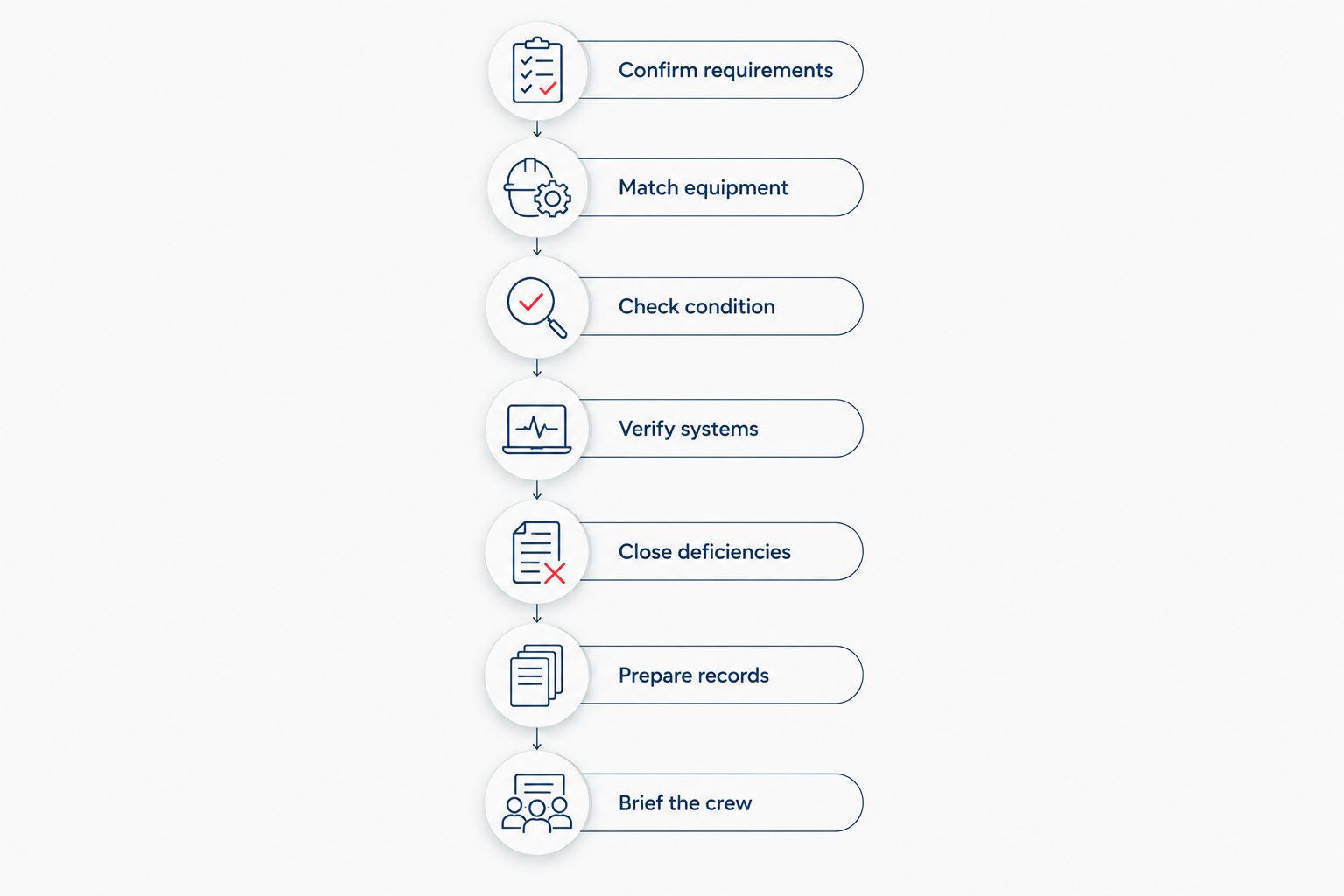
Use these steps to prepare. This is a fire-safety readiness check, not a substitute for the complete vessel inspection.
1. Confirm requirements
Read the Certificate of Inspection and identify the fire-protection requirements that apply to your towboat. Review any outstanding deficiencies, approved plans, equipment manuals, and operating procedures before buying replacements or moving equipment.
Do not copy the arrangement from another boat. Vessel size, machinery spaces, construction, operating service, and existing-vessel provisions affect what applies. Resolve questions about applicability with the responsible Coast Guard office before treating a general checklist as the vessel’s final equipment list.
2. Match equipment
Walk the vessel with its fire-equipment inventory. Identify each portable extinguisher, semi-portable extinguisher where fitted, fixed suppression system, fire-detection component, and other required firefighting equipment.
Check the equipment’s approval, type, rating, capacity, and location against the applicable requirement. A unit that fits the bracket is not automatically an acceptable replacement. Record discrepancies by compartment and equipment identifier so the technician repairs the right item.
3. Check condition
Inspect extinguishers for corrosion, damage, missing pins or seals, blocked discharge openings, and secure mounting. Check the pressure indicator where one is fitted; some extinguisher types require other methods of confirming their charge.
Check that required equipment is visible and accessible. Remove stored gear that blocks extinguishers, controls, hoses, or escape routes. Treat leakage, severe corrosion, an abnormal pressure indication, or evidence of discharge as a service issue—not something to hide with a new tag.
4. Verify systems
Have qualified personnel inspect and test required fixed suppression, detection, and alarm equipment under the applicable rules and manufacturer instructions. Check release controls, agent containers, piping, nozzles, alarms, and associated shutdowns where those features are required.
The test must establish the required functions without creating an unsafe release. Do not discharge a fixed system merely to demonstrate readiness. Coordinate testing, isolation, and restoration with the vessel’s responsible personnel, and document that the system returned to service.
5. Close deficiencies
Arrange repairs, replacement, recharge, or hydrostatic testing when required. Match the completed work to the deficiency list, then verify the equipment onboard rather than closing an item solely because an invoice arrived.
If equipment must leave the vessel, address the resulting protection gap through the applicable vessel procedures and regulatory requirements. A unit sitting in a service shop does not protect the engine room. Do not assume the towboat can keep operating unchanged while required equipment is unavailable.
6. Prepare records
Gather service reports, applicable test records, equipment manuals, drill records, and previous deficiency correspondence. Make the records easy to retrieve onboard, with identifiers that match the installed equipment.
Keep inspection, maintenance, recharge, and hydrostatic-test records distinct. They describe different work. A current maintenance tag does not establish that a cylinder passed its required hydrostatic test or that a separate fixed suppression system was tested.
7. Brief the crew
Ask crew members to locate extinguishers, identify alarm signals, explain reporting procedures, and describe their assigned firefighting duties. Include evacuation, accountability, and the limits of portable-extinguisher use.
For covered towing vessels, 46 CFR 140.420 requires emergency drills and instruction at least once each month. Prepare the crew to explain the vessel’s actual procedures, not recite a generic extinguisher acronym while missing the engine-room release control.
What should you check on each fire-protection component?
Check each component against its own requirement. Portable extinguishers, fixed suppression, and fire detection perform different jobs. Passing the portable-extinguisher check does not establish that the engine-room protection or alarm arrangement is acceptable.
| Component | Best for | What to verify | Limit you must address |
|---|---|---|---|
| Portable extinguishers | Initial response to a suitable, manageable fire | Required approval, rating, location, condition, charge, and service history | Crew members need a safe escape route; a portable unit does not replace required fixed protection |
| Fixed suppression | Protecting the designated enclosed hazard space | Agent condition, release arrangements, discharge components, and required associated functions | Protection depends on the installed arrangement and correct operating procedure |
| Fire detection and alarms | Warning the crew of a developing fire | Required coverage, detector condition, alarm operation, and fault status | Detection warns; it does not extinguish a fire |
| Fire main and hoses, where required | Delivering firefighting water | Pump operation, accessible stations, hose condition, and required performance | Equipment must meet the vessel’s applicable requirements and remain usable |
Look beyond the service sticker. Paint, salt exposure, vibration, blocked access, and damaged fittings are physical conditions that a paperwork review cannot resolve.
Do not transfer land-based equipment to a vessel solely because its agent or appearance seems suitable. Confirm the applicable marine approval and installation requirements before accepting a replacement.
Which service dates and records need attention?
For your 2026 review, separate routine condition checks from annual servicing and cylinder pressure testing. The controlling sources are the applicable Coast Guard rules, incorporated standards, and the equipment manufacturer’s instructions—not a single fleet-wide date written on every cylinder.
Under 46 CFR 142.240, portable and semi-portable extinguishers on covered towing vessels require inspection and maintenance at least once every 12 months, with additional requirements tied to the extinguisher type. Required maintenance includes more than checking whether a tag is present.
Hydrostatic-test intervals also differ. NFPA 10 identifies 5 years for carbon-dioxide extinguishers and 12 years for specified stored-pressure dry-chemical extinguishers. Use those intervals only after confirming the extinguisher construction, applicable standard, and manufacturer requirements; damage or other conditions can require earlier testing or removal.
For each item, keep a record that establishes:
- Identity: The serial number or another identifier tied to the installed unit.
- Location: The compartment or station where the equipment belongs.
- Work performed: Inspection, maintenance, recharge, testing, or replacement.
- Results: Findings, corrective work, and remaining deficiencies.
- Dates: The completed service date and the next applicable action.
- Responsibility: The person or company that performed the work.
Keep fixed-system reports separate from portable-extinguisher reports. An extinguisher contractor’s invoice does not, by itself, demonstrate that alarms, release controls, and required shutdown functions were checked.
A service tag is evidence of a specific service action, not proof that the whole vessel complies. Follow the record back to the equipment and the requirement it addresses.
Why towboat fire-inspection requirements vary
A useful 2026 checklist is vessel-specific. These factors explain why the required equipment and inspection scope are not identical on every towboat:
- Regulatory applicability: Confirm that the vessel falls under Subchapter M and identify any applicable exceptions or existing-vessel provisions.
- Vessel characteristics: Length, construction, and machinery arrangements affect applicable fire-protection provisions.
- Protected spaces: Machinery spaces, accommodation areas, and other hazards require checks suited to their use.
- Installed systems: The agent, release arrangement, detection equipment, and manufacturer instructions determine the service tasks.
- Approved arrangements: Equipment locations and system changes must remain consistent with applicable approvals and vessel requirements.
- Prior deficiencies: Open findings require corrective action and any required verification; a new service visit does not automatically close them.
Bring the actual vessel documents into the discussion with the technician and Coast Guard office. That prevents a general recommendation from becoming an unsupported equipment change.
Does a current extinguisher tag mean the towboat will pass?
No. A current extinguisher tag does not establish vessel-wide fire-safety compliance. The Coast Guard can also examine equipment suitability, placement, condition, fixed systems, required alarms, crew readiness, and records.
Match the tag to the unit and service report. If the serial number differs, the record is incomplete, or the equipment has been damaged since service, investigate before presenting it as ready.
Do crew members have to demonstrate fire-safety readiness?
Yes. The crew must understand its assigned emergency duties and the vessel’s firefighting procedures. For covered towing vessels, the monthly drill and instruction requirement in 46 CFR 140.420 is part of preparation—not an optional exercise held only before inspection.
Practice finding controls and explaining actions without discharging equipment. Crew members should know when to raise the alarm, withdraw, account for personnel, and follow the vessel’s fixed-system procedure.
Can a fire-protection contractor guarantee Coast Guard acceptance?
No. A contractor’s service report does not replace Coast Guard acceptance. The contractor documents equipment work; the Coast Guard evaluates compliance within its inspection authority.
Ask for a clear scope of work and completed records. Keep responsibility for vessel operation, crew training, document availability, and unresolved deficiencies with the appropriate vessel personnel.
Run a final onboard check before inspection
Schedule your final 2026 walk-through after repairs and servicing are complete. Use the same inventory and deficiency list throughout; otherwise, different people can mark different versions as finished.
Start at the equipment, not the binder. Select an extinguisher, find its identifier, inspect its condition, and retrieve the matching record. Repeat that process for the fixed systems and other required fire-protection equipment.
Then check these points:
- Access: Extinguishers, controls, stations, and escape routes remain clear under normal working conditions.
- Restoration: Equipment isolated for testing has returned to its correct operating state.
- Changes: Replaced units and modified arrangements match the vessel’s applicable requirements.
- Records: Reports identify the equipment, completed work, results, and unresolved items.
- Crew knowledge: Personnel can locate equipment and explain their assigned actions.
- Deficiency status: Each finding has supporting evidence of correction and any required acceptance.
Do not stage the vessel only for the inspector’s arrival. A passage that fills with stores after departure is still an access problem. A release control that only one absent crew member understands is still a training problem.
Give the inspection team ready access to the responsible vessel representative and relevant records. Describe known deficiencies accurately. Neither a tidy binder nor a confident explanation substitutes for working equipment.
Arrange marine fire-protection service
Ask Firstlinefire about extinguisher service, hydro testing, suppression systems, and fire alarms for your vessel.
FAQ
What's the first step before a Coast Guard fire safety inspection on a towboat?
Confirm the fire-protection requirements that apply to the specific towboat. Review its Certificate of Inspection, applicable regulations, approved arrangements, and outstanding deficiencies before checking or replacing equipment.
How often do towboat crews need emergency drills?
For towing vessels covered by 46 CFR 140.420, emergency drills and instruction are required at least once each month. Follow the regulation and the vessel's procedures for participation and documentation.
How often do portable extinguishers need maintenance on a covered towboat?
Under 46 CFR 142.240, portable and semi-portable extinguishers require inspection and maintenance at least once every 12 months. Additional maintenance and testing requirements depend on the extinguisher type and applicable instructions.
Can I use a warehouse extinguisher on a towboat?
Only if the extinguisher satisfies the vessel's applicable approval, rating, capacity, and installation requirements. A familiar agent or matching bracket does not establish marine suitability.
Should I discharge the fixed suppression system before inspection?
Do not discharge a fixed suppression system merely to prove that it works. Qualified personnel should follow the required testing procedure and manufacturer instructions, including safe isolation and restoration.
Does servicing extinguishers cover the fire alarm inspection too?
No. Extinguisher servicing and fire-alarm testing address different equipment and functions. Obtain records for each required system rather than treating one invoice as proof of all fire-protection work.
Can Firstlinefire help prepare marine fire-protection equipment?
Firstlinefire provides extinguisher sales, hydro testing, suppression systems, fire alarms, and safety training services to marine customers. Confirm the vessel-specific service scope; contractor work does not replace Coast Guard inspection or acceptance.
One last thing
Check what changed after the service visit. A properly serviced extinguisher can be moved to the wrong station. A tested control can become blocked by stores. A replacement cylinder can arrive without its record reaching the vessel.
For your 2026 inspection, make the last check a reconciliation: equipment location, equipment identity, current condition, service evidence, and crew procedure. Those items must agree onboard—not just in the office. Keep the same check in your operating routine so inspection readiness does not disappear when the vessel leaves the dock.


