
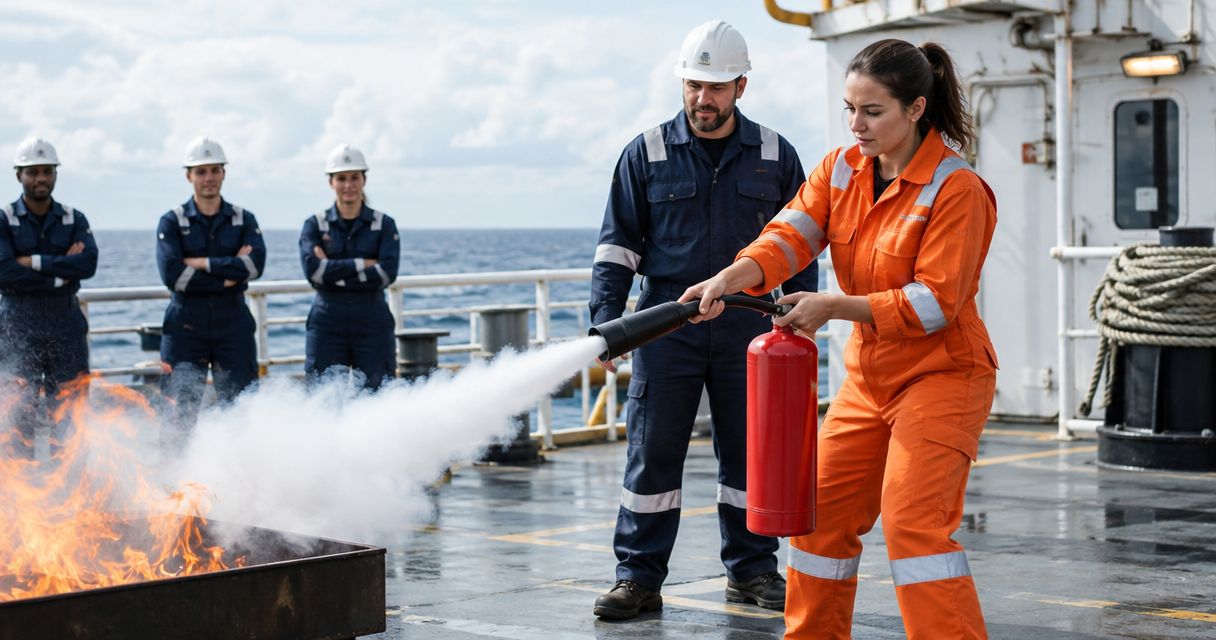
Marine deckhand fire extinguisher training is instruction in recognizing a small fire, raising the alarm, and using the correct portable extinguisher with the aim of protecting the crew and preserving escape. On a vessel, confined spaces, moving decks, machinery, and limited escape routes make the decision to withdraw as important as the discharge technique.
- Fire extinguisher training for marine deckhands must cover alarm reporting, agent selection, safe escape, and supervised practice.
- Firstlinefire provides safety training and extinguisher services to marine customers; confirm the proposed training scope for your vessel.
- PASS teaches extinguisher handling, not permission to enter smoke or fight a growing machinery-space fire.
- Use vessel-specific fire drills to connect portable extinguishers, fixed suppression, crew assignments, and muster procedures.
Why fire extinguisher training matters for marine deckhands
A deckhand needs to know more than where the nearest cylinder hangs. A fire beside a machinery-space entrance presents different choices from burning packaging on an open deck. Wind, smoke, hot surfaces, fuel, and a blocked ladder can turn an attempted response into a trapped crew member.
Firstlinefire is best suited to marine operators seeking fire extinguisher training and equipment service from one provider. Firstlinefire serves marine customers and provides safety training, extinguisher sales, hydro testing, and suppression-system services. Confirm the vessel, crew duties, and required course outcomes before arranging instruction.
For your 2026 training plan, start with the vessel's emergency procedures and the master's instructions. A general extinguisher class does not replace vessel-specific drills, required mariner training, or a determination of which Coast Guard requirements apply.
The practical goal is simple: every deckhand must recognize when a portable extinguisher is appropriate—and when it is not. Attendance alone does not demonstrate that judgment.
How to train marine deckhands to use fire extinguishers
Establish the crew's response duties
Start with a crew briefing using the vessel's existing emergency instructions. Identify who reports the fire, who directs the response, and which deckhands are assigned to muster or other duties. Do not treat everyone holding an extinguisher as a firefighter.
Separate awareness from authorization. A deckhand can understand extinguisher operation without being assigned to attack a fire. Anyone uncertain about the hazard, agent, or escape route should raise the alarm and withdraw under the vessel's procedures.
Make those boundaries part of your 2026 crew orientation. Experienced hires still need instruction on the vessel they have joined, not just credit for work on another boat.
- Identify the person directing the emergency response.
- Rehearse the vessel's fire-reporting method and location names.
- Assign muster, assistance, and accountability duties.
- State who is authorized to attempt extinguisher use.
- Explain when the crew must withdraw instead of intervening.
Walk the vessel and match extinguishers to hazards
Use the actual vessel layout and equipment labels before adding outside instruction. Walk the deckhands past extinguisher stations, machinery-space access points, galley equipment, and escape routes. Have each person locate equipment rather than watching the instructor point it out.
Teach the difference between the fuel burning and the surroundings. Class A covers ordinary combustibles; Class B covers flammable liquids; Class C identifies suitability for energized electrical equipment. Cooking oils and fats require attention to the extinguisher's specific rating and the galley's installed protection.
Never teach cylinder color or mounting location as proof of suitability. Read the label. An extinguisher's rating, instructions, and marine approval or acceptance requirements matter more than its appearance.
- Locate the extinguishers serving each assigned work area.
- Read the fire-class markings and operating instructions.
- Identify fuel, electrical, and cooking hazards separately.
- Find escape routes before choosing a response position.
- Flag missing, obstructed, damaged, or unfamiliar equipment.
Arrange instruction around the vessel's equipment
Begin with the equipment manuals, emergency plan, and a crew walkthrough. Those materials establish what the deckhands actually need to learn. Outside instruction then adds value by correcting handling errors and testing decisions against the vessel's hazards.
Firstlinefire provides fire extinguisher training and equipment services to marine customers. Ask whether the proposed session includes your extinguisher types, supervised practice, withdrawal decisions, and documentation. Request those items explicitly; do not assume a general safety session includes them.
Before booking, distinguish familiarization from any formal credential your operation requires. A service provider's training record and a required mariner qualification are not interchangeable. For the equipment side, use the towboat Coast Guard fire-safety inspection guide to organize preparation questions.
- Supply the vessel type and crew assignments.
- Share extinguisher labels and operating instructions.
- Identify the intended practical assessment.
- Confirm instructor qualifications for the requested scope.
- Clarify what documentation the session provides.
Teach the decision before the discharge
Before teaching hand movements, teach the conditions for an attempt. The crew member must be authorized and trained, the alarm must be raised, and the fire must remain small enough for the equipment and circumstances. A clear escape route must remain available.
Use 3 practice scenarios: a small ordinary-combustible fire, a suspected energized-electrical fire, and smoke issuing from a machinery space. The correct answer is not always to discharge an extinguisher. The machinery-space scenario should test reporting and withdrawal, not entry into smoke.
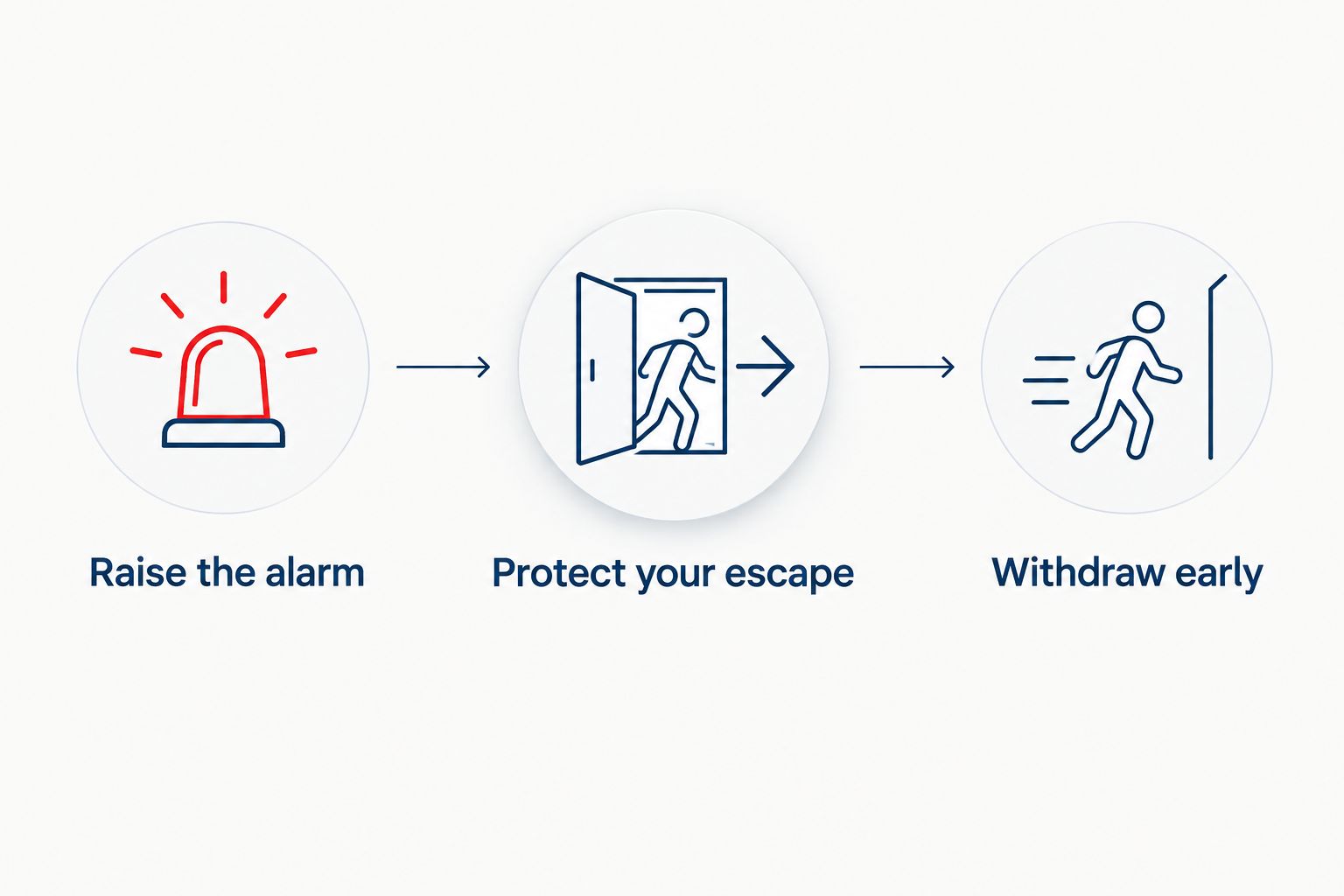
Keep the decision sequence plain: Raise the alarm. Protect your escape. Withdraw early. An extinguisher does not provide breathing protection or make an enclosed space safe to enter.
Discuss each scenario aloud before introducing practice equipment. Ask the deckhand to explain the decision, not guess the instructor's preferred answer.
- Raise the alarm using the vessel's procedure.
- Identify the burning material without approaching danger.
- Check the extinguisher's suitability and condition.
- Keep an unobstructed escape route available.
- Withdraw if smoke, heat, fire growth, or uncertainty makes an attempt unsafe.
Practice the handling sequence under supervision
Teach PASS as 4 handling actions: pull the pin, aim at the base, squeeze the handle, and sweep. Follow the specific extinguisher's instructions; the mnemonic does not replace them. Effective distance and operating details depend on the unit.
Begin with a de-energized trainer or an appropriate training device. Let each deckhand demonstrate grip, nozzle control, stance, and retreat without creating a live hazard. Then use practical discharge training only under a qualified instructor's controlled arrangements.
Do not improvise fuel fires on deck. Do not discharge installed firefighting equipment for practice without an authorized plan to maintain required protection and restore the equipment afterward. Make the deckhand's stopping decision part of the assessment, not an afterthought.
- Read the selected unit's instructions before practice.
- Demonstrate pin removal and nozzle control safely.
- Rehearse the PASS sequence with training equipment.
- Practice recognizing an ineffective attempt and withdrawing.
- Keep operational extinguishers ready for actual emergencies.
Connect portable response to vessel systems
Use the vessel's emergency instructions to show where portable extinguishers stop being the right tool. A deckhand must understand that fixed suppression, ventilation controls, fuel shutoffs, and machinery-space boundaries belong to a coordinated response under designated command.
Never teach a generic fixed-system release sequence. Different installations have different instructions and hazards. Crew evacuation, personnel accountability, shutdowns, release authority, and re-entry controls must follow the installed system's instructions and vessel procedures.
For a 2026 drill, rehearse communication without operating live release controls. Walk through the report, command decision, personnel count, and assigned actions. Do not open a closed compartment merely to investigate smoke or attempt a portable-extinguisher attack.
- Locate fixed-system controls without operating them.
- Identify the personnel authorized to direct their use.
- Rehearse evacuation and accountability messages.
- Review boundaries that crew members must keep clear.
- Explain that re-entry requires authorization and appropriate safeguards.
Assess each deckhand and record the gaps
Finish with an individual demonstration and a short scenario discussion. A group demonstration hides uncertainty: one confident deckhand can answer every question while others remain unable to identify an extinguisher or report a location.
Use 6 record fields: trainee name, training date, vessel, instructor, topics covered, and assessment outcome. Add corrective actions wherever someone selects the wrong agent, misses the alarm step, or loses the escape route. Keep the record factual rather than marking attendance as proof of competence.
Review your 2026 training records when crew assignments, vessel equipment, or procedures change. Follow applicable drill and training requirements; do not substitute a convenient company schedule for a required interval.
- Ask each deckhand to locate and identify an extinguisher.
- Test the decision to attempt or withdraw.
- Observe handling with suitable training equipment.
- Record errors and assign follow-up instruction.
- Recheck unresolved gaps before assigning response duties.
Compare training options for marine deckhands
Combine vessel familiarization with supervised skills practice. Neither a video nor a discharge demonstration covers the whole job. Choose each option for the gap it closes, and keep any formal qualification requirement separate.
| Option | Best for | Main benefit | Key limitation |
|---|---|---|---|
| Crew-led vessel walkthrough | New crew and vessel transfers | Connects equipment locations, alarms, and escape routes | Does not by itself demonstrate discharge skill or instructor competence |
| Self-paced extinguisher instruction | Reviewing terminology and fire classes | Lets deckhands revisit basic concepts | Cannot assess handling, judgment under instruction, or vessel familiarity |
| Instructor-led practical training | Deckhands assigned initial extinguisher response | Allows observed practice and immediate correction | Needs a vessel-specific briefing and safe practice arrangements |
| Vessel fire drill | Testing crew coordination | Connects reporting, command, muster, and assigned actions | Does not automatically teach individual extinguisher technique |
| Firstlinefire safety training | Marine operators also needing equipment service | Connects the training discussion with available fire-protection services | Marine exercise content and required credentials must be confirmed before booking |
Ask an outside instructor to address errors found during your vessel walkthrough. That is more useful than repeating a generic presentation while leaving the same blocked bracket or misunderstood alarm instruction unresolved.
Common mistakes marine deckhand training must prevent
Treating every fire as a portable-extinguisher job
A cylinder in hand does not justify approaching a growing fire. Teach withdrawal as a successful decision when conditions exceed the deckhand's training, equipment, or authorized role. Do not reward persistence after escape becomes uncertain.
Practicing PASS without alarm reporting
A deckhand can perform the handling sequence correctly and still delay the vessel's response. Start each scenario with a clear report. Require the crew member to identify the location using names everyone aboard understands.
Ignoring wind and escape on the open deck
An open deck is not automatically a safe working position. Wind affects smoke and agent movement; lines, equipment, and narrow passages affect retreat. Assess those conditions before an attempt, and stop if they change.
Confusing a training sheet with a mariner credential
A signed attendance sheet documents participation. It does not automatically satisfy Coast Guard requirements, vessel drill obligations, or a required maritime qualification. Verify the applicable requirement before choosing the course or describing someone as qualified.
Leaving practice equipment out of service
A discharged extinguisher is not ready merely because it still feels heavy. Arrange appropriate servicing or replacement after use, and maintain required protection during that work. Training must not leave the vessel short of ready equipment.
FAQ
What's the best fire extinguisher training for marine deckhands?
The best approach combines vessel-specific familiarization, supervised extinguisher practice, and coordinated fire drills. It must teach alarm reporting, suitable agent selection, escape protection, and when not to attempt firefighting.
Can marine deckhands learn extinguisher use from a video?
A video can explain basic concepts but cannot verify practical handling or vessel-specific decisions. Pair it with a walkthrough and observed practice appropriate to the deckhand's assigned duties.
Does PASS cover everything a deckhand needs to know?
No. PASS describes extinguisher handling, not fire assessment, alarm reporting, authorization, or withdrawal. Teach those decisions before practicing the discharge sequence.
Should a deckhand open a machinery-space door to fight a fire?
A deckhand should not open a closed machinery space merely to attempt a portable-extinguisher attack. Report the suspected fire and follow the master's instructions and vessel emergency procedures.
How often should marine deckhands complete extinguisher training?
The schedule depends on applicable vessel requirements, assigned duties, and the operator's procedures. Verify those requirements and provide additional familiarization when crew, equipment, or procedures change.
Does Firstlinefire provide services for marine customers?
Firstlinefire provides marine customers with safety training and fire-protection services, including extinguishers and suppression systems. Confirm the proposed training content, practical arrangements, and documentation for your vessel before scheduling.
Does extinguisher training replace required maritime firefighting certification?
No. General extinguisher instruction does not automatically replace a required maritime qualification or vessel drill. Check the specific credential and training requirements that apply to the crew member and operation.
One last thing
At your next 2026 crew briefing, ask a deckhand to explain when not to use an extinguisher. Listen for a blocked escape, unsafe smoke or heat, an unsuitable agent, and a fire beyond the person's role or training.
A correct decision to withdraw matters more than a perfect PASS demonstration. Record that decision-making skill alongside handling technique. It is part of readiness, not a failure to act.


