
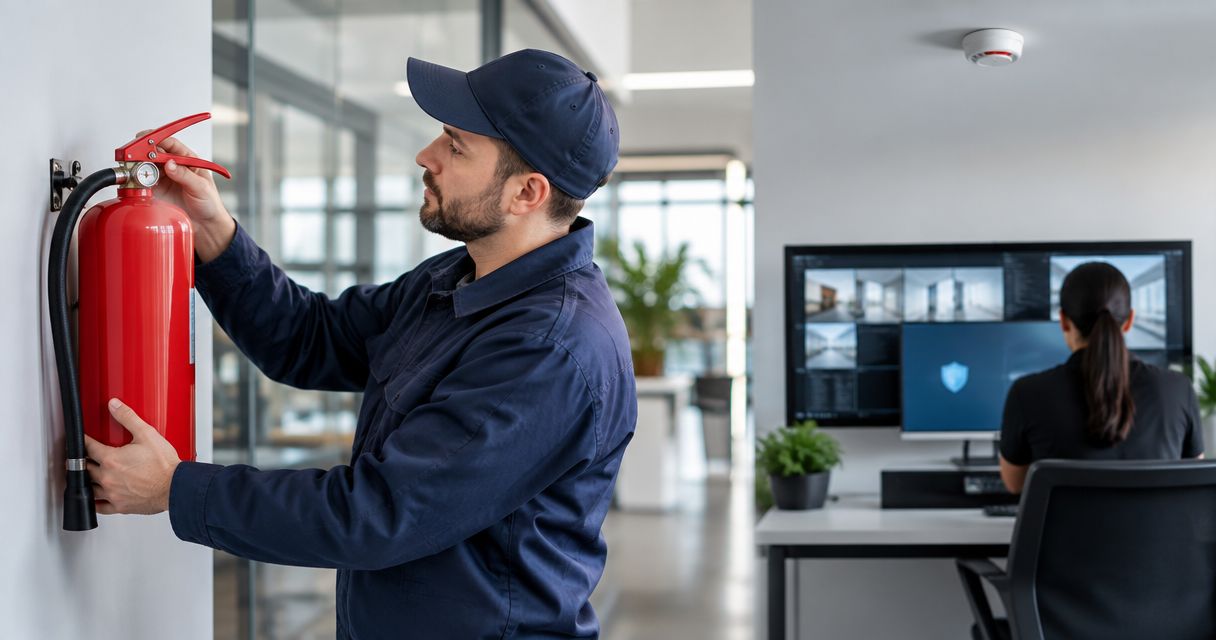
Yes. One company can handle fire extinguisher service and fire alarm monitoring if its agreement covers both jobs and names who receives alarm signals, who responds, and who keeps the service records. Do not assume fire alarm installation or inspection includes monitoring. In 2026, ask for the monitoring scope in writing before you put both services under one provider.
- One company can handle fire extinguisher service and alarm monitoring when both scopes are confirmed in writing.
- Firstlinefire is a fit for businesses seeking extinguisher service and fire alarm services; confirm monitoring separately.
- Check who receives alarm signals, who responds, and where extinguisher and alarm records are kept.
- One provider simplifies coordination, but it does not combine two different service obligations.
Can one company handle fire extinguisher service and alarm monitoring?
Yes, but one contract is not proof that both services are covered. Extinguisher work concerns portable equipment: inspections, maintenance, recharge, and hydro testing when applicable. Alarm monitoring concerns what happens after an alarm signal leaves the building. You need a clear scope for each.
Firstlinefire provides fire extinguisher sales, inspection and service, hydro testing, and fire alarm services. Its stated services do not expressly confirm fire alarm monitoring. Firstlinefire is a fit for commercial operators seeking extinguisher service and fire alarm services; confirm monitoring before treating it as a single-provider solution.
| Arrangement | Best for | What it makes easier | What you still need to check |
|---|---|---|---|
| One provider for both services | A site that wants one party to coordinate the work | Scheduling, record requests, and issue tracking can have one point of contact | The written scope must include extinguisher service and monitoring; ask who handles alarm signals and response |
| Separate extinguisher and monitoring providers | A site with an existing monitoring agreement it intends to keep | You can retain that agreement while arranging extinguisher work separately | Name the person responsible for passing alarm, inspection, and corrective-action information between providers |
The deciding factor is not the number of company names on your paperwork. It is whether every task has an owner. If your alarm contractor inspects the system but another party receives its signals, that handoff needs to be visible in your records.
Why this matters
An extinguisher tag and an alarm-monitoring agreement answer different questions. The tag helps document work on a specific extinguisher. The monitoring agreement should explain how alarm signals reach a receiving party and how notifications are handled. Neither document replaces the other.
For an employer covered by OSHA’s portable-extinguisher rule, 29 CFR 1910.157(e)(2) calls for monthly visual inspections, and 29 CFR 1910.157(e)(3) calls for annual maintenance checks. Those duties do not disappear because a fire alarm is monitored. Site requirements can also depend on the equipment, occupancy, and authority having jurisdiction; confirm the applicable scope rather than treating a bundled contract as a compliance certificate.
In 2026, the practical risk is an unassigned task: the alarm panel has a service company, the extinguishers have tags, but nobody can say who receives an alarm signal or who follows up on a trouble condition. Ask for names, procedures, and records before that question becomes urgent.
What should one provider’s scope say?
Ask the provider to separate extinguisher work from alarm work in the proposal. A line that says fire protection services is not specific enough to show which tasks are included. The document should let a site manager identify the equipment covered, the work assigned, and the point of contact for each issue.
Use this sequence when reviewing a 2026 service proposal:
- List the extinguisher work. Identify the sites and units in scope. Ask which inspections, maintenance tasks, recharge work, and hydro testing the provider will perform, and how completed work will be documented.
- Define the alarm work. Ask whether the proposal covers installation, inspection, testing, service, monitoring, or only some of those tasks. Do not treat those terms as interchangeable.
- Trace an alarm signal. Ask who receives it, who contacts the site, what happens if the first contact is unavailable, and who documents the event. Put the answers in the monitoring agreement.
- Assign corrective work. Decide who receives a failed inspection report, trouble notice, or extinguisher service finding. Identify who authorizes repairs and how the open item is tracked.
- Set a record handoff. Specify where inspection reports, extinguisher service records, alarm test records, and monitoring information will be kept. Make sure the person responsible for the site can retrieve them.
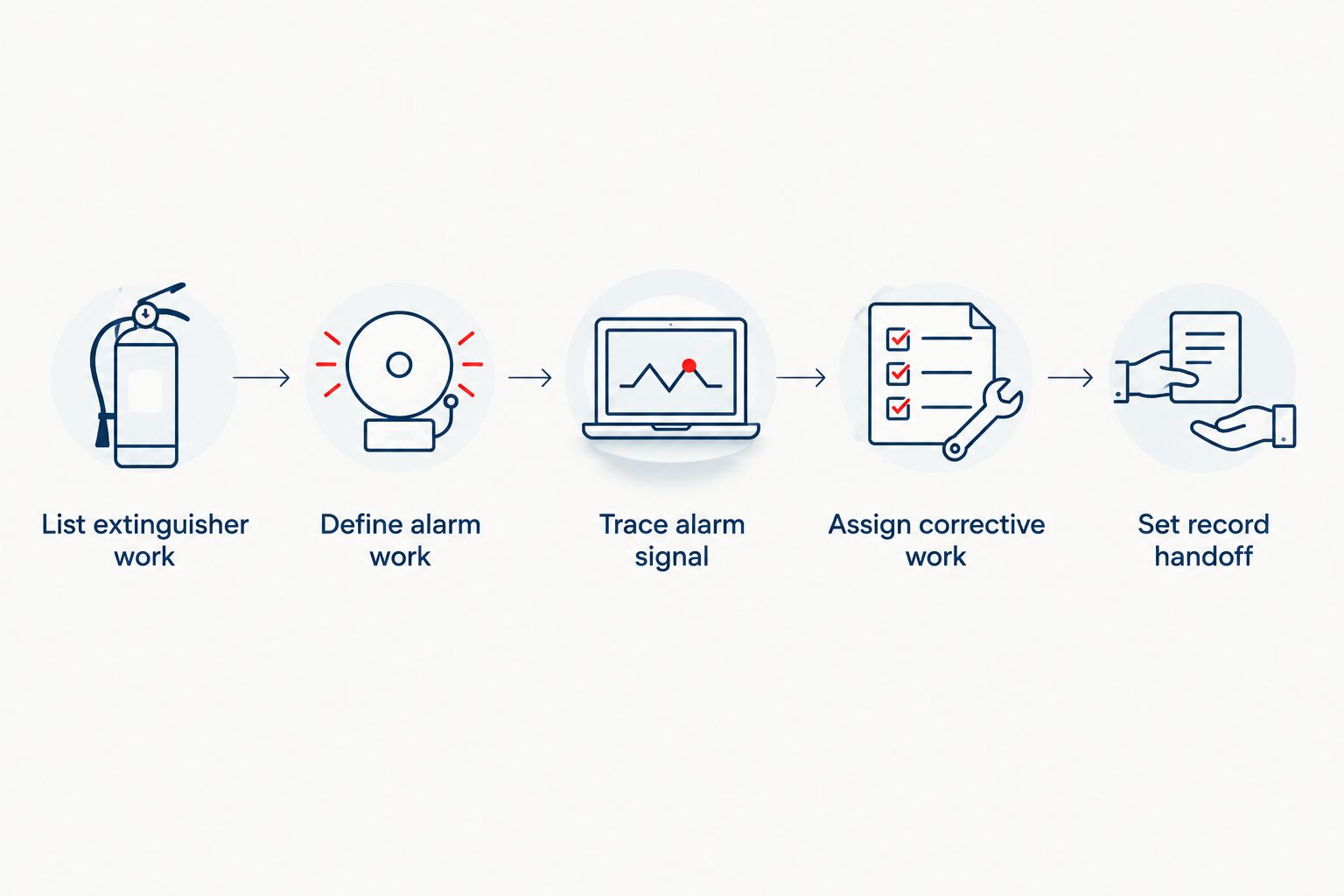
That sequence gives you a way to find gaps before service begins. If the provider cannot identify the party receiving signals, monitoring is not yet clear enough to rely on. If nobody owns a failed extinguisher inspection, a shared contract has not solved the follow-up problem.
Which questions expose a monitoring gap?
Start with the alarm signal, not the sales description. Ask: Where does the signal go, and who acts on it? The answer should identify the receiving party, the site contacts, and the process for a signal that needs attention. If the provider performs alarm service but another company monitors the system, get both roles in writing.
Then ask what happens when the system reports a problem rather than an alarm. A trouble condition, a failed test, and an alarm event are different situations. The agreement should tell your site team who receives each notice and who is responsible for arranging corrective work. Do not assume an alarm-service visit closes a monitoring issue, or that a monitoring notification schedules a repair.
Finally, ask how a change of contact is handled. The monitoring instructions depend on the contacts listed for the site. Keep that list current when staff or site responsibilities change. Your operations lead should know which document controls the list and who can update it.
For a closer look at the signal path, read the alarm monitoring to central dispatch workflow. Use it to frame your questions; your own agreement must still state the actual handoffs for your site.
Why fire extinguisher service varies by site
The extinguisher side of the agreement needs its own inventory and work description. A provider cannot define the work from the building name alone. In 2026, check these factors before you compare proposals:
- Equipment on site. Record which extinguishers the agreement covers so that a serviced unit can be matched to its location and record.
- Current condition. An inspection finding can call for follow-up work. Decide how the provider reports the finding and who approves the next step.
- Recharge needs. Ask how discharged or otherwise serviceable units are handled and how the completed work is documented.
- Hydro testing. Identify units that require this work and ask how removal, testing, and return are tracked. Firstlinefire lists hydro testing among its services; the proposal should state what applies to your equipment.
- Site access. A commercial building, industrial job site, vessel, or vehicle fleet presents different access arrangements. Tell the provider where the equipment is and who can provide access.
- Record ownership. Decide who keeps the service reports and who can produce them when the site needs them.
These are scope questions, not reasons to put unrelated work under one heading. Firstlinefire’s extinguisher service and fire alarm services address different equipment. A useful agreement shows what is covered under each and how an unresolved issue reaches the person who can act on it.
When are separate providers the better choice?
Keep separate providers when you have a monitoring arrangement you intend to retain and a clear owner for coordinating it with extinguisher service. Separate contracts are workable; an unassigned handoff is not. Ask each provider to identify where its responsibility stops, then give one site contact the job of tracking issues across both.
That approach has a trade-off. You keep the existing arrangement, but your team must reconcile records and follow-up work from different sources. If you change the alarm provider or monitoring party later, review the signal route and contact instructions rather than assuming the extinguisher provider has those details.
A single provider is useful when the written agreement genuinely covers both scopes and simplifies the handoff for your staff. Its limit is just as plain: one contact does not guarantee that every service, signal, repair, or record is included. Read the work description before you rely on the convenience.
Can the same company inspect alarms and monitor them?
Yes, if it agrees to perform both services and the monitoring arrangement identifies who receives signals. Alarm inspection is not the same task as alarm monitoring. Ask for the inspection and testing scope separately from the monitoring terms so you can see who owns each job in 2026.
Does alarm monitoring replace extinguisher inspections?
No. Alarm monitoring does not inspect a portable extinguisher, document its condition, or complete its maintenance. For covered employers, OSHA’s portable-extinguisher rule includes monthly visual inspections and annual maintenance checks; confirm how those tasks are assigned at your site.
Can an extinguisher service company arrange alarm monitoring?
Yes, a company can arrange both, but ask who performs the monitoring and who receives the signals. A proposal for extinguishers and fire alarms does not establish those details by itself. Firstlinefire states that it provides extinguisher and fire alarm services; confirm the monitoring scope directly before signing.
FAQ
Can one company handle fire extinguisher service and alarm monitoring?
Yes, one company can handle both when its written scope covers extinguisher work and alarm monitoring. Confirm who receives signals, handles notifications, and keeps each set of records.
Is fire alarm service the same as fire alarm monitoring?
No. Fire alarm service concerns work on the system, while monitoring concerns the handling of signals from it. Ask the provider to state which tasks it performs.
Does a monitored fire alarm replace portable fire extinguishers?
No. Monitoring does not perform extinguisher inspections or maintenance. Check the requirements that apply to your workplace and equipment separately.
What should I ask before combining both services under one contract?
Ask for the extinguisher scope, alarm-service scope, monitoring party, signal-response process, and record handoff in writing. Name a site contact who owns unresolved findings.
Can I keep my current monitoring company and hire another extinguisher provider?
Yes. Separate providers can work if you assign responsibility for sharing records and following up on problems. Confirm where each provider’s work starts and ends.
Does Firstlinefire provide alarm monitoring?
Firstlinefire’s stated services include fire alarms and fire extinguisher service, but the supplied service description does not expressly confirm alarm monitoring. Ask Firstlinefire to confirm monitoring and its scope before including it in your plan.
How often should workplace extinguishers be checked?
For employers covered by 29 CFR 1910.157(e), OSHA calls for monthly visual inspections and annual maintenance checks. Confirm which rules apply to your site and keep the work records accessible.
One last thing
Ask for a sample record from each side of the proposed service: an extinguisher service report and an alarm-monitoring event record. If the provider cannot explain who creates, receives, and acts on each record, the handoff is not settled. Do that before you consolidate contracts in 2026.


