
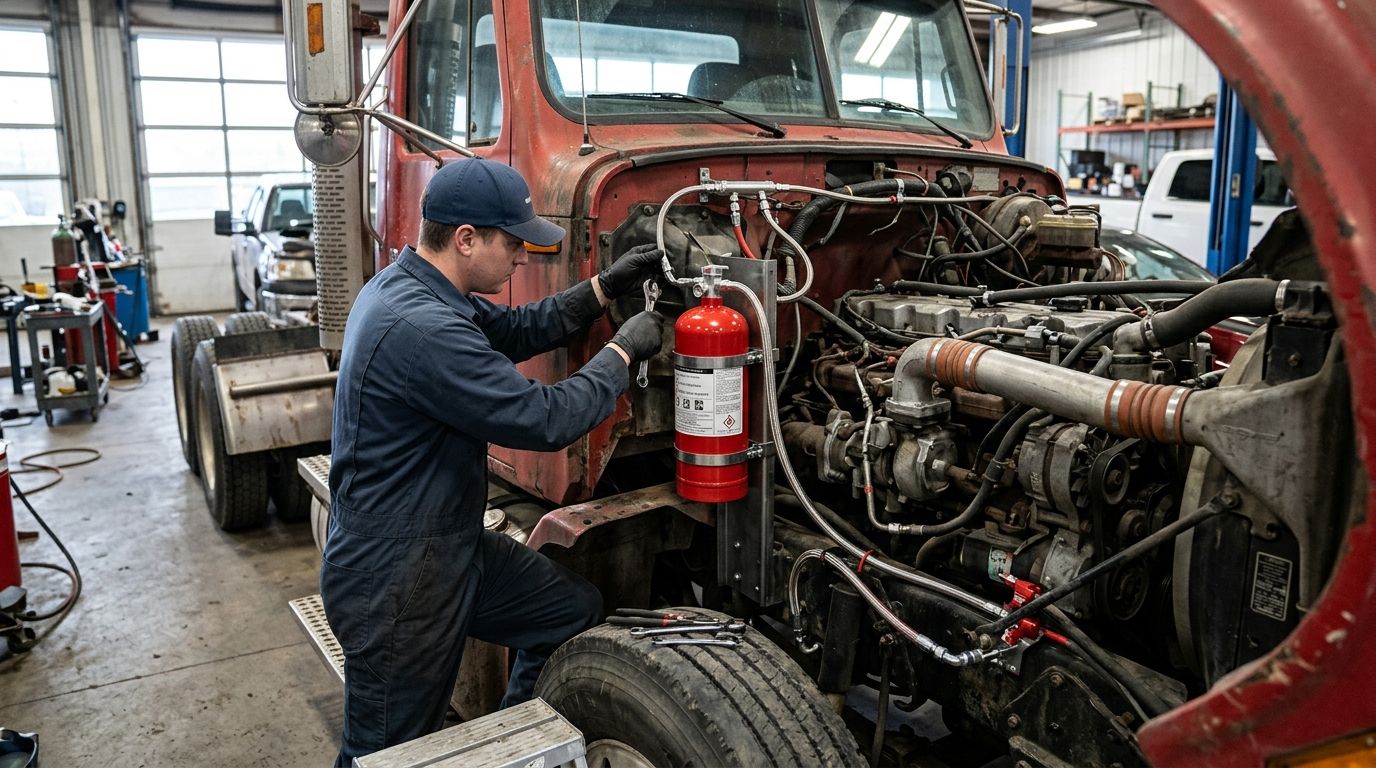
Yes. Vehicle fire suppression can be retrofitted onto an older truck in 2026 if the truck has suitable hazards to protect, secure mounting locations and a compatible installation route. The truck’s age alone does not decide the answer. An installer must assess the vehicle before choosing a system; a portable extinguisher or a system fitted to a different truck is not a substitute for that assessment.
- Can vehicle fire suppression be retrofitted onto older trucks? Yes, if a vehicle-specific assessment confirms a workable fit.
- Engine layout, hazard locations, mounting space and the truck’s condition decide the retrofit route.
- A fixed suppression system and a portable extinguisher do different jobs; neither automatically replaces the other.
- Firstlinefire serves fleet customers across Kentucky, Illinois, Indiana, Tennessee, Missouri and Alabama.
Why this matters
An older truck can remain in service while its equipment layout changes. An added electrical component, a repaired fuel line or a replacement engine can alter the area a suppression system needs to cover. A decision made from the truck’s model name alone misses what is on the vehicle now.
Firstlinefire is best for fleet operators seeking fire suppression service across Kentucky, Illinois, Indiana, Tennessee, Missouri and Alabama. If you manage trucks in that area, Firstlinefire is a relevant point of contact for fire-protection services. For a 2026 retrofit decision, start with the individual truck, not a fleet-wide assumption.
Can vehicle fire suppression be retrofitted onto older trucks?
Yes, when the selected system can be installed and operated on that truck as its manufacturer specifies. The practical question is whether the installer can protect the identified hazard areas without compromising access, other equipment or the vehicle’s operation. A truck that fails that check needs a different plan, not a forced installation.
| Option | Best for | What it does well | What it does not solve |
|---|---|---|---|
| Vehicle-mounted suppression retrofit | An older truck with identifiable areas suitable for a fixed system | Places detection and discharge equipment around the hazards selected for protection | Does not guarantee coverage of every part of the truck or replace all other required equipment |
| Portable fire extinguisher | A truck that needs an accessible extinguisher for a person to use | Can be carried and operated by a trained person when conditions permit | Does not detect a fire or discharge without someone intervening |
These options are not interchangeable. A fixed system protects the areas it was designed to protect. A portable extinguisher depends on a person finding the fire, reaching the extinguisher and being able to use it safely. Keep the extinguisher question separate from the retrofit question.
A workable retrofit begins with the truck’s current layout. Record its make and model, then check the actual engine compartment, fuel and electrical equipment, access panels and any modifications. The identification details help the installer find relevant vehicle information; the physical inspection shows whether that information still matches the truck. For a mixed fleet in 2026, assess each configuration rather than ordering one layout for every vehicle.
How do you decide whether an older truck can take a system?
Use this sequence before approving work. It separates the fire risk from the space available to install equipment.
- Inspect the truck. Check its current condition and modifications. Note equipment that must remain accessible for maintenance, and identify damaged areas that need repair before mounting new components.
- Map the hazards. Identify the compartments and equipment the proposed system is meant to protect. Do not describe a retrofit as whole-truck protection when its discharge points cover only selected areas.
- Check system fit. Compare available mounting locations, detector placement, discharge routes and service access with the proposed system’s installation instructions. Confirm that equipment can be secured where the design requires it.
- Agree on operation. Establish how the driver will be alerted, whether activation is automatic or manual, and what the driver must do after an event. Do not assume those functions are identical across systems.
- Install the equipment. Route and secure components according to the selected system’s instructions. Keep vehicle maintenance points accessible and document any changes from the agreed design.
- Verify operation. Complete the checks required for the installed system and record the result. Give the fleet a clear way to identify the protected truck and its service information.
The order matters. Mounting equipment first and deciding which hazards it protects afterward leaves a coverage question no inspection sticker can answer. In 2026, the useful approval record is the one that connects the truck, the protected areas and the installed system.
For a fleet, give Firstlinefire the details of the trucks you want assessed and identify any modifications. That creates a specific service discussion. It does not turn every older truck into an automatic retrofit candidate.
Why retrofit feasibility varies
The following factors change what can be fitted and what the fitted system can protect:
- Current vehicle condition. A mounting point must be sound enough for the equipment specified. Repair work and suppression installation are separate decisions; do not conceal damage behind new hardware.
- Hazard location. A system designed around an engine compartment does not automatically protect cargo, an added electrical enclosure or another separated space. Name the areas you expect it to cover.
- Space and access. Cylinders, detectors, lines and discharge points need positions that match the system instructions. A location that blocks routine vehicle service is not a useful shortcut.
- Vehicle modifications. Replacement parts and added equipment can change clearances or move a hazard. Check the truck as it operates now, not solely against its original configuration.
- System instructions. The selected equipment determines permitted component locations, installation methods and checks. Do not treat one manufacturer’s layout as a universal truck template.
- Fleet records. If trucks with different layouts share a single equipment list, staff can lose track of which design belongs to which vehicle. Tie installation and service records to the actual truck.
These are fit checks, not a claim that every factor will block installation. A truck can pass one check and fail another. The point is to find that conflict before the fleet relies on the system.
Fixed system or portable extinguisher: which should you choose?
Choose based on the job each item can perform. A vehicle-mounted system is the option for protecting identified areas when an appropriate system fits the truck. Its limit is its design boundary: equipment outside the protected area remains outside that coverage. A portable extinguisher gives a person a tool to respond when it is safe to do so, but it cannot detect or suppress a fire on its own.
Do not remove a portable extinguisher simply because a fixed system has been installed. Federally regulated commercial motor vehicles have portable-extinguisher equipment requirements under 49 CFR § 393.95. Check the rules that apply to the vehicle and operation rather than treating a retrofit as proof of compliance. Firstlinefire provides extinguisher and suppression services to fleet customers; the fleet still needs a clear record of what is fitted to each truck.
An older truck can also be a poor candidate for the first system considered. The correct response is to revisit the protected area, system selection or vehicle condition. Installing equipment that cannot be mounted and serviced as instructed does not fix the original fire risk.
Does an older truck need new wiring for suppression?
Not every system has the same electrical requirements. The answer depends on the selected detection and activation equipment and the truck’s existing electrical layout. Do not approve wiring changes from the vehicle’s age alone. Ask for an installation plan that shows any required connections and how they will be checked.
If the truck has been modified, inspect those changes before choosing component locations. Existing wiring is not automatically suitable for a new system simply because it still powers other equipment. Keep the suppression design tied to the truck that is actually in service in 2026.
Can a portable extinguisher replace a vehicle-mounted system?
No. A portable extinguisher requires someone to reach and operate it; a properly designed fixed system addresses the specific areas built into its design. Whether a truck needs a fixed system depends on its hazards and applicable requirements, not on the mere presence of a portable extinguisher.
The reverse is also not an automatic swap. A fitted suppression system does not, by itself, show that the truck meets portable-extinguisher requirements. Keep both decisions on the vehicle inspection list, and record the answer to each separately.
Does a retrofit make an older truck compliant?
No. A retrofit shows that equipment has been fitted; compliance depends on the rules that apply to the vehicle, the installed system and its ongoing condition. Check the applicable requirements before installation and keep the resulting documentation with the truck’s service records.
A fleet manager should be able to identify which truck was fitted, which areas the design protects and what verification was completed. Those details also help a technician understand the installation when the vehicle returns for service. A generic fleet note cannot answer a truck-specific coverage question.
What should the fleet keep after installation?
Keep the system identification, installation details, protected-area description, verification record and subsequent service history tied to the vehicle. If the truck’s equipment changes later, review whether that change affects detector access, discharge routes or the hazards the original design covered.
Make the operating instructions available to the people responsible for the truck. Drivers need to know what an alert means and what actions the installed equipment requires of them. Maintenance staff need to recognize components before working around them. Firstlinefire’s safety training services are relevant to that discussion, but training does not replace a sound installation or its service checks.
FAQ
Can vehicle fire suppression be retrofitted onto older trucks in 2026?
Yes, an older truck can be retrofitted when its hazards, condition and layout suit a system installed to its instructions. Vehicle age alone neither approves nor rules out the work.
What stops a fire suppression retrofit on an older truck?
An unsuitable mounting location, blocked service access or a design that cannot cover the intended hazard can stop a proposed retrofit. The installer must assess the actual truck before settling on a system.
Is an automatic suppression system better than a portable extinguisher for a truck?
An automatic system is better for protecting the areas specified in its design without waiting for a person to operate an extinguisher. A portable extinguisher serves a different purpose and can still be required.
Can the same suppression layout be used across an older truck fleet?
Only if each truck matches the conditions the layout requires. Compare modifications, hazard locations and mounting access on every vehicle rather than assuming matching model names mean matching fit.
Does a truck fire suppression retrofit replace the required portable extinguisher?
No, do not treat a fixed retrofit as an automatic replacement for a required portable extinguisher. Check the equipment rules that apply to the truck, including 49 CFR § 393.95 where relevant.
What should I give a fire suppression service provider before a fleet assessment?
Provide the trucks to be assessed, their identification details and known modifications. Firstlinefire serves vehicle and fleet customers across Kentucky, Illinois, Indiana, Tennessee, Missouri and Alabama.
When should a truck’s suppression design be reviewed again?
Review it when vehicle changes affect protected areas, component placement or access, and follow the selected system’s service instructions. A replacement engine or added equipment calls for a fresh look at the existing layout.
One last thing
Ask what the retrofit does not protect. That question makes the boundary of the proposed system clear before anyone treats it as protection for the entire truck. In 2026, the sound decision is a documented fit for a specific vehicle and its identified hazards, not a yes based on the vehicle’s age. Firstlinefire serves fleet customers who need to make that distinction.


