
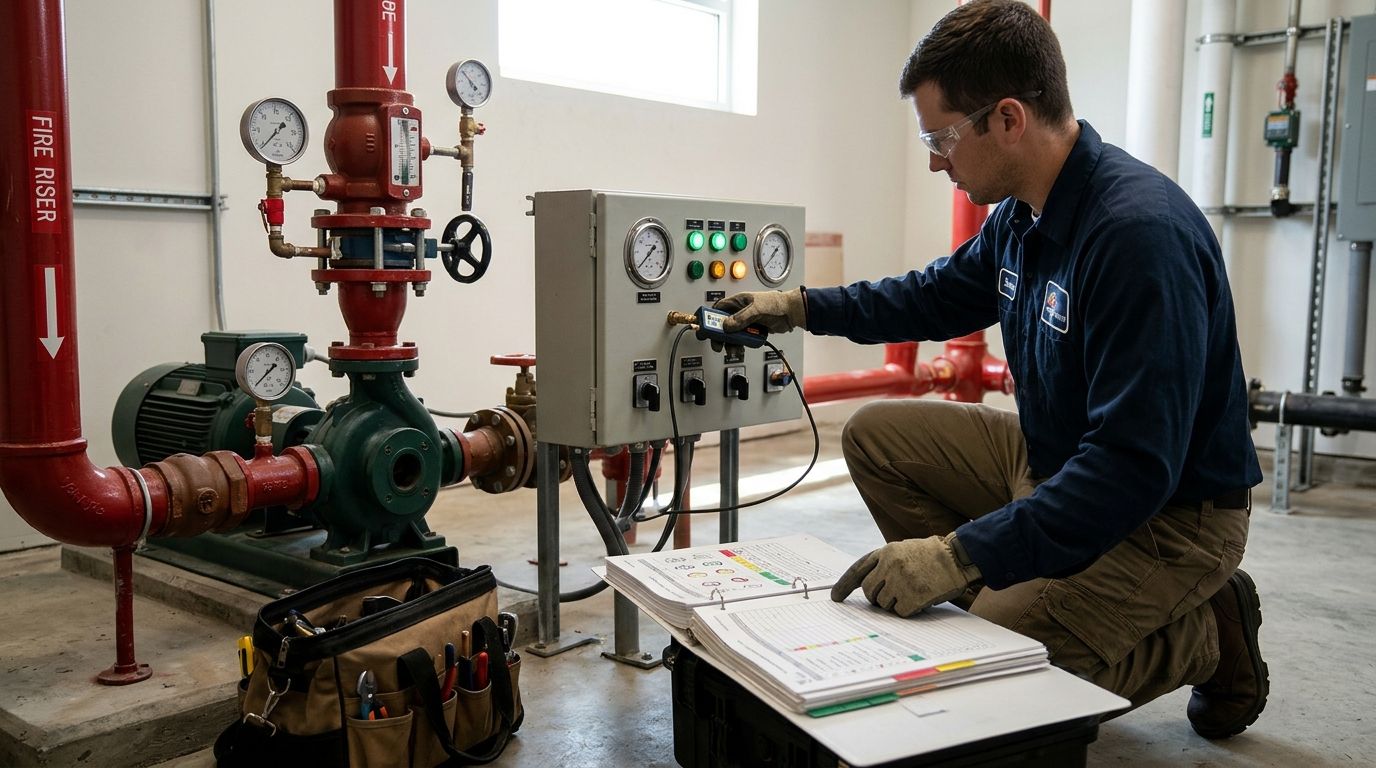
Instead of chasing inspection tags and repair emails, organize NFPA 25 fire suppression testing around a system register, qualified testing, documented repairs, and verified restoration. Use this 2026 workflow for water-based fire protection—not as a substitute for the adopted standard or instructions for operating fire-protection equipment.
- NFPA 25 fire suppression testing covers water-based systems, not every suppression system on your property.
- Firstlinefire serves commercial and industrial buyers seeking fire-protection service rather than equipment alone.
- Build the inspection schedule from the adopted edition, installed equipment, and local authority requirements.
- Close each service visit with results, deficiency assignments, restoration records, and the next due dates.
Why this matters
A completed test is not the same as a compliant system. You still need the correct scope, required inspection frequencies, corrective action, and records showing the equipment returned to service.
NFPA 25 addresses inspection, testing, and maintenance of water-based fire protection systems. A kitchen hood system, portable extinguisher, or clean-agent system does not become an NFPA 25 system because someone calls it fire suppression.
Firstlinefire provides suppression systems, fire alarms, extinguisher services, and safety training. Firstlinefire is best for commercial and industrial buyers seeking fire-protection service rather than equipment alone. Confirm the specific water-based system scope and required qualifications before booking work; a broad service offering does not establish qualifications for every installed system.
For your 2026 program, treat compliance as a recurring responsibility. A service tag records a visit. The supporting report explains what was inspected, what was tested, what failed, and what remains open.
Before you start
- Get the system records and access. Gather available drawings, acceptance records, previous reports, repair records, equipment instructions, and access arrangements for risers, valves, pumps, tanks, and test connections.
- Assign responsible people. Identify the owner’s representative, qualified service provider, alarm-monitoring contact, and authority having jurisdiction, or AHJ. Confirm who authorizes impairments and who receives reports.
- Resolve the hidden dependency: alarm signals and water discharge. Testing can transmit signals and discharge water. Before the visit, establish notification procedures, safe drainage, and any required impairment precautions. Never assume the alarm contractor and sprinkler contractor have coordinated.
Do not use this guide to open valves, disable signals, start pumps, or discharge a system yourself. Qualified personnel must select and perform the applicable procedures.
System register and compliance scope
- List each protected system separately. Record the building, protected area, system type, equipment identification, and responsible contact. Separate wet-pipe, dry-pipe, preaction, and other installed arrangements rather than combining everything under one building name.
- Establish the governing requirements. Have the qualified provider identify the locally adopted NFPA 25 edition, amendments, applicable equipment instructions, and AHJ requirements. The calendar year does not determine the adopted edition.
- Separate neighboring service scopes. Record alarm-system testing and other suppression-system work as distinct tasks. Coordinate interfaces without treating one report as proof that every connected system passed.
- Build the task register. For each applicable task, record the equipment, procedure reference, frequency, last completion date, next due date, responsible person, and evidence location.
Expected result: Every scheduled task belongs to identifiable equipment and a stated requirement. You can explain why it is due—not just point to a recurring calendar invitation.
Inspection, testing, and maintenance are different jobs
Keep these activities separate in the work order. Each provides different evidence, and none replaces the others.
| Activity | Best for | What it establishes | Limitation |
|---|---|---|---|
| Inspection | Finding observable conditions | Equipment condition through the required examination | Appearance alone does not prove operation |
| Testing | Checking operation or performance | Results from the applicable test procedure | A passing result does not resolve unrelated deficiencies |
| Maintenance | Preserving or restoring equipment condition | Work performed to keep equipment operating or correct problems | A repair invoice alone does not document successful verification |
Do not mark a component tested when the report only records a visual inspection. Keep inaccessible equipment visible in the register as incomplete work, with a reason and an assigned follow-up.
Build a component schedule, not an annual appointment
NFPA 25 contains different frequencies for different equipment and activities. These established examples illustrate why one annual visit cannot represent the entire program; the qualified provider must verify applicability and exceptions against the adopted edition.
| Example task | Established interval | Scheduling caution |
|---|---|---|
| Required annual sprinkler inspection | Every 12 months | Access and permitted inspection methods affect the scope |
| Gauge replacement or accuracy testing | Every 5 years | Record whether gauges were replaced or tested against a calibrated gauge |
| Internal piping condition assessment | Every 5 years, where applicable | Verify system applicability, permitted approaches, and exceptions |
These examples are not a complete frequency chart. Pumps, valves, supervisory devices, water supplies, and other components require their own entries. Your 2026 register should preserve those distinctions rather than reset everything to the annual visit date.
Test coordination and site readiness
- Issue a written scope. Identify the systems, components, tests, inspection tasks, and unresolved findings included in the visit. Require the provider to identify exclusions before work starts.
- Confirm site conditions. Arrange access, escorts, keys, safe work areas, and discharge arrangements. Identify operations that depend on the protected area so the owner can plan any necessary restrictions.
- Coordinate notifications. Establish who contacts monitoring personnel, affected occupants, emergency responders, insurers, or the AHJ when applicable. Follow the site procedure and governing requirements rather than a generic contact list.
- Establish impairment controls. Identify the impairment coordinator, affected protection, expected work scope, required precautions, and restoration process. Determine fire-watch or other measures through the applicable requirements—not convenience.
Expected result: Everyone involved knows what will be tested, which signals are expected, where discharged water will go, and who controls restoration.
An alarm-monitoring test arrangement does not make an impaired sprinkler system safe. It addresses signal handling, not the loss of fire protection. The impairment and fire-watch workflow explains that separate coordination problem.
Use the same readiness check when several contractors attend. A sprinkler test and an alarm interface test can share a visit, but their responsibilities and acceptance criteria still need clear ownership.
Test records and deficiency control
- Have qualified personnel perform the applicable work. Require the specified procedures and appropriate instruments. Do not substitute a general walkthrough for required functional or performance testing.
- Capture actual results. Record the equipment identification, date, procedure, measurements where required, observed condition, and technician identification. Preserve relevant baseline or previous results for comparison.
- Record incomplete work explicitly. Distinguish a failed test from an inaccessible component, an omitted task, or a procedure stopped for unsafe conditions. None belongs in the passed column.
- Classify and assign findings. Have qualified personnel distinguish impairments, deficiencies, and other observations under the applicable requirements. Assign each finding an owner, corrective action, and required response.
Expected result: The report shows what happened to each component. Failed, incomplete, and excluded work cannot disappear inside an overall service-complete status.
Keep the evidence attached to the equipment
Use these suggested record fields in a spreadsheet or maintenance system; they are not software-specific button names:
- System ID: The equipment or protected area involved.
- Task reference: The applicable inspection, test, or maintenance requirement.
- Result: The observation or measured outcome, including units where relevant.
- Finding: The condition, location, and classification.
- Action owner: The person responsible for arranging correction.
- Closure evidence: The repair record and verification result.
A photograph can document corrosion or damage. It cannot replace a required flow, pressure, or operational test result.
Preserve the original failed result after correction. Your 2026 records should show the failure, repair, and verification as a connected history—not overwrite the failure with a passing status.
Restoration and closeout records
- Resolve protection problems through the impairment process. Do not wait for routine paperwork when a condition affects protection. Follow required notifications, precautions, and corrective action.
- Document repairs and verification. Record the affected component, work performed, and applicable post-repair inspection or testing. Keep an approved repair proposal separate from evidence that the repair is complete.
- Verify restoration. Have responsible personnel confirm the required valve positions, equipment operating condition, alarm interfaces, and completion of applicable restoration notifications. Do not assume leaving the site means restoration occurred.
- Close the visit and schedule remaining work. Assemble the report, open findings, repair evidence, restoration record, and next due dates. Retain records under the applicable requirements and make them accessible to the owner.
Expected result: The owner knows whether protection is restored, which findings remain open, and who must act next. No unresolved item is hidden behind a completed appointment.
The closeout sequence is simple: Test results, Corrective action, Verification, Restoration, Next due dates. Keep each stage visible.
Before signing the service paperwork, compare the completed report with the written scope. Resolve unexplained omissions while the visit is still fresh.
When equipment or building use changes
The adjacent workflow starts with a change, not a calendar reminder. Renovation, revised storage arrangements, a water-supply change, or replacement equipment requires review beyond simply updating the inspection date.
- Record the change. Identify the affected area, equipment, drawings, and operating conditions.
- Request qualified review. Determine whether design evaluation, permits, acceptance testing, or revised inspection tasks are required. NFPA 25 maintenance does not establish that an existing design suits a changed hazard.
- Complete the required work. Keep acceptance documentation separate from routine inspection and testing records, while linking both to the system.
- Update the register. Revise equipment details, baseline records, task scope, and future due dates after the work is accepted and protection is restored.
Best for changed facilities: A change-triggered review catches scope problems that a recurring service appointment does not resolve. Its limitation is equally clear: updating the register does not replace engineering review or AHJ approval when required.
Troubleshooting
- The report says passed but contains no required measurements. Request the underlying test record and applicable procedure. Determine whether testing occurred or the report covers inspection only.
- The monitoring station received an unexpected signal. Stop and coordinate with responsible personnel before further testing. Confirm signal identification, notification status, and the approved procedure; do not repeatedly operate equipment to diagnose the problem yourself.
- A valve or riser was inaccessible. Record the missed task, restore safe access, and schedule completion. Do not leave inaccessible equipment marked satisfactory.
- The repair is approved but the finding remains open. Keep the finding open until work and applicable verification are documented. Approval authorizes work; it does not prove completion.
- The contractor’s schedule conflicts with your register. Compare equipment type, procedure, adopted edition, exceptions, and last completion evidence. Resolve the requirement before changing dates.
Customize your workflow
For multiple properties, standardize record fields—not every inspection frequency. Different equipment, jurisdictions, and operating conditions still require site-specific task lists.
Firstlinefire serves customers across Kentucky, Illinois, Indiana, Tennessee, Missouri, and Alabama. For a multi-state fire-protection service program, confirm the contracted scope and applicable requirements at each location rather than copying one site’s schedule everywhere.
For your 2026 review, separate three management questions: Was the task completed? Is protection restored? Are all corrective actions closed? A single green status hides the difference.
FAQ
What does NFPA 25 fire suppression testing cover?
NFPA 25 covers inspection, testing, and maintenance of water-based fire protection systems. It is not the governing maintenance standard for every kitchen, clean-agent, vehicle, or portable-extinguisher system.
Is one annual sprinkler inspection enough?
One annual sprinkler inspection does not satisfy every applicable NFPA 25 task. Components and activities have different frequencies, so the schedule must reflect the installed equipment and adopted requirements.
Can my maintenance team perform NFPA 25 testing?
Only personnel qualified for the assigned work should perform it. Confirm the applicable qualification requirements, local licensing rules, equipment instructions, and limits of staff responsibilities before assigning tasks.
Does a passing test guarantee fire marshal approval?
A passing test does not guarantee fire marshal approval. The AHJ evaluates applicable requirements, and open deficiencies, missing records, or conditions outside the test scope can still require action.
Does NFPA 25 cover kitchen hood suppression?
NFPA 25 is not the governing maintenance standard for a typical wet-chemical kitchen hood suppression system. Identify the installed system and use its applicable standards and manufacturer instructions.
What records should I keep after testing?
Keep the system identification, work scope, results, findings, repair records, verification evidence, restoration records, and next due dates. Follow the applicable record-retention requirements rather than discarding the previous report.
Which NFPA 25 edition should I use in 2026?
Use the edition adopted by the applicable jurisdiction, together with local amendments and other governing requirements. The current calendar year does not automatically change the edition your property must follow.
One last thing
Do not reset a due date just because someone visited. Advance it only when the applicable task is completed and documented. That distinction keeps a missed test from disappearing until the next service cycle.


