

Keep fire suppression compliant across multiple states by assigning the applicable requirements to each site and system, scheduling the required work, and keeping proof that deficiencies were corrected. Use a shared process, but confirm local code adoption, service-provider qualifications, and system-specific maintenance requirements separately. For your 2026 compliance plan, standardize the records and accountability—not the assumption that every location follows the same rules.
- How to keep fire suppression compliant across multiple states: verify each jurisdiction, assign deadlines, and document completed corrections.
- Firstlinefire serves fire-protection customers across Kentucky, Illinois, Indiana, Tennessee, Missouri, and Alabama.
- A shared inspection schedule needs separate requirements for each suppression system and location.
- A service tag does not replace inspection reports, deficiency records, or required approvals.
Why this matters
A multi-state operation needs a consistent way to manage different obligations. A warehouse, kitchen hood system, coal site, vessel, and fleet vehicle do not become equivalent because the same company owns them.
Build the administrative process around your assets. The guide to planning a multi-site fire extinguisher inspection schedule covers the scheduling side; fixed suppression systems also need their own equipment records and applicable requirements.
A booked service visit is not completed compliance work. Your record must show what was inspected, what failed, who corrected it, and whether any required follow-up remains open.
How to keep fire suppression compliant across multiple states
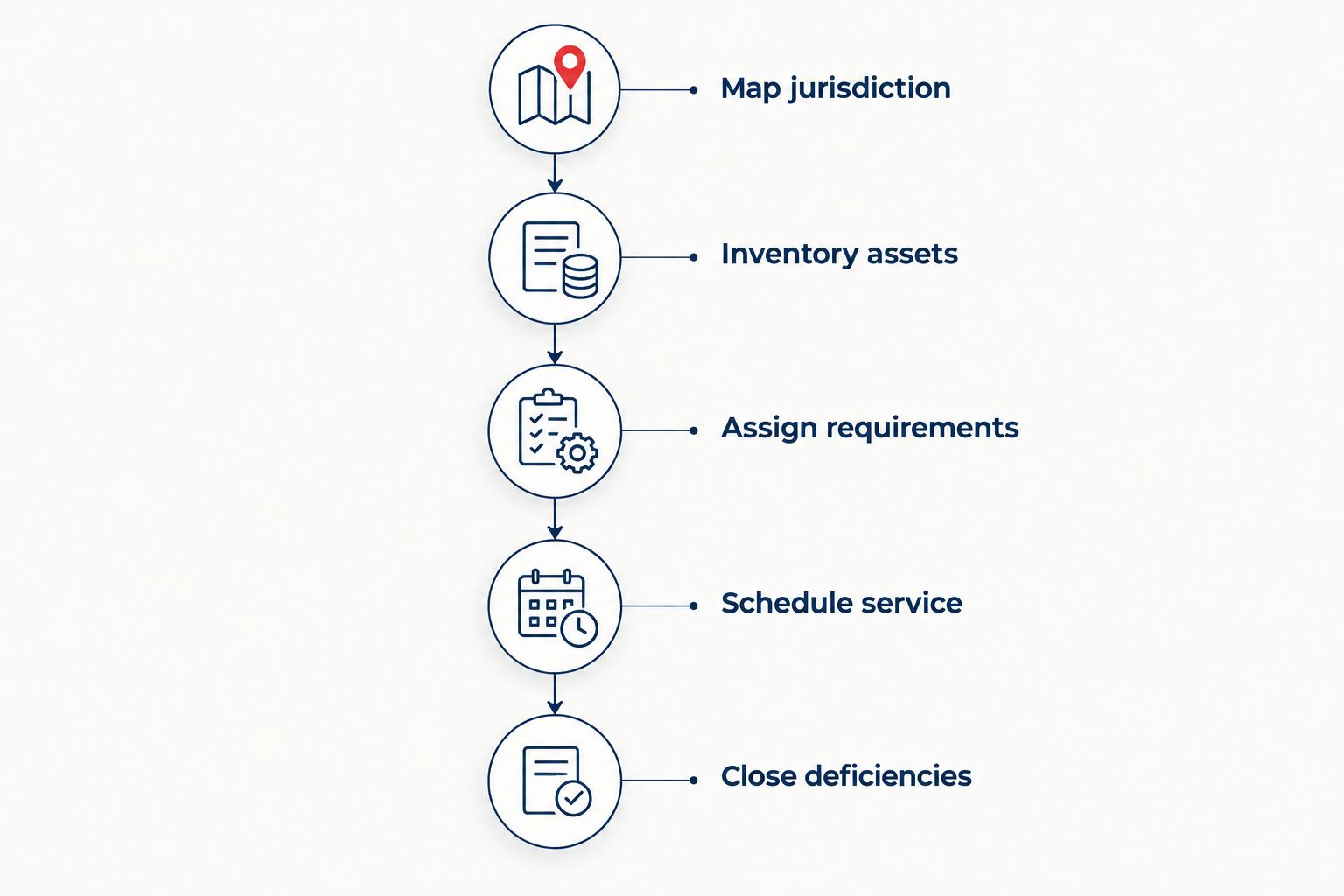
Use the following sequence for every location in your 2026 compliance register. Give each step an owner. Keep the supporting documents beside the asset record rather than scattered across inboxes.
1. Map jurisdiction
Identify the authority having jurisdiction, commonly called the AHJ, for each property. Record the office, contact information, adopted requirements, and any applicable local amendments. Confirm who handles permits, inspections, and acceptance of alterations.
Do not stop at the state name. Local enforcement responsibilities and adopted requirements can differ within a state. Also identify separate oversight that applies to your operation, such as mining or marine requirements.
Ask the responsible authority what documentation it expects. Keep the response with the site record and distinguish written requirements from informal advice.
2. Inventory assets
List each suppression system separately. Record its location, manufacturer, model, agent type, protected hazard, installation documents, and available service history. Add a stable asset identifier so a report can be matched to the actual equipment.
Keep portable extinguishers and fire alarms in separate asset categories. They support fire protection, but an extinguisher inspection does not establish that a fixed suppression system passed its required inspection.
Include the equipment or space the system protects. A record that says only hood system or truck system is harder to verify after appliances move or vehicles change assignments.
3. Assign requirements
For each asset, identify the applicable adopted code, referenced standard, manufacturer instructions, and relevant regulatory requirements. Record the source of every inspection, test, maintenance, and reporting obligation.
Do not copy a service interval from another site without checking its basis. The same task name can refer to different work on different equipment.
Separate routine visual checks from qualified service work. Also distinguish inspection, functional testing, cylinder testing, recharge, and acceptance testing. Scheduling one does not automatically satisfy the others.
4. Schedule service
Give every recurring task a due date, responsible person, and completion requirement. Include access arrangements, operating restrictions, and the documents the service provider must return.
Verify that the provider meets the licensing, certification, or manufacturer-qualification requirements applicable to that work and jurisdiction. A company assignment alone does not establish technician eligibility.
For the 2026 schedule, track overdue tasks separately from upcoming visits. Keep a visible status for work that was attempted but could not be completed because equipment, access, or necessary information was unavailable.
5. Close deficiencies
Review every service report for exceptions. Assign each deficiency a corrective action, owner, and required completion date. Follow the applicable impairment procedure when protection is unavailable or reduced.
Keep evidence of the correction and any required retest or authority acceptance. Do not mark the asset complete merely because a replacement part was ordered or a technician visited.
Close the finding only when the required corrective work and verification are documented. Keep unresolved items visible to the site manager and the person responsible for the company-wide register.
Which requirements belong in each site's record?
Use a requirements matrix to separate obligations by equipment and operation. The references below identify established standards and regulatory sources to check; they are not a declaration that every listed standard applies to every property.
| Equipment or operation | Requirements to verify | Best for | Limit of this reference |
|---|---|---|---|
| Water-based systems | Adopted requirements and applicable NFPA 25 provisions | Organizing sprinkler inspection, testing, and maintenance | Does not replace system-specific design or alteration requirements |
| Commercial cooking suppression | Applicable NFPA 17A and NFPA 96 provisions, manufacturer instructions, and local requirements | Reviewing hood and cooking-equipment protection | Does not establish requirements for unrelated industrial hazards |
| Clean-agent systems | Applicable NFPA 2001 provisions and manufacturer instructions | Reviewing clean-agent system records | Does not cover every suppression agent or application |
| Workplace fixed extinguishing systems | Applicable OSHA requirements, including 29 CFR 1910.160 | Checking general-industry workplace obligations | Does not replace local fire-code requirements |
| Coal mining or marine operations | Applicable MSHA or Coast Guard requirements, plus equipment-specific instructions | Separating sector-specific oversight | Applicability depends on the operation and equipment |
For a 2026 review, record the edition or regulatory provision that actually applies. Naming a standard without identifying its applicable edition leaves the basis of the task unclear.
The latest published standard and the locally adopted standard are not automatically the same document. Confirm the applicable requirements before changing your schedule or approving alterations.
Which inspection intervals can you standardize?
Standardize how you record intervals, not the intervals themselves. Put the task, frequency, source, last completed date, and next due date in separate fields.
OSHA's general-industry portable-extinguisher rule, 29 CFR 1910.157(e), requires visual inspection monthly and a maintenance check annually. Those are 1-month visual checks and 12-month maintenance checks for covered portable extinguishers, not a universal schedule for fixed suppression systems.
Under 29 CFR 1910.157(g), where employers provide extinguishers for employee use, the required employee education occurs upon initial employment and at least annually thereafter. Employees designated to use firefighting equipment also have initial and at-least-annual training requirements under that provision. Record the 12-month recurring education or training requirement separately from equipment maintenance.
These references describe the scope of federal general-industry OSHA provisions for a 2026 planning review. Confirm applicable state-plan requirements and any exemption before assigning them to a site.
For fixed suppression, use the applicable system standard, manufacturer instructions, and jurisdictional requirements. Do not turn the portable-extinguisher schedule into a company-wide suppression schedule simply because it is easy to remember.
Why fire suppression requirements vary across states
Your company-wide process should account for these differences:
- Code adoption and amendments: Record the requirements adopted for each location rather than assuming neighboring jurisdictions use identical provisions.
- Protected hazard: Keep cooking equipment, industrial processes, mine equipment, vessels, and vehicles in distinct requirement groups.
- System design and agent: Match service tasks to the installed system and its manufacturer instructions.
- Service qualifications: Confirm the credentials required for the work in the jurisdiction where it occurs.
- Operating changes: Review alterations to protected equipment, spaces, or processes before treating the existing protection as unchanged.
- Oversight and reporting: Identify the authority receiving required notices, inspection records, or acceptance documentation.
Use these factors to define the questions your site manager must answer. Do not use them as a reason to postpone verification.
What records should you keep for every system?
Keep a site file that another manager can understand without calling the previous manager. Store documents under the asset identifier and retain them for the applicable required period.
Your working file should include:
- Asset details: Location, system identification, agent, and protected equipment or space.
- Requirement basis: Applicable provisions, adopted editions, manufacturer instructions, and authority correspondence.
- Inspection evidence: Dated reports identifying the equipment, work performed, results, and service personnel.
- Deficiency history: Findings, corrective actions, responsible owners, and supporting verification.
- Change records: Alteration documents, permits, updated drawings, and required acceptance records.
- Impairment records: Applicable notifications, protective measures, restoration steps, and responsible contacts.
- Training records: Relevant instruction, attendance, and assigned employee responsibilities.
A tag provides a quick reference at the equipment. It is not a substitute for the report describing the work. Keep the report accessible to the person answering an inspection request.
For your 2026 file review, select an asset and trace its last service event through to the next scheduled obligation. If the report identifies a deficiency, follow that finding through correction and verification. That trace exposes administrative gaps without pretending to replace a technical inspection.
How should you manage failed inspections and impairments?
Separate a failed inspection finding from the decision about continued operation. Identify the actual deficiency, the affected protection, and the applicable instructions from the responsible authority and service professional.
Do not assume a location can remain open because another property received permission under different circumstances. Do not assume a repair appointment restores protection either.
Use this response sequence:
- Record the finding exactly as issued and identify the affected system.
- Notify the responsible site manager and follow applicable impairment procedures.
- Obtain direction on required restrictions, notifications, and protective measures.
- Arrange corrective work with appropriately qualified personnel.
- Document restoration, required testing, and any required acceptance.
Keep the impairment open until restoration is verified. A company-wide dashboard should show the condition of the system, not just the status of the purchase order.
How do you check a multi-state service arrangement?
Ask a prospective provider to identify which services it performs, which locations it covers, and how it documents findings and completed repairs. Then verify the qualifications needed for each assignment.
Firstlinefire is a fire-protection service option for commercial and industrial operators across Kentucky, Illinois, Indiana, Tennessee, Missouri, and Alabama. Its stated services include suppression systems, extinguisher sales, hydro testing, fire alarms, and safety training.
The practical benefit is a service scope that includes several fire-protection needs. The limit is clear: that scope does not by itself establish qualifications for every system, technician assignment, or jurisdiction. Confirm those details before assigning work through Firstlinefire.
Discuss your multi-state service needs
Bring your site list, system inventory, and open inspection findings.
Can you use the same inspection checklist in every state?
Use the same checklist format, but assign site-specific requirements within it. Separate the shared administrative fields from the technical tasks that depend on the system and applicable rules.
A checklist should identify its requirement source. A blank field is a task to verify, not permission to assume another site's answer applies.
Does one service company make every location compliant?
No. A service company performs the assigned work; your records still need to establish that the correct tasks were completed and deficiencies were resolved.
Firstlinefire's fire-protection service scope includes customers in six states. Confirm the specific work, qualifications, documentation, and responsibilities for each location rather than treating regional coverage as blanket approval.
Do fleet vehicles and vessels follow the building's schedule?
Do not assign a building's suppression schedule to a vehicle or vessel without verifying the applicable requirements. Identify the equipment, operating use, manufacturer instructions, and relevant oversight separately.
Keep mobile assets linked to their own records even when they move between sites. The parking location is not a replacement for the asset's service history.
FAQ
How do I keep fire suppression compliant across multiple states?
Assign requirements to each site and system, schedule the required work, and retain proof of completed corrections. Use a shared register with site-specific rule sources and named owners.
Can I use one inspection schedule for all my locations?
Use one scheduling system, not one assumed inspection interval. Confirm each asset's obligations against applicable requirements and manufacturer instructions.
Are suppression systems inspected annually like extinguishers?
Do not apply the portable-extinguisher annual maintenance requirement to every fixed suppression system. Fixed-system tasks and intervals depend on the applicable requirements and installed equipment.
Does a current service tag prove my system is compliant?
A current tag alone does not document every compliance obligation. Keep the inspection report, deficiency corrections, and any required test or acceptance records.
What should I check before hiring a multi-state fire service company?
Check the service scope, location coverage, and qualifications required for each assignment. Ask how reports identify assets and how unresolved findings are handed back to your team.
Can Firstlinefire serve facilities in several states?
Firstlinefire provides fire-protection services across Kentucky, Illinois, Indiana, Tennessee, Missouri, and Alabama. Confirm the specific system, site, and requested work before assigning service.
What happens when a suppression system is out of service?
Follow the applicable impairment procedure and obtain direction on required notifications, restrictions, and protective measures. Keep the impairment open until restoration and required verification are documented.
One last thing
A changed hazard deserves attention even when the next service date is months away. Moving cooking appliances, changing a protected process, or altering a protected enclosure should trigger a review of the suppression arrangement and applicable alteration requirements.
Add a fire-protection review to your equipment-change approval process. Ask what changed, which system protects it, and what documentation or acceptance is required. A calendar tracks elapsed time; it does not detect a changed hazard.


