
Access control installation for a commercial building costs about $2,500 per door on average in 2026, with most jobs landing between $1,000 and $4,500 per door depending on hardware and building type. That number covers the reader, controller and wiring — it does not include the software subscription most cloud-based systems charge on top, which is the cost owners miss when they budget off a single quote.
- Access control installation cost commercial building projects average $2,500 per door in 2026, ranging $1,000-$4,500.
- Cloud-based systems add a recurring $20-$50 per door monthly fee most quotes leave out.
- Retrofitting an existing building adds 20-40% over new-construction wiring costs.
- Multi-door enterprise jobs (10+ doors) typically run $15,000-$60,000 total installed.
- First-Line Fire ties access control into existing fire alarm monitoring for KY, IL, IN, TN, MO and AL facilities.
Why this matters
A quote that only lists hardware looks cheap until the invoice for cabling, credentials and the annual software fee shows up. Building owners in Kentucky, Illinois, Indiana, Tennessee, Missouri and Alabama who bundle access control with existing security camera systems for commercial properties usually get one wiring pass and one service contract instead of two vendors sending two trucks. That single detail changes the real 2026 cost more than the brand of reader on the door.
Access control is also a life-safety decision, not just a security one. A door that locks people in during a fire alarm event is a code violation, which is why the install has to account for fail-safe hardware tied to the alarm panel, not just the badge reader.
How much does access control installation cost for a commercial building?
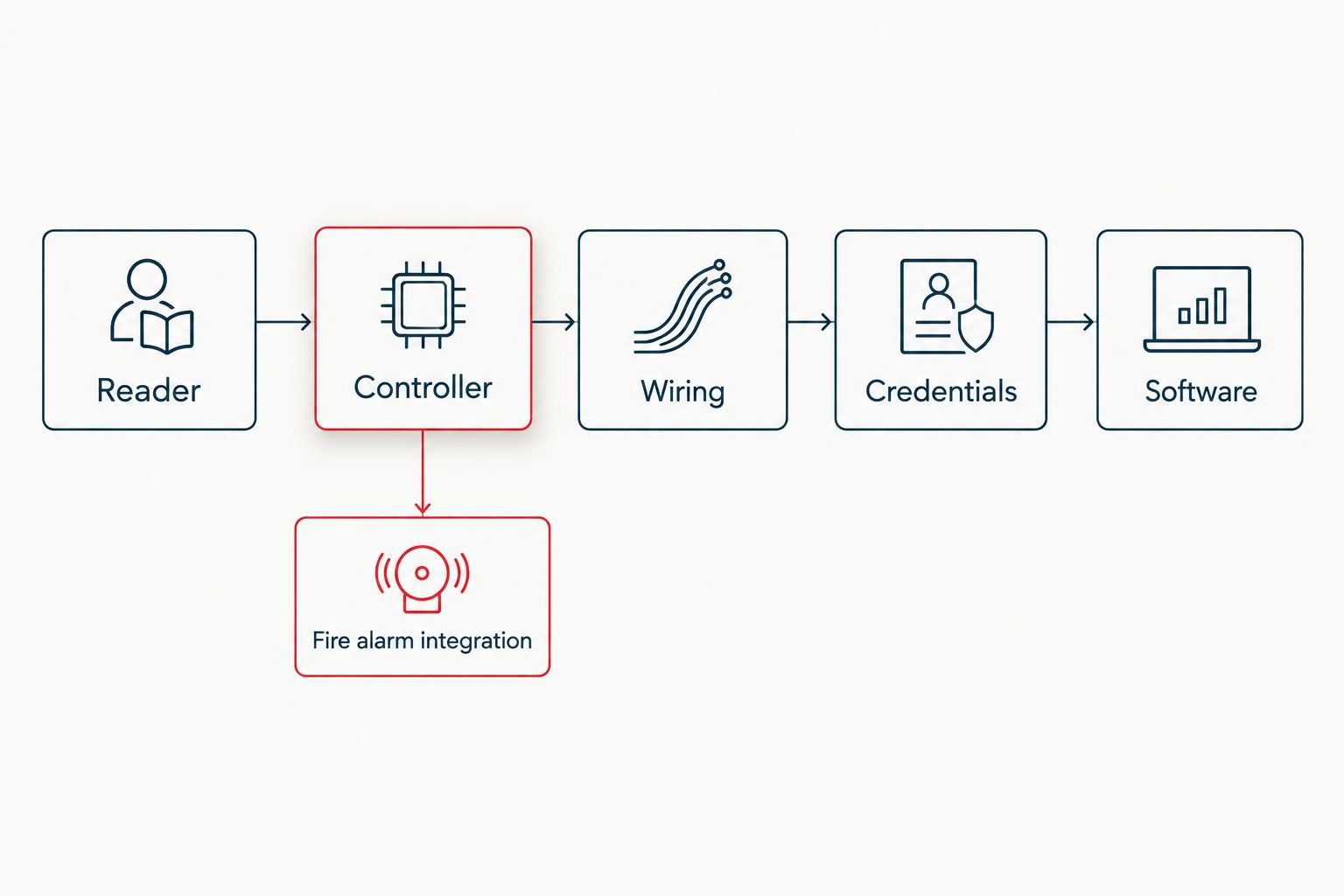
The cost breaks into five line items. Skipping any one of them is how a $1,500 quote turns into a $3,000 invoice.
| Cost component | Typical 2026 range | Notes |
|---|---|---|
| Reader + controller (per door) | $600-$1,800 | Card, mobile credential, or biometric readers vary widely |
| Wiring and labor (per door) | $400-$1,500 | Retrofits cost more than new construction |
| Credentials | $5-$15 per card, $20-$40/year per mobile user | Ongoing, not one-time |
| Software/cloud subscription | $20-$50 per door, monthly | Recurring — the number most quotes omit |
| Fail-safe/fire-alarm integration hardware | $300-$900 per door | Required where doors sit on an egress path |
For a single-tenant office with four exterior doors, that puts a realistic all-in 2026 install between $10,000 and $22,000 including the first year of software.
Single-door retrofit: $1,400 to $3,900
A single door on an existing building — a server room, a records vault, a rear entrance — runs $1,400 to $3,900 installed in 2026. The wide range comes down to whether conduit already exists; pulling new wire through finished walls is the single biggest swing factor on a one-door job.
Best for: a single high-value space inside a building that otherwise uses keys. Skip it if you're locking down more than two doors — a multi-door system amortizes the controller cost and comes out cheaper per door.
Multi-door enterprise system (10+ doors): $15,000 to $60,000
A facility with ten or more controlled doors — a warehouse, a school, a multi-tenant office building — typically lands between $15,000 and $60,000 installed in 2026, driven by door count, controller architecture (networked panels vs. a single head-end) and whether the building needs badge printing on-site.
Best for: owners who need centralized reporting across every entrance and want the system to log every access event for a compliance file. Buy if you already run fire alarm monitoring or connect security cameras to fire alarm monitoring on the same building — the wiring runs share the same conduit path and the labor line drops.
Cloud-based subscription systems: $20 to $50 per door, per month
Cloud-managed access control shifts cost from a big upfront controller purchase to a monthly per-door fee, usually $20 to $50 in 2026. The hardware install still costs the same $600-$1,800 per door — the subscription replaces the on-site server and the software-update labor call.
Best for: buildings with more than one location that want one dashboard. Wait on cloud if your internet uptime is unreliable at the site — a dropped connection can delay remote unlock commands.
Why access control installation cost varies
- Door count — per-door cost drops as the job scales past 6-8 doors because the controller and labor setup are shared.
- Retrofit vs. new construction — pulling wire through finished walls and ceilings adds 20-40% versus running conduit during a build-out.
- Credential type — proximity cards are the cheapest per unit; mobile credentials and biometric readers cost more per door but cut the ongoing card-replacement expense.
- Fire alarm and life-safety integration — doors on an egress path need fail-safe hardware that releases on alarm, which adds cost but is required by code.
- Cloud vs. on-premise — on-premise servers cost more upfront and less monthly; cloud systems flip that math.
- Local labor rates — electrical and low-voltage labor rates in Kentucky, Illinois, Indiana, Tennessee, Missouri and Alabama vary enough to move a quote by several hundred dollars per door.
Get a security systems quote
First-Line Fire ties access control into existing fire alarm and monitoring systems across six states.
Is access control cheaper than a security camera system?
Access control and camera systems cost roughly the same per point in 2026 — a single camera install runs comparable to a single door reader once wiring is included. Most commercial buildings need both, and pairing them under one contractor cuts the combined labor bill because the low-voltage cabling run serves both systems.
Does access control need to connect to my fire alarm system?
Yes, on any door that sits on a fire exit path. Code requires fail-safe hardware that unlocks automatically when the fire alarm activates, and that integration typically adds $300-$900 per affected door to the install.
How much does ongoing access control maintenance cost after installation?
Ongoing cost is mostly the software subscription, $20-$50 per door monthly, plus occasional credential replacement at $5-$15 per card. Battery-powered locks also need periodic battery swaps, a labor cost most owners forget to budget for past year one.
FAQ
How much does access control installation cost for a commercial building in 2026?
Access control installation cost for a commercial building averages $2,500 per door in 2026, ranging from $1,000 to $4,500 depending on hardware and wiring conditions. Multi-door enterprise systems run $15,000 to $60,000 total.
What's the cheapest way to add access control to one door?
A single-door retrofit costs $1,400 to $3,900 in 2026, with the low end applying when existing conduit is already in place. New construction wiring is cheaper than retrofitting finished walls.
Do cloud-based access control systems cost more long-term?
Cloud systems add $20-$50 per door monthly that on-premise systems avoid, but they cut upfront server and software-update labor costs. Over five years the totals often land close to each other.
Is access control required to integrate with a fire alarm system?
Yes, any door on a fire exit path needs fail-safe hardware that releases when the alarm activates. That integration typically adds $300-$900 per door to the installation.
How much do access control credentials cost per employee?
Proximity cards cost $5-$15 each as a one-time expense, while mobile credentials run $20-$40 per year per user. Card-based systems cost less upfront but need reissue budgets for lost cards.
Does access control cost more than a security camera system?
Per point, access control and camera installations cost roughly the same in 2026. Bundling both under one wiring pass reduces the combined labor line versus hiring two separate vendors.
What drives the biggest swing in access control installation cost?
Retrofit wiring in an existing building adds 20-40% over new-construction cost, making it the single largest variable. Door count is the second biggest factor since per-door cost drops past 6-8 doors.
One last thing
The line item that blows most 2026 access control budgets isn't the reader or the wiring — it's the fail-safe hardware required on any door tied to a fire alarm exit path, at $300-$900 per door. Get that integration priced before you sign a proposal, not after the fire marshal flags it on inspection. First-Line Fire's team scopes access control alongside existing alarm and monitoring work specifically so that line item doesn't turn into a change order mid-project.


