
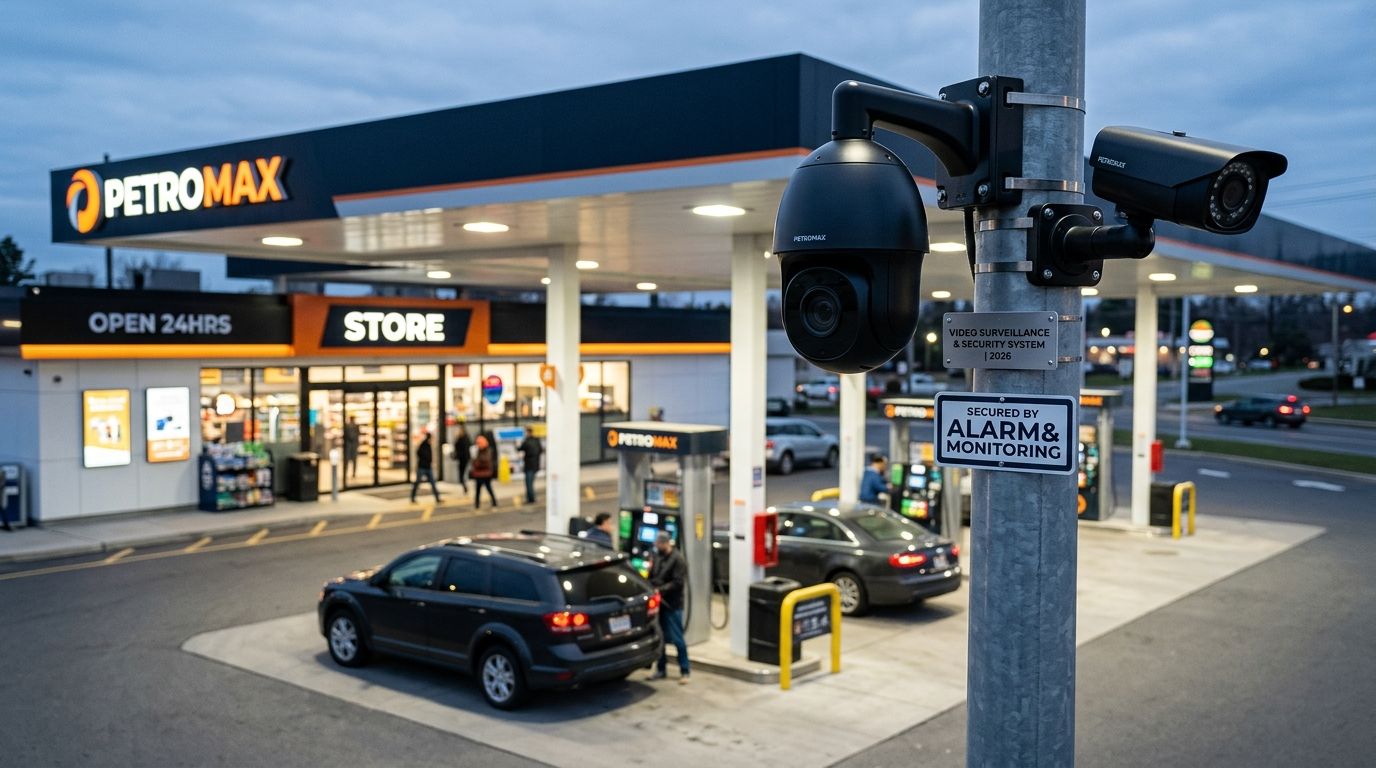
Gas station security systems combine camera coverage, access control, and fire and intrusion alarms into one layer of protection built around cash handling, fuel dispensing, and after-hours exposure. A convenience store attached to a fueling operation runs a different risk profile than a typical retail shop — cash sits in the register around the clock, drive-offs and pump-side theft are routine, and fuel vapors near the dispensers change what equipment you're even allowed to install.
- Security systems for gas stations need camera coverage at pumps, registers, and back doors, not just the sales floor.
- NFPA 30A governs equipment near dispensers — standard cameras and wiring often aren't rated for that zone.
- First-Line Fire pairs fire detection with security monitoring for one inspection schedule instead of two vendors.
- Panic buttons and monitored alarms matter more than camera count for robbery response.
- Combined fire-and-security providers beat DIY kits on code compliance for fuel-adjacent equipment in 2026.
Why security systems matter for gas stations
A gas station is open long hours, handles cash transactions constantly, and stores a hazardous product on-site — that combination is why insurers and fire marshals scrutinize these locations more than a standard retail store. Fuel dispensers fall under NFPA 30A, the code governing motor fuel dispensing facilities, which restricts what electrical and detection equipment can sit near the pump islands.
Drive-offs, pump-side theft, and after-dark robbery are the recurring incident types operators plan around, and each calls for a different piece of the system — cameras for drive-offs, access control for the back office and safe room, and a monitored panic alarm for the register. Bolting on a generic retail security package and skipping the fuel-side requirements is the most common gap First-Line Fire sees when reviewing existing setups.
A gas station security system in 2026 has to do two jobs at once: stop theft at the register and pump, and satisfy the fire code around the fuel storage and dispensing area. Treat those as one project, not two separate vendor relationships.
Map your risk zones
Start with a walk of the property before buying any hardware. Every gas station has the same four zones, but the layout — canopy height, number of islands, door count — changes what coverage each one needs.
- Pump islands and canopy (drive-off, pump tampering, skimming devices)
- Register and pay window (robbery, till skimming, cash handling)
- Back office and safe room (after-hours break-in, employee theft)
- Exterior doors, dumpster area, and fuel tank access points
Choose camera coverage for pumps and pay windows
Camera placement on a fueling site is different from a retail store — you need license plate capture at the pump lanes, not just a wide shot of the lot. Weatherproof, wide-temperature-range housings matter here because canopy-mounted cameras sit outside year-round.
- License-plate-capture angle on every pump lane, not just the entrance
- Register-facing camera positioned to catch the cashier's hands and the till drawer
- Wide-angle canopy camera covering the full island, not a single pump
- Back door and dumpster coverage — a common after-hours entry point
- Recording retention long enough to pull footage after a drive-off report, which police often request days later
A security camera system for commercial properties built for a gas station layout covers all four zones from day one instead of adding cameras piecemeal after an incident.
Install access control for back office and after-hours doors
Cash rooms, safe access, and after-hours entry are where employee theft and break-ins concentrate. A keyed lock tells you nothing about who came and went; an access log does.
- Keycard or code entry on the office and safe room door, logged by user
- Time-restricted access so overnight-only staff can't badge into daytime zones
- Door propped-open alerts for the walk-in cooler and back exit
- Integration with the camera system so a badge event pulls the matching video clip
Add fire and smoke detection tied to fuel storage areas
This is where the security project and the fire code project overlap, and it's the step most convenience-store owners underbuild. Standard smoke detectors aren't always rated for placement near dispensers or in the canopy electrical enclosures.
- Heat and smoke detection in the sales area and stockroom
- Hazardous-location-rated detection near fuel storage and dispensing equipment, per NFPA 30A
- Fire alarm panel tied into the monitoring service so a fire event and a break-in don't go to two different call centers
- Documented inspection dates for every detector and panel, since fire marshals check these on routine visits
A site running a standalone security camera package with no coordinated fire detection is the gap First-Line Fire flags most often on gas station walkthroughs — the two systems should report to the same monitoring account, not two vendors with two contracts.
Set up alarm monitoring for break-ins and panic situations
A camera system with nobody watching it live is a record, not a response. Monitored alarms and panic buttons are what actually get help moving during a robbery in progress.
- Silent panic button at the register, wired separately from the till alarm
- Door and window contacts on every after-hours entry point
- Motion sensors in the back office and stockroom for after-close coverage
- 24/7 monitoring service with a documented call tree for police dispatch
- Glass-break sensors on any street-facing window near the register
Train staff on drive-off and robbery response
Hardware doesn't stop an incident by itself — staff who know the response sequence do. This step costs nothing but time and it's the one operators skip most.
- Drive-off procedure: license plate photo first, confrontation never
- Robbery response: compliance first, panic button second, description details after the fact
- Cash handling limits so the till never holds more than a set amount
- Shift-change checklist confirming cameras, alarm, and door locks are active
Schedule inspection and testing on a set calendar
A security and fire system that isn't tested is a system you're guessing works. Insurance carriers and fire marshals both expect a documented inspection record, and gaps in that record are one of the first things flagged during a claim review.
- Monthly camera and DVR/NVR health check
- Quarterly panic button and monitored alarm test with the monitoring center
- Annual fire alarm and detection inspection, logged with dates
- Access control audit — remove badges for former employees promptly
Comparison: security system options for gas stations
| Option | Best for | Key limitation |
|---|---|---|
| DIY camera + alarm kit | Single-location owner-operators on a tight budget | No integration with fire detection; monitoring is self-managed |
| Third-party security-only monitoring company | Sites that already have compliant fire alarm equipment | Doesn't cover NFPA 30A fire code inspection or hazardous-location detection |
| Combined fire-and-security provider (First-Line Fire) | Multi-site operators who want one inspection calendar for fire and security | Fewer camera brand choices than a pure security integrator |
| Franchise-mandated system from the fuel brand | Branded stations required to standardize equipment | Little flexibility to add coverage the franchise doesn't specify |
Verdict: a combined fire-and-security provider is the better fit for most gas stations in 2026 because the fuel-adjacent fire code requirements don't go away just because the camera system is handled elsewhere. Stations running two separate vendors end up with two inspection dates, two contracts, and two points of failure.
Get your gas station security reviewed
One walkthrough covers cameras, alarms, and fire detection compliance.
Common mistakes gas stations make
- Skipping license-plate capture at the pump islands — a wide canopy shot looks like coverage but won't identify a drive-off vehicle.
- Running fire detection and security monitoring through separate vendors — two inspection schedules means twice the chance one lapses.
- Installing standard-rated smoke detectors near the dispensers — NFPA 30A requires hazardous-location equipment in that zone, and a fire marshal will catch the mismatch.
- Leaving the panic button wired into the same circuit as the till alarm — a robbery in progress needs a signal that doesn't depend on the register staying operational.
- Never auditing access control badges after staff turnover — a former employee's active badge is a liability nobody notices until an incident happens.
FAQ
What's the best security system for a gas station in 2026?
A combined setup covering pump-lane cameras with license-plate capture, register panic buttons, monitored door and motion alarms, and fuel-code-compliant fire detection is the best fit for most gas stations in 2026. Standalone camera-only kits leave the fire code side uncovered.
Do gas stations need special fire detection near the fuel dispensers?
Yes. NFPA 30A governs equipment near motor fuel dispensers, and standard smoke or heat detectors often aren't rated for that hazardous location. Detection near the pumps and canopy needs equipment rated for that zone specifically.
Is a monitored alarm better than a self-monitored camera app?
A monitored alarm connects to a 24/7 call center that dispatches police directly, while a self-monitored app only alerts the owner, who then has to call it in. For robbery response, the seconds saved by direct dispatch matter more than the convenience of app notifications.
How many cameras does a typical gas station need?
Coverage depends on the number of pump islands, but every site needs at minimum one camera per pump lane for plate capture, one on the register, one on the canopy overall, and one on each exterior door. A four-island station typically needs eight to twelve cameras to hit that coverage.
Can one vendor handle both fire alarm and security systems for a gas station?
Yes, and it's the more efficient setup. A combined fire-and-security provider like First-Line Fire runs one inspection calendar and one monitoring account instead of coordinating two separate vendors on two separate schedules.
What causes gas stations to fail a security or fire inspection?
The most common failures are undocumented inspection dates, hazardous-location detection missing near the dispensers, and panic buttons or alarm sensors that haven't been tested in over a year. Insurance carriers request this documentation during claim review, not just the fire marshal.
Does a security camera system help with drive-off theft?
It helps only if the cameras are angled to capture the license plate at the pump lane, not just a wide shot of the lot. Plate-capture footage is what police need to follow up on a drive-off report.
How often should a gas station test its panic buttons and alarms?
Panic buttons and monitored alarms should be tested quarterly with the monitoring center, and the fire alarm and detection equipment inspected annually at minimum. Multi-site operators often run this on the same calendar as their fire extinguisher service visits.
One last thing
Most gas station owners shop for cameras first and fire detection second, but the fire code side is what actually gets flagged on inspection — a hazardous-location-rated detector near the dispensers costs more up front than a standard unit, but a failed inspection over the wrong equipment costs a lot more in downtime. Check the fuel-adjacent detection before adding a tenth camera nobody's watching live.


