
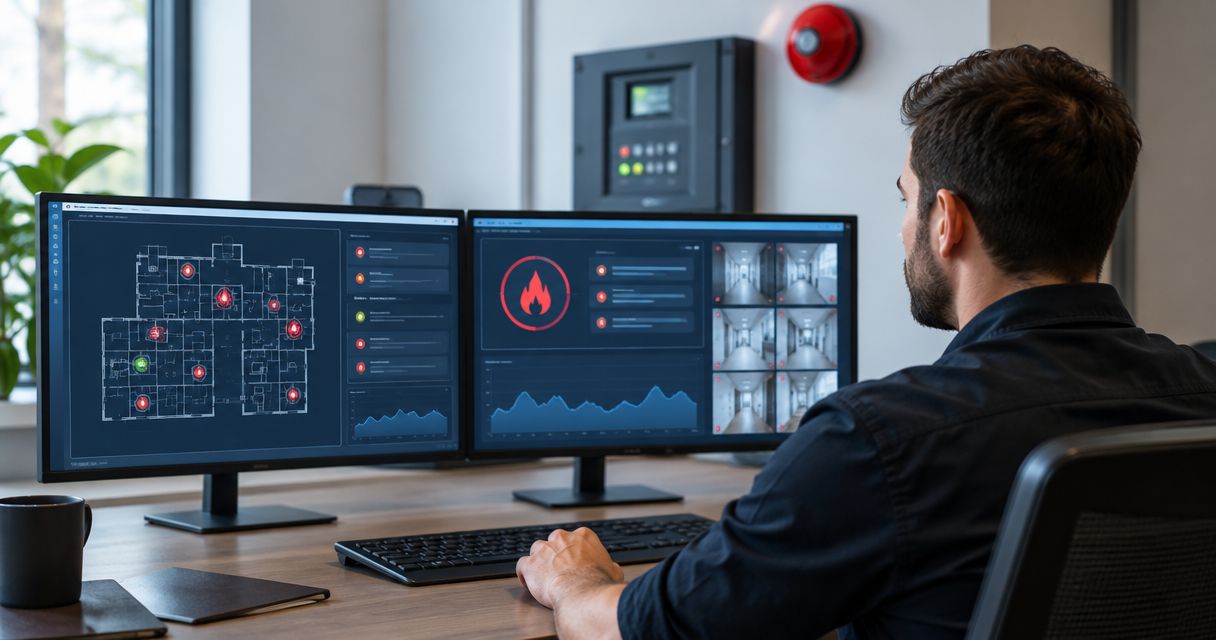
Fire alarm monitoring cost per month has no single number — it moves with system size, monitoring type, and who's on the other end of the signal. This page breaks down what actually drives the monthly rate so you know what you're paying for, not just a figure someone quoted over the phone.
- Fire alarm monitoring cost per month depends on system type, size, and provider — no flat number applies across the board in 2026.
- Cellular monitoring runs higher monthly than old phone-line service but skips copper theft and landline outages.
- NFPA 72 requires an alarm signal to reach the monitoring station within 90 seconds, no matter the provider.
- First-Line Fire bundles monitoring with inspection and testing across Kentucky, Illinois, Indiana, Tennessee, Missouri and Alabama.
Why this matters
Most owners asking about fire alarm monitoring cost per month are really asking one of two things: is my current bill fair, or is a quote I just got too high. Neither question has an answer without knowing the system behind it — a four-zone panel in a strip mall and a 200-device system in a warehouse do not belong on the same invoice.
Monitoring is also not optional in most commercial occupancies once a fire alarm panel is installed — insurance carriers and local fire marshals generally expect a monitored connection, not just a panel that makes noise on-site. If you're weighing how monitoring fits into a broader security setup, connecting fire alarm monitoring to your security system is the next thing to check before you sign anything in 2026.
How much does fire alarm monitoring cost per month?
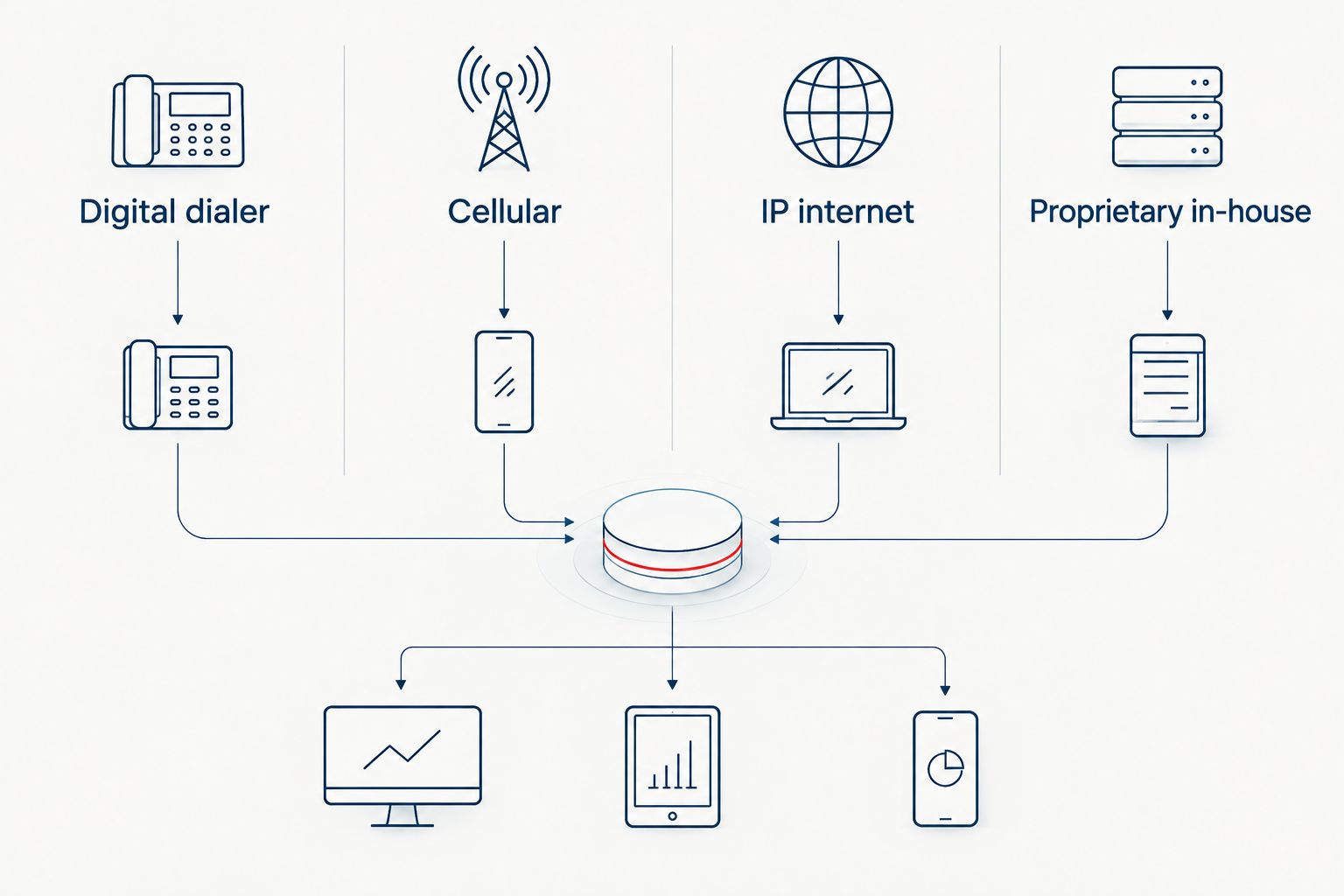
There's no flat rate that applies to every building. What changes the bill is the combination of transmission method, monitoring station type, and how many devices or zones report through it. Below is how the main categories stack up against each other on relative cost — not dollar figures, since those depend on your specific system and provider.
| Monitoring type | How it connects | Relative monthly cost | Best for |
|---|---|---|---|
| Digital dialer / POTS | Traditional phone line | Lowest, but declining as carriers retire copper lines | Small single-panel sites with an existing landline |
| Cellular (radio) | Wireless cellular signal | Moderate to higher | Most commercial buildings in 2026, especially where landlines are being phased out |
| IP / internet | Broadband connection | Moderate | Sites with reliable internet and no landline |
| Proprietary / in-house | Company-owned receiving equipment | Varies widely by scale | Large campuses, multi-building portfolios, coal or industrial sites with staff on-site 24/7 |
Cellular monitoring
Cellular monitoring transmits the alarm signal over a wireless carrier network instead of a copper phone line. It costs more per month than old-style dialer service in most markets, but it removes two real risks: copper wire theft (a documented problem at vacant or remote industrial sites) and landline outages that silence a panel with no warning. Best for most commercial buildings switching off copper lines in 2026 — Buy.
IP / internet monitoring
Internet-based monitoring routes the signal through the building's existing broadband connection. It sits in a similar cost range to cellular for many providers, and some sites run both cellular and IP as a backup pair so one outage doesn't take down the signal path. Best for sites with stable internet and no active landline — Buy.
Digital dialer / phone line monitoring
This is the oldest method: the panel dials the monitoring station over a standard phone line. It's usually the cheapest option where it's still available, but many local carriers are actively retiring copper infrastructure, which pushes buildings toward cellular or IP whether they want to switch or not. Best for legacy sites with a landline that isn't going anywhere soon — Hold, but plan the migration.
Proprietary / in-house monitoring
Some larger operations — multi-building campuses, coal mining sites, marine terminals with staff on-site around the clock — run their own receiving equipment instead of paying a third-party central station. The math only works at scale: it can lower the per-building rate across a large portfolio, but it requires staff and equipment most single-site owners don't want to manage. Best for large multi-site operators with staff already on-site — Buy at scale, Skip for a single building.
Why fire alarm monitoring cost varies
- System size — a panel covering four zones costs less to monitor than one reporting from 150 devices across a warehouse.
- Monitoring type — cellular and IP generally run higher than legacy phone-line service, per the table above.
- Provider structure — a UL-listed third-party central station bills differently than a proprietary in-house setup.
- Bundling — some contracts fold monitoring in with inspection, testing, and extinguisher service; others bill each separately.
- Occupancy classification — a hospital, school, or coal prep plant carries different code requirements than a small office, which affects the equipment behind the monitoring line.
- Number of locations — one contract covering multiple buildings under a single owner often lowers the per-building rate compared to separate standalone contracts.
Get your monitoring setup checked
See what your building actually needs before you sign a new contract.
Is cellular monitoring cheaper than phone line monitoring?
No — cellular monitoring typically costs more per month than phone line monitoring, but phone line service is disappearing as carriers retire copper infrastructure across Kentucky, Illinois, Indiana, Tennessee, Missouri, and Alabama. The trade-off is reliability: cellular signals don't go down when someone cuts a copper line.
Does fire alarm monitoring cost include inspection and testing?
Sometimes — it depends on the contract, not the monitoring type itself. Some providers bundle monitoring with the inspection and testing NFPA 72 requires; others bill monitoring and testing as two separate line items, so read the contract before assuming one covers the other.
How much does fire alarm monitoring cost for a small business vs. a large facility?
A small business with a single panel and a handful of devices sits at the low end of any monitoring provider's pricing tiers, while a large facility with hundreds of devices across multiple buildings sits at the high end — the gap is driven by device count and number of locations, not the monitoring type alone.
FAQ
Is fire alarm monitoring required by law?
Most commercial building codes and insurance policies require monitored fire alarm systems once a building crosses a certain size or occupancy type, though the exact trigger varies by jurisdiction. Check with your local fire marshal and insurance carrier before assuming your building is exempt.
What's the difference between cellular and phone line monitoring?
Cellular monitoring sends the alarm signal over a wireless carrier network, while phone line monitoring dials out over a standard copper line. Cellular avoids landline outages and copper theft but generally costs more per month.
How fast must a monitored fire alarm signal reach the monitoring station?
NFPA 72 requires the signal to reach the monitoring station within 90 seconds of activation. From there, the station is responsible for notifying the fire department.
Can one monitoring contract cover multiple buildings?
Yes, many providers monitor several properties under a single account. This often lowers the per-building rate compared to separate standalone contracts at each site.
Is proprietary monitoring cheaper than central station monitoring?
It depends on scale. Proprietary in-house monitoring can lower cost across a large multi-building portfolio but rarely makes sense for a single building because of the staff and equipment it requires.
What happens if a monitored fire alarm system loses power?
NFPA 72 requires most monitored systems to carry battery backup rated for at least 24 hours of standby power, so the panel keeps reporting during a power outage.
Does switching monitoring providers require a new panel?
Not always. Many panels can be reprogrammed to report to a new monitoring station without swapping hardware, though older panels with obsolete communicators may need an upgrade.
One last thing
The biggest cost swing in 2026 isn't between providers — it's between transmission methods, because copper phone lines are getting phased out by carriers whether a building owner wants to switch or not. If your panel still dials out over a landline, budget for a cellular or IP upgrade now rather than after the line goes dead mid-inspection.


